
Idea 1
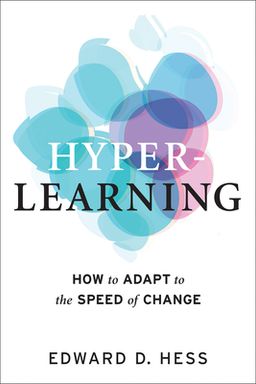
Hyper-Learning: Adapting to the Speed of Change
How can you stay relevant when smart machines threaten to outthink, outlearn, and outperform you? In Hyper-Learning: How to Adapt to the Speed of Change, professor Edward D. Hess argues that the future belongs not to those who know the most, but to those who learn the fastest. His core idea is simple yet radical: you must become a Hyper-Learner—someone who can learn, unlearn, and relearn continually, at the speed of technological disruption.
Hess contends that the Digital Age will transform every job, organization, and skill, making adaptability and personal reinvention essential. Smart machines will handle tasks requiring logic, precision, and efficiency. Humans, therefore, must master what machines cannot: curiosity, creativity, emotional intelligence, and meaningful collaboration. To do this, you need a New Way of Being—cultivating inner peace, humility, and self-awareness—and a New Way of Working—embracing idea meritocracies, psychological safety, and human-centered workplace cultures.
The Human Imperative in the Smart Machine Age
Hess frames Hyper-Learning as both an evolutionary and ethical necessity. Just as our ancestors had to learn new ways to survive when forced from lush rainforests onto dangerous savannas, we face a similar existential shift as artificial intelligence reshapes the modern landscape. Our challenge isn’t avoiding change—it’s finding meaning and mastery within it. This vision echoes futurist Yuval Noah Harari’s call for continual reinvention (“We must learn to reinvent ourselves again and again”).
Through the lens of neuroscience and psychology, Hess explains that humans are suboptimal learners. Our brains favor efficiency over insight, confirmation over exploration, and self-protection over discovery. We cling to old beliefs and automate our decisions. Hyper-Learning requires overcoming our wiring—our ego and fear—through disciplined self-management and emotional courage.
The Dual Path: New Way of Being and Working
In Hyper-Learning, Hess divides the journey into two interrelated transformations. First, the New Way of Being focuses on cultivating a state of Inner Peace—a quiet ego, quiet mind, quiet body, and positive emotional state that enables deep learning and authentic relationships. Second, the New Way of Working redefines organizations as spaces that enable people, not control them. Hierarchy, compliance, and fear must give way to cultures of trust, collaboration, and psychological safety. Leaders must become enablers—chief human developers—who nurture curiosity and humility throughout their teams.
The path begins with personal transformation: cultivating humility (as Hess explored in his previous book Humility Is the New Smart), mastering mindfulness, and practicing gratitude. Next comes behavioral adaptation through Hyper-Learning Behaviors—curiosity, courage, empathy, reflection, and collaboration. Finally, it extends to workplaces that embody humanistic design where people are empowered to think, care, and create collectively. This combination—personal stillness plus organizational openness—makes Hyper-Learning sustainable and joyful.
Stories of Transformation
Hess illustrates this transformation through vivid, real-world stories. Susan Sweeney, president of EnPro Industries, discovers emotional intelligence through vulnerability and gratitude. Marvin Riley, EnPro’s CEO, evolves from fear-driven competitiveness to servant leadership rooted in empathy and humility. Adam Hansen, an innovation consultant, embodies curiosity through his pursuit of Ikigai—the Japanese concept of meaning in work. Each story demonstrates that Hyper-Learning isn’t an abstract ideal but a lived practice, realized through disciplined self-reflection and courageous openness.
Why Hyper-Learning Matters
If the old success formula rewarded knowing more, the new era rewards learning better. Hyper-Learning is not about acquiring information—it’s about transforming yourself and your environment into a continuous learning system. It’s about learning from others, embracing mistakes, and creating workplaces where collaboration replaces competition. The payoff is not only professional relevancy but also human flourishing through meaning, connection, and joy.
“Hyper-Learning requires a radical New Way of Being and a radical New Way of Working.” Edward D. Hess insists that surviving the Digital Age depends on mastering what makes us uniquely human: our capacity for compassion, curiosity, and constant renewal.
In the chapters ahead, you learn how to achieve inner calm amid chaos, adopt mindsets and behaviors that fuel continual growth, humanize your workplace to unlock collective intelligence, and design practices that sustain lifelong learning. Together, these elements reveal how to adapt to the speed of change without losing your soul—not by competing with machines, but by rediscovering your full humanity in the process.