
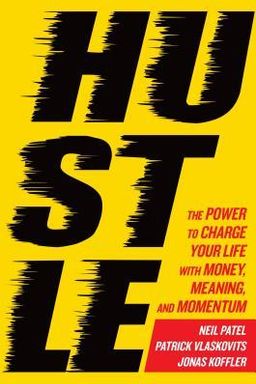
Hustle cover

Hustle

by Neil Patel, Patrick Vlaskovits, Jonas Koffler

Hustle reveals how to break free from unfulfilling jobs by embracing strategies that lead to personal and professional fulfillment. Through practical advice and inspiring stories, it guides you to achieve dreams by leveraging money, meaning, and momentum.

Hustle: Owning Your Dreams in a Rigged World

Have you ever looked around and wondered why some people seem to surge forward in life while others with equal talent stay stuck? That’s the provocative question at the heart of Hustle by Neil Patel, Patrick Vlaskovits, and Jonas Koffler. The authors argue that in a world where the old playbook for success—get good grades, land a secure job, climb the ladder—has collapsed, the only sustainable approach to fulfillment and prosperity is to own your dreams through hustle. But this isn’t the buzzword version of hustle that glorifies burnout. It’s a deliberate, strategic form of movement that creates “money, meaning, and momentum” in your life.

In their words, “hustle” is decisive movement toward a goal, however indirect, by which the motion itself manufactures luck, reveals hidden opportunities, and charges our lives with more money, meaning, and momentum. The power, they contend, lies in abandoning the rented dreams sold by society’s landlords—the corporations, universities, and outdated institutions that profit from your passivity—and taking ownership of your unique path.

Why Hustle Matters Now

Today’s economy rewards creativity and adaptability, not compliance. The authors—successful hustlers in their own right—argue that reality has changed faster than most people’s beliefs about work. Neil Patel, born to immigrant parents and once a janitor at a theme park, became a millionaire digital marketer by 21 only to lose everything in a failed startup. He rebuilt through relentless experimentation and grit. Patrick Vlaskovits, the son of European immigrants, turned his love for learning into bestselling books and tech startups. Jonas Koffler, after suffering a massive stroke in his twenties, reinvented himself as a creative consultant. Each story illustrates the book’s central promise: you don’t need special privileges or luck; you need movement, risk, and ownership.

In a world tilted toward inequality, the authors expose the “rigged game” of traditional success. Student debt, stagnant wages, and corporate conformity stifle ambition. Yet, paradoxically, technology and globalization offer more opportunity than ever—if you’re willing to hustle differently. This new hustle isn’t selfish ambition; it’s aligning your unique talents with meaningful work, building autonomy, and manufacturing your own luck instead of waiting for permission.

The Three Forces: Money, Meaning, and Momentum

The authors believe every hustler learns to balance three forces. Money fuels survival and confidence. Meaning gives purpose to your labor. Momentum arises when the first two align; it’s the energy that makes you unstoppable. Too much focus on money alone leads to emptiness, as explored later through the “Bohr Effect” of balancing money and meaning. Too much meaning without money leaves you broke. Together, these forces create the synergy that allows your hustle to flow continuously—a state they call “infinite hustle.”

The Structure: Heart, Head, and Habits

The book unfolds in three major parts that mirror this inner architecture of success: Heart (to find your purpose and break free from rented dreams), Head (to develop mental strategies that create luck and resilience), and Habits (to translate action into sustainable success). You’ll learn to repair the mediocrity of “meh,” embrace small doses of pain for growth (hormesis), uncover your hidden talents through real-world experimentation, and follow indirect paths (“obliquity”) to reach your goals. You’ll also build a “Personal Opportunity Portfolio” (POP)—a system for accumulating proof, people, projects, and potential.

Together these frameworks form what the authors call the Hustle Generation: a mindset of underdogs who reject the status quo and design their own definitions of success. Unlike “dreamers,” hustlers are doers who merge love and labor, strategically take the right kinds of risks, and continually reinvent themselves. The ultimate victory isn’t riches or fame—it’s freedom: the authority to live, work, and create on your own terms.

“In a world of boundless abundance,” the authors write, “the only thing standing between us and fulfillment of our dreams is self-imposed friction.”

By the end of Hustle, you’ll understand that success is not reserved for the privileged few but is available to anyone who moves, experiments, and seizes the unseen. The book challenges you to ask not, What should I do to fit in? but rather, How can I move to stand out? With practical tools, stories of entrepreneurs, creatives, and misfits, and a call to own your dreams, Patel, Vlaskovits, and Koffler redefine hustle as a philosophy of life—a lifelong, infinite game you play by continuing to move forward.


Owning Dreams, Not Renting Them

Most people live inside someone else’s blueprint—and the authors of Hustle call this “renting your dreams.” It happens when you let schools, employers, or social expectations dictate your choices. The result is stagnation, debt, and a sense of being trapped in what they label the “Cycle of Suck.” Neal Patel’s story in the preface illustrates the alternative: as an immigrant kid mopping bathrooms, he could have accepted the limits placed on him, but instead he owned his dream. Each chapter of Part One, “Heart,” teaches you how to break free from the landlords of society and build equity in your own life.

Recognizing the Rigged System

The book opens by confronting an uncomfortable truth: the traditional system is tilted. Education, corporate work, and home ownership once promised stability but now often deliver financial servitude. The American Dream, they argue, has been replaced by a debt trap. Expensive degrees, stagnant wages, and rising costs force bright people into rented lifestyles—working to service bills rather than their aspirations. Debt, like gravity, keeps you tethered. Yet awareness of this rigged game is the first step toward rebellion.

Choosing Ownership Over Compliance

To own your dream, you must start making choices for yourself instead of letting others choose for you. The authors contrast mindless consumption (e.g., reality TV, social media distractions) with intentional creation. They warn against relying on permission or waiting for the “right time.” Instead, they suggest taking small, direct actions—“owning the dream” by investing your labor and love in projects that express your identity. Just as homeowners build equity with every payment, dream owners build personal equity by investing effort, creativity, and risk into their passions.

From Overdreaming to Doing

An important distinction is made between dreaming and owning. As TV writer Shonda Rhimes quipped in her Dartmouth commencement (quoted in the book), “Be a doer, not a dreamer.” Dreaming without execution becomes what the authors call “OD’ing on dreams.” Too much fantasy can numb you, producing paralysis rather than power. They urge readers: “Dream as a noun—great. Dream as a verb—not so great.” Ownership begins when you take steps, however small, to convert abstract goals into tangible projects.

The Lesson of Ernesto

One striking example is Ernesto, a Cuban engineer earning $30 a month under the socialist regime. Facing poverty, he risked prison to start an underground business wiring buildings for foreign clients. By breaking the rules, he multiplied his income a hundredfold and ultimately gained freedom. His story demonstrates that even in oppressive systems, autonomy begins with action. The moral: you may not control the game, but you can choose how you play it.

Owning your dream means accepting responsibility for outcomes, even failure. You build “dream equity” instead of paying rent to others’ ambitions. The moment you shift from asking for permission to giving it to yourself, life expands. The authors remind us that renting may be necessary for a time, but the goal is always ownership—because only owners can renovate their destinies.


Repairing the Mediocrity of Meh

Ever feel like you’re moving fast but getting nowhere? That hollow rut is what Patel, Vlaskovits, and Koffler call the Mediocrity of Meh. In Part Two of Heart, they explain how comfort, fear, and hidden risks conspire to keep talented people stuck. You might not hate your job, but you don’t love it either—so you drift. To escape, you must confront the illusions of safety and learn to embrace manageable discomfort as a catalyst for growth.

How Risk Aversion Breeds Failure

Modern culture teaches us to avoid pain and failure at all costs. Yet, ironically, that avoidance introduces hidden risk. Using a clever analogy, they compare our daily choices to drinking diet soda: marketed as safe, yet studies link it to long-term weight gain. Similarly, minimizing failure may feel safe but often leads to intellectual and emotional obesity. The authors argue that the key to unlocking potential lies not in avoiding risk but in choosing the right kind of risk—incremental, intentional, and informative ones that stretch you without breaking you.

Breaking the Cycle of Suck

The book illustrates these concepts through vivid stories: Pete, the uninspired ad executive churning out mediocre campaigns; Milla, a young graduate trapped in the “need experience to get experience” paradox; and Max, the overlooked corporate veteran. Each repeats dull routines that reinforce frustration—the “Cycle of Suck.” Worse, repetition breeds learned helplessness, echoing psychologist Martin Seligman’s infamous dog experiment. Over time, they begin to believe escape is impossible, accepting “meh” as destiny. The authors insist this isn’t biology—it’s conditioning that hustle can unlearn.

The Antidote: Right-Sized Pain

To reverse meh, you must dose yourself with small, strategic discomforts. Take a new route to work, strike up conversations with strangers, or try a skill outside your comfort zone—these micro-risks recalibrate your tolerance for uncertainty. The authors compare it to strengthening muscles through “microtrauma”—small damage that triggers growth. Eventually, this practice builds confidence and resilience, breaking the dead inertia of mediocrity.

Living free of meh means choosing creative pain over passive comfort. You trade “safe suffering” for meaningful motion, and in doing so rediscover energy and curiosity. Hustle thrives not because life gets easier, but because you become harder to stop.


Discovering the Heart of Your Talents

Many of us are blind to our greatest abilities because we look into funhouse mirrors—distorted reflections shaped by ego or by others’ expectations. In chapter three, the authors confront what they call the Risk of Learned Blindness. The cure: experiment relentlessly to uncover what truly makes you effective, then double down on your strengths instead of obsessing over weaknesses.

The Illusion of Mastery

Malcolm Gladwell’s popular “10,000-Hour Rule” suggested mastery comes only through sustained practice. Hustle dismantles this myth, arguing that innate talent and self-awareness matter just as much. The real damage, they note, is that chasing mastery can lure you away from discovering your authentic gifts. As Patrick’s judo coach once said, “Perfect practice makes perfect.” But what if you’re practicing the wrong thing?

Escaping the Talent Funhouse

Two common distortions obscure talent: the Lake Wobegon effect—our tendency to see ourselves as above average—and the Kangaroo Court of Talent, where ill-informed others judge us harshly. Whether inflated or undervalued, these perspectives keep us guessing. The authors urge readers to reject external validation and follow Peter Drucker’s Feedback Analysis method: write down your expectations for every new project, then compare results afterward. Over time, patterns emerge showing what you naturally excel at.

Action Over Perfection

Once you uncover these “illegible talents,” value them over perfect skills. The goal isn’t to be flawless—it’s to be effective. Heinlein’s quote that “specialization is for insects” captures this philosophy. Experiment broadly. Be a flexible generalist. Your imperfections make your hustle unique. Fear of imperfection is quicksand; movement, no matter how messy, reveals and refines your abilities.

Real hustlers, the book concludes, see risk as oxygen. They breathe it daily, knowing every small step uncovers the truth of what they were built to do. The cure for blindness is not belief—it’s experimentation.


Building Resilience Through Small Doses of Pain

In Part Two, “Head,” the authors introduce the science of growth through small, deliberate stress—the principle of hormesis. Like muscles that grow stronger after micro-tears, your body and mind need manageable doses of adversity to adapt and thrive. Using examples from The Princess Bride to physiology, they show how this law applies to careers, creativity, and mindset.

The Power of Incremental Strain

The authors illustrate hormesis through Westley’s battle of wits in The Princess Bride. Westley survived poison by gradually ingesting small amounts, building immunity. Likewise, taking small professional risks immunizes you against fear. Avoid challenges and your skills atrophy; embrace them and you expand capacity. The antidote to fragility is not avoidance but exposure.

Applications in Mind and Body

Exercise, learning languages, or public speaking each illustrate this principle. Jonas tells how, recovering from a stroke, he forced his brain to relearn through incremental exercises—reading Spanish aloud, writing with his non-dominant hand, solving math problems. Science calls this neuroplasticity; hustle calls it commitment. The same idea applies to your career: attempt small projects outside your comfort zone to keep your professional muscles strong.

Life as a Laboratory

The authors propose a 10-item “daily dose of pain” experiment list—tiny acts like taking a new route to work, eating something unfamiliar, or starting an uncomfortable conversation. The goal is not suffering but stimulation: novelty keeps the brain learning and opportunities surfacing. Pain, in this model, is data; it shows where your growth edge lies. The dose makes the poison.

By courting small discomforts regularly, you prevent catastrophic crises later. Just as lifting a manageable weight prevents weakness, intellectual and creative stress builds resilience. The takeaway: pain, properly dosed, is your ally—it keeps your hustle alive and adaptive.


Manufacturing Luck and Momentum

Luck often feels mystical, but Patel, Vlaskovits, and Koffler insist it’s a skill. Their story of Patrick’s young son Shane discovering hidden crayfish by jumping in a creek captures this truth: motion reveals opportunity. They outline four kinds of luck derived from neurologist James Austin’s model—and show how hustle allows you to manufacture them all.

The Four Types of Luck

  • Random Luck: Pure chance—like finding an empty parking spot at a concert. You can’t control it, but being out in the world increases exposure.
  • Hustle Luck: Generated by movement. Neil Patel striking up elevator conversations that turn into six-figure deals exemplifies this.
  • Hidden Luck: Opportunities visible only to prepared minds. You recognize patterns others miss, like filmmaker Casey Neistat turning low-budget videos into viral sensations.
  • Quirky Luck: Luck that finds you because of your unique weirdness—Einstein’s violin serenades or Casey Neistat’s odd adventures—all amplifying signature individuality.

Keep Swinging at Life’s Pitches

Drawing from psychologist Dean Keith Simonton’s “constant-probability-of-success” model, they argue that quantity breeds quality. Once you’re competent, more attempts equal more hits. Life isn’t baseball—you can swing infinitely. Rocky Balboa’s .200 batting average beats Luke Skywalker’s .300 if he takes twice as many swings. Action multiplies fortune. As Francis Ford Coppola’s near failure on Apocalypse Now proved, persistence through chaos manufactures eventual triumph.

When hustle meets motion, luck stops being random. Every email sent, prototype tested, or connection made is another at-bat. As long as you keep swinging, something will connect. Hustlers don’t wait for opportunities—they stir the water until the crayfish scatter.


Seeing the Unseen: The Three Laws of Hustle

The Little Prince inspires this section’s metaphor: “One sees clearly only with the heart.” The authors distill this ethos into three durable principles: Do Something That Moves You, Keep Your Head Up and Your Eyes Open, and Seal the Deal and Make It Real. Together, these laws form a repeatable loop that turns vision into proof.

Law 1: Do Something That Moves You

Forget waiting to “find your passion.” Motivation follows movement, not vice versa. Whether fueled by love, anger, or curiosity, emotion must drive your first action. The authors argue against starting with Simon Sinek’s “Start with Why.” For hustlers, clarity comes after doing. Move first, understand later.

Law 2: Keep Your Head Up and Your Eyes Open

This principle involves noticing unseen opportunities and currents. They use Benjamin Franklin’s discovery of the Gulf Stream as a metaphor: while others sailed straight, he mapped indirect paths that moved faster. Insight requires awareness of what lies beneath the surface—office politics, shifting industries, or untapped connections. The difference between good and great hustlers is perspective.

Law 3: Seal the Deal and Make It Real

Ideas aren’t proof until they exchange value. Selling a product, closing a contract, or delivering a prototype transforms dreamy hustle into practical credibility. For Xerox CEO Ursula Burns and Sylvester Stallone writing Rocky, sealing deals meant redefining themselves. Habits, not inspiration, forge identity. As the authors declare, “Habits create identities; identities don’t create habits.”

Following these three laws repeatedly—move, see, and make real—becomes the pulse of a sustainable hustle. Like exercise reps, each cycle builds the muscle of opportunity.


The Indirect Path: Success Through Obliquity

Most self-help promises direct routes from A to B. Hustle argues the opposite: the shortest path is often crooked. Borrowing from economist John Kay’s “obliquity,” the authors show that indirect approaches yield better results because they maximize serendipity. NASA’s 4.9-billion-mile journey to Mercury, achieved through gravity assists rather than straight flight, becomes a metaphor for creative detours in life.

Reverse Engineering Your Goals

Instead of asking “How do I get there?” start from the destination (“point B”) and work backward to “point A.” In Vegas, Patrick and friends beat a 200-person taxi line by flagging a cab directly in the drop-off zone—an example of reframing the problem. Hustlers bypass bottlenecks by redefining what the game even is. Breaking from convention isn’t cheating; it’s efficient creativity.

Embracing Switchbacks

Success functions like mountain climbing. Straight ascents are impossible; switchbacks seem to go backward but ultimately lead higher. Jonas’s hike in the Swiss Alps—where detouring to a different peak brought greater vistas—embodies this lesson. Your deviations may be the point. “Going east to get west,” as one Texan firefighter told Jonas during a hurricane evacuation, captures the same truth: oblique paths are often the fastest detours to destiny.

Obliquity teaches humility and persistence. If direct strategies fail, try the scenic route; life’s gravity assists will sling you farther than brute force ever could. As the authors write, “The act of stepping creates opportunities that wouldn’t exist otherwise.”


Make Your Future POP

Part Three, “Habits,” centers on designing a Personal Opportunity Portfolio (POP)—a framework for managing your hustle like an investor manages assets. POP includes four “pieces of pie”: Potential, People, Projects, and Proof. When balanced, these create compounding momentum and lifelong growth.

Potential: Your Expanding Power

Your potential is your signature dish—the skill combo that differentiates you. Scott Adams, creator of Dilbert, succeeded not through mastery but by combining average abilities (writing, business, cartooning) into a unique portfolio. To grow potential, experiment and add complementary skills. Mediocre plus mediocre can equal amazing when creatively combined.

People: Build Bridges, Not Walls

Forget shallow networking. Adopt the Tertius Iungens mindset—the “third who joins.” Help others connect for mutual gain, creating long-tail goodwill. The authors contrast this with the opportunistic “Tertius Gaudens,” the broker who hoards contacts. Building “honeypots”—projects or communities that attract people naturally—creates sustainable circles of collaboration and luck.

Projects: Your Training Ground

Careers have dissolved into portfolios of projects. Each one tests and strengthens your abilities like reps at the gym. Fran Hauser’s story—from family masonry business to venture capitalist—illustrates how managing diverse projects creates cumulative leverage. Treat your duties, side hustles, and volunteer work as experiments feeding your POP.

Proof: Showing, Not Telling

Proof validates your hustle in the real world. Nina Mufleh’s viral “Airbnb résumé” is the gold standard: rather than apply conventionally, she built a live website with an in-depth market report. Her creativity earned job offers worldwide. Your Proofberg—visible proof above the waterline, unseen work below—signals capability and credibility. In an era of six-second résumé scans, proof is the new résumé.

Treat each piece of POP as an asset class. Diversify, rebalance, and invest consistently. The compounding effect of small wins—skills, relationships, projects, evidence—will expand your opportunities exponentially. Like any portfolio, growth comes not from luck or timing but steady contributions and reinvestment.


Balancing Money, Meaning, and Momentum

One of the book’s most elegant frameworks is the “More Effect,” inspired by physiologist Christian Bohr’s discovery of how oxygen and carbon dioxide balance in blood. Translated into life terms, money and meaning must coexist in harmony to sustain momentum. Too much of either destabilizes your hustle’s chemistry.

The Artist’s Fallacy

Through anecdotes of Picasso advising photographer Brassaï, the authors demolish the myth of the starving artist. Picasso insisted that “success is important” not for vanity but for continued creation—money fuels art. Similarly, romanticizing poverty or pure meaning often leads to burnout. “It’s not money that corrupts art,” they write, “it’s lack of money.” Prosperity enables generosity and exploration.

Homeostasis of Hustle

Too much focus on profit (hypercapnia) suffocates purpose; too much meaning (hyperoxia) starves practicality. The sweet spot lies where financial reward supports meaningful engagement—the same equilibrium that sustains life’s breath. Hustlers constantly monitor this ratio, adjusting course when either side dominates. The outcome is “momentum”—the effortless propulsion of forward motion.

When money and meaning balance, momentum emerges naturally—an energy that attracts opportunities, people, and proof. Lose balance, and burnout or boredom follow. The More Effect reminds you that ambition and altruism are not opposites but co-dependent gases in the lungs of your hustle.


Infinite Hustle: The Game Without End

The book closes with a powerful metaphor borrowed from philosopher James Carse’s Finite and Infinite Games. Most people play finite games—careers, competitions, or goals that end when someone wins. Hustlers play an infinite game, where the purpose is to keep playing, learning, and growing.

From Armchair Dreamer to Active Doer

The authors contrast “armchair hustlers,” who consume motivation passively, with active hustlers who create experience. Reading about adventure isn’t adventure; doing is. Life rewards motion, not contemplation. To stay sharp, they advocate “resting by moving”—taking vacations that stretch your senses, engaging in offbeat experiences, and scheduling “anti-schedules” for creativity.

Meaning as a Moving Target

Jonas’s story of driving east to go west during a hurricane captures life’s irony: the right path is often counterintuitive. Meaning emerges in motion, not introspection. Your “why,” they insist, reveals itself after many swings, stumbles, and rebounds. Hustlers don’t find purpose first—they build it through experience.

In the end, Hustle is not a destination but a pattern of perpetual adaptation. The authors urge: “When things go sideways, when the bank account is empty, remember this—keep playing.” The infinite game has no final score, only continuous progress. The win condition of hustle is simple: stay in motion.

Dig Deeper

Get personalized prompts to apply these lessons to your life and deepen your understanding.

Go Deeper

Get the Full Experience

Download Insight Books for AI-powered reflections, quizzes, and more.