
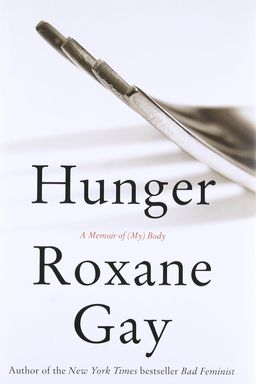
Hunger cover

Hunger

by Roxane Gay

In ''Hunger: A Memoir of (My) Body,'' Roxane Gay bravely explores the intersections of trauma, body image, and societal judgment. Through her candid narrative, she challenges readers to confront uncomfortable truths about how we perceive and treat bodies that defy societal norms, advocating for understanding and empathy.

The Hunger That Shapes a Life

What does it mean to live inside a body that both protects you and betrays you? Roxane Gay's Hunger: A Memoir of (My) Body poses this question with bracing honesty. She uses her life story—her trauma, her body, her relationships with food, and her hunger in all its forms—to explore how we claim agency over bodies that have been violated, judged, or misunderstood. This book is not a triumphant weight-loss story or an inspirational before-and-after tale. It is a meditation on what it means to survive and to live in a world that demands women’s smallness—physically, emotionally, and spiritually—while punishing them for taking up space.

Gay’s central argument is that the body tells the story of survival. Her lifelong struggle with size, shame, and desire stems from a sexual assault she endured at twelve years old—a trauma that taught her to see food as a refuge and fatness as armor. Yet by shielding herself from the world she also isolated herself from it. Through stark self-examination, Gay reveals how eating became a mechanism of safety, control, and denial all at once. The memoir becomes an act of reclamation—an effort to speak her truth after decades of silence about her assault and its consequences. It’s about learning to live in a body she once built to keep others out.

A Story of the Body and the World

At its heart, Hunger is a story about the relationship between body and culture. Gay writes that every body has a story, and society is relentless in how it demands certain bodies tell theirs. Her six-foot-three, 500-plus-pound body cannot move through the world unnoticed—every chair, flight, job, and meal becomes an exercise in managing other people's perceptions. Yet Gay also refuses to let others narrate her experience. Through her lens, the personal becomes political: the medical system’s biases, the fashion industry’s exclusion, and popular culture’s obsession with transformation all reflect a world that views fatness as failure rather than survival.

In that way, Hunger is not only about Gay’s body but also about America’s fixation on bodies—especially women’s. Like writers such as Audre Lorde and bell hooks, Gay positions her body at the intersection of gender, race, and power. As a Black Haitian American woman, she experiences compounded visibility and erasure: hypervisible as an object of judgment, invisible as a subject of empathy. Her hunger—to eat, to be safe, to be loved—mirrors a cultural hunger for order and control that punishes difference while glorifying thinness.

What the Memoir Explores

In this summary, you’ll trace how Gay’s relationship to her body unfolds across time. First, her childhood—the joy of a loved girl documented through family photos—and the rupture that follows her rape at twelve. You'll see how silence and shame transformed her relationship with food and herself. Next, you'll walk through her years at boarding school, her Harvard-to-Yale education, her time working various jobs, and eventually her emergence as a successful writer—all the while contending with secrecy, compulsive eating, and self-blame.

You will also explore her reflections on visibility—how fame as a writer forced her to be seen when she wanted nothing more than to hide. Gay questions what it means to advocate for body positivity while admitting that she still struggles with self-loathing and pain. Her honesty disrupts the simplistic messages of self-acceptance culture. Instead, she offers something more humane: the work of living in contradiction. “I am stronger than I am broken,” she writes, but that strength is not clean or easy; it is persistence born of necessity.

Why These Ideas Matter

Hunger matters because it reshapes how we think about bodies and trauma. Gay forces readers to reconsider the moral weight we assign to weight. She connects individual suffering to systemic cruelty—from fatphobia and racism to the predatory culture that normalizes violence against girls. Her memoir becomes a testament to how the personal body carries the scars of social injustice. Through her story, readers confront questions of empathy, visibility, and survival. What does it cost to live in a body that will never meet society’s expectations? And what might healing look like if you learn, slowly, to love a body that has been both weapon and refuge?

Over the coming sections, we’ll examine Gay’s key ideas: the link between trauma and control, the paradox of hunger as both need and defense, the politics of visibility, the limits of body positivity, and the power of reclaiming one’s narrative. Together, they form a meditation on what it means to live with pain, and an invitation for anyone who has ever felt at war with themselves to see survival as its own kind of beauty.


Trauma and the Making of a Fortress

Gay’s story begins with the devastating event that shaped her relationship with her body: when she was twelve, she was gang-raped by a boy she loved and his friends. That moment split her life into a before and an after. In the aftermath, she became terrified, ashamed, and convinced that what happened was her fault. Unable to tell her parents, she kept her secret sealed inside her. From that grief grew a desperate need to build walls around herself—to make her body so large, so unreachable, that nothing like that could happen again. As she puts it, she ate to make her body safe, to become a fortress.

Eating as Armor

Food became the tool through which she could assert control over a world that had stripped her of it. Unlike the unpredictability of people, food always delivered comfort and predictability. In the wake of her trauma, meals became an emotional sedative. At boarding school and later in college, Gay discovered the freedom of eating without limits. She recalls the dining hall at Exeter as an endless buffet of choice—one that offered pleasure and numbness in the same bite. The more she ate, the more she could disappear inside her own body’s excess.

Yet this “fortress” also imprisoned her. What began as protection became confinement. Each pound was both armor and evidence of pain. When doctors, family members, or strangers treated her body as a problem to be solved, they never saw the purpose behind it: that her fatness was not merely about appetite but about survival. (Psychologists like Bessel van der Kolk, in The Body Keeps the Score, echo this idea—that trauma embeds itself physically when it has nowhere else to go.) Gay’s memoir turns that hidden truth outward: her big body is not a failure of willpower but a testament to endurance.

Silence and Shame

For decades, Gay couldn’t speak the word rape. She used euphemisms like “something terrible happened” because the shame ran so deep she could barely let herself acknowledge it. The secrecy compounded the trauma. She believed she had sinned, that she was ruined, that her parents would be disgusted. That silence turned inward, shaping her identity: the good girl turned shadow, the bright student turned invisible. When she finally begins to name the violence in Hunger, Gay reclaims what her silence had surrendered—her authorship of her own story.

“I was broken, shattered and silent,” she writes. “To survive, I tried to forget what had happened.”

The Legacy of Power and Gender

Gay also exposes how society’s myths about gender and power make recovery harder. She learned early that girls are punished for wanting too much—for food, for love, for attention—and that men’s desires define them, not the harm they cause. Her assault wasn’t just personal; it was cultural. Her body became a battleground for patriarchal expectations: she had to be thin enough to be attractive but pure enough to repel attraction. The tension between repulsion and desire—both from others and within herself—would echo across her adulthood.

Hunger as Response

In a larger sense, Gay’s hunger is symbolic. It’s a hunger for safety, yes, but also for care, control, and dignity. By the time she reaches her twenties, that hunger consumes every aspect of her life. She jokes that she was “swallowing her secrets,” turning her body into an archive of pain. Yet even as her body expands, she still feels small, unseen, and silenced. Healing begins only when she stops “writing around” her trauma and starts writing through it—turning the fortress of flesh into a fortress of words. The act of telling the truth becomes her rebellion against fear and silence.


Bodies, Culture, and the Politics of Visibility

Much of Hunger explores what it means to live in a body that society refuses to see as fully human. Gay writes that as a fat woman, she is simultaneously hypervisible and invisible—noticed everywhere but rarely understood. Her body is an object lesson for others, a spectacle for ridicule, a problem to be solved. She endures constant stares in restaurants, airplanes, and classrooms, as if her existence were public property. Even medical care becomes an act of moral judgment rather than compassion.

The Public Body

In one of the book’s most striking patterns, Gay returns to the humiliation of fitting into chairs. Armrests bruise her sides; theater seats don’t hold her. These daily indignities show how public spaces are designed to exclude certain bodies. Fatness becomes a structural issue: architecture, commerce, and media all reduce human variation to a narrow ideal. When airplanes require her to buy two seats, Gay recognizes both the privilege of being able to afford the cost and the shame it imposes. “The bigger you are, the smaller your world becomes,” she notes. This phrase encapsulates not just the physics of fatness but the societal shrinking of possibility for those who don’t fit the norm.

Media and Morality

Gay dissects how entertainment reinforces these norms—the Biggest Loser “fat camp” fantasies, Khloé Kardashian’s “Revenge Body,” the performative triumphs of Oprah’s Weight Watchers campaigns. These shows promise redemption through thinness, teaching viewers that fatness equals moral failure. Gay watches them all, both drawn to and disturbed by their message. She understands their seduction: they thrive on the cultural conviction that transformation equals worth. (Sociologist Susan Bordo’s Unbearable Weight makes a similar argument: that diet culture disguises moral control as health.)

For Gay, such narratives deny the complexity of her experience. She knows intellectually that thinness is not synonymous with happiness—Oprah’s billions prove that—but emotionally, she wrestles with the same dream. Her critique is not cynical; it’s compassionate. She writes as both victim and participant in the culture that shapes her self-image.

Race and Gender Intersect

As a Black woman, Gay experiences compounded scrutiny. She points out how Black women’s bodies are historically desexualized or hypersexualized but rarely allowed the nuance of femininity. At times she is misgendered—called “sir” by strangers who associate size and height with masculinity. Race amplifies alienation, transforming mere curiosity into bigotry. Her fat body, she writes, lets white people express prejudice under the guise of “concern.” This doubling of marginalization—racial and bodily—reveals how beauty standards are ultimately political tools designed to uphold white, male power.

Despite these pressures, Gay doesn’t claim perfect acceptance. She admits to longing for beauty, for clothes that fit, for being able to breathe without occupying too much air. But she refuses to disguise her reality as inspiration. Instead, she insists that visibility without understanding is not representation—it’s exposure. She writes to transform exposure into connection, forcing readers to reckon with what they see when they look at her and at themselves.


Pain, Denial, and the Cycle of Control

Throughout Hunger, Gay maps how trauma breeds control and control mutates into obsession. She uses dieting, bingeing, denial, and discipline not as paths to wellness but as rituals of survival. Each attempt to command her body—whether through starvation, compulsive eating, or bulimia—reveals the illusion of mastery in the wake of violation. Her hunger shifts from an external appetite to an internal war.

The Mental Calculus of Eating

Gay describes waking each morning promising herself she’ll make good choices: take the stairs, eat lighter meals, be better. By evening, guilt and deprivation drive her to binge. This recurring loop shows how shame feeds itself. She writes about calorie-counting apps, liquid diets, Blue Apron boxes, and countless failed resolutions. These habits, though familiar to many readers, take on special weight in her story—each one is not a quest for beauty but for absolution. She wants to be good, to have “control,” even though that control always collapses under the heaviness of unmet need.

Her bulimia, which began in adulthood, shocks even her. She frames it not as youthful rebellion but as a desperate attempt to purge self-disgust, to empty herself literally. Even there she finds ironic solace: no one notices, because society assumes fat people overeat, not that they starve or vomit. Their pain is invisible because it contradicts the stereotype. The world simply doesn’t imagine fat people suffering in that way.

Exercise and Punishment

Gay’s honesty extends to her hatred of exercise. She admits she loathes gyms, treadmills, and cheerful trainers. Her physical discomfort—the sweat, the breathlessness, the pain—mirrors her emotional exhaustion. She’s aware that movement could help her health, yet she resists because every public act of exercise turns her body into spectacle again. When people cheer her on—“You go, girl!”—she hears condescension, not encouragement. Working out, for her, isn’t about strength or vitality; it’s about atonement. Each step on the recumbent bike measures how much punishment her body deserves.

Denial and Desire

One of Gay’s most haunting insights is that fatness doesn’t erase desire—it intensifies its complexity. She denies herself affection, style, and pleasure, reasoning that “people like me don’t get to eat chips in public.” She withholds beauty from herself because she believes she hasn’t earned it. The result is constant self-surveillance: denying treats, clothes, love, and softness to maintain a fragile sense of moral order. Even when she paints a single thumbnail in pink—a tiny rebellion taught by her best friend—she feels both shame and joy. For Gay, even the smallest act of self-adornment is political.

Over time, she learns that the quest for control is futile. The very systems meant to “fix” her—diet industries, reality TV, medical lectures—profit from her continued self-loathing. Real control comes not from shrinking her body but from broadening her compassion for it. She begins to see denial not as discipline but as deprivation, an inherited lie she must unlearn.


Love, Intimacy, and the Struggle to Be Seen

If pain made Gay retreat into her body, love becomes the force that slowly calls her back out. From her first crush, Christopher—the boy who would later violate her—to adult relationships marked by emotional coldness or manipulation, Gay traces how early violence distorted her sense of intimacy. She mistook cruelty for attention, silence for safety. Even as a successful adult, she finds herself drawn to people who confirm her lowest self-image.

Learning What Love Is Not

Her romantic relationships, both with women and men, often replay the dynamics of her childhood trauma: submission, secrecy, and self-erasure. A girlfriend criticizes how she eats or breathes. A boyfriend shames her for her size. Another man fetishizes her fatness but hides her from his friends. Each chooses her body as a stage to project their own insecurities. Yet Gay admits complicity: these partners gave her what she thought she deserved—attention, however cruel. She calls it settling for “the bare minimum of kindness.”

The Cost of Vulnerability

When she finally meets Jon, a kind logger in Michigan’s Upper Peninsula, the relationship offers unexpected gentleness. For the first time, a man touches her without violence or agenda. His ordinary decency terrifies her because it undoes her expectations of pain. She confesses that she both loves and sabotages him, unable to believe she can be cared for without condition. This push-and-pull between wanting connection and fearing it underscores the emotional logic of trauma: safety feels alien, danger feels familiar. (Trauma theorists often note this “repetition compulsion,” where survivors unconsciously recreate the dynamics of their hurt.)

Family and Forgiveness

Beyond romance, Gay’s family anchors her. Her Haitian immigrant parents—disciplined, loving, exasperated—never stopped worrying about her “problem,” her weight. Their concern, though genuine, often felt like scrutiny. Only later does she recognize their persistence as another language of love. When her father tenderly tells her, “I would have found justice for you,” after discovering her rape through a magazine profile, she understands the depth of his pain and her own readiness to be forgiven. The conversation is reluctant, awkward, but redemptive. Naming the violence bridges years of silence.

Loneliness and Warmth

Despite community, Gay often feels alone—isolated by her size, her fame, her mistrust. Yet she also writes of finding “the right people with whom to share my warmth.” Through friendships, teaching, and writing circles, she rebuilds a sense of belonging not rooted in performance. “I’m not cold,” she reminds us. “My warmth was hidden until I found the right people.” Love, for Gay, becomes less about being chosen and more about choosing—her body, her truth, her right to be seen fully.


Reclaiming the Narrative of the Body

Gay’s greatest act of rebellion is writing itself. Through telling the story of her body, she transforms shame into testimony. “This is not a success story,” she declares early on. “This is a true story.” That distinction is radical in a culture obsessed with redemption. By narrating her life without promising transformation or thinness, Gay asserts that survival, not perfection, is enough. She insists on owning the narrative others have written on her flesh.

Writing as Healing

Across her adolescence, Gay wrote stories about girls being hurt by boys, rewriting her trauma into fiction she could control. Writing, she realized, let her speak what she could not confess. As an essayist and novelist, she continues that practice—translating pain into clarity. Her work echoes the feminist dictum that “the personal is political,” but it also adds an intimate truth: writing can rebuild the self that violence fragments. Each essay in Hunger functions as a suture, imperfect but necessary, holding together a life still healing.

Visibility as Resistance

As her literary career grows—publishing Bad Feminist, appearing on television, teaching—Gay confronts the paradox of visibility. She has become a public intellectual whose body remains publicly scrutinized. After a humiliating incident struggling onto a stage during a reading, she sobs alone in her hotel, realizing that “sometimes, my body is a cage.” Yet she keeps showing up. By writing openly about such moments, she denies others the power to name her shame. Visibility, even when painful, becomes an ethical act: a refusal to disappear.

Her writing also reshapes feminist conversations about inclusivity. She critiques mainstream body-positivity movements for centering on “Lane Bryant fat” women—those still within visual limits of acceptability. “I don’t fit in these movements,” she writes. “I want to lose weight, and I still struggle.” In admitting imperfection, she invites a larger, more compassionate feminism—one that holds contradiction rather than erases it.

Truth Without Closure

By the book’s end, Gay doesn’t pretend to be healed. She remains hungry—for peace, for love, for comfort in her body—but she has stopped hiding from that hunger. She calls this process “undestroying myself.” It’s a word she coins to capture something subtler than recovery: the slow work of dismantling the defenses that once kept her alive. Her memoir ends not with resolution but reinvention. By telling her story, Roxane Gay proves that truth itself can be a form of freedom—even when it hurts.

Dig Deeper

Get personalized prompts to apply these lessons to your life and deepen your understanding.

Go Deeper

Get the Full Experience

Download Insight Books for AI-powered reflections, quizzes, and more.