
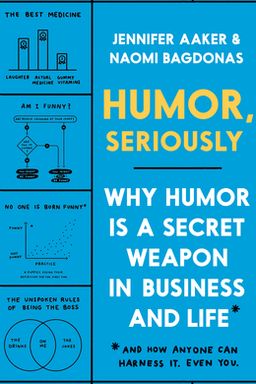
Humor, Seriously cover

Humor, Seriously

by Jennifer Aaker & Naomi Bagdonas

Humor, Seriously reveals how humor is a powerful tool in business and life. Through insights from science and psychology, the authors demonstrate how anyone can learn to use humor to build trust, enhance creativity, and create a more engaging and productive workplace.

The Missing Ingredient in Serious Work: Humor as Power

When was the last time you laughed at work—and truly enjoyed it? In Humor, Seriously, Stanford professors Jennifer Aaker and Naomi Bagdonas argue that humor isn’t a distraction from serious work but one of the most powerful tools for success in it. They contend that humor can strengthen trust, fuel creativity, reduce stress, and help you lead with authenticity. But somewhere along the way, most of us lost it—our natural instinct for levity has been smothered by professionalism, fear, and the ever-tightening pressures of modern work.

Drawing on behavioral science, neuroscience, and their own experiences teaching the wildly popular Stanford MBA course “Humor: Serious Business,” Aaker and Bagdonas show how humor is a transformative force in life and leadership. Their central idea is simple but radical: levity fuels gravity. The more we balance seriousness with laughter, the more meaning and resilience we unlock in our teams, our relationships, and ourselves.

Why Humor Matters More Than Ever

Aaker and Bagdonas begin with a paradox. Despite living in a world that feels increasingly absurd, laughter is in decline. Their surveys reveal that the frequency of laughter drops sharply after age twenty-three. The culprit? We enter the workforce, don our metaphorical “serious face,” and start equating professionalism with solemnity. Adults laugh a fraction as much as children, and organizations pay a steep price: disengagement, burnout, fear, and disconnection.

Humor, the authors argue, is not merely entertainment—it is a sign of humanity and emotional intelligence. Leaders who use humor are perceived as more competent and trustworthy; teams that share laughter perform better and recover faster from setbacks. And at a time when workplace trust is in crisis—when employees are more likely to trust a stranger than their boss—humor becomes an antidote, a way to rehumanize how we work together.

Levity, Humor, and Comedy

A key distinction in the book is between levity, humor, and comedy. Levity is a mindset—a baseline openness to joy and delight in daily life. Humor is the intentional expression of levity, channeling that joy toward connection or insight. Comedy, meanwhile, is humor pursued as craft: the professional art practiced by stand-up comics or writers. You don’t need to be a comedian to wield humor; you only need to rekindle levity, the willingness to smile instead of scowl at the world’s absurdities.

Levity changes our perspective: when we stop taking ourselves so seriously, we make space for insight, well-being, and empathy. In one experiment the authors cite, laughter floods the brain with dopamine and endorphins—the same chemicals that drive bonding and creative flow. We aren’t just happier when we laugh; we’re smarter, kinder, and more resilient.

Bridging Science and Story

Throughout the book, Aaker and Bagdonas weave scientific findings with stories from comedians, executives, and leaders. Pixar’s president Ed Catmull writes in the foreword that humor and meaning are inseparable—that a story without laughter becomes lecture, not art. Likewise, the authors show how humor helps leaders—from Secretary of State Madeleine Albright to Spanx founder Sara Blakely—defuse tension, connect across hierarchies, and lead more effectively.

The book spans seven core chapters that gradually move from mindset to mastery. You begin by understanding why adults stop laughing (the “humor cliff”) and what myths keep humor out of workplaces. You then explore how humor rewires the brain for trust and creativity; how to understand your personal “humor style”; how to communicate, negotiate, and lead with levity; and how to create an organizational culture where laughter fuels—not undermines—seriousness.

Finding Your Apple Moment

The introduction ends with a small moment that encapsulates the whole book. After a week immersed in improvisation at Second City, Bagdonas encounters a scowling cashier at an airport bodega selling apples. When she asks, “Can I please have your favorite apple?” the woman’s demeanor transforms. They laugh together, and the woman waves away payment—“I don’t charge for my favorite apple.” That brief exchange is what the authors call an “apple moment”: an ordinary slice of life transformed by a spark of levity. Humor, Seriously is an invitation to create more such moments—to live, lead, and love with gravity and levity in dynamic balance.


Falling off the Humor Cliff

Aaker and Bagdonas open their course—and the book—with a shocking finding: by the time most people reach their mid-twenties, laughter plummets. It’s what they call the “humor cliff.” We trade play for productivity, silliness for seriousness, and authenticity for armor. Yet studies show that humor supports every trait we value at work: creativity, competence, trust, and leadership effectiveness. The authors argue that reframing humor as a professional asset, not a liability, can reverse that decline.

The Four Deadly Humor Myths

Aaker and Bagdonas dismantle four pervasive myths that keep workplaces sterile:

  • The Serious Business Myth: People think humor undermines competence. Yet 98% of executives prefer employees with a sense of humor, and 84% believe they do better work. Humor signals confidence and warmth, not frivolity.
  • The Failure Myth: People fear bombing or offending. But research from Wharton and Harvard shows that even a failed joke—if appropriate—can raise others’ perceptions of your confidence.
  • The Being Funny Myth: You don’t have to be hilarious to use humor. Simply appreciating humor—laughing, acknowledging jokes, or creating small moments of lightness—has measurable effects on connection and trust.
  • The Born-With-It Myth: Humor isn’t innate but improvable. Like a muscle, it strengthens with awareness, practice, and feedback (echoing psychologist Carol Dweck’s work on growth mindset).

Discovering Your Humor Style

Everyone’s humor comes in different flavors. Through years of research, the authors identified four distinct humor styles using two axes: affiliative–aggressive and expressive–subtle. The framework helps people appreciate diversity in humor instead of assuming there’s one correct way to be funny.

  • Stand-Ups are bold and expressive; they use edgy wit and take risks for a laugh.
  • Magnets radiate positive, inclusive humor that uplifts others.
  • Sweethearts prefer planned, gentle humor that brings people together.
  • Snipers deliver precise, dry one-liners, often with an ironic bite.

Knowing your style—and your teammates’—lets you adapt. For example, Stand-Ups and Snipers may need to temper teasing in diverse groups, while Sweethearts and Magnets must avoid excessive self-deprecation that undermines their authority. The point isn’t to change your humor but to use it more intentionally.

From Levity to Leadership

The humor cliff isn’t destiny. When Aaker and Bagdonas teach their Stanford course, their students’ laughter and joy increase measurably by semester’s end. Humor shifts from something felt to something practiced—an intentional lens through which to view work and life. Their takeaway is both behavioral and philosophical: cultivating a mindset of levity helps you see opportunities for connection everywhere. Once you live on the precipice of a smile, you’ll start finding reasons to laugh again—even on Tuesdays.


Your Brain on Humor

Why does laughter make you feel instantly closer to someone—or suddenly braver in a tense negotiation? In Chapter 2, the authors dive into the neuroscience of humor to answer exactly that. Every laugh releases a natural cocktail of neurochemicals: dopamine for reward, oxytocin for trust, endorphins for euphoria, and a reduction in cortisol, the stress hormone. These biological effects explain why humor strengthens relationships, enhances creativity, and buffers us against adversity.

The Four Benefits: Power, Bonds, Creativity, and Resilience

Aaker and Bagdonas organize the science around four domains where humor consistently boosts performance:

  • Power: Humor signals competence and confidence. In experiments, people who add even a mild joke (“the flag is a big plus”) to a presentation are rated as 37% higher in status. Humor in negotiations (“and I’ll throw in my pet frog”) increases compliance and perceived friendliness—showing that levity can literally make deals.
  • Bonds: Shared laughter builds trust. Laughter triggers oxytocin, the same hormone that bonds parents to babies. Even watching a funny blooper reel with a stranger increases openness and intimacy by 30%.
  • Creativity: Laughter breaks “functional fixedness”—our tendency to view problems too rigidly. In studies, participants who watched a humorous video solved twice as many insight puzzles and generated 25% more creative ideas afterward.
  • Resilience: Humor reduces anxiety and speeds recovery from setbacks. Laughter lowers stress hormones by up to 70% and improves cardiovascular and immune functioning. Even anticipating a laugh lowers cortisol levels and increases focus.

Stories from the Field

The book brings these concepts alive through stories. When Ben Bernanke joined the Bush administration, staff pranked him with matching tan socks after the president teased him for his fashion sense—a moment that built lasting camaraderie. Or consider Apple design leader Hiroki Asai, who used humor-filled company meetings to “chase fear from the system” and unleash creativity. These anecdotes mirror a central truth echoed by Ed Catmull at Pixar: humor doesn’t just lighten work—it reveals meaning in it.

In short, humor is serious neuroscience. It sharpens thinking, deepens trust, and lengthens life. The human brain, write Aaker and Bagdonas, “is wired to laugh”—and when we understand how, we can wield this secret weapon with intention rather than leaving it to chance.


The Anatomy of Funny

Ever wonder why some jokes make you laugh every time while others fall flat? Chapter 3 unpacks the craft behind humor—the blend of truth, tension, and surprise that all comedians use. Drawing lessons from Seth Meyers, Ellen DeGeneres, and Sarah Cooper, Aaker and Bagdonas reveal that humor isn’t invented from thin air but mined from observation. In their words, “Don’t look for what’s funny; look for what’s true.”

Principles of Humor

Truth is the bedrock of comedy—why Seinfeld’s “show about nothing” resonated so deeply. We laugh at what feels recognizably human. Misdirection is the spark: when a setup leads our brains one way and the punch line swerves another, we experience surprise and delight. The authors cite the Incongruity-Resolution Theory, explaining that laughter is your brain rewarding itself for spotting the pattern break.

Finding the Funny

To generate humor, the book suggests exploring five sources of truth in your own life:

  • Incongruity: Notice contradictions (“I’m an adult who stays up past midnight arguing with my barista about foam”).
  • Emotion: Amplify strong feelings—love, envy, rage—in exaggerated form.
  • Opinion: Highlight absurd social norms (as Michelle Wolf does when roasting jogging).
  • Pain: Revisit moments of awkwardness with perspective; “comedy equals tragedy plus time.”
  • Delight: Share simple joys, from “salad frosting” to pets wearing clothes.

Tools of the Trade

Humor often follows a structure—setup and punch. To strengthen your punch lines, the authors suggest comedic techniques used by professionals:

  • Exaggeration and Contrast (John Mulaney’s flu-shot bit).
  • Specificity (Jimmy Fallon choosing “kale” instead of “vegetables”).
  • Analogy (“Big families are like waterbed stores—used to be everywhere, now just weird”).
  • Rule of Three (two normal examples, then one absurd twist).
  • Callbacks (reusing earlier jokes for deeper connection).

But humor isn’t only crafted; it’s lived. Comedians like Seth Herzog remind us that noticing the “here and now” transforms mundane moments into laughter. Responding to what’s specific to the room—or the team meeting—makes humor alive and human. Above all, authenticity trumps polish: Tig Notaro and Chris Rock may deliver jokes differently, but both align their style with their essence. You should, too.

By learning the anatomy of funny, you’re not trying to become a stand-up. You’re opening your lens—training your mind to spot truth, tension, and connection everywhere. As Ellen DeGeneres shows, a single relatable story (“Batu, my butler”) can carry all the comic wisdom you need: be real, keep elevating the premise, and trust the audience to laugh because they see themselves in you.


Putting Your Funny to Work

Once you understand humor’s anatomy, how do you actually use it at work without becoming “that person”? Chapter 4 shows how small injections of levity can transform communication, persuasion, and creativity—even in places where laughter feels scarce. The authors emphasize that humor is less about punchlines than about presence: the courage to be human in professional spaces that often penalize personality.

Talk Like a Human

Corporate jargon is humor’s natural predator. To reclaim authenticity, the authors tell the story of Deloitte CMO Brian Fugere, who built software called “Bullfighter” to flag meaningless phrases like “leverage synergies.” The program, cheekily delivering “Bull Index” scores, reminded consultants to write like humans. Within months, communication and morale improved—proof that levity and clarity go hand in hand.

Micro-Moments of Levity

Humor thrives in small gestures. You can lighten emails with witty sign-offs (“Yours, heavily caffeinated”) or playful post-scripts (“PS—PDFs are the new black”). Use callbacks to shared jokes or craft memorable out-of-office replies that make people smile instead of sigh. IDEO’s Heather Hunt reframes OOOs as opportunities to “shift from scarcity to abundance,” turning auto-replies into artful human touches.

Using Levity in Hard Moments

Humor can also soften difficult truths. Consultant John Henry defused defensive boards by reading aloud the CIA’s “Simple Sabotage Manual”—and letting executives realize they were following its dysfunction playbook. Spanx CEO Sara Blakely mailed a single high heel with the note “Just trying to get my foot in the door,” using wit to win her first major retail deal. Levity, at its best, turns friction into engagement.

Even failure can be reframed with humor. Consultant Sonal Naik, chastised for talking too long in a client meeting, signed her next email “In future brevity.” The self-deprecating humor flipped an awkward moment into camaraderie. When we own our missteps lightly, we give others permission to do the same.

Leading with Lightness

From departures to persuasion, levity creates memorable “peaks and ends.” Saying goodbye with a humorous note or running creative brainstorms like “bad idea sessions” (as Google X’s Astro Teller does) builds psychological safety and originality. The message through all these tactics: humor’s power lies not in performance but in intentional humanity. As the authors write, “You don’t have to be the quickest wit in the room. Just look for moments to laugh.”

In short, using humor seriously doesn’t mean clowning around—it means showing up fully. Laughter connects teams, diffuses hierarchy, and turns ordinary exchanges into meaningful ones. Start small: a wink in an email, a callback to a shared moment, or the courage to smile during stress. Those sparks are where transformation begins.


Leading with Humor and Humanity

When leaders use humor thoughtfully, they build trust faster than any memo ever could. Chapter 5 explores how humor transforms leadership from performance to connection—even in serious domains like diplomacy and business. In a world where half of employees trust strangers more than their managers, humor isn’t fluff; it’s strategy.

Trust, Status, and the Authentic Leader

Traditional management prized gravitas—distance, formality, and control. But Aaker and Bagdonas show that modern teams crave humanity. Humor humanizes authority: it signals approachability without sacrificing respect. Studies confirm this dynamic—leaders who use self-deprecating humor are rated higher on both trustworthiness and competence. Leslie Blodgett, founder of bareMinerals, leveraged that truth during the 2008 downturn when she published a hand-scribbled, funny ad inviting customers for coffee; sales and morale surged.

Levity in High Stakes

Diplomat Madeleine Albright exemplified levity under pressure. Facing hostility from Russian counterparts, she invited them to sing a parody duet of “Maria” titled “East West Story.” The performance diffused tension and birthed an enduring partnership. In another situation, she wore a giant bug pin to meetings after learning the Russians had planted listening devices in the U.S. State Department. Her humor didn’t trivialize issues—it clarified them. Levity, Albright said, “connects us as human beings so we can solve serious problems.”

Owning Failure and Inviting Joy

Spanx founder Sara Blakely institutionalized humor in culture through “Oops Meetings,” dancing to songs like “Mr. Roboto” to celebrate mistakes. Such rituals turn vulnerability into learning and fear into creativity. Leadership research backs this up: when people can laugh about missteps, psychological safety and innovation soar. “Better things happen when you’re not paralyzed by fear,” Blakely told the authors.

Other leaders, from Virgin’s Richard Branson to Twitter’s Dick Costolo, use self-effacing humor to flatten hierarchies. Branson transformed serious global summits by mixing work and play, even scheduling afternoons for leaders like Desmond Tutu and Jimmy Carter to “think with their feet in the sand.” Humor, he suggested, is what makes serious missions sustainable.

Great leaders know that laughter builds loyalty. Whether you’re giving tough feedback, navigating conflict, or rallying a team, humor may be your most underused currency. As leadership coach Dana Asher puts it: “Laughter serves leaders not in spite of but because of the vulnerability it exposes.” Humor doesn’t erode authority—it earns trust precisely because it reveals you as human.


Creating Cultures of Levity

A funny boss can shift a meeting—but a culture of levity can change an entire company. Chapter 6 examines how leaders and teams institutionalize humor so that laughter becomes part of how work gets done. Pixar, IDEO, and even the New York Yankees illustrate that levity, when modeled from the top, strengthens creativity, resilience, and belonging.

Setting the Tone

Pixar’s Ed Catmull emphasizes that humor was Pixar’s secret innovation engine: late-night pranks, goofy dress days, and “Pixarpalooza” concerts cultivated trust and risk-taking. Research confirms that teams who use humor communicate better and perform higher over time. Leaders don’t need to script fun; they just need to model it. Google founders Larry Page and Sergey Brin famously ran weekly “TGIF” meetings full of candid Q&As and spontaneous jokes, creating a relaxed but rigorous culture.

The Champions of Levity

Aaker and Bagdonas identify three archetypes who sustain humor in organizations:

  • Instigators challenge norms with playful rebellion, like Yankees player Johnny Damon blasting rock music in a too-serious clubhouse, boosting morale and performance.
  • Culture Carriers balance excellence with delight—Coursera’s Connor Diemand-Yauman famously impersonated a rival CEO to spark laughter, with his boss’s blessing.
  • Hidden Gems are humble contributors whose talents bring joy, like the Apple designer who turned an all-hands meeting into a surprise gospel performance.

Rituals and Physical Space

Enduring levity thrives on ritual—moments people remember. Google X’s annual “Dia X” celebrates failed projects with altars and eulogies, teaching teams to honor lessons learned. Other rituals, like Allbirds’ “Frosé Fridays,” evolve from spontaneous jokes into traditions that embody company spirit. Even offices can smile: JibJab kept a misspelled sign (“AGLITITY”) on its wall as a monument to imperfection. As IDEO designer Brendan Boyle puts it, “Physical space is the body language of an organization.”

Cultures of levity don’t ignore gravity—they balance it. They celebrate effort as much as achievement, connection as much as competition. As Catmull reminds us, “Lots of humor and levity in the good times make it easier for people to call on one another in the bad times.” That’s organizational resilience in its purest, most human form.


Navigating the Gray Areas of Humor

Humor connects—but it can also backfire. Chapter 7 and 7.5 tackle the moral and cultural nuances of humor: what’s funny to one person may offend another. Aaker and Bagdonas don’t shy away from this complexity. They want readers to laugh responsibly, balancing empathy with expression.

Truth, Pain, and Distance

Comedy lives at the intersection of truth (what’s real), pain (what hurts), and distance (how close we are to it). Anne Libera of Second City calls these the “three fires” of humor. When truth meets too much pain or too little distance, jokes sting. Timing and perspective create safety. After 9/11, The Onion published an issue that managed to bring cathartic humor by satirizing grief rather than victims—a reminder that even dark humor can heal if handled with care and timing.

Diagnosing Humor Fails

The authors propose a simple framework for when jokes misfire: Recognize, Diagnose, Rectify. When a CEO jokingly said “Take it away, Jackie!” after firing an employee, silence fell. To recover, he apologized sincerely and restarted the meeting with empathy—a model of emotional intelligence in action. Common pitfalls include punching down, misreading context, or letting status distort feedback. High-ranking leaders, especially, must remember: people laugh not only because it’s funny but because you’re the boss.

With Great Humor Comes Great Responsibility

Humor can reinforce stereotypes as easily as dismantle them. Research shows exposure to sexist jokes increases tolerance of harassment among prejudiced individuals. That’s why Seth Meyers created his recurring segment “Jokes Seth Can’t Tell,” giving space to voices who can own certain truths responsibly. The rule: don’t make someone else’s identity the prop or punch line. Laughter should lift, not wound.

Ultimately, humor’s purpose isn’t to avoid offense but to build connection through honesty and compassion. As the authors close, embracing levity in life—from Madeleine Albright’s resilience to Pixar’s playfulness—helps us live with more boldness, authenticity, and love. The world doesn’t need more serious people; it needs serious people who remember to laugh.

Dig Deeper

Get personalized prompts to apply these lessons to your life and deepen your understanding.

Go Deeper

Get the Full Experience

Download Insight Books for AI-powered reflections, quizzes, and more.