
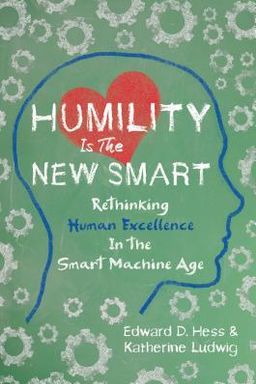
Humility Is The New Smart cover

Humility Is The New Smart

by Edward D Hess and Katherine Ludwig

Humility Is the New Smart guides readers through the Smart Machine Age, emphasizing the importance of humility, collaboration, and creativity as machines take over routine tasks. Learn practical skills to secure a thriving future.

Humility Is the New Smart: Redefining Human Excellence for the Machine Age

What happens when machines become smarter than you? In Humility Is the New Smart, Edward D. Hess and Katherine Ludwig argue that the rise of artificial intelligence and automation—the Smart Machine Age (SMA)—changes not only how we work but what it means to be human. Their bold claim is that humility, not arrogance or technical mastery, will be the key to thriving in the future. The great challenge of the twenty-first century, they contend, is not learning how to beat machines, but learning how to collaborate as humans in ways machines cannot replicate: by thinking critically, creating innovatively, and relating emotionally.

The authors begin with a striking warning from MIT mathematician Norbert Wiener: we can either live humbly with machines—or die arrogantly trying to compete with them. Today’s artificial intelligence systems already outperform highly educated professionals in data analysis, pattern recognition, and even creative problem-solving. As routine tasks vanish and automation spreads to white-collar industries, the old model of success—being the smartest person in the room—no longer works. In the Smart Machine Age, human value derives from what we can do that machines cannot: think deeply, learn continuously, and emotionally connect with other people.

A New Definition of “Smart”

Hess and Ludwig call this shift NewSmart. In contrast to the old, quantity-based definition of smart (how much you know, how few mistakes you make), NewSmart measures the quality of your thinking, listening, learning, and relating. You are not your ideas or your credentials; you are the process by which you test, refine, and evolve them. To be NewSmart means treating your beliefs as hypotheses, not as unchallenged truths. It means approaching work like a scientist—open to being wrong, hungry for better data, and willing to learn iteratively through experiment and feedback.

This mental model requires humility: recognizing that your mental maps are only stories about reality, not reality itself. Pixar co-founder Ed Catmull captured this mindset perfectly with his company’s mantra: “You are not your idea.” Likewise, Bridgewater Associates founder Ray Dalio teaches “radical transparency” and “being good at not knowing”—concepts that embody the intellectual humility to admit ignorance and seek truth through honest dialogue. In the NewSmart organization, it’s not about being right—it’s about getting it right.

The Core Four Human Behaviors

To live and lead with humility, the authors identify four foundational behaviors: Quieting Ego, Managing Self, Reflective Listening, and Otherness. These behaviors counter the reflexes of fear and ego that keep humans defensive, biased, and closed-minded. Quieting the ego through mindfulness, gratitude, and vulnerability helps you engage reality without distortion. Managing Self involves slowing down and deliberately regulating your thoughts and emotions instead of living on autopilot. Reflective Listening requires focusing fully on others before preparing your reply—an act of empathy that deepens collaboration. And Otherness is the practice of emotionally connecting and building trust so human teams can think, learn, and innovate together.

All four behaviors grow from humility. You can’t listen reflectively if you’re obsessed with showing you’re right. You can’t manage emotions effectively if you’re hijacked by fear of failure. And you can’t connect deeply with others if you view them only as competitors. In short, humility isn’t meekness—it’s cognitive and emotional strength. It’s the discipline to silence mental noise and let reality flow in without distortion. That’s what enables humans to perform well in domains machines can’t—where creativity, empathy, and ethical judgment matter.

Why This Matters

The Smart Machine Age will transform not only work but organizational culture. Hierarchies, command-and-control management, and elitist “big me” behaviors—common in the Industrial Age—stifle learning and collaboration. In their place, NewSmart organizations like Google and Pixar demonstrate that teams thrive in environments of psychological safety, transparency, and trust. Leaders in such systems don’t just manage people—they create conditions for hyperlearning, where humility becomes a collective practice. The message is clear: human excellence now means mastering ourselves, not mastering machines.

Central Thesis

Humility Is the New Smart argues that the future belongs to those who combine self-awareness, emotional openness, and critical curiosity to create, collaborate, and continually learn. The smart machines may think faster—but humble humans will think deeper, connect better, and adapt faster.


The Smart Machine Age and Its Human Challenge

Hess and Ludwig paint a vivid picture of the Smart Machine Age (SMA)—a period of accelerating automation powered by artificial intelligence, robotics, and data analytics. Machines can now perform not just manual tasks but cognitive ones once reserved for humans—analyzing legal documents, diagnosing diseases, and even writing articles. Jeff Bezos, Andrew Ng, and other technology leaders affirm that this transformation will reshape society as profoundly as the Industrial Revolution did.

From Efficiency to Creativity

In the Industrial Age, success meant doing routine tasks efficiently and accurately. In the SMA, efficiency belongs to machines. What remains for humans are the complex, creative, and emotional forms of work: critical thinking, innovative problem-solving, and deep collaboration. These are inherently messy, iterative, and emotionally demanding. Human learning, unlike machine learning, is not linear—it requires reflection, courage to fail, and the humility to admit ignorance.

Why Humans Struggle

Ironically, our own biology and culture make excelling at these uniquely human skills difficult. Evolution wired us for fight-flee-or-freeze responses—great for escaping predators, terrible for managing complexity and uncertainty. We defend our egos, fear failure, and cling to familiar ideas rather than face data that disconfirms our beliefs (Daniel Kahneman’s Thinking, Fast and Slow explains this bias extensively). Our culture exacerbates the problem by rewarding competitiveness, self-promotion, and flawless performance. These pressures breed fear and perfectionism—precisely the traits that stifle creativity and learning.

The Promise of Humility

Humility is the antidote. It allows us to shift focus outward—to the reality of data, the perspectives of others, and the process of discovery. Organizations like Bridgewater Associates, Google, and Pixar show that cultures grounded in open inquiry and intellectual humility outperform fear-driven hierarchies. Ray Dalio’s “radical transparency” invites constant feedback; Google’s “employee obligation to dissent” encourages open debate; Pixar’s “Braintrust” makes critique safe and constructive. All embody environments where curiosity replaces judgment and where people learn to be good at not knowing.

Key Lesson

To survive the Smart Machine Age, you don’t need to emulate the speed of AI—you need to cultivate the emotional and intellectual depth machines lack. Humility transforms fear into curiosity and ego into openness, creating the psychological safety required for real learning and innovation.


NewSmart: Rethinking What It Means to Be Intelligent

According to Hess and Ludwig, most of us inherited an outdated mental model of intelligence from the Industrial Revolution: if you know more facts and make fewer mistakes, you’re smart. They call this Old Smart, and in the Smart Machine Age, it’s obsolete. Machines will surpass humans in data collection, analysis, and precision. What remains is how well you can learn, think critically, and emotionally relate with others—qualities that require humility and adaptability.

Five Principles of NewSmart

  • You are defined by the quality of your thinking, listening, and collaborating, not by how much you know. Your identity shifts from “I have answers” to “I improve my thinking through others.”
  • Your mental models are not reality. They’re just stories you tell about how the world works; updating them is essential for learning.
  • You are not your ideas. Detaching ego from beliefs makes it easier to innovate and accept feedback.
  • Treat beliefs as hypotheses. Be scientific: test, stress, and modify your assumptions with better evidence.
  • View mistakes as learning opportunities. Each failure becomes data for growth rather than shame.

Lessons from Exemplars

Bridgewater Associates operationalized these principles through “radical transparency,” where all meetings are recorded and employees rate one another openly. Pixar practices collective creativity by reminding employees their ideas are hypotheses to be tested, not personal reflections of their worth. These companies embody humility as a form of organizational intelligence—a willingness to see clearly, question deeply, and learn continuously.

The authors liken NewSmart thinking to scientific inquiry: curiosity, skepticism, and comfort with uncertainty. Stuart Firestein’s Ignorance: How It Drives Science complements this view—progress depends more on questions than answers. In the same way, personal progress depends on embracing what you don’t know.

Reflection

Old Smart makes you defensive; NewSmart makes you curious. The shift from proving yourself to improving yourself may be the most radical transformation required for future success.


Humility: The Gateway to Human Excellence

Humility, as Hess and Ludwig define it, is not meekness but a mindset of openness and self-accuracy—recognizing your limitations and focusing less on yourself. It is the foundation for learning, collaboration, and creativity. In the Smart Machine Age, humility becomes a strategic advantage, because it allows you to perceive reality undistorted by ego or fear.

Philosophical Roots

The authors trace humility back to Socrates and Confucius, who taught that acknowledging ignorance is the beginning of wisdom. Socratic questioning and Confucian respect for teachers both depend on the willingness to ask, not tell. Yet modern Western culture flipped that approach: we equate questioning others with showcasing superiority and treat our own doubt as weakness. The result is a society of “big me”—competitive, self-promoting, and failure-averse.

The Science of Humility

Psychologists describe humility as a combination of self-accuracy, openness to new ideas, acknowledgment of mistakes, and appreciation of others’ contributions. Carol Dweck’s research on growth mindsets complements this: people who see ability as improvable learn faster and achieve more. Humility enables this learning mindset by removing the ego barrier. Studies show that leaders who score high in humility also rate higher in team performance and employee engagement.

Humility in Action

Bridgewater Associates practices humility through radical transparency; Google hires for intellectual humility and empowers employees to dissent; Pixar fosters humility in its creative teams through constant peer critique; and even the U.S. Navy SEALs define effective leadership as “checking your ego and operating with humility.” These examples confirm humility as a behavior, not just a belief—manifested through openness, honesty, and curiosity.

Core Message

Humility liberates you from defensiveness and allows you to engage fully with reality and with other people. In a world where machines master data, humility helps humans master connection.


Quieting Ego: Seeing Clearly Through Mindfulness and Gratitude

Quieting your ego is the first behavioral pillar of humility. The ego, Hess explains, is an automatic defense system that filters reality through your fears and insecurities. When your ego dominates, you react reflexively, protect your self-image, and distort facts to fit your narrative. Quieting the ego means shifting from self-focus to world-focus—perceiving reality openly, as it is.

Mindfulness: The Science of Ego Silence

Mindfulness, popularized by Jon Kabat-Zinn, is “paying attention on purpose in the present moment, nonjudgmentally.” Studies show that mindfulness reduces stress, increases attention, and even changes brain structure—expanding regions tied to emotional regulation and compassion. Hess describes his own journey with meditation, inspired by Bridgewater’s Ray Dalio, who credits mindfulness for his calm focus and creativity. Through daily breathing and meditation, Hess learned to let intrusive thoughts pass “like soap bubbles,” discovering that he was not his thoughts but their observer.

Daily Reminders and Gratitude

To reinforce humility, Hess created small rituals—signing emails as “ed” instead of “Ed” to remind himself he’s just one among billions, and pausing before meetings to recite: “I am not my ideas; my mental models are not reality; this is not all about me.” Gratitude also quiets ego by turning focus outward. Research shows gratitude lowers blood pressure, increases positivity, and enhances empathy. By thanking others frequently and acknowledging their contributions, you shift attention away from self-promotion toward connection.

Key Takeaway

Quieting your ego creates clarity. Through mindfulness and gratitude, you learn to see without distortion, listen without defensiveness, and engage the world as it truly is. That clear perception is the gateway to learning and collaboration.


Managing Self: Mastering Thoughts and Emotions

Managing Self is the discipline of regulating both your cognition and emotions—the inner mechanisms that influence every decision and interaction. As technology accelerates external chaos, your inner calm becomes a competitive advantage. This chapter translates the sciences of self-regulation, emotional intelligence, and psychological resilience into practical tools for thriving under uncertainty.

Slowing Down

In a culture obsessed with speed and multitasking, Hess urges you to slow down. Slowing down allows deliberate, “System 2” thinking (as defined by Kahneman) to replace automatic judgments. Physical cues—heart rate, breath, tension—signal when to pause and refocus. This form of mindfulness ensures you make choices based on clarity, not reflex.

Thinking Tools

Hess introduces a “thinking toolbox” combining methods like root cause analysis, design thinking, and Gary Klein’s PreMortem—visualizing failure before acting to uncover hidden risks. Bridgewater Associates uses similar tools to stress-test assumptions continuously. The goal is to treat beliefs as hypotheses and to foster curiosity rather than certainty.

Emotional Regulation

Hess shares five research-backed strategies for emotional management: (1) psychological distancing—observe yourself as a “fly on the wall”; (2) reframing fear through logic and humor; (3) recalling positive memories; (4) using encouraging self-talk (“Katherine, you can do this”); and (5) preparing if–then plans for stressful situations. Each technique bridges mindfulness and cognitive-behavioral science, showing that emotions can inform, not overwhelm, decision-making.

Emotional Intelligence

Beyond self-regulation, Hess focuses on empathy. Emotional intelligence, as defined by Peter Salovey and John Mayer, integrates perception, understanding, and management of emotions—both yours and others’. Studies show team performance depends not on average IQ but on social sensitivity and conversational equality (as found by Carnegie Mellon and MIT researchers). Success in future organizations will hinge on these human nuances—listening, empathizing, and cooperating better than machines ever could.

Practical Insight

To manage self is to choose awareness over autopilot. Each breath, pause, and choice to listen rather than react rewires you to think clearer and relate deeper—a discipline as critical as any technical skill in the Smart Machine Age.


Reflective Listening: Learning from Conversations, Not Contests

Reflective Listening transforms dialogue from a battle of egos into a process of learning. Ed Hess recalls believing he was a great listener—until he realized he had mostly been waiting for his turn to talk. To listen reflectively means to focus fully on the speaker, quiet your inner chatter, and reflect back understanding before responding. It’s the cognitive complement to humility.

Listening with a Quiet Ego

MIT’s William Isaacs defines true dialogue as “thinking together.” That requires slowing down and developing “inner silence.” Our minds process 600 words per minute, yet we speak only 150—creating space for distraction and judgment. Reflective listening disciplines that space. It means paraphrasing and confirming understanding (“What I hear you saying is...”) instead of preparing rebuttals. Bourne, Hess’s psychology mentor, told him that listening is the highest expression of humility.

Asking, Not Telling

Edgar Schein, in Humble Inquiry, warns against our cultural addiction to “telling.” Telling signals hierarchy; asking invites learning. Most questions are thinly veiled statements or judgments. Genuine questions—those seeking to understand—create psychological safety. In a world driven by complex teamwork, replacing “Yes, but...” with “Yes, and...” (as taught by Darden professor Jeanne Liedtka) transforms conversation into collaboration.

Practicing Presence

Before conversations, Hess uses a checklist: Clear mind, calm emotions, deep breath, remind yourself “I am not my ideas.” This minute of preparation often changes outcomes dramatically. He recounts a manager moved to tears after practicing reflective listening with his family—their most genuine talk in years. If good listening can heal relationships at home, imagine its power at work.

Lesson

Listening is not about agreement; it’s about understanding. Reflective listening anchors humility in daily life—it’s how you turn curiosity into connection and conversation into collective intelligence.


Otherness: Emotionally Connecting and Relating to Others

“Nobody reaches his or her full potential in isolation,” Barbara Fredrickson famously writes. Hess and Ludwig use this truth to build the concept of Otherness—the deliberate effort to emotionally connect, build trust, and express genuine care. In the Smart Machine Age, success depends on collaboration; Otherness transforms teamwork from coordination into authentic human connection.

Keys to Connection

Jane Dutton identifies five requirements for high-quality connections: be present, be genuine, communicate affirmation, listen effectively, and convey support. These sound simple—but they require constant choice. Hess’s anecdote about overlooking a young analyst in passing illustrates how small failures of attention can fracture trust. Emotional sensitivity and mindful presence signal value to others and ignite engagement.

Trust and Vulnerability

Authenticity is the gateway to trust. Sidney Jourard’s research on self-disclosure shows that knowing yourself requires revealing yourself. Vulnerability isn’t weakness—it’s the courage that fosters reciprocal openness. Edgar Schein’s concept of “Level 2 relationships” emphasizes crossing professional distance to express genuine care. Hess learned this firsthand: when he shared personal honesty with his employees, performance and creativity soared. Connection, when real, compounds.

Language Matters

Words shape relationships. Replacing “Yes, but...” with “Yes, and...” builds collaboration. Saying “want to” instead of “have to” reminds you of choice, and expressing gratitude—verbally, not just silently—shifts focus from ego to appreciation. By treating everyone as a partner rather than an obstacle, you cultivate an environment of positivity and mutual growth.

Main Point

Otherness means moving beyond transaction to transformation—relating to others as whole humans. Machines can process information, but only humans can build trust through empathy, laughter, and care.


Leading a NewSmart Organization: Humanizing Business in the AI Era

The final section of Humility Is the New Smart applies the principles of humility to organizational leadership. In a world where technology increasingly handles operational excellence, the only sustainable advantage is human excellence: learning faster, collaborating better, and innovating meaningfully. Hess and Ludwig propose that leaders design organizations around three psychological pillars—Positivity, Self-Determination, and Psychological Safety.

Positivity

Research by Barbara Fredrickson shows positive emotions broaden attention and improve creativity. Fear, conversely, narrows focus and destroys innovation. Companies like Pixar and Google cultivate positivity through environments of trust, play, and shared purpose. Leaders must model optimism and appreciation to unlock engagement.

Self-Determination

According to Edward Deci and Richard Ryan’s Self-Determination Theory, intrinsic motivation arises when three needs are met: autonomy, competence, and relatedness. Google empowers employees to dissent and choose projects; Facebook research shows high-performing managers genuinely care about team members. Meeting these needs turns work into meaningful self-expression, not mere survival.

Psychological Safety

Harvard professor Amy Edmondson’s research reveals that team learning and innovation depend on feeling safe to speak up without fear of punishment. Google’s studies confirm that Psychological Safety is the number-one predictor of team performance. Pixar’s Braintrust illustrates this safety in practice—feedback is candid but nonjudgmental, empowering creators to take risks. Without safety, curiosity dies; with it, innovation flourishes.

Human-Centric Leadership

Leading a NewSmart organization means replacing command-and-control with coaching and care. CEOs must model humility, invite critique, and set behavioral standards focused on learning across all levels. Processes like after-action reviews and open-dialogue meetings reinforce transparency. As Herbert Simon wrote, knowing leadership principles isn’t enough—you must develop habits of practicing them daily.

Final Insight

Technology may automate efficiency, but humanity drives excellence. Organizations of tomorrow will win not through algorithms but through empathy, learning, and humility made systemic.

Dig Deeper

Get personalized prompts to apply these lessons to your life and deepen your understanding.

Go Deeper

Get the Full Experience

Download Insight Books for AI-powered reflections, quizzes, and more.