
Idea 1
The Gentle Art of Asking Instead of Telling
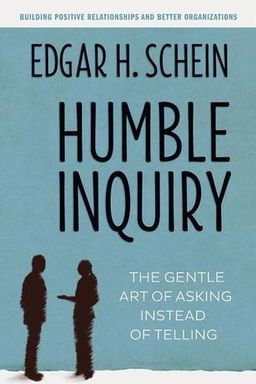
Have you ever found yourself frustrated when someone insists on giving you advice you didn’t ask for—or when you blurt out your own advice only to see it ignored? In Humble Inquiry: The Gentle Art of Asking Instead of Telling, Edgar H. Schein and Peter A. Schein argue that modern life and leadership depend not on how much we tell but on how humbly we ask. At its heart, this book contends that asking thoughtful, curious questions instead of asserting what we know allows us to build trust, dissolve misunderstanding, and collaborate effectively in complex, interdependent settings.
Schein’s central claim is deceptively simple: real learning and real connection happen only when we embrace what he calls “Here-and-now humility”—acknowledging our dependence on others and admitting that we don’t always have all the answers. Humble Inquiry turns ordinary conversations into opportunities for discovery and partnership by replacing the impulse to tell with the discipline to ask. This attitude doesn’t merely polish one’s communication style; it transforms relationships, leadership, and even organizational culture.
Why Asking Matters More Than Ever
Schein launches his argument with vivid everyday examples—a woman lecturing him about poisonous mushrooms instead of asking what he’s doing, and a busy father scolding his daughter when he might have simply asked why she had knocked on his door. These ordinary lapses of curiosity reveal something profound about our communication culture. We live in an age of relentless telling: social media feeds, workplace hierarchies, political debates, and even personal relationships are dominated by people who assert rather than inquire. But Schein cautions that telling, especially when unsolicited, subtly enforces status hierarchies and shuts down openness.
The remedy is deceptively accessible: asking questions we don’t already know the answer to. Humble Inquiry operates on the belief that curiosity is not weakness but strength. It acknowledges our dependence on others for information, understanding, and perspective. The more complex our world becomes—the more we deal with ambiguity, multicultural teams, and rapid technological change—the more vital this attitude becomes. When leaders, teachers, and parents ask humbly, they signal safety and respect, inviting others to share truthfully instead of defensively.
The Anatomy of Humble Inquiry
Schein describes Humble Inquiry not as a single act but as an art and an attitude. It involves three interwoven behaviors:
- Accessing ignorance—the courage to admit what you don’t know and let genuine curiosity guide your questions.
- Listening deeply—receiving responses without imposing your own frames or judgments.
- Revealing appropriately—sharing something personal or contextual when it helps build connection and trust.
This attitude shows up in the small choices of tone and timing that distinguish sincere curiosity from manipulative probing. Instead of interrogating, humble inquiry draws people out gently, creating “Level 2 relationships” grounded in openness and mutual trust—unlike “Level 1 transactional” relationships focused merely on tasks or roles.
The Cultural Challenge
Why is humble inquiry so rare? Schein points to deep cultural forces—especially the U.S. ethos of rugged individualism and a pragmatic, competitive “culture of do and tell.” In this setting, asking for help or not knowing something feels like weakness. Leaders are supposed to be decisive; subordinates are expected to have answers. The result is a toxic paradox: people say they want openness and candor, yet they create climates where truth-telling feels unsafe. Schein connects this mismatch to workplace disasters—from aviation errors to corporate meltdowns—where vital information failed to reach decision-makers because people didn’t feel invited to speak.
“Our failure to ask humbly and with the right attitude has created work climates in which people do not feel psychologically safe to share what they know.”
The book urges leaders to reverse this imbalance—not by demanding courage from employees but by demonstrating curiosity themselves. When those with power ask sincerely, they model humility and safety, allowing learning and honesty to flourish.
From Conversation to Culture
Each chapter builds from the individual to the collective. First, Schein explains how humble inquiry reshapes an ordinary conversation, making it a shared “dance” of revealing and discovery. Then he shows how that dance scales to organizational life: teams function better, trust spreads across rank, and learning becomes continuous. In later chapters, he integrates psychological models like the Johari Window and the ORJI cycle to help readers recognize blind spots, emotional reactions, and cognitive biases that derail dialogue. Finally, he outlines how leaders can unlearn their cultural scripts, slow down, and adopt new habits that sustain humility even in high-pressure environments.
Ultimately, Humble Inquiry is an invitation—to replace performance with partnership, arrogance with authenticity, and the need to be right with the desire to learn. You don’t have to become a different person; you simply have to enter each interaction aware that you are dependent on others to see reality more clearly. The book suggests that this humility—here and now, in every moment of conversation—is the foundation for collaboration, leadership, and human connection in a turbulent world.