
Idea 1
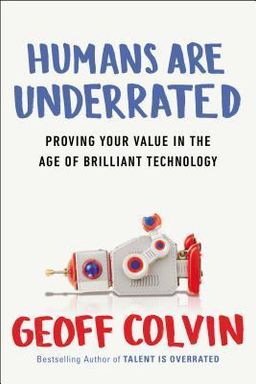
Humans Are Underrated: Rediscovering Deep Human Value in the Age of Machines
What will people do better than computers in a world where technology outperforms human intelligence, speed, and accuracy? Geoffrey Colvin’s Humans Are Underrated answers this question with a surprising thesis: as machines become smarter, faster, and cheaper, the skills that make humans uniquely valuable are not technical but profoundly social. In other words, the next great wave of human opportunity won’t be found in mastering algorithms—it will be found in mastering empathy, storytelling, collaboration, creativity, and relationships.
Colvin begins by acknowledging the growing fear that automation and artificial intelligence will obliterate jobs. He recounts IBM’s Watson defeating champions on Jeopardy! and Google’s self-driving cars outmaneuvering human drivers. Across industries—from law to medicine to finance—machines now outperform humans in analysis, prediction, and precision. Yet, Colvin observes, people continue to crave one thing computers can’t deliver: genuine human connection. When faced with uncertainty, pain, or moral choice, we instinctively turn to others, not machines. That insight becomes the backbone of his argument: as technology takes over cognitive and routine tasks, high value will shift to interpersonal and emotional skills—the deeply human abilities that machines still cannot replicate authentically.
How Technology Changed What We Value
The book traces four turning points in the history of work. First came the Industrial Revolution, which replaced artisans with factory workers. Then came the age of education, when knowledge became a currency for prosperity. Later, the information revolution devalued mid-level cognitive skills but rewarded those in high-skill professions and low-skill service jobs. Now, Colvin argues, the fourth turning point is here: computers are advancing into both ends of the skill spectrum, taking over everything from truck driving to legal analysis. What remains—the last domain where humans thrive—is what he calls “the human domain.”
In this new economy, success depends less on what you know and more on what you’re like. Being effective means communicating compassionately, collaborating intuitively, leading with empathy, and storytelling with authenticity. These capabilities can’t be replaced by circuitry because they depend on trust, vulnerability, and emotion—qualities that evolved deep in our species for survival. As Colvin observes, “Our brains are built to connect with others. That’s our advantage.”
Why Empathy and Social Skills Are the New Currency
The book shows how empathy became more lucrative than logic, especially in modern organizations. Employers increasingly prioritize emotional intelligence: American Express trains its call center employees to “bring their personality to life.” The Cleveland Clinic teaches doctors empathy as a clinical skill. And even armed forces train soldiers to read subtle cultural and emotional cues. These examples illustrate a broader pattern—industries once dominated by technical expertise are rediscovering that understanding others is the ultimate competitive advantage.
One of Colvin’s most striking insights comes from military training. In Vietnam, America’s most advanced fighter jets underperformed because pilots lacked the social and cognitive skills to predict opponents. The Navy’s “Top Gun” program changed that through brutally honest, human-centered feedback. When pilots learned to empathize—seeing through the eyes of an enemy—they increased success rates fivefold. The revolution was not technological but interpersonal. Empathy saved lives and reinvented modern training across the military and, later, business leadership programs.
The Social Brain at Work
Underlying all of Colvin’s arguments is neuroscience. Our brains didn’t evolve to compute—they evolved to connect. Studies show that face-to-face conversation triggers synchronization between brains, boosting cooperation and creativity. When you truly engage another person, your brain releases oxytocin—the “bonding hormone.” That physical response translates into trust, empathy, and collaboration. Digital communication, by contrast, inhibits these responses, making us less empathetic and less intelligent as groups. Our virtual lives, though efficient, are diminishing the very abilities that make us human.
From Knowledge Workers to Relationship Workers
Colvin redefines success in the twenty-first century. Where Peter Drucker coined the term “knowledge workers,” Colvin introduces the era of “relationship workers.” The most valuable people are those who collaborate, innovate, and inspire others—not those who merely store information. He demonstrates how empathy drives medical outcomes, how storytelling persuades more deeply than logic, and how inclusive teams outperform purely analytical ones. Crucially, he insists these skills are not innate traits but trainable abilities. Organizations from the Army to Stanford’s business school have learned to teach empathy, trust, and collaboration through realistic simulation, open feedback, and storytelling practice.
In a world where machines think, Colvin invites us to rediscover what only humans feel. The future belongs not to the smartest coders, but to those who can see, understand, and connect with others. That means your greatest advantage may already be inside you—the timeless ability to care, communicate, and collaborate. As technology races ahead, humans who are deeply human will lead the way.