
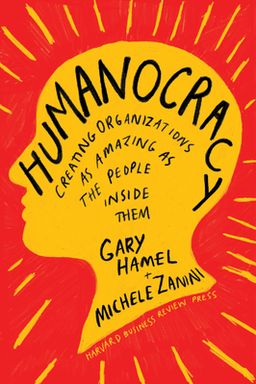
Humanocracy cover

Humanocracy

by Gary Hamel & Michele Zanini

Humanocracy exposes the limits of traditional bureaucratic structures and advocates for more human-centric organizations. By showcasing successful examples like Nucor and Haier, it provides strategies to unleash potential, creativity, and innovation in the workplace, fostering empowerment and adaptability.

Humanocracy: Restoring Humanity to Organizations

You live and work inside systems designed for control. Layers of approval, rigid rules, and job descriptions have normalized the idea that efficiency demands obedience. In Humanocracy, Gary Hamel and Michele Zanini argue that these bureaucratic structures may once have served industrial goals but now suffocate innovation, responsiveness, and meaning. The book offers a radical rethinking: organizations should be designed as engines of human potential, not machines of compliance.

The central argument

Bureaucracy prioritizes hierarchy, specialization, and control—each originally intended to solve coordination problems as companies scaled. Today, those same features act as constraints. Decision rights accumulate at the top, leaving the majority to wait for approval. Specialists are trapped in narrow roles, formalization stiffens responses, and standardization erases judgment. Hamel and Zanini show that this model produces what they call an organizational handicap: structures that make people less adaptive than the tasks they face.

By contrast, humanocracy is a creed for designing companies around contribution and capability. It shifts the management question from how do we control performance? to how do we amplify human potential? Control gives way to ownership, rules give way to principles, and scale evolves from bloat to agility.

Evidence for change

The authors back their case with data and vivid examples. Their Bureaucratic Mass Index (BMI) survey, conducted with Harvard Business Review, revealed that the average employee in large firms spends 27% of their time on bureaucratic chores. Nearly 80% report that bureaucracy frustrates fast decisions; most say new ideas meet indifference. The cumulative waste is staggering—billions of hours globally wasted on compliance and political navigation.

In economic terms, Hamel and Zanini estimate trillions lost annually worldwide. They calculate that U.S. firms could reclaim roughly $2.6 trillion in productivity if they halved managerial overhead and busywork. The moral dimension, however, is equally urgent. Bureaucracy turns work into what Studs Terkel called a “Monday through Friday kind of dying.” It deprives people of dignity and growth. The authors argue this dehumanization is a moral failure akin to other historical institutional injustices.

What humanocracy looks like

Humanocracy reverses the flow of authority. Power moves to those closest to problems. Teams self-organize, internal markets allocate resources, and influence arises from merit and reputation rather than titles. Instead of headquarters monopolizing decision power, governance becomes modular and peer-regulated. Transparency replaces secrecy, experimentation replaces policy, and accountability becomes horizontal.

Real examples prove viability. Buurtzorg, a Dutch home-care network, runs 15,000 nurses in self-managed teams with only two senior directors. Nucor in steelmaking delegates full P&Ls to local divisions and pays team bonuses based on output, creating frontline ownership. Haier, the Chinese appliance giant, split into 4,000 microenterprises under the Rendanheyi model—each unit accountable for both user and employee value. Morning Star’s tomato-processing operation runs without managers, relying on peer contracts instead of command.

Shifting principles, not practices

Hamel and Zanini caution against superficial reform—agile teams and innovation labs don’t suffice if underlying principles remain bureaucratic. The real rewiring happens at the level of beliefs: about people, ownership, and purpose. Leaders like Ken Iverson (Nucor) and Zhang Ruimin (Haier) succeeded because their mental models trusted human capacity. Bureaucracy is sustained not by necessity but by outdated assumptions that managerial elites know best.

The pathway to reform

Transformation begins locally. Michelin’s MAPP pilots show how volunteer teams can redesign work and share practices through a wiki-like platform, proving autonomy improves both morale and productivity. Other companies launch management hacks—small experiments that test humanocracy principles, like delegating travel approvals or internal crowdfunding. Over time these add up to cultural change, supported by data and moral conviction.

Core thesis

Bureaucracy once made organizations scalable; now it makes them slow, expensive, and lifeless. Humanocracy restores adaptability and meaning by redesigning power, work, and reward around what humans do best—think, create, and take responsibility.

Throughout the book, you encounter an intertwined economic and moral plea. Hamel and Zanini call not only for leaner structures but for a restoration of agency and respect. The message is simple yet profound: organizations should serve human flourishing, not the other way around.


The Case Against Bureaucracy

Every day, you encounter bureaucracy—approval layers, micromanagement, job silos. Hamel and Zanini argue that these are not mere inconveniences but symptoms of a deeper design flaw. Bureaucracy solves for scale but penalizes adaptability and initiative. It turns organizations into pyramids of permission and conformity.

How bureaucracy works—and fails

Its toolkit—stratification, specialization, formalization, and routinization—yields reliability but at the cost of agility. Decisions travel upward while knowledge resides at the front line. Roles narrow until employees are forbidden to act beyond defined slots. Everything becomes measurable, but little becomes meaningful. Microsoft’s stagnation in mobile and tablet markets illustrates how central mental models can blind entire organizations.

The human cost

Bureaucracy trains conformity, silences dissent, and de-skills labor. Over time people internalize its pessimism—believing they cannot think or act. Hamel and Zanini call this a self-fulfilling prophecy: organizations mistake learned helplessness for lack of ability. Their indictment is moral as well as functional; bureaucracy systematically dehumanizes work.

Where alternatives thrive

Buurtzorg’s nurse teams exemplify post-bureaucratic efficiency: 11,000 nurses managed by just two senior directors. Their lean overhead shows how much administrative ballast most firms carry. Likewise, Nucor’s decentralized steel operations prove large scale can coexist with autonomy. These stories serve as beacons: agility and coordination need not require hierarchy.

Key lesson

Bureaucracy’s promise of control once delivered efficiency; now it imposes drag, dulls creativity, and slows learning. Replacing control with contribution is the only sustainable way forward.

You cannot fix bureaucracy through minor process tweaks. The authors argue for an architectural rebalancing: distribute authority, dismantle unnecessary layers, and design incentives around initiative, not compliance. The goal is no longer efficiency through control but adaptability through empowerment.


Design for Human Capacity

You are not the problem; your organization’s design is. Hamel and Zanini observe that human capacity—creativity, resilience, and judgment—is abundant everywhere except in corporate structures that suppress it. People thrive when granted tools, context, and autonomy. The authors contrast stifled workplaces with the explosion of creativity outside formal hierarchies—millions making content, software, and businesses without managerial permission.

The deskilling trap

In bureaucratic environments, workers perform narrow tasks and follow orders. Managers then conclude employees lack imagination—a cycle that perpetuates dependency. The authors argue that so-called “low-skill” jobs are low-skill only because design denies learning and ownership. Add training, cross-function opportunities, and outcome accountability, and those same jobs become engines of growth.

Companies that unleash capacity

Morning Star eliminates managers entirely; employees write contracts defining mutual obligations and outcomes. Nucor trains factory workers in business thinking and cross-role mastery. A 30,000-worker manufacturing experiment cited by the authors produced thousands of innovations when workers were empowered to propose changes. Freedom breeds capability.

Core belief

Human capacity expands with opportunity and accountability. Organizational designs that presume incompetence create the incompetence they fear.

You can start by broadening roles, cross-training teams, and rewarding contribution instead of rank. As Hamel and Zanini remind you, you don’t need everyone to be a genius—you just need everyone free to act like one under the right conditions.


Replace Rules with Principles

Rules offer predictability; principles offer adaptability. The authors explain that over-standardization—what they call “controlitis”—makes organizations brittle. Procedures assume stability and uniformity, but most modern problems are variable and contextual. When you replace judgment with rulebooks, you trade intelligence for compliance.

When rules help and hurt

Standards work only when outcomes are clear and methods stable. Real-world conditions rarely meet those criteria. Rules that try to cover every possibility destroy initiative. Employees who follow them to the letter cannot serve customers or innovate. Southwest Airlines trusts employees to bend guidelines when needed; United’s infamous passenger incident showed the opposite—staff were trapped by their own procedures.

Principled autonomy

Principles—shared norms and values—allow flexibility while preserving purpose. Hayek’s metaphor of the gardener is cited: leadership should cultivate judgment, not dictate actions. That means training, transparency, and culture must build common sense. Information replaces supervision; shared goals replace edicts.

Design takeaway

Substitute rule-based control with principle-based autonomy. You’ll keep safety and coherence but unleash initiative and moral engagement.

Ask at every level: which decisions still require central approval, and which could be made locally with better information? The answer often reveals opportunities to trust more—to produce a smarter organization by making it more human.


Ownership and Internal Markets

When you give people a stake and a choice, they act as owners. Hamel and Zanini propose internal markets and distributed ownership as the most practical mechanisms for creating humanocracy. Instead of relying on command and control, organizations can coordinate through contracts, transparency, and accountability networks.

Why ownership transforms behavior

Autonomy alone motivates some; financial upside amplifies motivation. The authors cite research showing engagement peaks when authority and upside co-exist. Nucor’s team-based bonuses align pay with productivity. Handelsbanken’s branch-level profit sharing and monthly transparency dashboards turn local banks into entrepreneurial cells.

Haier’s internal marketplace

Haier’s Rendanheyi model shows internal markets at scale. Thousands of microenterprises transact through transparent contracts. Service units compete like vendors: if a node underperforms, it loses internal customers. This injects real market discipline into the heart of the firm, improving performance and innovation.

Core insight

Ownership and market mechanisms decentralize accountability better than bureaucracy ever could. They create self-regulating systems where performance replaces permission.

You can start small—pilot internal contracting between teams, test internal crowdfunding for ideas, or introduce profit sharing at unit level. When you give teams control over resources and returns, the mindset shifts from compliance to stewardship.


Meritocracy and Community

Real meritocracy and genuine community replace politics and isolation. Bureaucracies reward rank and proximity to power; humanocracy rewards contribution and connection. Merit and community together build trust, accountability, and belonging—the social foundation for performance.

How meritocracy really works

Systems that rely on single-boss ratings fail. Google spreads evaluations across peers and panels to reduce bias. Bridgewater’s Dot Collector aggregates thousands of peer ratings to calculate believability-weighted decisions. W.L. Gore uses peer ranking for pay. Each approach ties influence and compensation to evidence of impact rather than positional privilege.

Community as performance engine

Communities create shared purpose and emotional safety. Southwest Airlines nurtures authentic care and trust through open communication and rituals. Alcoholics Anonymous and StrivePartnership demonstrate self-organizing communities solving systemic problems without central control. Community replaces fear with belonging—the precondition for creativity.

Lesson

Meritocracy supplies fairness; community supplies meaning. Together they make organizations moral and adaptive rather than political and fragile.

Start by implementing multi-rater reviews, peer feedback, and transparent recognition. Build community through shared rituals and open metrics. When people trust both the system and each other, performance becomes a collective achievement.


Experimentation and Open Change

To reinvent management, you must experiment like a startup. Hamel and Zanini urge leaders to become hackers—testing, learning, and scaling what works instead of waiting for permission. Bureaucratic change is episodic; humanocratic change is continuous, decentralized, and learning-driven.

How to hack management

Use simple experiments to test humanocracy principles: autonomy, ownership, markets, merit, and community. Run a half-day “management jam,” pick a pain point, design a lightweight test with volunteers, and measure impact. Examples include internal crowdfunding (employees invest small budgets in peer ideas), travel approval self-tests, and hackathons producing dozens of viable experiments.

Scaling through openness

Open strategy and distributed leadership replace top-down programs. Cisco and Adidas used open calls and peer review to source thousands of strategic ideas. At the NHS, the grassroots campaign “Change Day” drew hundreds of thousands of pledges for care improvement. These illustrate how mass participation beats elite design.

Rethinking leadership

Leadership becomes activation, not authority. Leaders sponsor experiments, protect volunteers, and redistribute credit. Change is modular and emergent—like Amazon’s microservices, many small teams iterating simultaneously. Over time, politics loses ground to evidence and collaboration.

Action principle

Small, transparent experiments build credibility and community. When results go public, change becomes self-sustaining and hard to suppress.

You don’t need rank to start. Collect evidence, share results, and inspire others to run their own hacks. Step by step, you create a humanocracy movement—proof that organizations can be both productive and humane.

Dig Deeper

Get personalized prompts to apply these lessons to your life and deepen your understanding.

Go Deeper

Get the Full Experience

Download Insight Books for AI-powered reflections, quizzes, and more.