
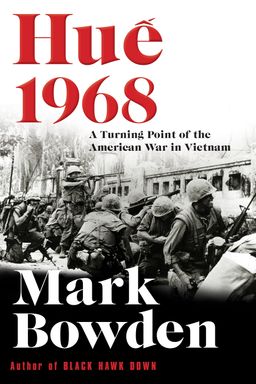
Hue 1968 cover

Hue 1968

by Mark Bowden

Hue 1968 by Mark Bowden delves into the gripping and pivotal battle during the Vietnam War that changed American public opinion and military strategy. Through meticulous research and vivid storytelling, Bowden uncovers the complexities of the conflict, the impact of media, and the harsh realities of urban warfare.

The Human and Political Anatomy of the Battle for Hue

At its heart, the story of Hue, 1968 is not just a military chronicle—it is the anatomy of a political gamble that collided with human endurance, civic tragedy, and institutional blindness. The book invites you to look past traditional categories of victory and defeat, and to examine how politics, intelligence failures, and local human networks transformed a single battle into a decisive moral and strategic turning point in the Vietnam War.

Hanoi’s wager and Washington’s illusion

At the highest levels of planning, Hanoi and Washington were both ruled by misreadings. General Westmoreland’s belief in spizzerinctum—an eternal confidence measured by body counts and charts—squared off against Le Duan’s conviction that a bold, city-wide uprising could ignite revolution and break the will of the Americans. In Hanoi’s vision, Tet was supposed to be both a battlefield and a stage: an armed assault married to a political theater of liberation. But optimism became hubris. The expected uprising never came in Hue, and thousands of lives were trapped between illusion and reality.

The battle as human network

Inside Hue, you see how a revolution relies not just on troops but on invisible labor. The local Huong River Squad—girls like Che Thi Mung and Pham Thi Lien—embodied infiltration through ordinary life. They sold hats, flirted with soldiers at fountains, memorized patrol rotations, and became the nervous system connecting Front command to the urban labyrinth. Their tradecraft broke the boundary between civilian and combatant, showing that intelligence born of the everyday can shift the fate of a city.

(Parenthetical note: These accounts echo Graham Greene’s interplay between innocence and complicity in The Quiet American—where personal motive becomes political machinery.)

American confidence and its collapse

Westmoreland’s headquarters in Saigon measures progress in body counts; belief outweighs evidence. The fixation on Khe Sanh—perceived as the major front—lets Hue stand nearly undefended when infiltration begins. When the city falls, military reflex collides with disbelief. Officers like Captains Coolican, Meadows, and Batcheller try to improvise defense plans while reports up the chain describe success. In those days the word "credibility gap" becomes tangible: what happens when arithmetic replaces empathy and the truth arrives too late.

Urban warfare reborn

Hue demands the reinvention of tactics. Lieutenant Colonel Ernie Cheatham, searching manuals on siege warfare, invents a grim improvisation: move through walls, not around them. Ontos recoilless rifles, 106-mm bazookas, and gas launchers turn buildings into perforated fortresses. Opposite him, Hoang Anh De orders his men to “hold on to the enemy’s belt”—fight so close that the Americans can’t use artillery. The result is medieval intimacy: grenades passed hand to hand, Ontos guns blasting meters from targets, medics working in doorways under sniper fire.

South of the river, assault teams like the Tam Thai raiders blow up tanks, while in the Citadel commandos force open gates at night. North of the city, cavalry and marine battalions stumble into ambush at La Chu, then cut their way out in a nighttime breakout led by Colonel Dick Sweet. Every maneuver reveals the same theme—adaptation at human scale amid institutional blindness.

Civilians and moral collapse

Within this map of tactics lies a deeper tragedy. Civilians crowd churches and pagodas, clutching white rags as surrender flags. Revolutionary tribunals execute officials, teachers, even children. Allied fire turns the old imperial city into rubble. Writers like Tran Thi Thu Van describe pews filled with corpses, and flags of peace waving over roofs crushed by shells. The liberation myth dissolves into horror and hunger; the Front’s claim to represent “the people” curdles into fear.

The press as mirror and detonator

If you want to see how local battle becomes global turning point, follow the reporters. Gene Roberts’s dispatches in the New York Times and images from photographers like John Olson and Catherine Leroy drag the truth from rubble to headlines. When Walter Cronkite looks into the camera and calls the war “mired in stalemate,” he crystallizes what Hue made visible: that numbers and slogans cannot outweigh human images. The confidence machine of official briefings disintegrates under the lens.

Aftermath and memory

Hue ends with paradox. Militarily, the city is retaken; politically, the war is lost. Westmoreland’s career collapses, Johnson abandons reelection, and American public conviction fractures. Veterans like Alvin Grantham, Coolican, and Ehrhart carry the war home—in scars, guilt, or poems. In the ruins of Hue, victory has no moral shape, only survivors and lessons: that misperception kills as efficiently as bullets, and that truth, once seen, cannot be unseen.

Together these threads—political overreach, invisible local intelligence, tactical adaptation, civilian ruin, and journalistic revelation—form the anatomy of modern war. You watch how a city becomes a battlefield of truth, and how human eyes—those who fight, heal, witness, and write—become the lasting instruments of remembrance.


Hanoi’s Gamble and American Misread

Hanoi’s decision to launch the Tet Offensive was an audacious mix of politics and faith. Led by Le Duan, the Politburo believed simultaneous attacks would trigger revolt in southern cities. Giap and Ho Chi Minh warned against it, but were sidelined. The plan—codified in Resolutions 13 and 14—was designed less to win ground than to win minds. Each assault targeted symbols: Hue’s Citadel, Saigon’s embassies, the U.S. command network. Political impact would substitute for military strength.

In contrast, Westmoreland’s headquarters in Saigon treated war as an engineering problem. The body count was data; morale derived from metrics. He sold progress through graphs and television briefings, not from conditions on the ground. Both sides misread the moment: Hanoi exaggerated southern revolutionary fervor, and Washington inflated its control. Hue became the collision point where both illusions shattered.

When the uprising never came, Hue’s battle dissolved into destruction. Yet, paradoxically, that failure accomplished the strategic purpose Hanoi sought: it broke American faith in its own leadership.

Key insight

Grand strategy built on imagined behavior of populations risks collapse when people do not act as planned. In Hue, reality punished both revolutionary hope and managerial arrogance.

The result was a disaster shared by both combatants but framed differently: Hanoi saw sacrifice as leverage, Washington saw progress through attrition. In the end, the more accurate weapon was perception.


The Hidden War of Women and Locals

While you might picture NVA regiments in helmets, Hue’s infiltration owed much to those who wore conical hats. Che Thi Mung and Pham Thi Lien’s Huong River Squad operated as villagers by day and revolutionaries by night, renting homes, selling hats, and noting troop rotations. Their intelligence fed maps and timings for the entire assault on Hue’s bridges and compounds. Invisible networks of women and youths created a logistical miracle—the heart that pumped blood into the body of the offensive.

Human tradecraft in plain sight

The squad mastered simplicity: memorize, don’t write; use daily life as cover; report by memory. Che re-entered the very post where she was once tortured to record schedules. They transformed gendered assumptions about harmlessness into weapons. A woman carrying laundry or goods became espionage embodied. This underlines how insurgency blurs civilian boundaries—small acts create strategic effect without visible battlefields.

Strategic consequences

These networks allowed northern commandos to appear inside the city with uncanny precision during Tet. The infiltration challenged the American belief in technical superiority; no satellite could see a girl at a water pump memorizing license plates. Intelligence from life replaced intelligence from machines. By capturing that nuance, the book reframes the concept of infiltration from military supply to social disguise.

Hue’s hidden women demonstrate the invisible foundation of modern warfare—the gray zone where loyalty, survival, and family history intertwine into strategy.


Urban Warfare and Tactical Reinvention

Hue forced a century’s worth of tactical adaptation in a month. American marines trained for jungle skirmishes suddenly faced fortress streets and sniper towers. Lieutenant Colonel Ernie Cheatham—reading manuals written for World War II—crafted new doctrine from desperation: use heavy weapons close, tear gas for confusion, and never cross open streets. Ontos vehicles, 106-mm rifles, recoilless bazookas, and flamethrowers turned French colonial buildings into pulverized passageways.

Close contact warfare

The defenders, guided by Hoang Anh De, responded with “hold on to the enemy’s belt.” They stayed so close that artillery support risked friendly fire. Every block became a personal duel. The Dong Ba Tower stood as the archetype: multiple floors, overlapping vantage points, marines climbing walls under machine-gun rain. The treasury, post office, and Jeanne d’Arc School each demanded creative violence—gas storms, wall breaches, and room-by-room clearances where hand grenades replaced strategy meetings.

Learning under fire

Commanders like Cheatham and Capt. Harrington built impromptu knowledge chains: rigged launchers, combined arms with tanks and infantry, mule trains carrying 106s. Counterpart failures, like Major Thompson ignoring advice and walking his men into daylight ambushes, highlight how doctrine alone cannot replace humility and intelligence. Lessons from Hue later became templates for Fallujah and Baghdad—a grim lineage of urban combat reinvented amid destroyed walls.

Hue teaches that adaptation in combat isn’t innovation by choice—it is survival carved from failure.


Failure, Command, and Fog

If you trace the chain of command in Hue, you find the most lethal enemy was miscommunication. Major Thompson’s slaughter on Mai Thuc Loan Street stems from one assumption—that ARVN allies still held his flank. They didn’t. Orders from Task Force X‑Ray restricted heavy fire to protect heritage, leaving marines exposed to close‑range ambushes. Command arrogance and delayed intelligence turned vigilance into victimhood.

(Note: this contrast recurs in war literature—comparable to the Somme or Fall Gelb—where belief in elegant plans collapses upon contact with ground truth.)

When information kills

Thompson marched by daylight despite warnings from advisers like Jim Coolican: “We fight at night.” Within minutes his column was shredded. His resignation after the debacle becomes an emblem of institutional pride and its cost. Meanwhile, medics and platoon leaders rebuilt battered units one corner at a time. The book repeatedly reminds you that war’s machinery runs on assumption, but survival depends on listening.

In the language of systems theory, Hue exposes a feedback loop failure: when fear of damaging image or heritage outweighs battlefield reality, the system cannibalizes its soldiers.


Civilians Between Revolution and Rubble

For Hue’s people, liberation and occupation were indistinguishable horrors. Revolutionary cadres entered with lists—teachers, officials, policemen—and unleashed tribunals and executions. Where ideology left off, vendetta began. Families hid in drainage ditches or churches while Front commissars filled ditches with victims. Writers like Tran Thi Thu Van describe cathedrals turned into sepulchers, where fear hung like incense.

Mass purges and human cost

Documents and eyewitnesses reveal bureaucratic genocide: printed arrest sheets, mistyped names turned death warrants. Local opportunists—like Mai Van Ngu—used political cover to settle debts with bullets. After the Front withdrew, marines unearthed mass graves holding thousands. The statistics blur—some claim 2,800 executed, others 5,000—but the essence is certain: ideology consumed its makers and victims alike.

Collateral ruin

American and ARVN artillery added their own desolation. Naval guns, airstrikes, and mortars destroyed 80 percent of the city’s structures. Hue’s royal heritage—once praised as the soul of Vietnam—became dust. Few accounts better convey the double tragedy: purged by revolutionaries, bombarded by liberators, civilians bore the sins of both sides.

Hue’s civilian story stands as a permanent indictment of ideological absolutism and military expedience alike.


Media Truth and the Collapse of Credibility

The battle’s second front unfolded through cameras and typewriters. Reporters like Gene Roberts, Don McCullin, and Catherine Leroy captured the dissonance between briefing rooms and bloodied streets. Civilian reporters risked ambush to file copy while Marine 'snuffies' like Steve Berntson wrote from inside the squads themselves, merging reporter and participant. Their shared work ripped apart Washington’s narrative of steady progress.

When images overruled statistics

John Olson’s Life photo of wounded marines on a tank, its anonymous face later identified through veteran testimony, condensed the entire battle into a symbol. Similarly, television footage of refugees and burning temples overrode official kill ratios. (Parenthetical note: in democratic wars, pictures often outperform reports; emotion outvotes metrics.)

Cronkite’s broadcast and political shock

When Walter Cronkite—America’s television conscience—declared Vietnam a stalemate, he mirrored what Hue made obvious. Johnson’s lament, “If I’ve lost Cronkite, I’ve lost middle America,” marks the crossroad where battle narrative became policy change. Military triumph suddenly meant political collapse. The press did not lose the war; it illuminated the cost in faces.

Hue demonstrates how journalism, when rooted in proximity and courage, can realign history faster than any official campaign.


Tactical Victory, Strategic and Moral Loss

By February’s end the marines and ARVN re‑raised their flags, but triumph was hollow. The city lay in ruins: 250 Americans killed, more than 1,500 wounded, thousands of Vietnamese dead. Officially, the enemy was crushed; politically, disbelief had conquered the United States. Johnson’s withdrawal from reelection, Westmoreland’s removal, and public disillusion trace directly to Hue’s televised evidence of contradiction.

The paradox of success

America retook every street but lost its narrative. Hanoi lost armies but gained legitimacy as the actor capable of startling the superpower. The destruction of Hue’s temples and neighborhoods became moral calculus: how can a war justify saving a city by destroying it?

This paradox extends beyond Vietnam. War fought with overwhelming firepower in populated centers guarantees hollow victories. Hue evolves from case study to warning: tactics can win a week; truth determines centuries.

Strategically, Hue unseated imperial confidence. Morally, it marked the moment when seeing replaced believing.


Aftermath, Memory, and Moral Reckoning

Decades after the battle, survivors returned to Hue’s rebuilt streets haunted by ghosts visible and unseen. Veterans like Grantham bore physical scars; others like Bill Ehrhart carried the moral ones into poetry and activism. For some, like Coolican, the war’s purpose stayed clear; for others, it dissolved into remorse. Each story enlarges the definition of victory or defeat.

Personal reckonings

Richard 'Lefty' Leflar’s journey from panic to brutality to guilt mirrors a generation’s transformation. Photographers debated which wounded marine appeared in Olson’s image—because identity itself had blurred. Memory became the last battlefield, fought through archives, reunions, and confessions. Even former Viet Cong cadres like Nguyen Dac Xuan later urged public acknowledgment of Hue’s atrocities.

Collective memory

Over time, Hue turned into a prism of lessons: about the futility of idealized wars, the inevitability of civilian sacrifice, and the power of witnessed truth. Readers walk away understanding that remembrance isn’t nostalgia—it’s accountability. Every name recovered from mass graves or photograph re‑identified undoes a line of propaganda.

Hue’s final legacy is moral, not operational: truth costs blood, but silence costs history.

Dig Deeper

Get personalized prompts to apply these lessons to your life and deepen your understanding.

Go Deeper

Get the Full Experience

Download Insight Books for AI-powered reflections, quizzes, and more.