
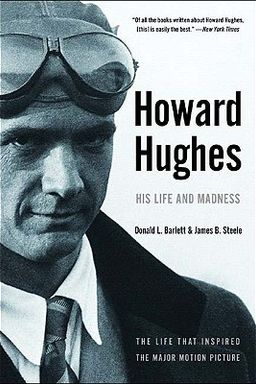
Howard Hughes cover

Howard Hughes

by Donald L Barlett & James B Steele

Discover the extraordinary yet tragic life of Howard Hughes, a pioneering aviator and Hollywood mogul who battled personal demons and mental illness. This biography explores his rise to fame, obsession with control, and ultimate descent into isolation and addiction.

Howard Hughes: Vision, Obsession, and Isolation

When you trace the life of Howard Hughes, you see a man whose genius and madness were forged in equal measure. His story is not simply about wealth or invention—it's a psychological and institutional study of how creative ambition, secrecy, and control can build empires and eventually destroy them. Hughes’s journey moves from oil and aviation to Hollywood spectacle, national politics, defense contracting, and finally into paranoia and corporate collapse. You can view it as an arc of transformation: an innovator becomes a myth, then a ghost within his own empire.

The Family Engine and Early Inheritance

It begins with the Hughes Tool Company—an industrial monopoly born from Howard Robard Hughes Sr.’s rock bit invention in 1908. That mechanical triumph generates not just fortune but a cultural script: secrecy, technical audacity, and control of intellectual property. When Howard Jr. inherits that wealth, he also inherits a mindset—solve problems yourself, guard information, demand precision. (Note: In psychological terms, this sets up Hughes’s lifelong pattern of treating both machines and people as instruments of control.)

Hollywood and the Performance of Genius

In the 1920s and 1930s, you see how money and technical obsession evolve into public performance. Hughes turns cinema into engineering theater—funding massive projects like Hell’s Angels that consume lives and fortunes for the sake of technical authenticity. Aviation simultaneously becomes his real stage. The H-1 Racer and later world-flight records prove that spectacle and science can fuse. He learns the principle that drives all later ventures: technical perfection marketed through drama creates both fame and control.

War, Bureaucracy, and the Hercules Obsession

World War II exposes Hughes to institutional limits. His projects—the D-2 fighter, the HK-1 Hercules flying boat—reveal both brilliance and dysfunction. Vision collides with management chaos. As the government grows wary of his erratic decisions, Hughes insists on his autonomy. The Hercules project becomes symbol and symptom: monumental ambition without organizational infrastructure. This pattern recurs again and again—creative daring undermined by secrecy and unstable leadership.

Politics, Reputation, and Moral Reversal

Through the Senate hearings after his 1946 crash, Hughes demonstrates his mastery of narrative. He turns political attack into theater, presenting himself as patriotic and persecuted. Fame and fear fuse. But that same event deepens his physical and emotional dependence—painkillers, reclusion, and paranoia begin to dominate. Eventually his empire, including RKO studio, becomes an arena where personal compulsions shape institutional policy. His anti-Communist campaigns mirror his internal fears: cleanse contamination, control narrative, purge dissent.

The Empire of Secrecy and Technical Control

By mid-century, Hughes redefines management as isolation. Romaine Street functions as a sealed operations machine—a command post that translates his instructions into bureaucratic rituals. Through Bill Gay and loyal Mormon staff, Hughes constructs a priesthood of secrecy. He creates coding systems, “alert lists,” and classified categories more rigid than some defense agencies. Information becomes both protection and prison. (Parenthetical note: In corporate governance studies, this case is often cited as the ultimate failure of centralized decision isolation.)

Decline, Enablers, and Legacy

From the 1950s forward, management gives way to maintenance—of both empire and body. Drugs, aides, and strange rituals replace engineering charts. His Las Vegas takeover fuses power and pathology: acquisitions used for political leverage, publicity as moral theater, and operations run through intermediaries like Robert Maheu. As the decades advance, internal coups, swindles, and political entanglements reveal the cost of his isolation. The same secrecy that safeguarded innovation now protects corruption. When Hughes dies in 1976, Summa Corporation collapses under opaque debt and governance failure. The empire of secrecy ends in audit and litigation.

Why His Story Matters

You can read Hughes’s life as an allegory of modern power: how private wealth can act like a state, how secrecy can become ideology, and how technical brilliance without emotional discipline inevitably spirals into institutional decay. The same qualities that make innovators indispensable—obsession, precision, control—can make them destructive when unchecked. In simple terms, Hughes shows what happens when a system designed around one mind loses that mind’s balance.

Core insight

Howard Hughes built a world where secrecy was synonymous with genius. The longer that world survived, the more genius became indistinguishable from madness. His legacy teaches you that innovation without transparency ends not in progress—but in silence.


Inventing Wealth: The Rock Bit Legacy

The foundation of everything—Howard Hughes’s empire, his mystique, and his later madness—rests on steel cones rotating underground. The Hughes Tool Company arose from an innovation so practical that it remade global energy extraction. You see how a simple frustration with worn fishtail drills transformed into a patented technology that bored through rock faster than any previous tool. It created not only capital but philosophy: the belief that machinery, patent secrecy, and precise control could generate limitless power.

From Family Entrepreneurship to Monopoly

Howard Sr. and his partner Walter Sharp developed the rotary rock bit in 1908, filed patents, and turned physical friction into mechanical advantage. By 1913, incorporation secured not only profits but legal walls—lawsuits, licenses, and confidentiality contracts that guarded technical data. The bit’s commercial success at Goose Creek marked the start of monopoly: every drill rig across America needed Hughes’s design. When Sharp died and Hughes Sr. consolidated ownership, the dynasty became the archetype of secured wealth based on intellectual property.

Inheritance and Behavioral Blueprint

When Howard Jr. inherits the company in 1924 after his father’s sudden death, he receives not just a business—he receives a mental model. The tool company taught him that invention should stay private, that operational secrecy equals strength, and that litigation is merely defense of credibility. These lessons guide how he handles films, aircraft, and later political dealings. (Note: You can compare this to Thomas Edison’s approach to patent control—innovation as empire management.)

Capital Converts to Culture

The rock bit fortune becomes more than capital—it funds ideology. Hughes grows up believing commerce validates intellect and that mechanical mastery equals moral virtue. His later clashes with Hollywood producers, military engineers, and politicians trace directly back to this template. Where others sought compromise, Hughes sought domination. The drill bit taught him that a single design could annihilate competition; he applied the same logic to art, aviation, and governance. Every new venture—from Hell’s Angels to the Hercules—echoed the original belief that technical perfection justified total secrecy and unilateral power.

Key idea

In Hughes’s world, the rock bit was not just machinery—it was metaphor. Control of technology meant control of truth. The family invention forged a personality convinced that secrecy is intelligence and that wealth must remain invisible to stay secure.


Spectacle and Flight: Engineering as Performance

You can see the best of Howard Hughes—the pure engineer and showman—when he challenges the air itself. Hughes’s aviation chapter merges science, aesthetics, and risk into a single narrative. Whether filming dogfights for Hell’s Angels or chasing speed records in the H-1 Racer, he proves that invention can be both experimental and theatrical.

Film Method Meets Flight Craft

For Hughes, Hollywood and aerodynamics were two versions of the same idea: realism through obsession. In Hell’s Angels, he demanded real smoke trails, actual aces, and authentic crafts; in aviation, he insisted on new alloys, flush rivets, and secret prototypes. The 1935 H-1 Racer achieved a land-plane speed record of 352 mph—a triumph of design aesthetics. Wind tunnel tests and inventive wings reduced drag so precisely that engineers later used the H-1’s techniques to shape future fighters. (Parenthetical: Hughes’s aerodynamic innovations prefigured the North American P-51 Mustang’s design philosophy.)

Records as National Theatre

Hughes’s 1938 around-the-world flight compresses modernity into myth: four days, seven stops, and ticker-tape parades. You see him shaking hands with Roosevelt, hailed as technological patriot. These flights turn engineering into storytelling—a national ritual of speed, audacity, and identity. When Hughes circumvents the globe faster than Lindbergh’s Atlantic crossing, he refashions spectacle into credibility. Technical mastery becomes stagecraft; heroism becomes corporate capital.

The Pattern of Technical Purity

Every future project—including his wartime aircraft—follows the same pattern: uncompromising design at any cost. Hughes repeatedly subordinates business logic to mechanical obsession. Each risk validated his genius but strained his organization. You realize this is not just ambition—it’s pathology masked as perfectionism. (Compare with Elon Musk’s iterative testing model of pace and failure acceptance; Hughes differed by denying failure altogether.)

Insight

For Hughes, innovation required spectacle. The performance proved the truth. But when every project had to double as public theater, engineering ceased to be method—it became obsession.


War Contracts and the Bureaucratic Collision

World War II exposes Hughes’s empire to its first external limits: bureaucratic systems that reject charisma. Here you confront the D-2 duramold aircraft, the Hercules flying boat, and the later XF-II mishap—episodes that reveal how revolutionary dreams collide with organizational reality. Hughes enters government contracting as an outsider convinced genius outweighs procedure.

Duramold Dreams and Wright Field Resistance

Hughes’s plan to build a wooden fighter using duramold resin meets instant skepticism. The military establishment distrusts unconventional materials and Hughes’s secrecy. His resentment grows into combative politics; he brands officials the "Hate Hughes Club." You glimpse the deeper truth—innovation in isolation rarely survives institutional ecosystems.

The Hercules: Monument and Failure

Together with Henry Kaiser, Hughes undertakes the largest flying boat ever—HK-1 Hercules—a project so vast it becomes legend long before completion. The wooden colossus consumes wartime resources, faces congressional scrutiny, and ultimately flies only once. Behind the ambition lies organizational anarchy: divided managers, chaotic payrolls, Hollywood interlopers running engineering staff. The Hercules becomes physical proof that genius without systems implodes.

Crash and Congressional Theatre

The 1946 XF-II crash transforms Hughes into a wounded hero and political actor. The Senate hearings that follow showcase his mastery of deflection—turning inquiry into spectacle, painting himself as victim of bureaucratic jealousy. The public witnesses brilliance defended by arrogance. The hearings reveal a wider American tension: between entrepreneurial audacity and procedural accountability.

Lesson

The war years teach a timeless managerial truth: inventive minds need structured teams. A vision without systems becomes spectacle; systems without vision breed stagnation. Hughes’s wartime chaos delivers both lessons vividly.


Secrecy, Power, and Corporate Mutation

After the war, Hughes transforms secrecy from habit into organizational principle. His empire mutates: RKO becomes propaganda platform; Hughes Aircraft becomes defense contractor; HHMI becomes tax strategy disguised as philanthropy. You watch how personal paranoia evolves into systemic control—a case study in secrecy institutionalized.

Studio Intrigue and Political Crusade

Buying RKO in 1948 allows Hughes to weaponize media. He pushes censorship battles—Jane Russell’s bra design, anti-Communist firings, and blacklists—to assert moral dominance. Ideology and image merge: the studio becomes political machine. But mismanagement erodes profit and employee morale. The need for control eclipses creative logic.

Defense and the Medical Institute Shell

In 1953, Hughes invents a corporate masterpiece—the transfer of Hughes Aircraft Company to the Howard Hughes Medical Institute. Legally a charity, economically a tax shield, strategically a fortress. The scheme transforms taxable income into philanthropic illusion. Control stays intact while money circulates internally. The IRS calls it siphoning; Hughes calls it science funding. (Note: This model prefigures modern debates on billionaire foundations as instruments of power.)

Romaine Street: Bureaucracy of Obsession

7000 Romaine Street becomes the empire’s nervous system. There, Mormon aides codify secrecy with letter classifications, wax seals, and controlled communications. Operations rewrites decision-making: no human intuition allowed, only procedure that mirrors paranoia. The result is functional total control—and total vulnerability.

Core paradox

The more Hughes sought privacy, the more his empire became self-disclosing. Bureaucracy replicated his fears so precisely that secrecy itself became the most visible symptom of collapse.


Collapse: Isolation, Politics, and Death

In the last decades, Hughes’s empire unravels under the weight of its founding logic. Las Vegas purchases mix with political money; espionage infiltrates corporate offices; Watergate operatives cross paths with Hughes lobbyists. The man who once symbolized innovation becomes a specter of corruption and physical decay.

Las Vegas and Political Patronage

Arriving in 1966, Hughes buys hotels to prevent eviction and ends up owning Desert Inn, Frontier, Sands, and local media. Robert Maheu operates as frontman, blending mob-linked intermediaries and political lobbying. Money floods Nevada politics. Philanthropy becomes shield and bargaining chip—pledges for universities and state agencies traded for regulatory lenience. (Note: This anticipates modern casino-political entanglements and regulatory capture theory.)

Internal Coups and External Scandals

The Gay–Maheu power struggle and the subsequent mining swindles reveal corporate cannibalism. Proxies signed in hotel rooms transfer control away from Hughes into gatekeepers’ hands. Offshore flows, fraudulent Nevada claims, and Washington lobbying converge, eventually implicating figures in the Watergate circle. The Romaine Street burglary and Glomar Explorer episode show how intelligence, journalism, and commerce interpenetrate—a billionaire’s empire serving as cover for state operations.

The Physical and Institutional End

By the 1970s, Hughes lives entombed in hotel rooms across the Caribbean, surrounded by aides who negotiate over enemas and narcotics. His body mirrors his company: frail, hidden, and managed by enablers. The 1976 death sparks courtroom chaos—the Mormon Will hoax, estate fights, and forensic audits of Summa’s losses exceeding $130 million since 1971. Lummis’s eventual intervention rescues fragments but cannot restore faith. The empire ends not with innovation but litigation.

Final reflection

Howard Hughes built America’s mythology of genius—self-made, mysterious, fearless. But his decline reveals its flaw: when secrecy becomes system and spectacle replaces reason, empires implode into myth. His life remains warning and fascination in equal measure.

Dig Deeper

Get personalized prompts to apply these lessons to your life and deepen your understanding.

Go Deeper

Get the Full Experience

Download Insight Books for AI-powered reflections, quizzes, and more.