
Idea 1
Measuring a Life That Truly Matters
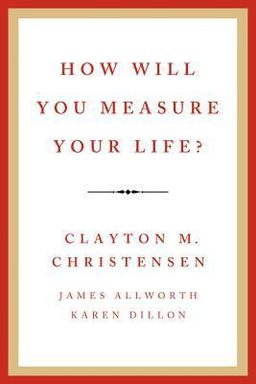
What does it mean to live a successful life? That’s the question at the heart of How Will You Measure Your Life? by Clayton M. Christensen, written with James Allworth and Karen Dillon. Christensen, renowned for his work on innovation, turns his analytical lens toward life itself—arguing that the same theories used to build great companies can also help shape meaningful careers, loving families, and moral integrity.
Christensen’s central claim is that we often chase the wrong measures of success. We may climb the career ladder only to discover it’s leaning against the wrong wall. Instead, he suggests we apply foundational business principles—motivation, strategy, culture, and purpose—to design lives of deeper fulfillment. Using management theory as a moral compass, he maps out how to create a strategy for happiness, allocate your resources wisely, build strong relationships, and define an enduring personal purpose.
The Power of Theory in Everyday Life
Early in the book, Christensen recounts his discoveries with innovators like Intel’s Andy Grove. When Grove pressed him for practical business advice, Christensen insisted he teach the theory first. Only when Grove understood the underlying cause-and-effect behind disruption could he apply it wisely. This principle—using theory to guide future decisions—becomes the foundation of the book’s message: you must understand what causes success and failure, not just copy examples of others. Just as flight wasn’t achieved by strapping on wings but by discovering Bernoulli’s principle, you need to identify the deeper “physics” of your own happiness.
For Christensen, theory is not jargon; it’s a tool for personal prediction. It helps you foresee the consequences of choices in your career or family before you actually make them—a far more reliable compass than hindsight.
Three Fundamental Questions
Christensen structures the book around three deceptively simple questions that he posed to his Harvard Business School students:
- How can I be sure that I’ll be successful and happy in my career?
- How can I be sure that my relationships with my spouse, children, and close friends become an enduring source of happiness?
- How can I be sure that I live a life of integrity—and stay out of jail?
Each question represents a different dimension of measuring a life, but together they form a holistic framework—what Christensen calls your personal “strategy.” He argues that clarity in these areas allows you to guide your decisions in the countless micro-moments that ultimately shape destiny.
Why Measurement Matters
Christensen’s journey is deeply personal. Diagnosed with cancer and later surviving a stroke that nearly stole his ability to speak, he reflects on mortality not with fear but with analytical curiosity. When his former classmates—brilliant, ambitious Harvard MBAs—ended up divorced, alienated, or even imprisoned (like Enron’s former CEO, his classmate Jeffrey Skilling), Christensen sought to understand why good people make such bad choices. His conclusion: they didn’t have bad intentions—they had bad theory. They misunderstood what truly motivates happiness, failed to allocate their time consistently with their values, and adopted flawed “marginal cost” logic in ethical decisions.
He warns that the metrics we unconsciously choose to measure success—income, prestige, titles—are seductive but shallow. The real metrics, he proposes, are the lives we’ve touched, the people we’ve helped become better, and the integrity we maintain when no one’s watching. In the book’s poignant epilogue, Christensen shares his own measure: he hopes his life will be judged not by accolades or books sold, but by “the people whose self-esteem I was able to strengthen, whose faith I was able to reinforce, and whose discomfort I was able to assuage.”
A Strategy for a Meaningful Life
The book unfolds like a personal MBA in living well. In the first section, Christensen applies motivation theory (from Frederick Herzberg) to explain why money and status are “hygiene factors”—important but incapable of generating lasting joy. True motivation comes from meaningful work, responsibility, growth, and learning. Next, he explores how to craft a career strategy that balances deliberate planning with openness to emergent opportunities—illustrated through stories like Honda’s accidental U.S. success and Christensen’s own unplanned path to academia.
The second section turns to relationships, showing how the same principles guiding great organizations—resource allocation, culture, and purpose—apply to families. Just as companies must build strong cultures through consistent behavior, parents must do the same in their homes if they want children who “make good decisions when we’re not there to guide them.”
Finally, the book closes with a sobering reflection on integrity. The “full versus marginal thinking” theory explains how small compromises (“just this once”) can erode ethics over time—whether you’re a CEO or a parent. As Christensen’s life shows, it’s easier to hold your principles 100% of the time than 98% of the time.
Why This Book Endures
While How Will You Measure Your Life? reads like a conversation between a wise professor and an introspective student, its depth lies in blending evidence-based management with moral philosophy. It weaves in stories from Pixar, Netflix, and Honda alongside biblical reflection and family anecdotes. The result is a blueprint for redefining success—not as the accumulation of achievements, but as the intentional design of a good life.
“Decide what you stand for—and then stand for it all the time.”
Ultimately, Christensen invites you to ask not how much you earn, but how much love, purpose, and integrity you give away. The answer to “How will you measure your life?” is not found in your résumé—but in your relationships, your moral choices, and the legacy of kindness and contribution you leave behind.