
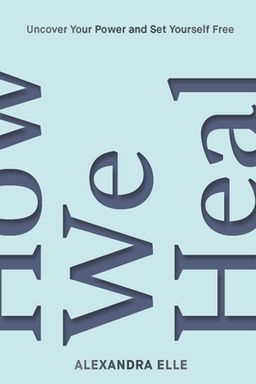
How We Heal cover

How We Heal

by Alexandra Elle

How We Heal by Alexandra Elle reveals a transformative four-step framework for self-healing, blending encouragement with practical strategies and journaling exercises. Discover how to release false narratives, nurture your inner child, and embrace gratitude, empowering yourself with inner peace and resilience.

Healing as a Lifelong Practice of Wholeness

What if your pain could become your teacher instead of your enemy? Alexandra Elle’s How We Heal begins with that radical question—the idea that our wounds, fear, and self-doubt aren’t obstacles but invitations. Instead of viewing healing as a final destination, Elle shows that it is a lifelong practice: a way of coming home to yourself over and over again. From her own story of trauma, motherhood, and creative rediscovery, she invites you to see healing as an active, everyday process grounded in compassion, courage, and community.

Throughout the book, Elle argues that lasting transformation begins when you stop running from what hurts and instead learn to hold space for your pain. Healing, she says, is not something we rush or achieve—it is something we nurture, one breath, one word, and one forgiving moment at a time. Her approach centers writing, meditation, journaling, and rest as tools for emotional restoration. With stories from herself and interviews with other women—such as Glennon Doyle, Tabitha Brown, and Dr. Thema Bryant—Elle illustrates that there are as many pathways to healing as there are people willing to engage in it.

Why Healing Matters

Elle challenges the prevailing belief in the wellness world that we will one day reach a state of being “healed.” She insists that healing has no endpoint; it is cyclical, like seasons, and demands continuous care. This perspective matters because many people avoid looking inward out of fear that they will never be finished—yet Elle reframes that permanence as a gift. When we accept the lifelong nature of healing, we stop chasing perfection and start cultivating peace. Pain is not proof that we’ve failed; it’s proof that we’re still alive and still learning.

The Author’s Story as Framework

Elle writes from experience: childhood trauma, a fractured relationship with her parents, early motherhood, and years of anxiety and depression. Her honest storytelling grounds the book in lived truth rather than theory. Each chapter mirrors her own evolution—from self-doubt and fear toward forgiveness, power, and joy. She uses very tactile metaphors—from baking peach cobbler to walking daily—to describe how healing happens through action and attention. For example, when her mother’s offhand comment about her cooking triggered old wounds, Elle realized that even after years of therapy and growth, certain pain points resurface. That realization became a turning point: restarting from scratch doesn’t mean failure; it means commitment.

Healing as Active, Communal, and Creative

Elle emphasizes three dimensions of healing:

  • Active healing requires deliberate engagement through journaling, breathwork, and mindfulness. You learn by doing—by writing letters to your younger self, by naming what you need, and by practicing self-forgiveness.
  • Communal healing happens when you look beyond your own pain to recognize others’ struggles. The story of the “Mean Lady” neighbor shows how compassion can soften even distant relationships—how kindness can ripple outward as a form of collective healing.
  • Creative healing invites the use of art, writing, movement, and mindfulness to translate emotion into expression. (Elle aligns with thinkers like Julia Cameron in The Artist’s Way, who also asserts creativity as a spiritual recovery practice.)

The Four-Step Process of Healing

Elle structures the book around four steps: Starting from Scratch, Befriending Fear, Reclaiming Power, and Healing the Heart. Each step deepens from self-recognition to action. You start by dismantling doubt, then move through fear, learn to reclaim your story, and finally arrive at joy and gratitude. These stages overlap and repeat; you cycle through them throughout your life. Her method—writing to heal—is both an instruction and a philosophy. Writing is not about producing polished words but about seeing yourself honestly on the page. Journaling, she says, is a mirror: a place to watch yourself grow, stumble, and return again.

Why This Approach Works

Elle’s process works because it dismantles shame. By replacing internal judgment with curiosity, focus, and compassion, you learn that healing can coexist with grief. She reminds us repeatedly: you don’t need to be “fixed” to be whole. Healing itself is an act of freedom—an ongoing relationship with your humanity. Ultimately, How We Heal proposes that your journey through pain, journaling, and connection is not just about personal restoration but about creating a lineage of wellness. When you heal yourself, you heal those who came before you and those who will come after. In essence, Elle teaches that healing is community care disguised as self-care—a forever practice of returning to yourself with love.


Starting from Scratch and Self-Forgiveness

Elle opens her first stage of healing—Starting from Scratch—with the truth that you will begin again many times. Healing is not linear; you will think you’ve made progress only to be pulled back to old wounds. Her story about baking peach cobbler with her friend Erika captures this cycle perfectly. When a small comment from her mother reopened past feelings of inadequacy, Elle realized that no amount of progress erases the need for return. Starting over is not regression—it’s repetition in service of growth.

Facing Self-Doubt and Fear

According to Elle, the biggest barrier to beginning again is fear that we will fail or look ridiculous for still needing to heal. She invites readers to dismantle self-doubt through small acts of truth-telling. Exercises like journaling columns titled “What hurts? Where does it hurt? How do I want to feel?” create awareness. By putting pain into tangible words, fear loses its invisibility. She draws parallels to therapy and meditation practices, emphasizing that healing only occurs when we engage curiosity rather than impatience.

The Necessity of Rest

Rest is not avoidance. Elle argues that emotional rest is sacred maintenance—the pause that prevents burnout and deepens transformation. Rest, she says, is not the opposite of work; it’s part of the work. When she fought against taking breaks for fear of losing momentum, she discovered the irony: by resting, she regained clarity and self-compassion. This echoes bell hooks’s notion that “love is an action,” suggesting that rest and care are active forms of loving oneself.

Offering Self-Forgiveness

Forgiveness is a cornerstone of Elle’s philosophy. You cannot heal what you continue to punish. She recounts her own experience as a young mother at eighteen, burdened by self-hate and shame. Through therapy and journaling, she slowly learned that forgiving herself was not a luxury—it was survival. She writes, “I am so sorry for everything. I forgive you for everything. I’ll love you through this.” That sentence embodies the shift from guilt to grace, from judgment to compassion.

Expanding into New Beginnings

Forgiveness opens the door to new beginnings. Elle believes that manifesting change requires releasing what no longer fits. She critiques how the wellness community often emphasizes “manifestation” without accountability—wanting results without taking action. She reframes manifestation as both decision and labor: naming your desire and doing the work to make space for it. The breathwork ritual she offers—“Inhale releasing uncertainty, exhale receiving peace”—represents that dynamic balance between surrender and intention.

In this stage, Elle reminds you that healing never ends at forgiveness alone. You must actively rebuild trust with yourself by naming your needs, resting, and beginning again whenever necessary. Each restart is an opportunity to meet yourself anew—flawed, worthy, and alive.


Befriending Fear and Reclaiming Power

The second stage of Elle’s framework asks you to look directly at fear—the invisible force that keeps you from living your truth. In a striking story from her childhood, she recalls being terrified as her father drove recklessly using his knees, ignoring her pleas to stop. That experience taught her two things: the physical memory of fear can linger for decades, and healing begins when we speak the fear aloud. Years later, writing about that trauma in her journal transformed her panic into awareness: “Dear Self, you are safe now.” That act of naming marked her transition from victimhood into agency.

Identifying and Seeing Pain as a Partner

Elle insists that pain deserves partnership, not exile. Instead of resisting what hurts, she encourages seeing pain as a messenger. The more you acknowledge it, the weaker its grip. She cites her frustration when therapy forced her to revisit childhood trauma she thought she had “finished healing.” Confronting those memories renewed her understanding that healing repeats in cycles—each return offers new insight. This reframing mirrors ideas from trauma researcher Bessel van der Kolk, whose work (The Body Keeps the Score) also notes that embodied memories must be met with compassion, not repression.

Cultivating Positive Self-Talk

The antidote to fear is language. Elle teaches the practice of affirmations—spoken declarations of self-worth backed by action. Writing “I am reclaiming my power” or “I am valuable” may feel forced at first, but repetition rewires your internal narrative. She warns against passive affirmations without behavioral change: faith must meet work. Transforming belief into action—whether through setting boundaries or practicing gratitude—translates healing into daily behavior.

Claiming Your Voice

To reclaim power, Elle guides readers to uncover their authentic voice. By journaling questions like “What’s hurting you?” and “How do you want things to change?” you begin constructing new scripts that replace inherited fear and silence. She likens this process to restorative writing—a slow unfolding of truth that mirrors therapeutic narrative work. Power, in her view, is not dominance but self-definition: the ability to listen to yourself and respond with care.

Ultimately, befriending fear and reclaiming your power means recognizing that vulnerability itself is strength. Each time you face what scares you and speak your truth aloud, you reinforce your capacity to live fully—a quiet, everyday revolution of courage.


Healing the Heart through Compassion and Community

When Elle moves into healing the heart, she broadens the lens from self to society. Healing, she says, becomes whole only when it reaches outward. Her story of the “Mean Lady”—an unfriendly neighbor she greeted daily despite cold stares—demonstrates how compassion transforms isolation into connection. After months of silent exchanges, the woman finally smiled back, revealing the shared human need to be seen. That small moment embodied Elle’s lesson: when you heal inwardly, you extend that healing to others.

Go Where It Feels Good

Elle discovered the power of simple, physical practices—particularly walking. Every day, she set out to walk as a promise to herself, processing emotions step by step. Walking reminded her that healing, like movement, cannot be rushed. “Each walk teaches me to put one foot in front of the other,” she writes, “because the only way home to myself is through consistent movement.” This echoes Libby DeLana’s advice in Do Walk: slowing down transforms self-awareness.

Growing in Gratitude

When anxiety pulled Elle back into depression, she found refuge in gratitude lists. Beginning with small victories—“I’m grateful for getting out of bed”—she redefined success from doing everything to simply being present. She distinguishes gratitude from gratefulness: the former counts blessings, the latter embodies them. Kristi Nelson’s Wake Up Grateful influenced this reframe, inspiring Elle to treat gratitude as a lifestyle rather than an occasional practice.

Rediscovering Joy

Healing is not only about tears. Elle urges readers to seek joy amidst pain—to balance the work of grieving with the practice of delight. She introduces “letters to joy” and “permission slips” where you allow joy to enter your life even when you feel undeserving. This permission, she says, must be practiced daily: permission to rest, to laugh, to celebrate stability. Her meditations, like “Receiving Joy,” invite a gentler rhythm of healing—one that celebrates life rather than overanalyzing it.

To heal the heart, Elle reminds you to witness others’ healing too. Compassion radiates outward, turning solitude into solidarity. Healing is communal: when you mend yourself, you authorize others to begin. It’s the slow rebirth of both heart and humanity.


Lessons from Women Who Heal Themselves

Throughout the book, Elle weaves intimate interviews with women from diverse backgrounds—each illuminating a unique path to wholeness. These voices demonstrate that healing takes infinite forms but shares common threads of resilience, creativity, and forgiveness.

Finding Agency after Trauma

Barb Schmidt’s story of surviving abuse and addiction underscores the power of persistence. After years of denial and bulimia, Schmidt sought treatment, beginning her long process of therapy, yoga, and mantra writing. Her insight—“Forgiveness isn’t for others; it’s for yourself”—reveals how self-compassion dismantles shame. Schmidt visualizes healing as peeling an onion: layer by layer until reaching the wound’s core. Each layer, though painful, brings light.

Faith and Freedom

Tabitha Brown’s journey through illness and doubt embodies spiritual surrender. Her autoimmune condition forced her to shed identities that suffocated her authentic self. When she prayed, “If you heal me, you can have me,” she exchanged control for trust. Ever since, she’s lived in the “layer of understanding,” where each challenge teaches purpose. Brown’s story highlights faith as both rest and release—a recurring idea echoed later by Dr. Thema Bryant, who bridges psychology with spirituality.

Healing through Expression

Sara Kuburic, an existential therapist, found healing in travel. What began as escapism evolved into self-discovery. Each country stripped away old assumptions, forcing her to anchor within herself. Likewise, artist Morgan Harper Nichols channelled her autism diagnosis into art, discovering solace in drawing and painting. “I heal by painting,” she writes, “by letting my bare feet touch the grass.” For these women, embodiment and creativity replace perfectionism with presence.

Joy, Boundaries, and Ongoing Growth

Other contributors—Nedra Glover Tawwab, Chriselle Lim, Lisa Olivera, among others—model boundaries and emotional rest. Tawwab compares healing to gardening: everything grows in its season. Lim, navigating divorce, finds restoration through slowing down and fiction reading—embracing rest without guilt. Each story reiterates Elle’s thesis: healing is continual, multi-dimensional, and deeply personal.

Taken together, these narratives form a collective mosaic of resilience. They affirm what Elle teaches: you heal by feeling, forgiving, moving, loving, and by returning—again and again—to yourself.


Releasing, Writing, and Awakening Joy

The latter chapters of How We Heal crystallize Elle’s philosophy of liberation: the more you release what harms you, the more you create space for joy. “Releasing what no longer serves you” offers practical rituals—such as creating an ‘I Am Letting Go’ jar—to symbolically unload emotional baggage. Writing each item on paper transforms intangible pain into something you can confront, fold, and finally release. This tactile practice embodies integration—pain to physical form, form to freedom.

Writing as Self-Recognition

For Elle, writing is both mirror and medicine. Whether through journaling prompts or letters to joy, she frames writing as an act of remembrance: of worth, love, and belonging. One of her most transformative practices is composing letters to her younger self—acts of mentorship for the inner child who still aches. This helps separate inherited pain from self-made strength. (This method resembles narrative therapy, where rewriting one’s story reshapes identity.)

Choosing Joy without Permission

Elle closes with a call to celebrate joy as a healing right. You don’t need to earn happiness by finishing your healing. Instead, joy and pain coexist as dual teachers. Exercises such as “Writing Letters to Joy” remind you that happiness is not denial but renewal. When you express gratitude for both grief and grace, you reclaim balance.

Healing as Restorative Community

In her final note, Elle writes directly to the reader with the tone of a friend: healing will not always be light, but it will always be yours. She insists that resting, failing, and trying again are sacred acts. Healing becomes a dialogue between self and world—a process of collective transformation. In forgiving yourself, you forgive generations before you. In sharing your story, you give courage to others to start theirs.

The final message resonates powerfully: there is no finish line. Healing is a lifelong return to your own heart. Through release, reflection, and radical joy, Elle teaches that the path home is never lost—it simply waits for you to walk it again.

Dig Deeper

Get personalized prompts to apply these lessons to your life and deepen your understanding.

Go Deeper

Get the Full Experience

Download Insight Books for AI-powered reflections, quizzes, and more.