
Idea 1
How Six Innovations Shaped Modern Civilization
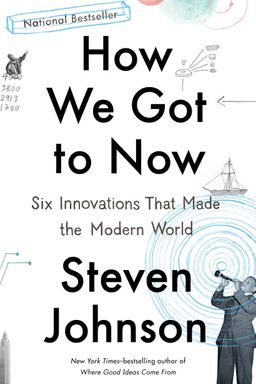
What if the things you take completely for granted—the pair of glasses on your desk, the smartphone in your hand, the light above your head, or even the cold air swirling from an air conditioner—were actually the invisible forces that most profoundly shaped our modern world? In How We Got to Now, Steven Johnson argues that the true story of human progress isn’t written by kings or wars, but by ideas embedded in everyday technologies that transformed how we see, hear, live, and think. Johnson traces six pillars of modern life—Glass, Cold, Sound, Clean, Time, and Light—showing how each one created astonishing ripple effects, often far beyond the inventor’s intentions.
Across history, Johnson suggests, progress happens not just through hero inventors but through networks of curiosity, chance, and unintended consequences. Borrowing the concept of the “hummingbird effect” from evolutionary biology, he explains how one invention sets off waves of influence that ‘pollinate’ other fields—much as the flower’s nectar invited hummingbirds to evolve hovering flight. A lens created to help monks read also leads to telescopes, cell biology, and eventually computers. Ice harvested from New England ponds will trigger global commerce, refrigeration, and finally modern air conditioning, reshaping demographics and politics. The echo of a Neanderthal song in a cave foreshadows the transistor and the smartphone speaker. As you read, you realize the story of civilization is woven out of serendipitous connections and coevolution between human ingenuity and materials like silicon, glass, or water.
The Robot Historian’s Perspective
Johnson opens with a thought experiment borrowed from philosopher Manuel De Landa: imagine a robot historian writing humanity’s story. To the robot, the fall of Rome or the Magna Carta would seem minor next to the first punched card or the silicon microchip. From this non-human view, the history of technology—not political empires—is the real story of how we got to now. Johnson embraces this perspective and stretches it into what he calls a “long zoom” approach—zooming out to track centuries-long causal chains, then zooming into the atomic structures or human moments that made them possible. This cosmic yet intimate lens encourages you to see your daily reality—the clean water from a tap, the glow of a city at night—as part of an unbroken narrative from glassmakers in Venice to scientists scanning deep space.
Ideas That Pollinate Each Other
To Johnson, innovation follows a recognizable pattern: breakthroughs rarely emerge in isolation. Instead, they arise from what he calls the “adjacent possible”—the realm of ideas that become achievable only after specific preconditions exist. Just as you couldn’t invent refrigeration before understanding air pressure or gases, or the computer before electricity, every new advance depends on earlier discoveries unlocking a door. Once open, those doors invite others to explore new rooms. For example, the spread of printed books revealed how many people were farsighted, which, in turn, created a market for spectacles. Those spectacles nurtured lensmakers who later built microscopes and telescopes—tools that redefined humanity’s perception of the cosmos and itself. This pattern repeats endlessly: each technology expands the frontier of what people can imagine next.
The Double Edge of Progress
Johnson is careful to note that not all outcomes of innovation are positive. Every “hummingbird effect” carries unintended consequences. Clean drinking water drastically reduced infant mortality but also drove population booms that strain resources. The vacuum tube amplified the human voice into stadiums—fueling political empowerment for some, tyranny for others. Ultrasound lets families glimpse unborn children but has also enabled widespread sex-selective abortions in some countries. In reminding you that technology’s moral application is always a human choice, Johnson rebuts simple stories of progress. The march of innovation isn’t a straight line toward utopia; it’s a branching coral reef of discoveries, accidents, and moral decisions.
Living in the Long Zoom
Each of the book’s six main sections—Glass, Cold, Sound, Clean, Time, and Light—casts everyday materials as protagonists in the human saga. Glass makes us see beyond the visible. Cold liberates us from climate and mortality’s grip. Sound connects cave chants to radio to digital code. Clean saves lives and invents modern hygiene. Time teaches discipline and precision, paving the road for computers. Light begins with whale oil candles and ends at lasers that might power nuclear fusion. Together, these stories reveal a truth worth reflecting on: progress thrives when curiosity crosses boundaries—between disciplines, nations, and centuries. By the end, you’ll notice the world differently, seeing every light switch and faucet not as a convenience, but as a networked artifact of countless invisible innovators who, knowingly or not, helped you live the way you do today.