
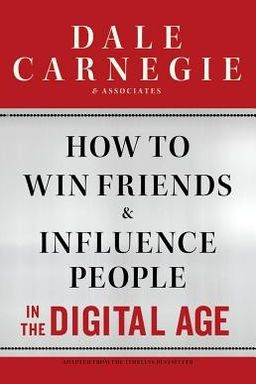
How to Win Friends and Influence People in the Digital Age cover

How to Win Friends and Influence People in the Digital Age

by Dale Carnegie

In ''How to Win Friends and Influence People in the Digital Age,'' Dale Carnegie''s timeless principles are adapted for today''s connected world. Learn to use digital platforms to build meaningful relationships and foster influence, enhancing both personal and professional interactions.

The Art of Winning Friends and Influencing People

How can you turn the ordinary encounters of life into extraordinary relationships? In How to Win Friends and Influence People, Dale Carnegie argues that success in every sphere of life—from business to love—depends not on technical skill or intellect, but on how skillfully we deal with people. Written during the bleakest years of the Great Depression, this book tapped into a universal truth: what motivates people most is not money or status, but recognition, respect, and understanding.

Carnegie contends that any person can dramatically change their life by mastering a few timeless human relations principles. These are not manipulative tricks, but habits of empathy—ways of seeing the world through others' eyes and helping them feel important. As he puts it, “Dealing with people is probably the biggest problem you face,” whether you’re a manager, parent, salesperson, or friend. And those who can handle people skillfully, he insists, will have the world with them.

The Birth of a Human Relations Revolution

When Carnegie began teaching public speaking and communication in New York in 1912, he quickly discovered that his students weren’t merely afraid of speaking—they were afraid of people. They didn’t understand how to build rapport, win cooperation, or spark enthusiasm. The book grew from years of teaching thousands of adults who practiced these principles in daily life and reported “miraculous” transformations. Success stories poured in—from salespeople doubling their income to estranged spouses reconciling.

Carnegie’s message was simple: technical knowledge accounts for only 15% of success. The other 85% rests on “human engineering”—the ability to arouse enthusiasm, inspire confidence, and elicit willing cooperation. (This idea parallels Daniel Goleman’s later concept of emotional intelligence.)

Four Pillars of Personal Influence

The book is structured around practical “how-to” techniques that can help you transform relationships both personally and professionally. Carnegie breaks them into four main parts:

  • Fundamental Techniques in Handling People – Stop criticizing, start appreciating, and awaken in others a genuine desire to respond.
  • Six Ways to Make People Like You – Master simple but profound habits: being genuinely interested, smiling, remembering names, listening attentively, talking in terms of others’ interests, and making people feel important.
  • How to Win People to Your Way of Thinking – Avoid arguments, admit your own mistakes, appeal to nobler motives, and let others feel the idea is theirs.
  • Be a Leader: How to Change People Without Arousing Resentment – Lead through empathy: begin with praise, call attention to mistakes indirectly, and make others eager to improve.

Carnegie illustrates these ideas through vivid stories: Charles Schwab praising employees into peak performance, Abraham Lincoln learning not to criticize, and Theodore Roosevelt remembering servants by name. They serve not as lofty ideals but as specific, reproducible actions that anyone can adopt.

Why These Ideas Still Matter

Despite being nearly a century old, Carnegie’s advice resonates in today's hyperconnected but impersonal age. Relationships remain the currency of influence—from the boardroom to social media. His emphasis on empathy, respectful communication, and genuine interest is echoed by modern thinkers like Stephen Covey’s “Seek first to understand, then to be understood.” Carnegie anticipated this by decades: “Talk with someone about themselves and they’ll listen for hours.”

At its core, How to Win Friends and Influence People teaches a revolutionary idea that’s as relevant now as in 1937: success, happiness, and leadership flow from the habit of looking at life through the other person’s eyes. When you replace criticism with curiosity, and control with cooperation, you engage the human heart. And once you win hearts, influence naturally follows.


The Power of Genuine Appreciation

Carnegie believed that appreciation, not criticism, is the fuel of human motivation. “The deepest craving in human nature,” he wrote, “is the desire to be appreciated.” Every person, regardless of status, wants to feel valued and important—and if you satisfy this urge sincerely, you win their enduring goodwill.

Why Criticism Always Fails

Carnegie begins with a blunt truth: people never criticize themselves, no matter how wrong they may be. Even notorious criminals like Al Capone insisted they were fundamentally good. Criticism wounds pride and arouses defensiveness, the exact opposite of the cooperation you seek. (Modern psychology confirms this: critical feedback triggers the limbic system, putting people into fight-or-flight mode.)

Instead of condemning others, Carnegie suggests practicing understanding. As Abraham Lincoln realized after a near-duel in his youth, empathy achieves what anger cannot. When his generals failed disastrously, Lincoln didn’t reprimand them—he sympathized with their challenges, kept them motivated, and quietly replaced them when necessary. His greatness lay not in his authority but in his compassion.

The Transforming Magic of Praise

Charles Schwab, one of America’s earliest million-dollar executives, claimed his success stemmed not from technical genius but from the ability to arouse enthusiasm. He said, “I am hearty in my approbation and lavish in my praise.” Carnegie uses Schwab’s story to reveal a universal law: people improve most under encouragement, not judgment. As B.F. Skinner’s research later proved, behavior reinforced by praise is far more likely to be repeated than behavior punished by criticism.

A foreman who had scolded his workers into resentment began instead to ask about their discomfort and express gratitude for their safety compliance. The result? Higher cooperation and morale. When you recognize even small successes, you create a ripple effect of enthusiasm.

From Flattery to Authentic Appreciation

Carnegie warns against flattery—it’s manipulative and “cheap praise.” True appreciation must come from the heart, focusing on specific qualities you genuinely admire. As he put it: “Be hearty in your approbation and lavish in your praise.” This shift in mindset transforms relationships from transactional to emotional. When you help others feel important, cooperation becomes effortless.

“Talk about the things you admire in others, and they will cherish your words for a lifetime.”

Whether managing a team or raising a child, Carnegie’s principle holds: replace your urge to correct with the habit of appreciating. In doing so, you multiply goodwill, loyalty, and performance—the very foundation of influence.


Understanding Human Desire for Importance

At the heart of Carnegie’s philosophy is a profound observation: people want to feel important. This need drives nearly every human action—from Rockefeller donating millions to a hospital to a child wanting attention. Understanding this universal desire grants you extraordinary influence.

Why Importance Matters

Psychologist William James called appreciation “the deepest principle in human nature.” Carnegie expands on this, explaining that our craving for importance is as vital as hunger or sleep. It motivates success, underlies ambition, and can even lead to destructive behavior when denied. Al Capone and Dutch Schultz justified their crimes by imagining themselves as public benefactors—proof that the desire for recognition can twist morality itself.

Appealing to Positive Motives

Carnegie argues that effective influencers appeal to the better angels of human nature. He shares how John D. Rockefeller praised a subordinate for saving part of a bad investment rather than criticizing him for the loss. This gentle, appreciative approach transformed the mistake into commitment. A good leader, Carnegie insists, makes others proud of their contributions rather than fearful of failure.

Creating Cooperation Through Self-Expression

People also crave self-expression. Carnegie cites countless examples of employees and children who changed dramatically when given space to share opinions and feel heard. “Self-expression is the dominant necessity of human nature,” he writes. This insight aligns with modern leadership theories emphasizing autonomy and engagement (as echoed by Daniel Pink’s Drive).

By making others feel important, not through false praise but genuine respect, you trigger a powerful force of goodwill. It's not manipulation—it’s recognition of a basic truth about human dignity. When you satisfy people’s hunger for importance, they give you their finest effort freely.


Win People to Your Way of Thinking

Carnegie’s genius lies in transforming persuasion from confrontation into collaboration. His central claim: you can’t win an argument, because even if you “win,” you lose the other person’s goodwill. True influence comes by aligning interests, not defeating opponents.

Avoiding Arguments and Criticism

Arguments, Carnegie warns, are futile. “A man convinced against his will is of the same opinion still.” He illustrates this through stories—from business disputes to Lincoln’s gentle diplomacy—that show how reasoning alone cannot overcome pride. Instead, he advises listening first, acknowledging others’ perspectives, and saying “I may be wrong.” This humility disarms defensiveness and opens the door to honest communication.

Let Others Save Face

A crucial persuasion skill is allowing people to maintain dignity, even when they err. Carnegie celebrates leaders like the General Electric executives who removed a brilliant but impossible manager by giving him a new title and office instead of firing him outright—preserving goodwill while solving the problem. For Carnegie, respecting others’ pride is not indulgence; it’s emotional intelligence in practice.

Appeal to Nobler Motives

One of Carnegie’s most elegant techniques is appealing to higher ideals. When Rockefeller asked a newspaper to remove his children’s photos from publication, he didn’t scold; he appealed to the journalists’ parental instincts: “You know how it is—you have children too.” This appeal transcended conflict and generated instant compliance.

“If you want enemies, excel your friends; if you want friends, let your friends excel you.”

Carnegie’s vision of persuasion is less about argument than understanding. By putting yourself in others’ shoes, appealing to their values, and letting them preserve self-respect, you make them partners in your success. Influence thus becomes a shared discovery, not a contest of egos.


How to Be Liked Instantly

Carnegie insists that being likable isn’t about charm or manipulation—it’s about sincere interest in others. “You can make more friends in two months by becoming interested in other people,” he writes, “than you can in two years by trying to get other people interested in you.”

The Secret of Liking People

Carnegie uses vivid examples, including Roosevelt, who greeted his servants by name and remembered their families. His warmth toward “ordinary” people made him extraordinary. Likewise, a salesman who began noticing small details about his clients’ interests turned cold prospects into long-term customers. In both cases, true curiosity replaced self-centeredness—and affection naturally followed.

Six Habits of Likable People

  • Be genuinely interested in others – It disarms suspicion and creates connection.
  • Smile – A universal sign of goodwill that communicates warmth faster than words.
  • Remember people’s names – “A person’s name,” Carnegie says, “is the sweetest sound in any language.”
  • Be a good listener – Encourage others to talk about themselves.
  • Talk in terms of their interests – It proves empathy.
  • Make others feel important—and do it sincerely – This, he argues, is the master key to human relationships.

These small acts may seem obvious, but Carnegie’s insight is timeless: people don’t remember what you said—they remember how you made them feel. When you shift your focus from impressing others to investing in them, you create not only connection but influence.


Leadership Without Offense or Resentment

How can you improve someone’s behavior without making them defensive? Carnegie’s final section redefines leadership as the art of guiding others without criticism. Leaders, like gardeners, should draw out potential rather than hack at faults.

Begin with Praise

Carnegie advises opening every correction with honest appreciation. Lincoln, McKinley, and even Calvin Coolidge used this technique to soften criticism and preserve goodwill. A compliment, he explains, “is the warm-up before the correction.” It builds receptivity—the emotional Novocain that makes correction painless.

Encourage Instead of Condemn

Leaders should avoid giving direct orders; instead, ask questions that lead employees to discover the solution themselves. This not only builds initiative but communicates trust. By praising small improvements and making faults seem easy to correct, leaders create momentum for excellence.

For example, when General Electric needed to remove a faulty manager, they promoted him sideways with a new title, preserving his dignity while solving the issue. Respecting pride, Carnegie argues, is fundamental to morale and teamwork.

Inspiring Through Example

Ultimately, Carnegie’s “nine rules to be a leader” emphasize empathy over enforcement: start with praise, admit your own mistakes, use encouragement, give a fine reputation to live up to, and make people glad to do what you suggest. Leadership based on fear dies fast; leadership based on respect lasts for generations. Carnegie’s method restores human dignity to influence, proving that kindness is not weakness—it’s the strongest strategy of all.

Dig Deeper

Get personalized prompts to apply these lessons to your life and deepen your understanding.

Go Deeper

Get the Full Experience

Download Insight Books for AI-powered reflections, quizzes, and more.