
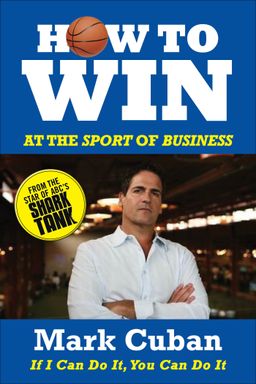
How to Win at the Sport of Business cover

How to Win at the Sport of Business

by Mark Cuban

In ''How to Win at the Sport of Business,'' Mark Cuban shares unconventional insights from his journey to success, encouraging readers to embrace passion, relentless learning, and strategic growth. Discover how he transformed challenges into opportunities and built a multi-billion dollar empire.

Winning the Sport of Business

What if business wasn’t just work — what if it was a sport? In How to Win at the Sport of Business: If I Can Do It, You Can Do It, entrepreneur and Dallas Mavericks owner Mark Cuban argues that business should be approached as the most intense, endless, and rewarding competition on the planet. According to Cuban, winning doesn’t require luck, an Ivy League degree, or investors with deep pockets — it requires relentless effort, the willingness to learn, and the courage to take risks over and over until you get it right.

Cuban’s central thesis is simple: success in business is just like success in sports — it’s about preparation, effort, and heart. You can’t control luck, but you can control your effort, your curiosity, and your ability to outlearn and outwork everyone around you. The book is not a traditional business manual filled with corporate jargon or market analysis; instead, it’s a conversational, personal collection of stories and lessons drawn from Cuban’s entrepreneurial journey — from sleeping on a couch in Dallas to building and selling companies for millions, then billions.

The Hustler’s Mindset

Cuban began as a broke college grad from Indiana who wanted to live in a big house like the ones he used to drive by and dream about. He tried countless jobs — from selling powdered milk to bartending — yet saw every role as a chance to be “paid to learn.” This simple reframe turned every setback into an education. When he was fired for closing a sale instead of opening the store, he didn’t sulk. He launched MicroSolutions, a small computer software business that he built through sheer persistence and curiosity.

This theme of learning through doing runs throughout the book. Cuban reads obsessively — technical manuals, industry magazines, and business books — because he knows that in an age where information is free, most people still won’t bother to read. That willingness to become an expert faster than anyone else is his secret weapon. (It’s a principle echoed by other self-made entrepreneurs, from Elon Musk to Naval Ravikant.)

Effort, Preparation, and “The Edge”

Cuban believes there’s only one thing you can control in business: effort. In sports, you can’t control whether every shot goes in, but you can control your hustle. In business, the same rule applies. He emphasizes what he calls “the edge” — an unstoppable desire to learn, compete, and improve. The edge means staying up all night reading until you have an informational advantage, being obsessed with what others ignore, and being relentless when everyone else relaxes.

As he puts it, relaxing is for the other guy. “The sport of business is the ultimate competition — 7 days a week, 24 hours a day, forever.” For Cuban, this relentless drive doesn’t come from greed but from love of the game itself: solving problems, beating the odds, and creating value where none existed before. The challenge never ends — that’s the beauty of it.

From Lessons Learned to Rules for Life

Each story in the book comes with a rule or insight that Cuban learned by trial and failure. Hustle beats pedigree. Effort beats talent when talent slacks off. Never lie to yourself about what you’re good or bad at. Don’t drown in opportunity — focus on winning the battle you’re already in. And if things go wrong, remind yourself that “you only have to be right once.”

He also stresses humility and realism. Entrepreneurs tend to be dreamers, but Cuban warns against delusion. If you can’t be objective about what you know and don’t know, you’ll fail fast. This brutal honesty helped him find complementary partners like Martin Woodall, whose precision balanced Cuban’s improvisation. True success, he argues, comes from knowing yourself as much as knowing your market.

Playing the Long Game

Cuban ultimately reframes success as mastering lifelong competition — not a single event, not a product launch or IPO. Like a professional athlete, you must constantly train and refine your skills. You win not once, but repeatedly, by preparing better than anyone else. The sport of business is infinite, and the scoreboard resets every day.

If you want to turn effort into results, “play” like Cuban: study harder than anyone else, think for yourself, and never lose your hunger to compete. The road to success is messy, nonlinear, and exhausting, but as Cuban shows in this blend of memoir, manifesto, and playbook — if he could do it, so can you.


Get Paid to Learn

Cuban insists that every job — even the worst one — is a form of education if you approach it that way. When he graduated from Indiana University, his dream wasn’t to work for a bank, but he took a job at Mellon Bank anyway because it was a way to get paid to learn about technology. Later, even when he hated his job selling TV repair franchises, he learned to cold call and talk to customers. Each skill became a building block toward his eventual success.

Turning Jobs into Tuition-Free Training

After bouncing between jobs and states, Cuban realized he didn’t need graduate school—he could make money while learning from real people, products, and problems. Every rejection call, every failed sale taught him something that no MBA program could. This mindset forms the core of his early philosophy: view each position not as a paycheck, but as a paid apprenticeship in how business really works.

He used even his firings as education. When Your Business Software let him go for “leaving the store to close a sale,” he recognized his mismatch as an employee and decided to build his own company. In business, the lesson is that every negative turns into tuition if you learn from it.

Learning Faster Than Everyone Else

At his first tech job, Cuban hadn’t even touched an IBM PC before. His workaround? Take home software manuals every night and study them like textbooks. He stayed up late reading Peachtree Accounting and Lotus spreadsheets while his roommates were out drinking cheap champagne. Soon, he’d learned enough to advise customers better than his coworkers. That edge became the foundation for MicroSolutions.

“Turns out not a lot of people ever bothered to read the frickin’ manual, so people started really thinking I knew my stuff.”

The takeaway: knowledge compounds when you choose to self-educate obsessively. Cuban’s approach mirrors that of autodidacts like Benjamin Franklin and modern startup founders who learn tools by trial, not classes. His distinction wasn’t access — it was effort.

From Survival to Mastery

When Cuban started MicroSolutions, he had no investors, no computer, and almost no clients. He called old customers, offered risk-free deals (“I’ll install this system; if it doesn’t work, you don’t pay”), and worked endless nights to earn trust. Within two years, he had $85,000 in the bank. Then, after being robbed of nearly all of it by a dishonest secretary, he didn’t collapse; he went straight back to work. The lesson? Learning beats losing, every time.

By reframing his twenties as a decade-long classroom, Cuban turned hardship into advantage. You might not control your first job or your first break, but you control whether you treat experience like school or punishment. And if you truly want to win at business, you’ll read, learn, and experiment until everyone else is playing catch-up.


Effort Is the Only Thing You Control

When Cuban talks about effort, he’s not preaching clichés—he’s issuing a challenge. At 27, broke after a failed engagement, he recommitted to his company by realizing the one thing he could truly control wasn’t luck, talent, or timing—it was effort. “Effort is measured by results,” he writes, “not by hours clocked.”

Effort Means Obsession, Not Exhaustion

Cuban’s definition of hard work isn’t just putting in long hours. It’s showing up early, staying late, and constantly searching for ways to get better. It’s studying your competitors, reading your industry’s trade journals, and preparing until you can’t be outprepared. For him, “relaxing” is what his rivals do that gives him an opening.

Like Coach Bobby Knight taught him, “Everyone has the will to win; only a few have the will to prepare to win.” Effort isn’t glamorous — it’s the unseen practice that makes success look effortless later. (This echoes Malcolm Gladwell’s “10,000-hour rule” in Outliers, though Cuban’s tone is grittier and more street-level.)

Don’t Confuse Working Late with Working Smart

Cuban warns against measuring effort by time spent “at work.” Being at your desk 14 hours a day means nothing if those hours don’t move your business forward. Instead, he asks practical questions: What did you close? What did you create today? What did you learn that gives you an edge tomorrow?

He recounts losing money, getting cheated, and making repeated mistakes — but in each case, his antidote wasn’t self-pity, it was redoubled focus. When $83,000 was stolen from his company account, he didn’t waste energy on revenge. He went back to work the same day. That’s effort in action.

Passion Makes Effort Sustainable

Cuban’s hustle isn’t martyrdom—it’s fueled by genuine excitement. He doesn’t work because he “has to.” He studies technology, basketball, and media because he can’t not. That’s the secret to sustainable effort: finding something so personally stimulating you’d do it for free (and eventually get paid a lot for it). “When you love what you do, being tired doesn’t feel like exhaustion—it feels like progress.”

In the end, Cuban shows that consistency beats charisma. You don’t have to be the smartest, richest, or most connected person in the room. But if you keep putting in disciplined effort when others quit halfway, you end up owning the sport of business.


You Only Have to Be Right Once

Every entrepreneur fails often — but as Cuban insists, you only need to get it right once. In sports, players need to win repeatedly to stay on top; in business, one hit can change your life. He uses this idea to strip the fear out of failure and emphasize the power of persistence.

Cuban himself failed constantly. He tried selling powdered milk. He started a bar that got busted for letting in a 16-year-old. He was fired from multiple jobs before starting MicroSolutions. But because he learned from each setback, when the right opportunity came — streaming radio on the early Internet with AudioNet — he was prepared. That company became Broadcast.com and sold for billions.

Failure as Training, Not Punishment

Instead of fearing failure, Cuban reframed it as practice for the one big win. Every botched idea reveals what not to do next. The only true failure is quitting before you find what sticks. This shift in mindset mirrors the approach of founders like Jeff Bezos, who views experimentation as mandatory “tuition payments” for innovation.

“No one’s counting your strikeouts,” Cuban writes, “they only remember the home runs.” That’s liberating advice for anyone paralyzed by perfectionism. The marketplace eventually rewards resilience, not purity.

Luck Favors the Prepared

People often call Cuban “lucky.” He laughs at that. Luck is real, but it’s meaningless without readiness. He spent years mastering tech systems, reading manuals, and building relationships so that when broadcasting over the Internet became viable, he already had the skills and network to seize it. You can’t predict the exact window, but you can train like it’s coming.

Cuban’s philosophy liberates aspiring entrepreneurs from waiting for perfect timing. You can fail nine times in a row — but when you finally succeed on the tenth, that’s the one that defines your career. You only have to be right once, and all the wrong turns become stories that make the win even sweeter.


Don’t Lie to Yourself

Cuban warns that the most dangerous person to lie to is yourself. Entrepreneurs often overestimate their skills or deny their weaknesses. He admits he used to do the same — ignoring his disorganization and procrastination because he didn’t want to face them. At 23, with no assistant and boxes of receipts serving as “accounting,” he deluded himself into thinking he could handle everything. He couldn’t.

The wake-up call came when his business nearly buckled under poor documentation. The fix? Partner with someone who complemented his blind spots. Enter Martin Woodall — meticulous, methodical, and precise. Together they balanced each other’s extremes and turned MicroSolutions into a well-run company. The partnership worked precisely because Cuban stopped pretending he could do it all.

Honesty Precedes Growth

Cuban’s advice applies beyond business: if you don’t know what you’re not good at, you’ll sabotage yourself. Pretending eliminates opportunities to collaborate with those who are better. Instead, accept your limitations, then delegate or partner strategically.

He quotes former Mavericks coach Don Nelson: “The worst evaluator of talent is a player trying to evaluate himself.” Leaders who misjudge their capabilities destroy teams; the same rule applies to entrepreneurs. Self-knowledge isn’t humility — it’s strategy.

Match Passion with Precision

Cuban stayed the visionary but trusted Martin to handle the details. They fought constantly but respected each other’s differences, which led to better decisions. The partnership illustrates that great companies are marriages of chaos and control. The founder brings fire; the operator brings order. Together, they create something sustainable.

Lying to yourself might feel comforting in the short term, but the truth is undefeated. Whether in startups, sports, or relationships, Cuban urges you to face weakness early — or it will face you later, usually at higher cost.


Rules, Sweat, and Startups

Cuban doesn’t believe in romantic startup myths. Forget lavish offices, espresso machines, or investor-driven launches. His first rule: sweat equity is the best equity. The more energy you invest yourself, the more ownership — literally and psychologically — you gain over your success. Raising capital too early, he warns, flips the power dynamic: now your investors control you, not your dream.

Start Simple and Stay Scrappy

Cuban started MicroSolutions with $500 borrowed from a customer. He didn’t draft 100-page business plans — just short outlines about what he’d offer, why it mattered, and how much he’d need to break even. His advice: businesses don’t have to start big. They have to start real. “It’s okay to start slow. It’s okay to grow slow.”

He also mocks early extravagance — PR firms, office swag, or “startup culture” luxuries. In Cuban’s world, if you have a logo-embroidered polo shirt before profitability, you’re doing it wrong. Spend on talent and tools that create revenue, not appearances. (This minimalist view parallels Paul Graham’s dictum at Y Combinator: “Do things that don’t scale.”)

Sales Cure All

No matter your product, the key currency is sales. “There has yet to be a successful company that survived with zero sales,” Cuban insists. Founders often obsess over code, design, or fundraising — but sales fix everything. If you can’t sell, learn. If you can sell, you can go broke and still find another opportunity tomorrow. This is why he tells aspiring sports executives, “Don’t major in Sports Marketing — major in business and sales.”

Culture and Grit Over Perks

Cuban’s twelve startup rules redefine leadership: make work fun but focused, reward hustle, and avoid empire builders who crave titles and private offices. Keep hierarchies flat and energy high. At his companies, celebrations weren’t lavish retreats — they were spontaneous $100 bills for record-setting sales, or “company Kamikaze” shots at a local bar. The message? Achievement is the party.

Entrepreneurship, as Cuban frames it, isn’t glamorous. It’s scrappy, sweaty, and exhilarating — and that’s what makes it fun. When you own the majority of your company’s sweat, mistakes sting less and victories matter more. No outside investor can ever buy that feeling.


Finding Joy and Purpose at 90

After decades of wins and losses, Cuban uses one question to guide life decisions: “When I’m 90, will I regret having done this, or not having done it?” This rule cuts through fear and hesitation. He used it before starting projects as varied as Motley’s Pub at Indiana University, buying the Mavericks, or appearing on Dancing with the Stars. If it would make for a smile at 90, it’s worth it.

Defining True Success

For Cuban, success isn’t about net worth—it’s about freedom, family, and fun. After selling MicroSolutions and later Broadcast.com, he “retired” at 29 and traveled the world on an American Airlines lifetime pass. But the real payoff wasn’t the money—it was waking up excited to keep competing, learning, and enjoying life on his terms.

He reminds you that happiness comes from creating your own version of unique, not living by someone else’s playbook. Whether that’s starting a business, raising a family, or coaching Little League, fulfillment is defined by memories, not milestones.

Legacy Through Living Fully

Cuban argues that too many people defer joy for “someday.” When he asks “What will I remember when I’m 90?” he’s reminding himself — and you — that life’s adventures are finite, but stories are forever. The moments that make you proud later are rarely the “safe” choices. They’re the bold ones that make you nervous now.

The entrepreneurial mindset, he concludes, is ultimately about living life like a sport — pushing your limits, embracing risk, laughing at the setbacks, and enjoying every second of the game. Whether you win or lose, you’ll remember that you played hard — and that’s the real victory.

Dig Deeper

Get personalized prompts to apply these lessons to your life and deepen your understanding.

Go Deeper

Get the Full Experience

Download Insight Books for AI-powered reflections, quizzes, and more.