
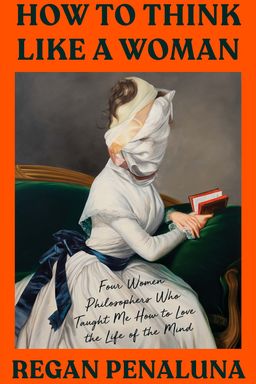
How to Think Like a Woman cover

How to Think Like a Woman

by Regan Penaluna

How to Think Like a Woman offers an enlightening journey through the overlooked contributions of female philosophers. Regan Penaluna weaves memoir and biography to challenge male-centric philosophy and inspire a future where women’s voices are central to intellectual discourse.

Philosophy and the Gendered Search for Wisdom

Philosophy presents itself as a neutral search for truth, yet Regan Penaluna’s book dismantles that illusion to show how women have long wrestled with the discipline’s exclusionary codes. Her argument unfolds through memoir, biography, and history: the story of a woman discovering philosophy’s hostile climate becomes also a recovery project that restores women thinkers to their rightful lineage. If you imagine philosophy as detached curiosity, this book invites you to see it as a lived enterprise shaped by gender, community, shame, and courage.

When Philosophy Turns Hostile

Penaluna begins with lived experience. A professor named Berg tells his class to consider whether women might be less intelligent than men. That remark concentrates centuries of exclusion into one scene. The incident illustrates how structural hostility hides behind ideals of rational objectivity. Only about 17 percent of full‑time academic philosophers are women, and even fewer appear in leading journals or reference works. The field’s biases are not accidental but the product of myths about genius and the policing of what counts as serious thought. Departments valorize detached debate while socializing students into networks that quietly shut women out of influence and mentorship.

This story is personal yet emblematic. The author’s own shrinking confidence mirrors what many women philosophers experience: the internalization of skepticism, the sense that raw talent is something men possess by default. Penaluna’s turn toward history becomes both escape and inquiry—an attempt to understand why philosophy, of all disciplines devoted to reflection, fails so often to reflect on itself.

Tracing the Roots of Exclusion

To explain how that culture emerged, Penaluna sketches a genealogy of prejudice woven through canonical texts. Aristotle calls women incomplete males; Augustine treats them as moral auxiliaries; Rousseau trains them to please; Kant praises reason’s universality while defining femininity as unsuited to autonomy. Each thinker installs gender hierarchy into the logic of rationality itself. The result is an academic inheritance that treats femininity as the counterexample of reason, a notion quietly sustained through centuries of institutional practice.

Yet islands of resistance have always existed. From ancient Pythagoreans who admitted women to study to medieval mystics and early modern correspondents, women kept thinking even when libraries did not keep them. The book insists that recovery is not optional: if we want philosophy to be self‑knowing, we must restore the speech it has erased.

Rediscovery as Renewal

Penaluna’s intellectual rebirth begins with a microfilm reel in a college basement, a footnote pointing toward Damaris Cudworth Masham, daughter of a Cambridge Platonist and friend of John Locke. That discovery unspools into a network of women—Mary Astell, Catharine Cockburn, Mary Wollstonecraft—whose work redefines what philosophy might mean. Reading them not only rescues their ideas but also restores her desire to think freely. Recovery, for Penaluna, is therapy: to rebuild her vocation she must rebuild the intellectual lineage she can claim as hers.

These recovered writers share recurring commitments: the belief that reason belongs to all souls; the conviction that love and care are forms of knowledge; and the insistence that education and material independence make moral life possible. By following their works from manuscripts to published treatises, Penaluna demonstrates how archival research can become existential repair.

Living the Costs of Thought

Interwoven through history is memoir. The author recounts dependence on a romantic partner who rewrote her drafts, the draining years of adjunct work, and the slow awakening that liberation might require leaving both a marriage and an institution. Her later life in New York—motherhood, journalism, and renewed intellectual creation—embodies the question that haunted earlier philosophers: how can a woman live a life of the mind without forfeiting love or livelihood? She turns the canonical question of the good life into a feminist one of practical self‑building.

Throughout, doubt stalks her imagination as a demon—a figure borrowed from Descartes’s thought experiment but reinterpreted through Teresa of Ávila and Sandra Bartky. The demon exposes how self‑criticism in women often bears social origins rather than epistemic rigor. Learning to converse with that demon, not obey it, becomes the new philosophical method.

Rethinking What Philosophy Is

By its end, the book demands a larger redefinition: philosophy is not the pure product of solitary minds but a social practice sustained by hidden caregivers, partners, editors, and mothers. From Xanthippe’s caricature beside Socrates to Harriet Taylor Mill’s partnership with John Stuart Mill, Penaluna recasts intellectual history as a field of collaboration and erasure. Recognizing those dependencies makes the discipline more honest—and more humane.

The journey closes on both ethical and practical notes. Ethically, it asks you to treat inclusion as rigor, not charity. Practically, it invites you to read forgotten women, teach them, and build communities where care and critique coexist. The love of wisdom cannot flourish until philosophy loves all its seekers equally. Penaluna’s story reminds you that changing who gets to philosophize changes what philosophy itself can know.


The Inherited Bias of Reason

Penaluna’s historical chapters trace how major philosophical systems encoded gendered prejudice. From Aristotle through Kant, ideas of rationality, authority, and virtue developed alongside assumptions of male superiority. Understanding this inheritance is critical if you want to see why certain questions—about care, domestic labor, or emotion—still appear peripheral today.

Ancient and Medieval Roots

Aristotle shapes the earliest template, calling the female an incomplete male and using this as evidence of limited deliberative reason. Medieval theologians such as Augustine and Aquinas rework this biology into theology, preserving subordination through doctrines of moral weakness or wifely submission. When the early printing press broadcast these ideas, they hardened into cultural common sense, justifying limits on female speech and education.

Modern Philosophy’s Contradictions

The Enlightenment promises equality but reinscribes hierarchy. Rousseau teaches that women’s education should train them for men’s support; Hume and Kant attach reason to masculinity while describing women as ruled by feeling. Even well‑meaning figures stop short of inclusion. Plato’s guardians admit women in theory but not in civic practice, and Spinoza’s universalism excludes domestic life from rational freedom. Penaluna’s point: the canon’s exclusions are philosophical, not merely social—it theorizes women’s inferiority as part of its epistemology.

A pivotal lesson

You cannot reform philosophy by editing behavior alone; you must examine its premises about who counts as a knower and what emotions or experiences qualify as knowledge.

By mapping these prejudices, Penaluna transforms outrage into analysis. Recognizing recurring logical patterns—universalism used to justify exclusion—arms you to ask deeper questions about objectivity, authority, and the politics of knowledge itself.


Recovering the Women Who Thought First

In rediscovering early modern women philosophers, Penaluna turns archival work into a philosophical act. Her searches reveal that Mary Astell, Damaris Masham, Catharine Cockburn, and Mary Wollstonecraft were not marginal curiosities but central to shaping moral and political thought. Each offered a distinct path toward reconciling intellect and care, belief and freedom.

Mary Astell’s Vision of Education

Astell imagined women’s enlightenment through education, grounding equality in theology: all souls share God‑given reason. Her Serious Proposal to the Ladies calls for women’s colleges where contemplation and virtue could flourish free from patriarchal distraction. Yet she remains bound by her class context—her “ladies” are privileged. Penaluna reads her both as revolutionary and limited, showing that feminism often begins in tension with its own milieu.

Damaris Masham’s Ethic of Love and Knowledge

Masham’s friendship with John Locke expands philosophy’s scope: she ties love and maternal care to epistemology, arguing that affection generates moral understanding. Her rebuttal to Nicolas Malebranche’s fear of women’s imaginings suggests that motherhood is intellectually productive, not corrupting. Masham thus unites emotional and rational life—a correction the canon still needs.

Catharine Cockburn’s Moral Imagination

Cockburn bridges drama and philosophy, asserting benevolence as the root of moral law. Her blend of empiricism and piety refutes Hobbesian egoism and models intellectual perseverance amid motherhood. Through letters and plays she mentors younger women, proving that creative and philosophical forms can intertwine when academic routes are closed.

Mary Wollstonecraft’s Ethics of Selfhood

Wollstonecraft places emotion at the heart of reason. In A Vindication of the Rights of Woman she exposes how social training, not nature, creates female dependence. Her life—travels, heartbreaks, restless intellect—demonstrates that passion and reason need not oppose each other. Penaluna reads her not merely as proto‑feminist but as an existential philosopher of feeling, teaching that self‑respect must be cultivated through risk and honesty.

Together these figures form a lineage of women who argued that learning, love, and conscience are shared human powers. Their recovery changes the canon and gives contemporary readers mirrors in which to recognize themselves.


The Hidden Labour Behind Genius

Penaluna compiles biographies that reveal philosophy’s dependence on unseen women. Behind celebrated thinkers often stood wives, lovers, daughters, or housekeepers who provided emotional, domestic, and even intellectual labor. By resurfacing them, the book redefines the image of the solitary genius as a social fiction reliant on unpaid collaboration.

Examples of Erasure

Consider Xanthippe, reduced to a caricature so that Socrates could appear heroic, or Heloise, whose letters with Abelard show an equal intellect hidden under monastic silence. Descartes’s daughter Francine, Rousseau’s partner Thérèse Levasseur, Maria von Herbert longing for Kant’s empathy, and Harriet Taylor Mill collaborating with John Stuart Mill—all show how women’s contributions were minimized or moralized away. Philosophical detachment depends on others’ attachment, a paradox the tradition refuses to name.

Correction through acknowledgment

When you trace these hidden lives, you see philosophy as a network of care. Recognizing the caretakers refines—not weakens—the idea of intellectual autonomy.

Penaluna’s retelling turns biography into ethics: if the love of wisdom relies on unseen labor, justice demands that we see it. Teaching students these stories restores integrity to philosophy’s own claims to truthfulness.


Demons of Doubt and the Work of Self-Belief

A recurrent theme in Penaluna’s memoir sections is the internal demon of doubt—a metaphor that fuses philosophical skepticism with psychological harm. Borrowing from Descartes’s evil demon and Teresa of Ávila’s spiritual struggles, she depicts how women trained in deference learn an invasive inner voice that questions their worth.

Doubt as Cultural Training

Feminist philosophers such as Sandra Bartky and Adrian Piper explain that young women acquire habits of self‑scrutiny that distort confidence. Shame becomes epistemic: it shapes how knowledge is produced by narrowing speech and gesture. Penaluna pairs these theories with scenes from her own graduate life—muted classes, vague feedback, the “male glance” that moves past women’s ideas—and identifies doubt as a social construction masquerading as humility.

Philosophy’s Double Edge

Cartesian doubt was meant to secure certainty; women’s doubt often destroys it. Yet transforming that demon into a companion rather than a tyrant revives philosophical courage. Recognizing when your skepticism investigates truth and when it reproduces social subordination is crucial to intellectual survival.

Practicing a new rationality

Treat self‑trust as philosophical discipline. Knowledge grows not from erasing emotion but from learning which feelings tell the truth.

Through the demon motif Penaluna fuses existential therapy and epistemology: understanding prejudice at the level of feeling is the first step to resisting it intellectually.


Leaving, Loving, and Rebuilding

The book’s closing movement narrates Penaluna’s departure from an unequal marriage, her experience of single motherhood, and her reconstruction of a career beyond academia. These choices embody her philosophy: knowledge and freedom require reconfiguring love and labor, not escaping them.

From Dependence to Autonomy

Leaving her husband—after realizing at a language‑school costume ball that her life had become too governed by another’s approval—triggers loss of security but recovery of voice. Moving to New York, she sustains herself through adjunct teaching and journalism. This reinvention enacts what earlier women philosophers preached: intellectual liberty begins with material and emotional self‑sufficiency.

Motherhood and Moral Ambivalence

Her later relationship with Marc and the birth of her child reopen perennial problems of care and work. Night feedings parallel study sessions; both test endurance and love. She turns to thinkers like Masham and Cockburn to find precedents for maternal intellect. Motherhood, she concludes, can sustain rather than suffocate thought if institutions stop treating care as distraction.

Creative Recovery

Through essays and public readings, Penaluna transforms pain into community. Her life becomes case study and invitation: break from conformity, accept turbulence, and craft environments where reflection and care coexist. This is philosophy lived, not lectured.

The ending reframes wisdom as ongoing reconstruction. Freedom is not an achieved state but a rhythm of leaving and rebuilding—the same rhythm by which forgotten women philosophers reentered history through her pen.


Building a Global Feminist Canon

Penaluna widens her map beyond Europe to prove that women’s intellectual history is global. From ancient Indian debates to Korean Confucian reflections, she uncovers continuous traditions where women theorized ethics, education, and the self. The goal is not token diversity but a redefinition of what counts as philosophy at all.

Cross‑Cultural Voices

Figures like Gargi and Sulabha in ancient India challenged kings on metaphysics; Diotima in Greece taught Socrates love’s philosophy; Sor Juana Inés de la Cruz in Mexico defended women’s right to study theology against church authority; Nana Asma’u in Sokoto composed Sufi poetry to educate peasant women; and Im Yunjidang in Korea argued for spiritual equality within Confucianism. Across these contexts, rational inquiry coexists with poetry, revelation, and narrative.

Why Global Inclusion Matters

Acknowledging these thinkers dissolves the notion that philosophy’s essence is European logic. It reveals that its true continuity lies in questions of moral imagination, education, and freedom—all fields women explored while barred from academies. The message mirrors contemporary calls in decolonial theory: the canon is not timeless but curated, and curation can change.

Action for readers

Read across boundaries. Teaching or citing these women reconstructs philosophy from a single story into a shared conversation about the good life.

By concluding with a global view, Penaluna fulfills her claim that philosophy’s task is to enlarge sympathy and comprehension. Wisdom, she shows, has always been plural; our job is finally to listen.

Dig Deeper

Get personalized prompts to apply these lessons to your life and deepen your understanding.

Go Deeper

Get the Full Experience

Download Insight Books for AI-powered reflections, quizzes, and more.