
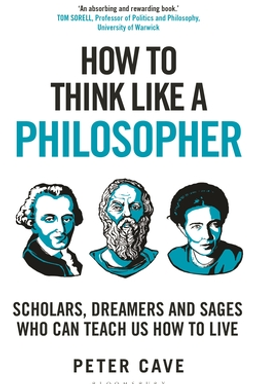
How to Think Like a Philosopher cover

How to Think Like a Philosopher

by Peter Cave

How to Think Like a Philosopher invites readers on a journey through history''s greatest minds, revealing unique perspectives on life''s big questions. Discover how philosophy''s timeless quest for meaning can inspire purpose and awareness today.

Philosophy as a Way of Living and Wondering

What does it mean to live a thoughtful life? Peter Cave’s How to Think Like a Philosopher: Scholars, Dreamers, and Sages Who Can Teach Us How to Live invites you to slow down, wonder, and engage with the oldest question in philosophy: how should we live? In a world obsessed with instant answers and quick fixes, Cave makes a compelling plea to rediscover the art of deep reflection. The book is both a philosophical journey through thirty thinkers and a demonstration that philosophy is not just an academic discipline—it’s a lived practice, a way to understand yourself, others, and the very essence of existence.

Spanning from Lao Tzu to Samuel Beckett, Cave curates intellectual lives from East and West to show how philosophical thought—whether expressed in argument, poetry, paradox, or silence—helps us navigate the human condition. He explores love through Sappho’s lyricism, logic through Aristotle’s empiricism, freedom through Simone de Beauvoir’s situated feminism, and despair through Schopenhauer’s pessimism. Each philosopher offers a distinct lens, yet all share a common project: pursuing truth and meaning beyond superficial certainties.

Philosophy as Wonder and Examination

In his prologue, Cave quotes Plato’s insight that philosophy begins in wonder. This sense of wonder doesn’t merely involve awe at the universe but a restless curiosity about how to live within it. He recalls Wittgenstein’s recommendation that when two philosophers meet, they should tell each other, “take your time.” This call to patience resists the modern demand for immediate conclusions. Instead, it urges slow thinking through complex issues—what C. P. Cavafy’s poem “Ithaka” celebrates as wishing “the journey long, full of adventure and of knowledge.”

Cave emphasizes that philosophy is diverse: some philosophers write with humor and imagination (Lewis Carroll), while others construct grand systems (Plato, Kant, Hegel). Some see philosophy as continuous with science, others as therapy for the mind (as Wittgenstein later suggests). What unites them is not a common method but a shared devotion to truth-seeking—truth understood not as a fixed destination but as a process of continual reexamination. To think like a philosopher, according to Cave, is to live reflectively, courageously, and often paradoxically—accepting that understanding may deepen precisely through our confusions and contradictions.

Thinking Through Contradictions and Diversity

Cave threads together a grand tapestry of philosophical diversity: Lao Tzu’s enigma of the Tao contrasts with Zeno’s paradoxes, yet both reveal the limits of human reasoning. Sappho’s celebration of erotic longing sits beside Schopenhauer’s grim view of desire. Even humor, Cave shows, becomes philosophical—Lewis Carroll’s absurd dialogues or Russell’s wit about logic expose the fragility of our assumptions about reality and language. Unlike a dry history of philosophy, Cave’s work reads as a conversation across centuries, reminding you that thinkers debate not only concepts but ways of being.

Each chapter couples biography with thought: Simone Weil’s ascetic compassion mirrors her philosophical insistence on attention and refusal of complicity; Marx’s critique of alienation emerges from his empathy for exploited workers; Murdoch’s heron-like “unselfing” reflects her belief that moral vision requires turning away from ego toward the Good. Cave thus rescues these figures from mere abstraction—showing philosophy as inseparable from the messy, embodied realities of hunger, love, labor, faith, aging, and death.

Why Philosophy Still Matters

In an age of algorithms and social media distractions, Cave warns against what he calls the “spirit of our times”—a craving for instant gratification, quick tweets, and prefabricated opinions. Against this superficiality, philosophy teaches endurance of thought. As Wittgenstein quipped, “What’s the good of having one philosophical discussion? It’s like having one piano lesson.” The point is not just to read philosophy but to practice it daily, allowing it to transform how you perceive and act.

Cave’s journey culminates in a moral and existential insight: philosophers may not find absolute truth, but in seeking it they model how to live wisely. By tracing the lineage from Socrates’ self-knowledge to Beckett’s bleak resilience (“I can’t go on. I’ll go on.”), he shows that philosophy offers not certainties but courage—the courage to keep thinking amid confusion. This, Cave suggests, is the real meaning of being human: to think attentively, to care about truth, and to live with curiosity, humility, and wonder.


Eastern Beginnings: Lao Tzu and the Way of Tao

Cave begins his exploration with Lao Tzu, an ancient Chinese sage who may not have existed at all. Through the Tao Te Ching, Lao Tzu invites you to confront what cannot be spoken: “The Tao that can be told is not the eternal Tao.” This paradox captures the heart of Taoism—the understanding that ultimate reality, the Way, escapes conceptual grasp. Cave frames this not as mystical evasion but as philosophical insight: the deepest truths about life may emerge in silence, humility, and attentiveness to nature rather than in the clamor of logic.

Quietism and the Flow of Nature

To follow the Tao, Cave writes, is to “go with the flow.” It’s a lesson both ecological and spiritual. The wise person acts without striving, embracing simplicity and contentment rather than acquisition and ambition. In modern terms, Lao Tzu calls you to resist the relentless productivity culture—the idea that value depends on activity. His quietism isn’t passivity; it’s alignment with natural order. If everything is part of one unified whole, then to fight against it is to fight against yourself.

Contradiction as Illumination

Lao Tzu’s apparent contradictions—doing by not doing, speaking by silence—illustrate how philosophical wisdom often transcends binary thinking. Cave compares this with Western paradox-mongers like Zeno of Elea, noting that while Zeno used contradiction to expose human confusion, Lao Tzu used it to cultivate acceptance. The sage’s message resonates today as “deep green” philosophy: seeing nature’s intrinsic value beyond human utility. In this way, Taoism becomes an early ecological ethic and a meditation on humility before the world’s mystery.

For Cave, Lao Tzu’s teaching also interrogates free will: if the self is an illusion within the flow of Tao, the anxiety over autonomy dissolves. You act as nature acts. To think like Lao Tzu, he concludes, is ultimately to recognize when to say nothing—an attitude echoed centuries later by Wittgenstein’s closing line in the Tractatus: “Whereof one cannot speak, thereof one must be silent.”

(In contrast, Western philosophy often treats paradox as a problem to be solved. Lao Tzu models another path: paradox as the teacher itself. Through contradiction, he exposes the mind’s limits and leads you to peace within mystery.)


Love, Desire, and the Human Heart: Sappho

From Lao Tzu’s silence, Cave turns to Sappho’s song. The poet of Lesbos, writing in the sixth century BC, becomes philosophy’s unexpected voice of emotional truth. Her surviving fragments—often just a few lines—capture the intensity of love as both bliss and torment. When Sappho describes Eros as a “bittersweet irresistible creature,” Cave notes that she articulates a fundamental philosophical insight: desire unites pleasure and pain, rationality and madness. To love is to encounter contradiction at the core of being human.

Love as Knowledge of the Self

Cave treats Sappho not merely as a poet of passion but as an early thinker of identity. When she writes, “When I desire you, a part of me is gone,” she anticipates the existential philosophers who see the self as unstable and relational. Love exposes vulnerability: it reveals how we are incomplete without others. (This theme returns in Sartre’s later account of love as conflict between freedom and possession.)

The Bittersweet Human Condition

Sappho’s concept of “bittersweet” becomes a metaphor for life’s dualities—youth and aging, joy and loss, permanence and change. She laments fading beauty yet finds poetry in transience. Comparing her with Heraclitus’s assertion that “everything flows,” Cave shows how Sappho intuitively grasped impermanence long before formal metaphysics. Love’s brief brilliance mirrors our mortal condition: we seek eternity in experiences destined to vanish.

Cave also highlights Sappho’s defiance of patriarchal norms. Her unapologetic depiction of female desire challenged male-centered views of rationality and virtue. In including Sappho among thirty “philosophers,” Cave broadens the canon, showing that lyric feeling can be as philosophically profound as logical deduction. To think like Sappho, he suggests, is to embrace emotion as insight—to see that reason divorced from passion yields an impoverished life.

Even Plato acknowledged Sappho as the “tenth muse.” Her union of body and soul’s longing anticipates his own ladder of love in the Symposium—where erotic attraction becomes ascent toward Beauty itself. Thus, in Cave’s opening chapters, philosophy sings before it argues, and feeling becomes a path to truth.


Socrates and Plato: The Quest for the Good Life

If Sappho made love lyrical, Socrates made thought dialogical. For Cave, Socrates is philosophy’s archetype: the gadfly who provokes you to examine your life. Through Plato’s dialogues, Socrates appears not as an author but as a living method—a relentless questioner devoted to moral clarity. His famous declaration, “The unexamined life is not worth living,” anchors Cave’s entire book. Philosophizing, he insists, is less about possessing knowledge than about recognizing ignorance and engaging others in honest conversation.

Dialogue, Humility, and the Midwife of Thought

Cave recounts Socrates’ image of himself as a midwife of ideas: he helps others give birth to understanding that was already “within.” This image captures philosophy as an act of cooperation. Socrates’ dialogues often end in confusion but also awakening—the “torpedo shock” of realizing you don’t know what you thought you knew. Cave draws parallels to modern pedagogy: genuine learning arises not from lectures but dialogue, where humility replaces arrogance.

Plato’s Light Beyond the Cave

Plato, Socrates’ student, transforms questioning into grand architecture. In The Republic, his Allegory of the Cave literalizes enlightenment: most of us mistake shadows for reality. The philosopher’s task is to ascend toward the Forms—eternal truths like Beauty, Justice, and the Good—and then return to the everyday world to lead with wisdom. Cave underscores how Plato’s vision remains revolutionary: he connects personal virtue to political justice, insisting that right living and good governance require the same disciplined attention to truth.

Yet Cave resists taking Plato at face value. He notes the tension between Plato’s idealism (truth above the world) and Aristotle’s realism (truth within it). “Lift your eyes to the Forms,” says Plato, but Aristotle (coming next) urges, “keep your feet on the ground.” Both, however, insist on moral character and rational reflection as foundations for human flourishing. To think like Socrates and Plato, Cave concludes, is to live in dialogue—with oneself, with others, and with the Good that beckons beyond appearances.


Aristotle and the Art of Flourishing

Aristotle, Plato’s brightest pupil and fiercest critic, brings philosophy down from the heavens to the marketplace. Cave presents him as the philosopher who grounded abstract ideals in the realities of human life. Unlike Plato’s chariots flying toward timeless Forms, Aristotle preferred walking—literally teaching while pacing the Lyceum gardens. For him, philosophy is empirical: we begin from what people ordinarily believe and refine it through reasoning and experience.

Happiness as Flourishing (Eudaimonia)

Cave explains Aristotle’s ethics not as a moral code but as a practical art of living. The ultimate goal of life, Aristotle claims, is eudaimonia—not fleeting pleasure but flourishing, a life of excellence fulfilled through virtuous character. Virtue lies in the “golden mean” between extremes: courage between rashness and cowardice, generosity between waste and greed. This middle way, Cave notes, demands wisdom, context, and emotional maturity; you can’t calculate morality like a formula (a subtle dig at later utilitarians).

Friendship, Honesty, and the Habit of Excellence

Flourishing, for Aristotle, requires community. Cave highlights how friendship becomes an ethical model: true friends wish the good for each other’s sake, not out of utility. Virtue is a habit, cultivated by action and reflection. You become just by doing just things—practice shapes the soul. Aristotle’s approach feels strikingly modern: moral development as skill building rather than rule keeping.

Cave also touches on Aristotle’s logic and curiosity—his classification of causes, his syllogisms (“All men are mortal; Socrates is a man; therefore, Socrates is mortal”). Logic, in his hands, is a tool for clarity, not abstraction. Even his biological studies echo his ethics: understanding living forms reveals how each strives toward its function or purpose. To think like Aristotle, Cave writes, is to combine intellectual rigor with openness to the ordinary: wonder at why a leaf falls, a friend laughs, or justice matters.

(Modern philosophers like Martha Nussbaum echo this Aristotelian humanism, grounding ethics in human capabilities and empathy. Cave uses these links to show philosophy’s continuity across millennia.)


From Descartes to Hume: Mind, Reason, and Skepticism

Modern philosophy, Cave explains, begins when thinkers turn inward—from asking what reality is to asking how we know it. Descartes, the “Father of Modern Philosophy,” famously doubted everything until he reached one certainty: cogito, ergo sum—“I think, therefore I am.” Cave recounts how Descartes’ radical skepticism leads to dualism: mind as immaterial “thinking substance” distinct from body. This vision promised certainty but created modern anxiety about how mind and matter connect—a puzzle that haunts philosophy still.

Spinoza’s Unity and Hume’s Doubt

Cave contrasts Descartes’ separation with Spinoza’s daring unity: “God or Nature” (Deus sive Natura) means everything is one substance, seen under different aspects. Spinoza, excommunicated for heresy, found peace in understanding all things “under the aspect of eternity.” His calm rationalism redefines God not as a person but as the totality of being—ethics grounded in understanding necessity rather than commandment. For Cave, Spinoza models philosophical courage: living by reason against social condemnation.

Then comes Hume, who dismantles rational certainties altogether. Experiences, not reasoning, shape belief; cause and effect are expectations, not proofs. His skepticism about miracles—urging us to proportion belief to evidence—anticipates modern scientific method. Yet Hume remained cheerful: after doubting in his study, he dined and played backgammon, finding philosophical humility compatible with human joy.

Cave unites these thinkers into a continuum: Descartes’ confidence births rationalism, Spinoza’s reason births serenity, Hume’s doubt births empiricism. Their legacy is the modern mind itself—critical, self-aware, and unsettled, forever balancing skepticism with wonder.


The Ethics of Freedom: Kant, Mill, and Beyond

For Cave, the Enlightenment’s moral revolution turns on one question: what does it mean to act freely and rightly? Kant, Mill, and later moral philosophers supply contrasting answers that still shape ethical debate today. Kant’s moral world is one of duty; Mill’s, of happiness. One demands principle; the other demands compassion. Both, Cave argues, reveal complementary sides of the moral life.

Kant: Duty and the Moral Law Within

Kant insists that morality derives from reason alone: act only on maxims you could will as universal law. In doing so, you respect others as ends, never merely as means. Cave recounts Kant’s famous discipline—walking punctually each day through Königsberg—as a metaphor for moral consistency. Yet Kant’s rigor also exposes tension between rational purity and human compassion. His “axe-man” dilemma, arguing you must not lie even to save a life, forces you to confront the cost of absolute moral rules.

Mill: Happiness as Flourishing

John Stuart Mill, writing a century later, sought to humanize ethics: the good is not cold duty but “the greatest happiness of the greatest number.” Cave presents Mill as the philosopher of enlightened empathy—defending liberty, women’s rights, and education as conditions for shared flourishing. His utilitarianism affirms both pleasure and personal development: better to be a dissatisfied Socrates than a satisfied pig. Where Kant grounds morality in duty, Mill grounds it in cultivated humanity. Cave bridges them: morality needs both duty’s structure and empathy’s warmth.

(Later thinkers like Iris Murdoch revive this synthesis through the concept of attention—seeing moral goodness as clear vision rather than rule or calculus. Cave threads these connections to show ethics as an evolving conversation about freedom, responsibility, and love.)


Existence, Anxiety, and the Self: Kierkegaard to Sartre

Cave’s middle chapters unravel what it means to exist as an individual. From Kierkegaard’s leap of faith to Sartre’s declaration that “man is condemned to be free,” existentialism becomes the philosophy of self-making under uncertainty. These thinkers, passionately engaged with God, love, and despair, transform philosophy into confession and rebellion alike.

Kierkegaard: Passionate Commitment

For Kierkegaard, truth is subjectivity: it’s not knowing about God but living before God. In Fear and Trembling, his Abraham willingly risks everything in faith’s paradox. Cave links this to modern authenticity: living by choice, not convention. Yet Kierkegaard warns that freedom without grounding leads to despair—echoing modern anxieties of meaninglessness.

Nietzsche and Sartre: Creativity and Nothingness

Nietzsche’s proclamation “God is dead” confronts you with radical freedom: without divine order, values must be re-created. The challenge is to affirm life even amid suffering—the spirit of the Übermensch who says “Yes” to existence. Sartre adopts this atheistic legacy but moralizes it: existence precedes essence; we create ourselves through acts. His portraits of bad faith—the waiter performing his role, the lover seeking to possess—expose our flight from freedom. Cave reads both as calls to courage: to invent meaning where none is given.

When combined with Simone de Beauvoir’s feminist humanism and Simone Weil’s ascetic compassion, existentialism becomes not despair but ethical engagement: freedom bound to responsibility for others. To think existentially is to stand, trembling but resolute, before your life and choose.


Language, Meaning, and the Limits of Thought

Cave transforms 20th‑century philosophy—often caricatured as dry logic—into living drama. Through Bertrand Russell, G. E. Moore, Martin Heidegger, and Ludwig Wittgenstein, he charts how language became the new frontier of thought. The question shifts from “What is the world?” to “How does language shape what we can know?”

From Logic to Life

Russell’s quest for mathematical certainty collides with paradoxes that reveal the fragility of reason itself. Moore counters grand systems with common sense—holding up his hands to prove the external world. Wittgenstein, beginning as Russell’s protégé, ends by rejecting such certainties: philosophy’s task, he now says, is “to show the fly the way out of the fly-bottle.” Meaning arises from use, not hidden essence. Words are tools embedded in practices; “if a lion could talk, we would not understand him,” because our lives differ. Cave uses these shifts to show philosophy evolving from pursuit of foundations to therapeutic clarification.

The Poetry of Limits

Meanwhile, Heidegger’s dense language of “Being‑in‑the‑world” reveals how our very existence—our Dasein—is defined by time, care, and death. Though Cave is critical of Heidegger’s obscurity and politics, he concedes his insight: understanding is existential, not detached. Wittgenstein converges with him from the opposite end: “Whereof one cannot speak, thereof one must be silent.” Both remind us that silence can be philosophical—an echo of Lao Tzu and Beckett’s minimalism. Cave thus closes the circle: philosophy, whether stated in logical symbols or poetic fragments, must confront the limits of language and the mystery of being.

(In contemporary terms, this anticipates cognitive science’s realization that meaning rests in use, context, and embodiment—not abstraction. Cave invites you to see that everyday talk—promises, jokes, prayers—is already metaphysical.)


Philosophy as Compassion and Attention

In his later chapters, Cave shifts from logic to love—from how we think to how we see. Through Simone Weil, Hannah Arendt, Iris Murdoch, and Samuel Beckett, he argues that philosophy is not only about reasoning but also about moral vision and empathy. Attention, not abstraction, becomes the highest virtue.

Weil and Arendt: Responding to Suffering

Simone Weil, starving herself in solidarity with wartime victims, exemplifies philosophy lived to extremity. Her injunction—“Refuse to be an accomplice; don’t keep your eyes shut”—defines moral clarity as compassionate attention. Arendt, witnessing totalitarianism, calls this the antidote to the “banality of evil”: thinking without stubborn thoughtlessness. Both link morality to wakefulness—the refusal to look away from injustice.

Murdoch and Beckett: Attention and Unselfing

Iris Murdoch refines compassion into “unselfing”—that moment when attention to beauty, like watching a kestrel, dissolves ego. Morality, she says, is a matter of vision, not willpower: seeing the world truthfully frees you from vanity. Beckett, by contrast, strips compassion to its bones. In his bleak humor—“I can’t go on. I’ll go on.”—he finds dignity in endurance amid absurdity. Cave reads Beckett not as nihilist but as tragic stoic: awareness itself becomes redemption.

To think like these philosophers, Cave concludes, is to combine clarity with kindness—to realize that philosophy’s end is not mere knowledge but care: for truth, for others, and for the fragile miracle of being awake in a bewildering world.

Dig Deeper

Get personalized prompts to apply these lessons to your life and deepen your understanding.

Go Deeper

Get the Full Experience

Download Insight Books for AI-powered reflections, quizzes, and more.