
Idea 1
Say the Quiet Part Out Loud
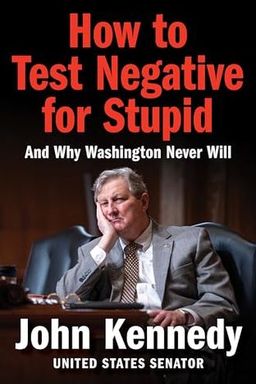
When do you bite your tongue—and when is blunt honesty the only way to get anything fixed? In How to Test Negative for Stupid, U.S. Senator John Kennedy argues that candor is both a civic virtue and a governing tool. He contends that Washington, D.C., too often runs on euphemism, theater, and self-preservation—and that plain talk is the shortest route to accountability, better policy, and public trust. But Kennedy’s version of candor isn’t shock-jock snark; it’s a studied approach that blends preparation, humor, and moral lines he refuses to cross.
The book is a political memoir laced with stories—from a one-stoplight Louisiana upbringing and Oxford tutorials to Senate-floor needling and high-stakes confirmation hearings—that double as a manual for citizens who want to understand power without the usual fog. If you’ve ever watched Congress and wondered, “Are they really serious?” Kennedy’s answer is yes—and that’s why he insists on saying the quiet part out loud.
What the book claims (and why you should care)
Kennedy’s core argument is simple: You’re not free if you can’t speak plainly. He positions candor as both a personal code (he jokes that he has the right to remain silent but not the ability) and a strategic method to puncture pretension, smoke out bad ideas, and get to better ones. He takes readers behind the Senate’s velvet rope: empty chambers used as home-district video studios, leadership choke points that bottle up real debate, and rules that “read like they were put together by a heroin addict with a socket wrench.” The claim isn’t that everyone’s corrupt; it’s that the incentives reward showmanship and obedience—unless someone breaks the spell with common sense in public.
You’ll see how that plays out in hearings where Kennedy uses short, basic questions to reveal competency (or the lack of it), in floor speeches that travel because they’re memorable (“Only water and milk allowed on the Senate floor”), and in policy fights where he prefers proof over posture (getting $80+ billion for the public by insisting the FCC auction valuable 5G spectrum rather than give it away).
What you’ll learn (and how this summary is organized)
First, you’ll get a decoder ring for the U.S. Senate: why so little happens, why speeches rarely change votes, and where the real choke points live. Then you’ll meet the person behind the persona: the small-town work ethic, the Oxford grind, the law clerk who loves the elegance of good rules, and the state official who returned $400 million in unclaimed property and enforced tax and domicile law—even against the well-connected. You’ll also walk into crises (Hurricane Katrina dog rescues; New Orleans street triage) to see what competence looks like up close.
Next come the hearings—where Kennedy’s “ask-then-shut-up” method dents nominees across two administrations (Saule Omarova on nationalizing banking; an unprepared district court nominee who couldn’t define Article II; a Trump pick who didn’t know Daubert). You’ll also see his line-drawing: refusing sleazy shortcuts (like a 1991 “sample ballot” cash deal that likely would have made him attorney general) and warning a second Trump administration not to turn justice into tit-for-tat retribution (“Two wrongs don’t make a right—but they do make it even”).
Why this matters now
Polarization thrives on abstraction. Kennedy’s stories make governing specific. He names what many sense: rules that block debate, a media culture that acts like an umpire with a favorite team, and activists (left and right) who treat every disagreement as heresy. Whether you share his policy views or not, his method—preparation, short questions, exact words, public accountability—offers a replicable practice for anyone who wants to change a room: school board members, city councilors, managers, or neighbors.
Key Idea
“Only dead fish go with the flow.” Kennedy’s credo is not just contrarianism; it’s a reminder that improvement requires friction. (Compare to Nassim Taleb’s Antifragile, which argues systems strengthen under stress.)
Where the book sits among political memoirs
If Robert Caro’s Master of the Senate unmasks Lyndon Johnson’s power mechanics, Kennedy’s book is a field guide to the modern Senate clog. If Michael Lewis’s The Fifth Risk warns about competence in the bureaucracy, Kennedy shows how to test for it live on camera. And if Ben Sasse’s Them laments the loneliness driving our anger, Kennedy prescribes practical antidotes: show up, do the reading, ask obvious questions, and be decent—but unmoved by fashion.
Finally, you’ll leave with a citizen’s checklist: what real oversight looks like, how to spot integrity lines, why “saying the quiet part out loud” isn’t cruelty but clarity—and how you can use it wherever you lead.