
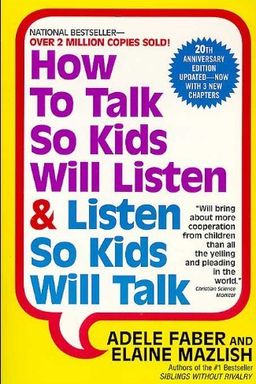
How to Talk So Kids Will Listen & Listen So Kids Will Talk cover

How to Talk So Kids Will Listen & Listen So Kids Will Talk

by Adele Faber and Elaine Mazlish

How to Talk So Kids Will Listen & Listen So Kids Will Talk offers parents practical communication techniques to build stronger, more respectful relationships with their children. By acknowledging feelings and encouraging independence, parents can transform challenging situations into opportunities for growth and understanding.

Communicating So Children Feel Heard and Respected

Have you ever found yourself in a power struggle with your child, repeating the same requests or lectures, only to be met with blank stares, tantrums, or defiance? Adele Faber and Elaine Mazlish believe that these battles aren’t about obedience—they’re about communication. In How to Talk So Kids Will Listen & Listen So Kids Will Talk, they argue that most parenting breakdowns stem from the way we speak to our children and how we respond to their emotions. The authors contend that if parents learn to acknowledge their children’s feelings, replace commands with collaboration, and express their own needs honestly but respectfully, they can transform conflict into connection.

At the heart of this book is the idea that children’s behavior is directly linked to how they feel. When kids feel understood and respected, they behave better and cooperate more willingly. But when their feelings are denied—when parents say things like “You’re not tired” or “Stop crying, it’s not a big deal”—children become defensive, resentful, and eventually tune adults out. The solution? Replace denial, accusation, and punishment with empathy, descriptive praise, and problem-solving. These communication skills form a kind of emotional grammar for parenting, one that helps both parent and child feel heard.

Why Communication Matters More Than Control

Faber and Mazlish illustrate that children learn language not just from words, but from tone and response. When parents listen with compassion and describe rather than judge, they give their children a space to develop emotional intelligence. Instead of seeing parenting as a series of commands or corrections, the authors encourage you to view it as an ongoing dialogue—a relationship where both people’s needs are important.

During their workshops inspired by psychologist Dr. Haim Ginott (author of Between Parent and Child), they noticed how small verbal shifts could change an entire family dynamic. A frustrated “Clean up your room!” might become a calm “There are toys on the floor that need a home.” Suddenly, the same message feels less threatening and more collaborative. The authors discovered that when parents describe problems instead of blaming, children often respond automatically with helpful action.

Core Principles: Empathy, Respect, and Clarity

Throughout the book, Faber and Mazlish return to three central principles. First, empathy fuels cooperation. By acknowledging how children feel (“You’re disappointed that we can’t go to the park today”), you validate their emotional experience, which diffuses resistance. Second, respect replaces punishment. Rather than imposing consequences from anger, parents can talk about what needs to be done (“I expect toys to be put away before bedtime”). Finally, clarity builds autonomy. The more specific and descriptive a parent’s communication, the more capable a child feels of figuring things out independently.

These principles shape every chapter—from handling emotions and engaging cooperation to giving effective praise, encouraging autonomy, and freeing children from limiting roles. The authors explore how to express anger without insults, how to set boundaries without shaming, and how to give children choices that teach independence.

Why It Works: From Struggle to Connection

Faber and Mazlish show that communication skills do more than manage behavior—they strengthen relationships. Parents in their groups report transformations: tantrums easing into conversations, bedtime battles turning into cooperation, and once-defensive kids offering solutions themselves. The process isn't about being perfect; it’s about building a habit of mutual respect. When children learn the language of empathy, they don’t just listen better—they grow into adults who can relate kindly and communicate effectively.

“We want to live with one another in a way that helps each person feel good about himself. We want to find a way to express anger without doing damage.” —Adele Faber & Elaine Mazlish

Ultimately, How to Talk So Kids Will Listen is about more than parenting—it’s about communication skills that apply to every relationship. By turning empathy into action, by seeing feelings as guideposts rather than obstacles, parents learn a new language of respect, one that their children will carry into adulthood and use with everyone they meet. As Faber and Mazlish explain: “When you learn a new way of communicating, you’ll always speak with an accent—but for your children, it will be their native tongue.”


Helping Children Handle Emotions

Faber and Mazlish open their approach with a deceptively simple insight: when children feel right, they behave right. The emotional climate between parent and child shapes everything else—from the child’s ability to learn, cooperate, and trust, to the parent’s ability to guide without friction. The authors teach you that listening to your child’s feelings is not indulgent; it’s effective. It’s the foundation of discipline built on connection.

Four Steps to Emotional Understanding

The book introduces four steps for helping children deal with their feelings: (1) Listen with full attention; (2) Acknowledge their feelings with a simple word or sound (“Oh,” “Hmm,” “I see”); (3) Name the feeling; and (4) Give the child’s wishes in fantasy. This method replaces moral lectures and logic with empathy, creating space for children to calm themselves and think clearly.

For instance, when a child cries, “I hate Grandma!” a parent’s instinct might be to scold (“That’s terrible! Don’t say that!”). But Faber and Mazlish suggest acknowledging the feeling instead: “You’re really angry with Grandma today.” By naming the emotion and resisting the urge to correct, the parent gives the child a chance to process anger safely rather than suppress it. Once feelings are accepted, behavior changes naturally.

Why Empathy Outperforms Logic

Parents often jump straight to advice or reasoning—“It’s not so bad,” “You’ll be fine,” “Don’t worry.” But logical explanations rarely soothe an emotional brain. Acknowledgment, by contrast, says: “I see you. I understand you.” One mother in the book notices that her son’s tantrum over spilled juice subsides when she simply echoes his frustration rather than correcting it (“You were trying so hard not to spill it, and now it’s everywhere”). These moments of empathy turn chaos into calm.

Researchers and therapists (like Carl Rogers and Haim Ginott) have long agreed that naming emotions builds self-esteem and clarity. Children who learn words for frustration, sadness, and disappointment grow up better able to regulate themselves. Faber and Mazlish’s workshops demonstrated that parents who practiced this emotional vocabulary saw fewer meltdowns and more cooperation within weeks.

Fantasy as a Family Tool

One of their most unexpected techniques is giving children their wishes in fantasy. When a child wails, “I want ice cream for breakfast,” instead of saying “No,” the parent might answer, “Wouldn’t it be wonderful if we had an ice cream tree growing outside?” The authors found that when children’s desires were recognized playfully, reality became easier to accept. Empathy didn’t spoil them—it soothed them.

This tool, akin to the imaginative empathy found in Virginia Axline’s Dibs: In Search of Self, shows how understanding can replace control. By acknowledging feelings rather than fixing them, you teach emotional resilience—the kind of strength built from being deeply understood.


Engaging Children’s Cooperation

Once emotions are acknowledged, cooperation becomes possible. The next challenge is helping children participate willingly in daily routines—without resorting to nagging or threats. Faber and Mazlish reveal five communication skills that transform commands into collaboration: describe, give information, say it in a word, talk about feelings, and write a note.

From Accusation to Description

Instead of blame (“You spilled your milk again!”), parents can describe the situation (“There’s milk on the table”). When children hear a direct description of what’s wrong rather than an attack on who they are, they feel competent enough to fix it. This small linguistic shift changes the emotional tone from confrontation to communication. A child who hears “The towel is on the bed” is far more likely to act than one who hears “You’re so careless!”

Information and Feelings Instead of Orders

The authors suggest offering information rather than barking commands. “Wet towels make the blanket damp” conveys facts without hostility, prompting natural cooperation. Meanwhile, sharing your own feelings—“I don’t like sleeping in a wet bed”—models emotional honesty. When children see feelings expressed respectfully, they learn to respond kindly.

Short reminders can also help. A single word like “Towel!” or “Shoes!” is more effective than long lectures. Kids tune out speeches but respond to clarity. Even written notes can have remarkable power; a note reading “Wet towels make me see red!” can communicate boundaries with humor instead of anger.

Tone and Authenticity

Tone matters as much as words. Faber and Mazlish remind you that “phony patience” can backfire—pretending calm while seething inside teaches dishonesty rather than respect. It’s better to be genuine (“I’m furious that my tools were left outside in the rain”) than falsely polite. Authenticity builds trust; manipulation breeds resistance.

This approach aligns with Thomas Gordon’s Parent Effectiveness Training, emphasizing communication instead of coercion. Faber and Mazlish make clear that cooperation depends on respect, not fear. Their methods give you alternatives to nagging that work because they honor your child’s intelligence rather than undermine it.


Alternatives to Punishment

Few challenges test parents like misbehavior. When your child lies, defies, or breaks something, punishment feels like justice—but it usually backfires. Faber and Mazlish argue that punishment teaches resentment, rebellion, and revenge instead of responsibility. Drawing on Haim Ginott’s research, they show that consequences can educate without humiliation.

Turning Discipline into Teaching

Punishment distracts from the real lesson. A child who’s grounded for lying spends more energy feeling angry than understanding honesty. Faber and Mazlish recommend seven alternatives: point out a way to be helpful, express disapproval without attacking character, state expectations clearly, show the child how to make amends, offer a choice, take action, and allow natural consequences.

For example, instead of yelling “You never return my tools!” a parent can say, “Tools rust when left outside. I expect them to be returned.” If the problem persists, the toolbox can be locked temporarily—not as revenge, but as a logical outcome linked to the behavior. This form of teaching mirrors natural consequences in life.

Problem-Solving Together

When conflicts repeat—chronic lateness, messy rooms, forgotten homework—the authors suggest a five-step problem-solving process: (1) Discuss the child’s feelings; (2) Share your own; (3) Brainstorm solutions; (4) Write down all ideas without judgment; (5) Choose and implement one together. This turns authority into partnership.

In one workshop case, a mother and her son Bobby negotiated his curfew by recognizing his wish to keep playing with friends and her need to feel calm. Together they decided dinner could start fifteen minutes later, and Bobby would leave the playground when the town’s fire whistle blew. Cooperation replaced punishment because both voices mattered.

Teaching Responsibility Instead of Fear

These methods help children see themselves as capable problem-solvers rather than helpless victims of authority. Psychologists like Rudolf Dreikurs and Selma Fraiberg supported this shift, noting that punishment creates guilt and defiance, while encouragement builds resilience. Faber and Mazlish’s approach transforms discipline into dialogue—a practical, humane way to help children learn from mistakes instead of fearing them.


Encouraging Autonomy

Most parents want children to become independent—but often sabotage that independence by doing too much for them. Faber and Mazlish reveal how constant assistance, correction, and interference undermine self-confidence. True autonomy begins when you let kids make decisions, struggle, and even fail safely.

Six Ways to Foster Independence

The authors outline six core skills for encouraging autonomy: (1) Let children make choices; (2) Show respect for their struggle; (3) Don’t ask too many questions; (4) Don’t rush to answer theirs; (5) Encourage use of outside sources; and (6) Don’t take away hope. Each skill helps children trust themselves rather than depending solely on parental judgment.

When a five-year-old struggles to button a shirt, instead of stepping in, a parent can say, “Small buttons can be tricky—sometimes pushing harder helps.” Respect for effort succeeds where “Let me do it” fails. Similarly, letting a child choose between pajamas or pants gives practice making decisions. These everyday choices teach self-regulation long before adulthood makes tougher demands.

Respect and Restraint

It takes patience to restrain urges to fix or advise, especially when mistakes seem inevitable. But Faber and Mazlish remind you that “to learn a new language is not easy—you will always speak with an accent. For your children, it will be their native tongue.” When you model trust and calm, children internalize confidence. As one mother discovered, her son’s autonomy grew when he took responsibility for cleaning up spilled juice instead of waiting for her scolding.

Encouraging autonomy also means giving information without control—“Sweaters are for cold weather” instead of “Put your sweater on.” You teach wisdom without dominance. Over time, kids learn to manage their lives and value adults as guides, not gatekeepers.

This emphasis on autonomy echoes Carl Rogers’s view in On Becoming a Person: that unconditional positive regard allows people to self-direct. Faber and Mazlish make this philosophy extremely practical for daily life—helping parents shift from command to collaboration.


The Art of Praise

Praise sounds harmless, but misused praise can quietly undermine self-esteem. Faber and Mazlish discovered that evaluative praise (“You’re great!”) triggers anxiety and dependence, while descriptive praise (“You worked hard on that project”) builds authenticity and pride. In short, praise should show appreciation, not judgment.

Descriptive, Not Evaluative

Instead of saying “Good job,” describe what you see or feel: “You sorted your Legos by color—that’s organization!” The child naturally responds, “I’m good at sorting!” This moment of self-praise is healthier because it stems from recognition, not approval-seeking. Faber and Mazlish’s workshops showed that descriptive praise motivated more cooperation than rewards or flattery.

Why Empty Praise Backfires

When children hear constant “You’re great” or “You’re smart,” they eventually fear losing that status. Praise can turn into pressure—“Will I still be smart if I fail?” The authors compare this to Nathaniel Branden’s insight that self-esteem depends on self-evaluation, not others’ opinions. Descriptive praise grounds confidence in reality and effort.

One father found that instead of telling his son, “You’re terrific!” after solving a math problem, he said, “You figured out how to multiply fractions—that took persistence.” The child felt proud without anxiety. Another parent described her daughter’s cleaned room rather than comparing her to siblings, turning chores into collaboration instead of competition.

Summing Up Behavior in a Word

Finally, parents can “sum up in a word.” After describing effort, add a defining term: “That’s what I call determination.” These labels become identity markers that children internalize. They teach values—organization, empathy, persistence—through affirmation rather than evaluation. Descriptive praise teaches self-reflection, not performance, and sets the foundation for genuine self-worth.


Freeing Children from Negative Roles

Children often get trapped in family roles—“the stubborn one,” “the shy one,” “the troublemaker.” Faber and Mazlish reveal how these labels shape behavior and self-image. The more people repeat them, the more children become them. To break the cycle, parents must offer new experiences and new pictures of who their children can be.

Why Labels Stick

When a mother calls her daughter “bossy” or praises another child as “the good one,” she unintentionally defines both children’s boundaries. The labeled child acts out the role she’s been assigned. As Faber discovers with her son David, being called “stubborn” since infancy made him defensive; only when she started highlighting his flexibility did his behavior evolve. Words become prophecies.

Six Strategies for Liberation

The authors propose six methods to free children from roles: (1) Look for opportunities to show them a new picture of themselves; (2) Put them in situations where they can see themselves differently; (3) Let them overhear positive remarks about themselves; (4) Model the behavior you want to see; (5) Store their special moments (“Remember when you handled that well?”); and (6) When they act according to the old label, state feelings and expectations clearly (“I expect sportsmanship”).

For example, one mother reframed her son’s “destructive” behavior by praising him when he repaired something he’d broken. Another stopped calling her daughter “my shy child” and began saying “She speaks when she’s ready,” teaching patience and confidence. Over time, these new images replaced old ones.

Why It Matters

Roles are more powerful than punishment—they define identity. By freeing children from negative scripts, parents teach adaptability and self-awareness. This chapter echoes Rogers’s and Ginott’s belief that unconditional acceptance allows change. For Faber and Mazlish, the mission is clear: help your children write their own roles, not live in yours.


Putting It All Together

The final chapter synthesizes every principle and skill into a coherent philosophy of parenting communication. Faber and Mazlish remind you that these methods aren’t isolated tricks—they’re a way of living based on empathy, respect, and collaboration. Their dramatized examples (“The Princess,” where one mother learns to handle her manipulative daughter calmly) show how combining acknowledgment, limits, and choice breeds harmony.

Integrating Emotion, Autonomy, and Respect

When parents blend skills—acknowledging feelings, expressing their own, problem-solving together—they create a sustainable pattern. The child feels seen, the parent feels sane, and mutual respect replaces authority battles. Communication becomes a tool for building trust rather than control.

The authors caution that real life isn’t a tidy script. You’ll slip, shout, and regret—but then get another chance. The goal is progress, not perfection. “If our children deserve a thousand chances,” they write, “let’s give ourselves two more.” In time, empathy becomes second nature.

A Universal Language of Respect

This approach transcends parenting. Teachers, therapists, even workplace leaders report success using these methods. The same language that calms a tantrum also resolves adult disagreements. The authors end by inviting readers to see communication not as manipulation but as moral practice: “We teach children to speak a language that builds compassion.”

If these skills feel difficult at first, remember Ginott’s prophecy: once learned, they become your children’s native tongue. Each empathic statement, every moment of listening, becomes part of a lifelong conversation—one that teaches your family how to live with dignity, understanding, and mutual respect.

Dig Deeper

Get personalized prompts to apply these lessons to your life and deepen your understanding.

Go Deeper

Get the Full Experience

Download Insight Books for AI-powered reflections, quizzes, and more.