
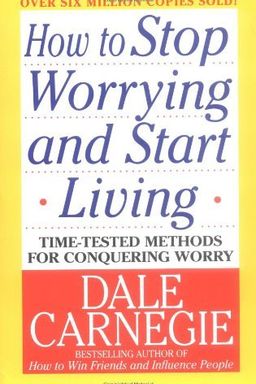
How to Stop Worrying and Start Living cover

How to Stop Worrying and Start Living

by Dale Carnegie

Dale Carnegie''s ''How to Stop Worrying and Start Living'' provides timeless tools to combat worry and enhance well-being. Through insightful anecdotes and practical techniques, this self-help classic empowers you to live a more fulfilling, stress-free life by focusing on present actions and positive thinking.

Mastering the Art of Letting Go of Worry

Why do some people remain calm under pressure while others collapse under fear? Dale Carnegie answers this question in How to Stop Worrying and Start Living by showing that worry is not an unchangeable habit but a mental pattern you can retrain. His core message is deceptively simple: worry is the misuse of imagination. By learning specific, trainable disciplines—analytical, physical, and emotional—you can reclaim peace, make better decisions, and live more fruitfully.

Carnegie structures his approach around practical psychology. Each principle converts abstract emotion into concrete action so you can manage not only crises but the ordinary pressures that quietly consume health and happiness. The book’s arc leads you from controlling immediate fear, to reorganising your daily thinking, to adopting enduring habits that protect joy and physical vitality.

Understanding Worry as Learned Behavior

Carnegie draws from physicians such as Dr. Alexis Carrel and psychologists like William James and Carl Jung to show that worry is a learned reaction, sustained by habits of rumination. Its effects are measurable: ulcers, heart disease, hypertension, arthritis, and exhaustion. Eliminating worry is therefore not moral preaching—it’s preventive medicine. If you treat your mental habits with the seriousness you reserve for physical health, you lengthen both your life expectancy and its quality.

In Carnegie’s logic, worry is a problem of imagination divorced from disciplined thought. Your task is to reconnect emotion with realistic appraisal and deliberate action. That theme underlies all of his rules: get facts, make decisions, accept limits, and redirect attention into constructive activity.

The Book’s Practical Architecture

The first group of methods teaches you to dissolve panic through clarity and structure. The chapter on “Live in Day-Tight Compartments” teaches concentration on the present day—the only unit of time you can control. The next method, the Willis H. Carrier formula, channels worry into problem-solving by three steps: identify the worst case, accept it, and then calmly improve upon it. This intellectual acceptance drains fear of its paralyzing power. Likewise, the “Analyse, Decide, Act” pattern transforms vague dread into a written plan: get the facts, analyse them, make a decision, and execute without reopening the decision to endless reconsideration.

The second set of lessons addresses physical and occupational remedies. “Crowd Worry Out With Work” leverages the psychological principle that a mind engaged in purposeful labor cannot simultaneously ruminate. “Rest and Relaxation” focuses on preventing fatigue, the physiological foundation of anxiety. Fatigue breeds fear, while regular rest, good posture, and muscular relaxation stabilize emotions and sharpen thought.

Emotional Acceptance and Perspective

Beyond controlling thought and work habits, Carnegie insists on emotional realism. “Co‑operate with the Inevitable” distills the essence of mature acceptance—fight what can be changed and serenely yield to what cannot. This balance, echoed in Reinhold Niebuhr’s serenity prayer, protects you from both fatalism and futile rebellion.

He supplements this stoic wisdom with strategic perspective: use the law of averages to cool irrational fears, impose “stop‑loss” limits on how much time or feeling you will expend on trivial matters, and apply humor or reframing to avoid being eaten alive by small annoyances—the “beetles” that consume inner peace more than storms ever do.

Living Outward: Service, Faith, and Perspective

Carnegie culminates the program with an outward turn. Worry thrives in self-absorption; peace grows when you lose yourself in purposeful service, curiosity about others, or faith in something larger than yourself. Stories like Margaret Yates aiding war widows or John R. Anthony rediscovering prayer show that attention moved outward restores health inwardly. Whether you call it religion, meditation, or simple gratitude, connecting to a source beyond ego reduces isolation—the psychological breeding ground of anxiety.

In his final metaphor, “Don’t Saw Sawdust,” Carnegie reminds you to stop mentally laboring over the irrevocable. You cannot reconstruct spilt milk or replay yesterday’s loss, but you can harvest its lesson and move ahead lighter and wiser. This final exhortation closes the circle: yesterday is sealed, tomorrow is unknowable, and today—if consciously managed—is enough.

Core Principle

All of Carnegie’s techniques reduce to this discipline: turn emotion into action and acceptance. When you direct energy toward what you can do and release the rest, worry loses its oxygen.

(Note: In tone and structure this philosophy aligns with Stoic writings like Marcus Aurelius’ Meditations and modern behavioral therapy. Its distinct power lies in making those philosophies operational through daily rituals, examples, and vivid human stories. Carnegie transforms serenity from abstraction into skill.)


Think in Day‑Tight Compartments

Carnegie’s first habit of mental hygiene is to live in "day‑tight compartments." Like a ship closing its bulkheads to stop flooding, you must mentally seal off yesterday and tomorrow so neither can swamp your focus on today. This practice, borrowed from Sir William Osier’s famous lecture at Yale, prevents cumulative anxiety—the mingling of yesterday’s regret and tomorrow’s worry that paralyzes present judgment.

Why Living by the Day Works

Psychologically, distress multiplies when past failures and future fears are kept mentally available. By deliberately concentrating on current duties—writing this report, attending this meeting, cooking this meal—you reclaim the only sphere of influence you actually possess. Osier paired his advice with the line from the Lord’s Prayer, “Give us this day our daily bread.” Living one day at a time is not fatalism; it is practical realism that separates planning from anxiety.

Examples of the Method in Action

Army physician Ted Bengermino endured combat stress by visualizing an hourglass—one grain of sand at a time. Mrs. E.K. Shields conquered grief by keeping the phrase "Every day is a new life" before her eyes. Admiral Ernest J. King planned far ahead but refused emotional rumination on what was beyond his direct control. Each case illustrates that selective mental framing restores usable energy.

Applying the Discipline Yourself

  • Plan each morning only for the day ahead; write down three critical tasks.
  • When tempted to recall old errors or dread future possibilities, pause and repeat a focusing phrase (“Today is the only day I can live”).
  • At night, consciously “close the bulkheads”—review lessons, release thoughts, rest.

(Note: Modern mindfulness practices echo this same restriction of attention to the present moment. Carnegie’s genius was to integrate it into the machinery of daily productivity rather than mysticism.)


Turn Fear into Facts and Action

When worry clouds judgment, Carnegie prescribes analysis and decision. The combined wisdom of Dean Herbert Hawkes, Willis Carrier, and Charles Kettering underpins a single thesis: confusion is the generator of fear. The cure is systematic thinking that extracts worry’s teeth by bringing truth to light and replacing museful dread with motion.

The Analytical Cure

Carrier’s three‑step formula—anticipate the worst, accept it mentally, and then improve upon it—is the bluntest tool yet astonishingly effective. When Carrier faced a failing installation at Pittsburgh Plate Glass, he calculated a worst‑case job loss, accepted it, and instantly regained composure to find the fix that turned loss into profit. Acceptance breaks catastrophic paralysis. William James supported this: once you accept fate emotionally, you are free to act intelligently upon it.

Carnegie couples this with the “Analyse, Decide, Act” algorithm: write out factual answers to “What am I worrying about? What can I do? What will I do? When will I do it?” Executives and civilians alike—like Galen Litchfield under Japanese arrest threats—found that written structure transmuted panic into clarity.

Using Data and Limits to Curb Anxiety

Equally logical are his tools of scale: consult the law of averages to test fears (how many times has disaster actually struck?) and apply “stop‑loss” orders to emotion. Just as traders sell a declining stock automatically, you set a personal boundary: “I will give this problem fifteen minutes of attention a day—no more.” Charles Roberts used that rule to avoid obsessive revisiting of financial fluctuations. In both approaches, you subordinate emotion to fact and discipline.

Psychological Law

Fear thrives on vagueness. Facts define boundaries; action replaces speculation.

At the crossroads of crisis, make analysis your ritual: gather data, accept limits, decide once, act promptly, and refuse to ruminate. The mind that moves cannot panic.


Work, Organization, and the Energy of Purpose

Carnegie insists that positive work—not merely toil—crowds worry out. He distinguishes between frantic activity and disciplined engagement. The human brain concentrates fully on one dominant thought, so when you immerse yourself in useful fascination, anxiety starves from lack of fuel.

Keep Busy, but Constructively

Army psychiatrists knew that engagement healed shell-shocked soldiers faster than idle contemplation. The same law applies to ordinary lives. Marion Douglas, nearly destroyed by grief, built a toy boat for his son and found three hours of real peace. Admiral Byrd’s Antarctic schedule protected his sanity during isolation. Purpose drives balance: it must absorb both attention and meaning, not just kill time.

Rest and Organization as Foundations

Yet constant movement alone is insufficient. Fatigue and disorganization invite anxiety back in hidden form. Carnegie, echoing army doctrine and physicians like Dr. David Fink, stresses frequent rest before you are tired and relaxation while working. Churchill’s naps and Rockefeller’s desk rest illustrate that small pauses increase total usable energy. Meanwhile, clearing your desk of everything but one job (Roland L. Williams’ rule) prevents the sense of an infinite workload.

Effective organization also means decisive delegation. Leaders such as Charles Luckman and Ben Franklin mastered planning and priority; they trained others instead of hoarding control. To manage work without worry, decide promptly within known facts, assign tasks, and review progress regularly.

Injecting Interest into Routine

When boredom replaces tension, fatigue returns through monotony. Make dull tasks interesting by gamifying them, learning new facets, or acting “as if” you were fascinated until you genuinely are. From stenographers who turned form‑typing into contests to Samuel Vauclain’s rise from bolt‑turner to president of Baldwin Locomotive, curiosity converts routine into growth.

(Note: These methods prefigure modern behavioral activation therapy: purposeful work, rest, and mastery offset anxiety more effectively than introspective analysis.)


Perspective, Acceptance, and Emotional Economy

Managing inner life also requires philosophy. Carnegie’s next trio of lessons—co‑operate with the inevitable, disregard trifles, and avoid sawing sawdust—form the emotional economy of sanity. You learn not to fight reality, not to bleed over pinpricks, and not to re‑live scenes you cannot edit.

Acceptance as Power

To “co‑operate with the inevitable” means serene flexibility. Booth Tarkington lost his eyesight but not his humor. Actress Sarah Bernhardt accepted amputation and returned to the stage. Saying “If it must be, it must be” is not surrender; it is emotional jujitsu that channels energy into adaptation instead of protest. The Niebuhr prayer crystallizes this mindset: courage to change what can be changed, serenity for what cannot, and wisdom to know the difference.

Control the Small Stuff

But serenity must include proportion. Carnegie’s “beetles” metaphor—tiny irritations that fell forest giants—reminds you that minor domestic or professional annoyances cause chronic corrosion. Simple reframing works: Homer Croy turned radiator clatter into the crackle of a campfire; Mrs. Carnegie refused to spoil dinner over missing napkins. Ask yourself, “Will this matter in a year?” If not, let it pass. Use humor; as André Maurois said, “Life is too short to be little.”

Stop Replaying the Past

Finally, “Don’t saw sawdust.” The only useful relation to the past is educational, not emotional. Write a brief lesson‑learned note from each mistake and archive it. Franklin’s childhood “whistle” story, Dempsey’s career recovery, or a convict gardening cheerfully at Sing Sing all demonstrate that usefulness outlasts shame. The deliberate act of letting go—“I learned; I file it; I move on”— converts remorse into restored capacity for joy.

Together, these attitudes constitute emotional minimalism: waste neither your anger, your tears, nor your hours on what is gone or trivial.


People, Purpose, Faith: The Inner Reorientation

Perhaps Carnegie’s most transcendent insights concern orientation beyond self. You cannot worry and sincerely serve at the same moment. When you focus on others or connect to something larger than ego—through kindness, prayer, or social contribution—your consciousness changes axis from rumination to relationship.

Forget Yourself by Serving Others

Margaret Yates transformed invalidism into vigor by comforting war wives after Pearl Harbor. Professor William Lyon Phelps practised micro‑kindness daily: praising a shopgirl’s eyes, chatting with porters, acknowledging hidden workers. Each act brightened recipients and lifted his own spirits. Benjamin Franklin’s axiom, “When you are good to others, you are best to yourself,” frames this as enlightened selfishness. Psychologists like Carl Jung confirmed the diagnosis: self‑centered lives calcify into neurosis, while service refills emotional reservoirs.

Faith and Prayer as Psychological Energy

Prayer or reflection transforms worry through articulation, connection, and surrender. By describing your anxiety aloud, you translate chaos into clarity. By addressing a higher power—or your own conscience—you feel shared weight. By asking for guidance, you pre‑commit to action. Mary Cushman’s life was saved by a spontaneous moment of prayer over the hymn “What a Friend We Have in Jesus.” John R. Anthony read a Bible verse on worry and the next day doubled his sales. Even scientists like Alexis Carrel catalogued such inner revitalization as empirically beneficial.

Carnegie makes clear this is not sectarian. If you are secular, the same effects arise from meditation, gratitude, and mindful silence. Admiral Byrd’s Arctic solitude confirmed this: feeling “a Presence” ended despair and restored focus. Faith, however defined, reconnects the anxious self to an organizing meaning.

The Courage to Live Outwardly

Ultimately, the antidote to worry is love in practice—love through service, curiosity, craftsmanship, or reverence. Worry collapses perspective to the narrow self; generosity widens it. Start with one helpful deed or one small prayer. Over time, these outward gestures rebuild an inner architecture of confidence stronger than any intellectual argument against fear.

(Note: This final orientation completes Carnegie’s pragmatic circle—from controlling thoughts and actions to renewing meaning. Only when attention turns outward and upward does worry permanently lose hold.)

Dig Deeper

Get personalized prompts to apply these lessons to your life and deepen your understanding.

Go Deeper

Get the Full Experience

Download Insight Books for AI-powered reflections, quizzes, and more.