
Idea 1
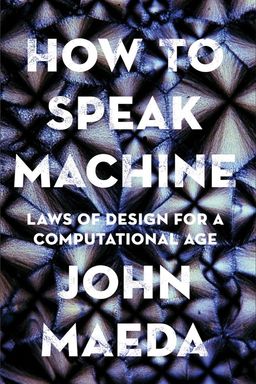
Learning to Speak Machine: Understanding Computation’s Invisible Power
How can you understand a force that shapes your life but that you can’t see or touch? In How to Speak Machine, technologist and designer John Maeda contends that to thrive today, you must grasp at least the basics of computation—the invisible language that powers technology, business, and modern design. He argues that computation is not just programming; it is an entirely new way of thinking, one that alters how we create, communicate, and understand the world. To design, lead, or even live effectively in the digital era, Maeda says, we must learn to literally ‘speak machine.’
Maeda opens with the story of his own journey—from MIT scientist and Media Lab professor to president of the Rhode Island School of Design. His career mirrors the uneasy relationship between design and technology: simplicity and complexity, humanism and computation, creation and automation. After a controversy where he was quoted as saying, “Design is not that important,” Maeda reframes his argument—design matters most when fused with computation. The book thus explores what computation truly is: an alien force that operates exponentially, invisibly, and relentlessly through loops, networks, and machines.
Why This Matters to You
Maeda insists that every modern professional—from artist to entrepreneur—must understand how machines think. Computation has become the new raw material of creativity and commerce. Without it, you’re operating in the old world of atoms while the new world of bits expands faster than physics allows. When you understand its workings—loops, exponential scale, recursion, incompleteness, instrumentation, automation—you stop fearing technology and start shaping it.
The Journey Through Computation
Maeda structures his book across six major ideas: first, that machines run loops (they repeat indefinitely without tiring); second, that machines get large (they scale exponentially through networks and replication); third, that machines are living (they mimic life via artificial intelligence and behavior); fourth, that machines are incomplete (their imperfection mirrors ours and demands iteration); fifth, that machines can be instrumented (they measure and learn from data, enabling predictive design); and finally, that machines automate imbalance (if we embed bias, they will amplify it). Each theme builds from technical insight to human reflection, translating computer science into design philosophy and ethical responsibility.
Speaking Machine vs. Speaking Human
The tension between machine logic and human emotion runs throughout. Computation follows perfect, repeatable rules. Humans, by contrast, are messy, intuitive, and contradictory. Maeda warns that people who 'speak machine' too fluently risk losing empathy—what he calls forgetting to “speak human.” The creator immersed in infinite loops and algorithms can drift into arrogance or detachment. Yet he also shows how human creativity rescues technology from toxicity: art, empathy, and audacity preserve balance in a world increasingly defined by code.
The Call to Audacity and Curiosity
The author closes his introduction with a challenge: be curious, not afraid. The computational universe—like Bowie’s “alien life form”—is bewildering, but fear yields destruction while curiosity sparks invention. Maeda sees computation as a vast, invisible culture you can learn to understand enough to direct, not merely consume. The heroes of the next era will be people who combine curiosity with courage, who speak both machine and human. These will include designers who code, technologists who care, and leaders who can interpret complexity as clearly as they feel compassion.
In essence, Maeda’s mission is to give you a conceptual fluency in computation—to transform your perspective from passive user to active participant. If you learn even “a bit” of machine-speak, you can unlock creative, ethical, and strategic power in the digital world. And through this understanding, you may not only speak to machines—you may begin to shape how they speak back to humanity.