
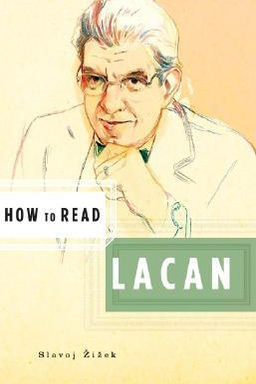
How to Read Lacan cover

How to Read Lacan

by Slavoj Žižek

How to Read Lacan offers an eye-opening exploration into the unconscious mind, revealing the hidden forces behind our beliefs and actions. Through Žižek''s interpretation of Lacan, discover how rituals mask feelings and reshape our understanding of freedom.

Reading Lacan with Žižek: Making the Unconscious Speak Again

What if the voices inside your head—the ones that whisper your doubts, your fantasies, and even your social beliefs—are not purely your own? In How to Read Lacan, philosopher Slavoj Žižek invites you to meet that hidden companion: the unconscious as structured by language. Far from a dusty academic exercise in psychoanalysis, Žižek’s reading of Jacques Lacan is a guided tour into how desire, ideology, and speech intertwine to create our experience of reality itself.

Žižek contends that Lacan’s “return to Freud” is not about nostalgia. It is a revolution in understanding what makes us human in a modern world obsessed with science, consumerism, and performance. Whereas Freud shocked his contemporaries by revealing the unconscious as a site of irrational desires, Lacan reframes this mystery through the lens of language: “the unconscious is structured like a language.” In Žižek’s hands, this statement becomes a secret key for interpreting everything from political repression to love, cinema, and even the design of toilets.

Why Psychoanalysis Matters Now

Žižek opens by situating psychoanalysis within modern scientific and social developments. In today’s neuroscientific and pharmacologically driven world, it seems that the Freudian unconscious has become obsolete. Isn’t everything about us just brain chemistry? Žižek argues the opposite. Precisely because neuroscience explains so much, it overlooks what makes us tick as speaking beings: the symbolic order—language, beliefs, and fantasy—that structures desire beyond biology. Lacan’s focus, resurrected by Žižek, restores meaning and contradiction to the human experience that science often sterilizes.

The Triad of Reality

You inhabit three dimensions simultaneously whether you know it or not: the Imaginary, the Symbolic, and the Real. Žižek compares these to a game of chess. The Symbolic realm is the system of rules—the law, language, and cultural codes that define what moves are possible. The Imaginary is the field of images that make those symbols appear alive (the knight, the queen, the storylines we tell). The Real is the unpredictable interruption—the player’s emotions, a phone call midgame, the random events that disturb our simulations. Through examples from pop culture and politics, Žižek shows how our sense of self arises from the Symbolic law, is sustained by Imaginary identifications, and is continually threatened by the impossible Real.

Desire, the Big Other, and the Human Comedy

At the core of Žižek’s reading lies Lacan’s most haunting figure: the big Other. This is not another person but the invisible network of expectations, conventions, and unconscious beliefs that speak through us. When you say what’s “proper,” when you pray, when you follow social decorum, it’s the big Other listening. Žižek illustrates the concept with an almost comic scene: a man stranded on an island with a model falls in love but can only consummate his desire after asking her to dress up like his drinking buddy and fake a mustache—because only the symbolic witness, the Other, can confirm his pleasure.

From this, the book spirals into Lacan’s other signature themes—the empty gesture (the social ritual meant to be refused), interpassivity (allowing another to experience emotions for us), and fantasy as the lens through which we perceive the Real. Žižek reinterprets these through politics (as in the CIA’s “monster plot” paranoia), religion, and film, showing that every cultural symptom is a message addressed to the big Other, even if no one is there to read it.

Bridging Psychoanalysis and Culture

Each chapter of the book pairs Lacanian theory with a cultural artifact: Alien for the monstrous “Real,” Casablanca for the dynamics of desire and censorship, Dostoevsky’s dead souls for the God who “doesn’t know he’s dead,” and even quotes from Bobok or Marx’s commodity fetishism to show how unconscious structures invade everyday life. Žižek’s method itself enacts Lacan’s maxim that truth is always “partial”—he does not explain Lacan from the outside but lets cinema, politics, and jokes reveal Lacan’s logic from within.

Ultimately, Žižek’s argument is that reading Lacan is not about deciphering obscure theory but about confronting ourselves—the desiring, talking, fantasizing beings who cannot fully know what we want. The unconscious isn’t a dusty attic of repression; it’s the voice that speaks where we least expect it—through laughter tracks, ideology, or the “Oops!” we utter when stumbling. For readers today, this means turning psychoanalysis into a living tool for understanding the hidden scripts of modern culture rather than a relic of Freudian Vienna.

By the end of How to Read Lacan, you understand why Žižek insists that “it is only now that the time of psychoanalysis has come.” When our world of performance, surveillance, and consumption makes authenticity feel impossible, Lacan’s vision—revived by Žižek—is an unsettling guide for those who dare to ask not merely “What do I want?” but “What does my desire itself want from me?”


The Symbolic Order and the Big Other

Žižek begins by tackling one of Lacan’s most misunderstood ideas: the Symbolic Order and its mysterious enforcer, the big Other. Far from being mystical, the big Other is the invisible structure of language, rules, and ideology that governs how you act, even when you think you’re free. Žižek’s image of Mexican soap opera actors prompted through earpieces—reciting lines fed live by unseen directors—captures our condition perfectly. We believe we act spontaneously, yet our gestures, morals, and even outbursts are scripted by social protocols that whisper in our ear.

The Chess Analogy

Žižek clarifies Lacan’s triad with the famous chess analogy. The rules of the game (the Symbolic) precede and define the pieces (the Imaginary), while the unpredictable moves of the players and real-world intrusions (the Real) disrupt this order. You cannot play chess outside its Symbolic structure—you cannot even imagine a knight without implicit reference to its permitted movement. Likewise, human interactions depend on invisible linguistic and cultural codes that define what can be said or desired.

Empty Gestures and Social Rituals

Daily life, Žižek notes, is full of empty gestures: actions meant to sustain appearances rather than accomplish results. When a friend offers to withdraw from competition after beating you for a promotion, both know the gesture must be refused—it’s meant to preserve friendship, not change outcomes. These rituals are the glue that keeps social life functioning. What happens when someone actually accepts the offer? The social fabric collapses, revealing that society depends not on honesty but on shared pretense. (Think of Immanuel Kant’s insistence that sincerity cannot replace duty, then flip it: Žižek shows duty itself rests on polite illusions.)

When the Big Other Breaks Down

Žižek translates the collapse of this Symbolic scenery into politics through the story of CIA officer James Jesus Angleton’s hunt for a “Monster Plot.” Convinced by his own suspicions, Angleton turned counterintelligence into paranoia so intense that the system paralyzed itself. Žižek comments that this is how ideology functions when it includes even suspicion itself—like a worker stealing wheelbarrows by making inspectors look inside them, not seeing that the theft is the wheelbarrow itself. The unconscious, Žižek says, is the same: the meaning is not hidden in content but in the act of symbolization itself. When you insist that there must be more behind appearances, you produce the illusion you're chasing.

By understanding the big Other as both fragile and necessary, you start to see why faith, law, and ideology persist. They exist only as long as people act as if they exist. Žižek’s political message is sobering: when societies lose their shared fictions—when no one believes in the big Other even at a performative level—social reality itself begins to disintegrate.


Interpassivity: When Objects Enjoy for You

One of Žižek’s most accessible and amusing ideas comes from Lacan’s thoughts on spectatorship: interpassivity. If interactivity means participating with media, interpassivity means letting the object do something for you. This explains why you can watch a sitcom without laughing yet feel relieved afterward—the canned laughter has laughed for you. Your emotional obligation has been outsourced.

How the Object Feels in Your Place

Žižek multiplies examples: Tibetans set prayer wheels spinning so the wind prays on their behalf; people hire professional mourners to weep at funerals while they manage logistics; even recording a movie to “watch later” allows your VCR (or streaming queue) to watch it for you. Such acts reassure us that participation occurred without the inconvenience of physical or emotional involvement. The machine or ritual partner carries our inner life externally, fulfilling feelings we no longer have time—or courage—to experience directly.

False Activity and the Sociopolitical Version

In politics, interpassivity takes the form of endless “activism” that changes nothing. The obsessional subject, Lacan wrote, keeps talking to prevent real transformation. Similarly, citizens attend protests or online debates to maintain the illusion of engagement while avoiding the silence in which a genuine act might emerge. Žižek calls this false activity—we stay busy to escape confronting the impossibility of real change. (In this sense, clicking “like” on social causes functions just like a prayer wheel: it enacts care symbolically.)

Belief by Proxy

Interpassivity blends seamlessly into Lacan’s idea of the subject supposed to believe. No one believes in Santa Claus directly, but everyone pretend-believes for the sake of someone else (the children, the parents, society). Your culture “believes” for you. Žižek demonstrates how this structure sustains ideology: even atheists process religion as something others must still believe so that the social order holds. As Niels Bohr joked about his lucky horseshoe, “It works even if you don’t believe in it.”

For Žižek, interpassivity reveals a truth of modern life: culture, technology, and media do not simply distract us—they perform our emotions, beliefs, and moral attitudes on our behalf. The cost of outsourcing belief and enjoyment is a growing gap between acting and feeling. Psychoanalysis, he insists, is one of the few remaining spaces where you are allowed not to enjoy—to cease performing and to listen to the silence of your own divided desire.


Fantasy and the Question of Desire

For Lacan, fantasy is not the opposite of reality—it is the skeleton of reality itself. Žižek dedicates one of his richest chapters to tracing the path from Che vuoi? (“What do you want?”) to the invention of fantasy as our defense against the enigma of the Other’s desire. We construct fantasies not to dream of impossible satisfaction but to make sense of why others look at us the way they do, love us, threaten us, or call us to responsibility.

The Enigmatic Other

When you fall in love or face betrayal, you inevitably encounter the terrifying question: “What does the other want from me?” Žižek illustrates this through the biblical commandment to “love thy neighbor,” which, in Lacan's reading, is not a moral instruction but an impossible one. Beneath the familiar neighbor lies a monstrous strangeness—a reminder that the Other’s desire is impenetrable, possibly even inhuman. Horror films like The Shining embody this trauma: when the loving father turns into a murderous stranger, the neighbor reveals his monstrous core.

Fantasy as a Protective Screen

To live among others, you must invent a framework—a fantasy—that mediates this unbearable alterity. In the sexual scene from Ryan’s Daughter or Kubrick’s Eyes Wide Shut, Žižek identifies how fantasy literally filters the Real: music, ideological passion, or revolutionary imagery overlays and sanitizes raw desire. Without such screens, the Real of enjoyment would be intolerable. Even our political ideals—freedom, nation, equality—function as collective fantasies that give form to an impossible Real of social antagonism.

When Reality Becomes an Escape

Žižek reverses common-sense logic: reality itself often serves as an escape from the Real. In Freud’s dream of the father whose dead child says, “Father, can’t you see I’m burning?”, the father wakes not to face external danger but to flee from a truth too traumatic to bear. Likewise, we escape from dreams to routine life to avoid confronting the Real that dreams express. Fantasy gives us coherence at the price of blindness.

Žižek’s conclusion strikes both intimate and social chords: every fantasy conceals a deadlock of desire. To awaken—truly awaken—is not to discover some pure truth but to lose the screen that sustained your existence. For those who think of psychoanalysis as indulgent daydreaming, Žižek flips the script: fantasy is the daydream we call reality; analysis is the alarm clock reminding you to wake up.


Troubles with the Real: From Alien to Anamorphosis

In one of his most frequently cited sections, Žižek reads Ridley Scott’s Alien as if Lacan had written its screenplay. The monster, he suggests, perfectly embodies the lamella—Lacan’s mythic creature of pure drive. Like the alien that endlessly replicates, the lamella is indestructible, immortal, and horrifyingly intimate: a piece of life that has escaped death. Here Žižek unveils Lacan’s concept of the Real not as the raw external world but as the uncanny excess within life itself, the kernel that refuses to integrate into meaning.

Three Faces of the Real

Žižek identifies three aspects of the Real through Freud’s dream of “Irma’s injection.” First, the imaginary Real: the fleshy horror of the open throat, the obscene materiality of life. Second, the scientific Real: the cold inscription of chemical formulas and laws. Third, the real of lost enjoyment: the elusive objet petit a—the cause of desire that animates us but withdraws when we approach it. The alien, the virus, the unkillable drive—all mirror what he calls the “undead” persistence of libido, the piece of ourselves that never dies.

Seeing Awry

To encounter this Real, you must look askew, like viewing an anamorphic blotch that suddenly becomes a skull in Holbein’s The Ambassadors. Žižek uses this to explain how ideology works: we never see the truth directly, only from an angle through our desires. The Real appears as confusion until desire bends perception and “a form” emerges. When stripped of symbolic identifications, however, what remains is terrifyingly meaningless—a void at the center of being, as dramatized in Shakespeare’s Richard II, whose dethroned king discovers that without his title, there is no self.

(In The Parallax View, Žižek would later revisit this theme: both physical and ideological realities are sustained by subtle distortions—see how it echoes Kant’s philosophy of phenomena versus the noumenal.)

Žižek’s audacious analogies between modern physics, surrealist art, and Lacanian concepts underscore his point: the Real is not outside but within the gaps of symbolization itself. Whether in quantum fluctuations or political paranoias, what appears as chaos is often the trace of our own lack reflected back at us. Reading Alien through Lacan, you finally see why monsters are so familiar: they are pieces of us that refuse to stop living.


The Superego and the Command to Enjoy

Most people imagine the superego as the inner voice saying “don’t.” For Lacan, and by extension Žižek, its modern form says the opposite: “Enjoy!” This paradox—that enjoyment itself becomes a duty—is one of Žižek’s most striking social commentaries. He illustrates it through Michael Curtiz’s Casablanca, where censorship and desire dance in 3½ ambiguous seconds.

Ego-Ideal vs. Superego

Žižek distinguishes three agencies. The ideal ego is your image of perfection. The Ego-Ideal is the observer whose approval you crave—the imagined moral camera. The superego is that same gaze turned sadistic, demanding impossible satisfaction and punishing failure. In our permissive society, prohibition gives way to compulsion: you must optimize, love freely, and be authentic, or feel guilty for not enjoying yourself enough. (Compare this with Herbert Marcuse’s critique of “repressive desublimation,” where liberation itself becomes control.)

Hollywood’s Double Game

In Casablanca, Ilse’s visit to Rick’s room culminates in a dissolve to an airport tower and back. Did they have sex? Žižek shows that the scene provides simultaneous evidence for yes and no. This elegant duality lets the audience indulge desire while maintaining innocence before the big Other—Hollywood’s censorship code. The moral law (“they didn’t”) coexists with the obscene fantasy (“they did”). The superegoative structure of ideology works the same way: you disavow enjoyment publicly but pursue it privately as the secret that keeps the law alive.

Obscene Law and Modern Power

Žižek extends the analysis to politics with references to A Few Good Men and even Dick Cheney’s statements about the U.S. “dark side.” Every public system sustains its official ideals through an obscene underside—violence or enjoyment it cannot admit. The soldier who tortures “for the greater good,” the bureaucrat obeying “orders”—both act as perverse subjects enjoying their guilt as proof of moral superiority. Society functions because we collectively pretend that the law and its shadow are separate, yet each sustains the other.

By recognizing the superego’s cheerful tyranny—its command to enjoy responsibly—you can better see why modern happiness feels anxious. The more we seek pleasure as duty, the more punished we feel. For Žižek, true ethics lies not in obeying or disobeying the command to enjoy but in breaking its cycle—by acting from the desire that no big Other can guarantee.


God, Atheism, and the Return of the Prohibition

Žižek’s reading of Dostoevsky’s “Bobok” encapsulates Lacan’s shocking formula: “God is unconscious.” If, as Ivan Karamazov says, “If God is dead, everything is permitted,” Žižek flips it: “If God doesn’t exist, nothing is permitted.” The modern secular subject, he argues, represses not desires but prohibitions. We proclaim freedom yet live under an invisible tyranny of moral and social injunctions stronger than ever.

The False Freedom of the Postmodern Father

To illustrate, Žižek gives the example of two fathers: the old authoritarian says “Visit your grandmother—it’s your duty.” The modern permissive version says, “Visit her only if you want to.” The second is worse because it commands not obedience but desire itself—you must want to obey. What seems like liberated choice becomes total control of inner freedom. This inversion mirrors the post-religious world: we no longer fear God’s commands but internalize them as the demand to be ethical, tolerant, happy.

The Commodity as Theological Object

Žižek rereads Marx’s passage on the “theological niceties” of commodities as a psychoanalytic parable. It’s not we who believe money is magical, but our everyday practices that act as if it were. Even atheists behave ritually toward capital accumulation, displacing faith onto objects. Like Kafka’s clerks who obey meaningless bureaucratic laws, we enact belief unconsciously. Thus, the “dead God” lives on through our material rituals, and the unconscious becomes his last dwelling.

When Atheism Meets Anxiety

The moral of Dostoevsky’s talking dead is not hedonistic liberation but its opposite: shame’s disappearance fuels obscene compulsions. Without an external Law, the superego demands endless confessions and exposures. Žižek warns that our secular quest for authenticity—“saying it all,” sharing everything online, confessing desires—resembles the undead chatter of Dostoevsky’s corpses. They “strip and be naked,” not because they are free, but because a cruel, unconscious God commands them to enjoy transparency.

This paradox closes Žižek’s loop: psychoanalysis, rather than destroying belief, reveals its undead remains in our most enlightened moments. True atheism, he suggests, would mean accepting the void at the center of the symbolic order without rushing to fill it with new prohibitions or pleasures—the courage, perhaps, to live without the big Other’s whisper.


Perversion and the Politics of Obedience

Žižek concludes with the figure of the pervert—not as sexual deviant but as the model political subject of obedience. The pervert, in Lacanian terms, makes himself the instrument of another’s will. Whether a Stalinist purger or a religious martyr, he takes secret pleasure (jouissance) in fulfilling orders “for a higher cause.” The key is his self-image as innocent: he suffers while committing atrocities because he’s only doing his duty for God, History, or the Revolution.

From Stalin to Fundamentalism

Žižek reads the letter left by Islamist extremist Mohammad Bouyeri, who murdered filmmaker Theo van Gogh, as a textbook case of perverse logic. Bouyeri commands the reader to “wish for death” as proof of faith—equating willingness to die with truth. Like the Nazi bureaucrat who laments the suffering he had to inflict, Bouyeri’s devotion masks his own enjoyment of being the instrument of divine wrath. Their shared fantasy: they are mere tools, yet precisely this belief licenses boundless cruelty.

Obedience Beyond Ethics

Žižek contrasts this with Shakespearean irony: in All’s Well That Ends Well and As You Like It, truth and deceit intertwine so completely that law and transgression become inseparable. Modern perversion, however, abolishes ambiguity—the pervert insists on pure Truth, even when it demands murder. The result is a world without symbolic mediation, where meaning collapses into the literal. “Only death,” writes Bouyeri, “will separate Truth from Lie.” This logic, Žižek warns, is shared by both terrorists and technocrats alike—each claiming obedience to an impersonal big Other (God, Market, Algorithm).

Žižek ends with a tiny act of resistance that redeems the human: the story of Soviet doctor Sophia Karpai, who refused to sign false confessions during Stalin’s “doctors’ plot.” Her silent endurance, the opposite of perverse obedience, preserved not innocence but ethical dignity—a faith without guarantee. In her simple refusal, Žižek finds the fragile possibility of freedom: to act without the support of the big Other, neither as his instrument nor against him, but as a subject divided yet responsible.

Dig Deeper

Get personalized prompts to apply these lessons to your life and deepen your understanding.

Go Deeper

Get the Full Experience

Download Insight Books for AI-powered reflections, quizzes, and more.