
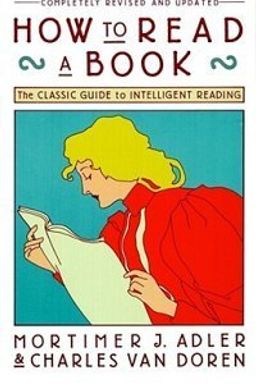
How to Read a Book cover

How to Read a Book

by Mortimer J Adler and Charles van Doren

Discover the timeless methods of intelligent reading with ''How to Read a Book.'' This enduring guide unlocks the secrets to mastering any text, from quick assessments to deep analysis, enhancing your comprehension and retention.

Reading as the Art of Understanding

How do you transform reading from the passive consumption of words into the active pursuit of understanding? How to Read a Book by Mortimer Adler and Charles Van Doren answers this question with a framework that treats reading as an intellectual discipline—an art of self-elevation where your mind actively engages with the ideas of another. The authors argue that true reading is not for entertainment or information-gathering alone; it is a means of growth, a practice in which you wrestle with a book until you understand what it means, why it matters, and whether it is true.

Adler begins with the premise that reading is a form of learning, and that learning can occur in two ways: aided (instruction) and unaided (discovery). When you read, your teacher—the author—is absent, so reading becomes a unique blend of both. You must simulate the dialogue that a teacher would have provoked, asking questions and seeking answers within the text itself. This 'active reading' transforms a seemingly solitary act into an intimate conversation with the mind on the page.

Active Reading vs. Passive Absorption

Adler insists that reading well requires effort and deliberate questioning. You cannot be a tape recorder, mechanically absorbing phrases. Instead, you act as a catcher to the author’s pitcher—the words are inert until you make contact with them through mental movement and judgment. To read well, you must read with the intention to understand what you have not previously grasped. A book that only adds to what you already know offers information; one that stretches your intellect fosters understanding.

The distinction is crucial: you read the newspaper or a magazine article for information, but you read Darwin’s Origin of Species, Aristotle’s Ethics, or Shakespeare’s plays to grow in understanding. Adler’s larger thesis is that great books demand this higher form of engagement—they invite you to climb toward their level of insight.

The Four Levels of Reading

To systematize this growth, Adler lays out four cumulative levels of reading: Elementary, Inspectional, Analytical, and Syntopical. Each level represents not a separate type but an increasing mastery. Elementary reading is the basic skill of decoding words. Inspectional reading, or strategic skimming, allows you to grasp the shape and surface of a text to decide whether it warrants deeper analysis. Analytical reading is the heart of the practice: the careful, slow, question-driven study of a single text. Finally, syntopical reading—the highest form—compares multiple books on a shared problem, translating them into common terms and constructing new insights beyond any single author’s view.

A Book as a Teacher

Since a book cannot answer questions directly, you must become both student and teacher. Adler distills this into four essential questions that drive all understanding: (1) What is the book about as a whole? (2) What is being said in detail, and how? (3) Is it true? and (4) What of it? These questions move you from discovery to critical evaluation, from comprehension to meaning. They are the backbone of the entire reading method.

Marking the book is part of this dialogue—annotating, underlining, summarizing, and noting arguments in the margins. You externalize thought so that reading becomes a visible act of thinking. By writing in your books and keeping notes—structural, conceptual, or dialectical—you are not defacing them, but claiming intellectual ownership.

The Unfolding Journey from Reading to Judgment

Adler’s method progresses from comprehension to interpretation to criticism. First you understand what the author says; only then can you judge it fairly. This sequence underlies his intellectual etiquette: never dispute before you fully understand. Criticism becomes an honest conversation when you can state an author’s argument better than he could himself and still disagree.

Ultimately, the purpose of reading well is not merely to accumulate knowledge but to build a more orderly and questioning mind. Like physical exercise, this mental effort strengthens your capacity for thought. Adler’s framework applies across genres—philosophy, history, science, poetry, and fiction—each demanding adjustments in technique but sharing the same core aim: to engage at the deepest level possible with the best that has been thought and said.

The Core Promise of the Art

To read well is to think well in company with others across centuries. Books are instruments for raising your mind, and active reading is the discipline through which the mind teaches itself to see farther and more clearly.

From decoding words to synthesizing ideas, from catching arguments to contributing your own, this art transforms books into a lifelong dialogue. Adler and Van Doren’s enduring insight is that reading, when done well, is not a passive pastime but a deliberate act of self-education—the foundation of all intellectual growth.


The Four Levels of Reading Mastery

To progress as a reader, you must understand that reading operates on four distinct yet cumulative levels. Each level represents a leap in skill and purpose, building the foundation for higher-order thinking. These levels—Elementary, Inspectional, Analytical, and Syntopical—form a ladder of understanding from basic literacy to intellectual synthesis.

Elementary Reading: The Foundation

Elementary reading is more than child’s work—it is the decoding of language into meaning. Even advanced readers revisit this when tackling a text in a new domain or confronting specialized jargon. Adler reminds you that many adults plateau at this level; their comprehension never moves beyond plot and plain exposition. To advance, you must move from reading for pleasure to reading for discovery.

Inspectional Reading: Systematic Skimming and Superficial Reading

Inspectional reading, the second level, is an efficient method for previewing and diagnosing a book. By reading title pages, prefaces, tables of contents, and crucial chapters, you can decide whether a book deserves deep study. Adler’s “superficial-first” rule advises you to read difficult books cover-to-cover once before stopping to analyze: a complete first impression often clarifies the author’s main argument better than sentence-level scrutiny.

This approach not only saves time but primes your mind for later analysis. Inspection reveals the architecture of a text and prevents you from confusing early puzzlement with incomprehension.

Analytical Reading: Thoughtful Understanding

Analytical reading is the intense engagement with a book’s argument. Here you dissect structure, locate key terms, reconstruct reasoning, and judge coherence. The process begins with four rules: classify the book, state its unity in a sentence, outline its major parts, and identify the author’s key problems.

Analytical reading demands patience and note-taking—underlining, annotating, summarizing. It is the level where active reading manifests most clearly because you converse with the text rather than merely hearing it.

Syntopical Reading: Comparative Understanding

The fourth level, syntopical reading, pushes you beyond single books. You select works on the same subject, prune irrelevant ones, and bring diverse authors into a structured dialogue. This discipline requires you to translate each author’s vocabulary into a neutral frame, pose shared questions, identify disagreements, and analyze how different traditions approach the same problem. (Note: This method parallels comparative analysis in research and academic criticism.)

Reading as a Climb Toward Mastery

Each level of reading transforms skill into judgment and judgment into wisdom. The syntopical reader does not seek agreement but clarity—mapping controversies, patterns, and frameworks that allow knowledge to progress.

When you learn to move gracefully among these levels—inspecting widely, analyzing deeply, and synthesizing thoughtfully—you gain the power to approach any subject with precision. In Adler and Van Doren’s view, this mastery makes reading an intellectual art equal to writing or teaching itself.


Analytical Reading: Thinking with the Author

Analytical reading is the centerpiece of Adler’s method, the bridge between comprehension and criticism. It demands that you read as an equal mind in dialogue with the author, reconstructing arguments and testing their integrity. The goal is to x-ray the book—to uncover its skeleton of ideas and understand its purpose before judging it.

Pigeonholing and Structural Insight

The first step is classification. Decide what kind of book you are reading: theoretical, practical, or imaginative; scientific, historical, or philosophical. Only then can you know what standards of truth or coherence to apply. From there, outline its unity in a concise sentence, identify its major parts, and state the primary problems the author seeks to solve. This “x-raying” exercise converts a long, confusing text into a manageable structure.

Coming to Terms

Next, you must 'come to terms' with the author—achieving shared meanings for important words. Words become terms when used unambiguously within a given argument. Many misunderstandings arise when you and the author use the same word differently. By marking recurring or confusing words, you identify key concepts that anchor the author’s reasoning. For instance, “species” in Darwin, “virtue” in Aristotle, or “capital” in Adam Smith each require contextual interpretation. Creating a list of such terms and their meanings ensures that you read what the author actually said, not what you assume.

From Sentences to Arguments

Once terms are clear, you extract propositions—the author’s claims—and then connect them into arguments. Adler recommends paraphrasing key sentences and identifying premises and conclusions. Ask whether the logic holds or if steps are missing. The test of comprehension is your ability to restate an argument in your own words and give examples. If you cannot paraphrase or exemplify, you’ve memorized words, not understood ideas.

Rule of Honest Understanding

Do not criticize a book before you can accurately summarize it. Only once you can teach its argument should you attempt to judge it.

Analytical reading, therefore, is not just interpretation—it is apprenticeship in disciplined thought. By constructing, testing, and refining arguments within the author’s context, you cultivate an internal dialogue that sharpens intellectual rigor and fosters independent insight.


Criticism and the Etiquette of Judgment

After understanding comes judgment. Adler urges you to critique with precision, not prejudice. The moral rule is simple: you may agree, disagree, or suspend judgment—but only after full comprehension. The purpose of criticism is not to defeat the author but to continue the search for truth collaboratively.

Rules for Intellectual Conduct

Adler’s rules of criticism (9–11) protect the quality of dialogue. First, never criticize before understanding. Second, avoid disputatiousness—the aim is clarity, not victory. Third, ground every judgment in reasons, not opinions. When you criticize, confine objections to four legitimate categories: the author is uninformed, misinformed, illogical, or incomplete. These categories anchor your judgment in evidence rather than bias.

Reading Practical Books

Not all books aim to inform; many aim to persuade or guide action. In practical works—ethics, politics, manuals—you must analyze both ends and means: What goal does the author propose? Are the means sound or applicable to your situation? Agreement implies moral or practical action. Understanding this differentiates philosophy from propaganda and self-help from genuine instruction.

Using Extrinsic Aids Wisely

Adler distinguishes between intrinsic reading (working solely from the text) and extrinsic aids (experience, reference works, commentaries). External aids can clarify meaning but must never replace first-hand reading. Lookup materials serve the book; they cannot interpret it for you. Reading summaries before originals, Adler warns, turns active engagement into passive dependency.

Criticism as Cooperation

Fair criticism respects the author’s intent, recognizes the limits of context, and adds to the discussion rather than closing it. Judgment is an extension of understanding, not its negation.

This stage of reading transforms comprehension into wisdom. Once you can articulate both the author’s truth and your reasoned disagreement, you have transcended the book—you’ve achieved the mature reader’s independence of mind.


How to Read Literature Intelligently

Adler extends his principles from informational to imaginative works, showing how the same active reading methods reveal layers of meaning in poetry, drama, and fiction. These genres differ from exposition: their primary aim is not to argue but to illuminate human experience and satisfy emotional, moral, and aesthetic needs.

Fiction and the Need for Moral Order

Readers hunger for the moral clarity that stories provide. Great fiction offers “poetic justice”—it restores order where life seems chaotic. When you read Tolstoy’s depiction of redemptive suffering or Shakespeare’s tragic insight, you receive emotional understanding without real loss. Adler observes that such stories endure because they make life intelligible through structure and justice. Choosing fiction that satisfies deep, universal needs, rather than passing taste, strengthens moral imagination.

Reading Plays as Performance

Plays are incomplete on the page; performance completes them. When reading drama, you must direct it in your imagination: cast voices, visualize motion, and interpret tone. The example of Hamlet shows how staging decisions—such as whether Hamlet overhears Claudius and Polonius—alter interpretation. Reading aloud and imagining stage action converts the text into a living dialogue between page and mind.

Understanding Lyric Poetry

Poems must be read as wholes first and aloud second. Their unity is emotional and rhythmic, not logical. Speaking the words discloses structure and emphasis. Repetition, rhyme, and image act as signposts toward the poem’s central conflict—often between time and love, life and death, or permanence and decay. Adler illustrates these tensions in Shakespeare’s sonnets, Marvell’s “To His Coy Mistress,” and Archibald MacLeish’s modern echoes. Reading for sound and unity, rather than fragmentary meaning, demystifies even “difficult” poems.

The Imaginative Mode of Understanding

In reading imaginative literature, you do not test factual truth but sympathetic truth—the truth of feeling and moral pattern. The test is coherence within the fictional world.

By approaching literature with the same respect for structure and unity you bring to philosophy or science, you increase both enjoyment and understanding. A play or poem mastered through active imagination becomes not only an aesthetic experience but moral training for reading life itself.


Reading the Disciplines: Science and History

Different kinds of books demand different kinds of reading. Adler distinguishes how to approach the exacting languages of science, mathematics, and history with the same underlying purpose: not to memorize data but to understand methods, assumptions, and universal insight.

How to Read Science and Mathematics

When reading science, focus on the question, not the formula. Newton, Galileo, and Darwin wrote to explain phenomena to educated but non-specialist audiences. Identify the problems they addressed and the evidence they marshaled. You may not reproduce all proofs but you can grasp the conceptual revolution they sparked. Hands-on experiments—recreating Newton’s prism tests or geometric constructions from Euclid—translate abstract claims into perception and reinforce understanding.

Mathematics, as the purest form of logic, is also a language. Learn its grammar by recognizing symbols, definitions, and proofs as parts of a complete reasoning system. Euclid’s Elements remains the model because it demonstrates perfect clarity: every conclusion flows from defined premises.

How to Read History

History must be read as interpretation, not as a sequence of brute facts. Like juries judging ancient testimony, historians reconstruct meaning from limited evidence. Because every historian selects and orders events, you must identify his theory or philosophy of history—Providence, class conflict, progress, decline. Great history, from Thucydides to Gibbon, seeks universality beneath particular events, revealing enduring patterns of human behavior. Reading multiple accounts of the same event exposes differences in selection and bias—a miniature exercise in syntopical reading.

Fact, Method, and Meaning

Science aims at laws; history aims at narrative understanding. But both demand you see beyond raw data to the structures of explanation that give facts meaning.

When you approach specialized disciplines this way—actively reconstructing problems and frameworks—you participate in humanity’s cumulative reasoning, not merely catalog its results. This attitude transforms technical or historical reading into a conversation across centuries about method, meaning, and truth.


Syntopical Reading and the Pursuit of Wisdom

At the summit of Adler’s hierarchy lies syntopical reading—the art of engaging many minds at once. This is the method of the scholar and the philosopher, but it is also a powerful practice for anyone seeking genuine wisdom. Syntopical reading moves you from mastery of single books to the creation of an intellectual map of a whole subject.

How to Read Across Books

Syntopical reading begins by defining your problem or question, then selecting works that address it. Through inspectional skimming you eliminate irrelevant books and isolate passages that speak to your specific topic. Then, as you read deeply, you construct a neutral vocabulary—your own language—into which all authors can be translated. You frame the central questions they appear to answer, line up conflicting answers, and arrange them into an organized discussion.

Adler outlines five steps: find relevant passages, bring authors to terms, clarify the questions, define the issues, and analyze the conversation. The Syntopicon from the Great Books project exemplifies this process, cataloguing hundreds of enduring ideas (“justice,” “progress,” “freedom”) and linking the passages that engage them.

Objectivity Through Dialectic

The aim of syntopical reading is not agreement but disciplined comparison. When you set Plato, Aristotle, Hobbes, and Locke in conversation on government, you occupy a higher vantage: the discussion itself becomes your subject. By juxtaposing diverse minds objectively, you map the boundaries of knowledge and ignorance in a given domain. The dialectical method—Balancing argumentative opposites—is not relativism; it is a searchlight that shows where real progress is possible.

The Reader as Synthesizer

Through syntopical reading, you cease being a student of single voices and become a participant in an ongoing dialogue among the greatest minds. The act itself is the education.

Adler sees this level as the culmination of all earlier ones—a collaborative enterprise across authors and eras. By reading syntopically, you practice the method of civilization itself: the disciplined comparison of ideas toward common understanding. This, for Adler and Van Doren, is both the highest form of reading and the essence of intellectual culture.

Dig Deeper

Get personalized prompts to apply these lessons to your life and deepen your understanding.

Go Deeper

Get the Full Experience

Download Insight Books for AI-powered reflections, quizzes, and more.