
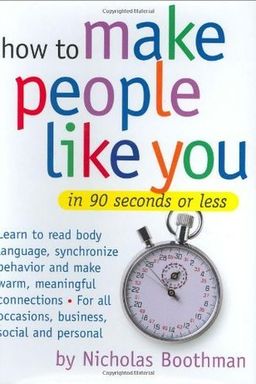
How to Make People Like You in 90 Seconds or Less cover

How to Make People Like You in 90 Seconds or Less

by Nicholas Boothman

Discover the art of making people like you in just 90 seconds! Nicholas Boothman provides practical techniques for mastering first impressions, building rapport, and enhancing your communication skills, paving the way for richer social interactions and professional success.

Making Instant Human Connections

Have you ever met someone for the first time and instantly felt like you’d known them for years? That magic spark—the effortless connection—is what Nicholas Boothman explores in How to Make People Like You in 90 Seconds or Less. Boothman argues that connection isn’t luck; it’s a learnable skill rooted in psychology, body language, and an understanding of how people perceive the world. The better you get at creating rapport quickly, the richer your personal and professional life becomes.

Across the book, Boothman distills his experience as a fashion photographer and NLP (Neuro-Linguistic Programming) practitioner into practical steps for winning people’s trust and affection almost instantly. He explains that rapport—what he calls “feeling in sync”—can be designed deliberately through physical openness, vocal tone, shared sensory language, and mindful attitudes. The author shows that nearly anyone can learn to project warmth and sincerity, engage others deeply, and make others feel at ease within moments of meeting.

The Power of First Impressions

Boothman begins by reminding us how quickly judgments form. Within a few seconds, people decide whether to trust, like, and listen to you. Those first moments activate ancient survival instincts—the brain subconsciously scans for cues of safety, familiarity, and friendliness. That’s why knowing how to present yourself matters so much. To communicate trust, your face, voice, and body must send one consistent message—a concept he calls congruity. When words, tone, and body language match, others perceive you as genuine. When they clash, people’s subconscious defenses rise.

For Boothman, likability isn’t about charm or manipulation; it’s about creating comfort. He defines rapport as a state of harmony in which mutual trust blossoms naturally. The book claims that mastering this skill can transform every area of life—whether you’re selling an idea, networking at work, or building deeper friendships. Connection is the key currency in relationships and success.

Rapport by Design

Some people “click” instantly because they share innate similarities. Boothman calls this rapport by chance: you find common ground naturally, like bonding with a stranger from your hometown. But the true art lies in creating rapport by design—consciously synchronizing your behavior to build connection quickly. Using strategies from NLP, Boothman shows how to adapt your tone, body language, and words to the other person’s patterns. This “mirroring” isn’t mimicking but entering someone’s world so they feel understood. In essence, likability means being similar enough that someone’s subconscious whispers, “We’re alike, so I can trust you.”

This approach reframes communication as a measurable, controllable skill instead of a mysterious intuition. By approaching first meetings intentionally, anyone can make others feel valued and seen. And once rapport is established, people open up easily—because at a deep biological level, connection signals safety.

Why Connection Matters

Boothman places connection at the center of what makes us human. From prehistoric tribes gathered around fires to online communities today, survival and happiness depend on cooperation. The book cites research showing that people with strong social ties live longer and report greater wellbeing. A community built on trust and connection becomes safer and more resilient. On an individual level, likability creates opportunities: when people like you, they help you, forgive you, refer you, and believe you.

Understanding this human dynamic transforms how you view first impressions—from social rituals into vital bridges of empathy. Boothman’s goal isn’t superficial networking; it’s emotional resonance. By learning a few practical tools, you gain the ability to connect across barriers of age, culture, or personality. You can become, as he often says, “the person people feel good around.”

The Promise of Change

Boothman insists that fast rapport can be learned by anyone—introvert or extrovert—because it builds on natural human instincts. He outlines specific tools like the five-step greeting (“Open–Eye–Beam–Hi!–Lean”), body language alignment, speaking in sensory terms, and listening actively. Each step moves you closer to emotional synchronicity—the moment when both people feel “in tune.” These tools don’t require new personalities, only awareness and practice.

Ultimately, Boothman’s message is simple but profound: other people are our greatest resource. Knowing how to make them feel comfortable, valued, and seen in under two minutes is one of life’s most important skills. As he puts it, people who connect easily live happier, richer, and even longer lives. This book is an invitation to master the art of instant rapport—turning strangers into allies, opportunities into relationships, and fear into curiosity.


The Greeting Formula: Open–Eye–Beam–Hi!–Lean

Boothman’s most memorable and immediately usable idea is the five-step greeting formula: Open–Eye–Beam–Hi!–Lean. It’s a deceptively simple, physical sequence designed to make strong first impressions in 90 seconds or less. Each action engages another layer of nonverbal rapport, sending unmistakable signals of friendliness and confidence.

Open: The Body as a Welcome Mat

“Open” refers to both your attitude and your posture. Before you even approach someone, drop your defensive gestures—unfold your arms, face them directly, and point your heart toward them. Boothman often uses the phrase “aim your heart at theirs.” This communicates honesty on a subconscious level. An open torso and visible hands signal safety, whereas crossed arms or closed jackets communicate guardedness. When you open up physically, your mindset follows.

Eye: Real Contact

Next, make eye contact first. People instinctively equate eye contact with attention and sincerity. In Boothman’s seminars, he trains participants to notice eye color in everyone they meet—a mindfulness exercise that transforms a fleeting glance into genuine focus. You’re literally “connecting through the eyes,” one of the most primal forms of human bonding.

Beam: Smile With Energy

After the eyes, comes the “beam.” Your smile should reflect the enthusiasm and warmth of your attitude—not a fake grin but what Boothman calls “a beam from the heart.” This visibly lifts others’ energy and reassures them you’re friendly. The combination of openness, eye contact, and a genuine smile activates trust within seconds.

Hi!: Voice and Name

Introduce yourself with a warm, confident “Hi!” or “Hello!” using positive tonality. Attach your name—“Hi, I’m Naomi”—and remember theirs by repeating it naturally once or twice (“Great to meet you, Glenda!”). According to Boothman, hearing one’s name instantly makes people feel valued. In his view, names are the fastest route to personalization and belonging.

Lean: The Subtle Signal of Interest

Finally, “lean” slightly toward the person—literally and metaphorically. This minimal forward movement communicates engagement without invading space. It can also extend to the handshake or what he calls the “hands-free handshake,” where you project the warmth of a handshake through posture and tone even when a physical shake isn’t possible. This gentle lean completes the nonverbal loop of welcome, showing curiosity and care.

Together, these five micro-actions form a repeatable system for instantly making people comfortable. Whether you’re meeting a potential client, a coworker, or a stranger on a train, this formula announces confidence, kindness, and openness faster than words can.


The Role of Attitude in Human Connection

Everything begins with attitude. Boothman distinguishes between Really Useful Attitudes—curiosity, enthusiasm, warmth—and Really Useless Attitudes—anger, cynicism, boredom. Your attitude, he argues, controls your body language and voice tone automatically, so choosing the right mental stance before any meeting shapes your entire presence. People don’t respond to what you say as much as to how they feel around you.

Attitudes Are Contagious

Boothman illustrates with stories—like Joanne, the cheerful bank teller who transforms a mundane institution into a welcoming place. She radiates two simple attitudes—cheery and interested—and everyone benefits from her presence. Positive energy boomerangs back. In contrast, negative emotions spread just as fast: the angry customer, the impatient doctor, the uninterested salesperson. Each shuts down rapport instantly.

Choosing the Right Attitude

Attitude isn’t fixed; it’s a choice. Boothman urges readers to ask, “What do I want right now, and which attitude will serve me best?” It’s a mental rewrite from victimhood (“I don’t want my boss yelling again”) to ownership (“I want my boss’s job”). This approach mirrors cognitive reframing techniques found in modern psychology (similar to Carol Dweck’s “mindset” framework). When you expect cooperation and warmth, your body automatically mirrors those qualities.

Triggering Useful Attitudes

Using NLP principles, Boothman teaches how to anchor positive feelings physically. The exercise “Triggering Happy Memories” guides you to recall a vivid moment of warmth or curiosity and link it to a physical gesture—like clenching your fist. Later, when you need that feeling, repeating the gesture instantly resurrects the emotion. Over time, this conditioning allows you to access your ideal attitude on demand before any interaction.

A Really Useful Attitude is the foundation of rapport. It ensures your facial expressions, tone, and movements align automatically, creating congruity. People may forget what you said, but they will always remember how you made them feel. And how you made them feel always starts with how you decide to feel first.


Body Language and Congruent Communication

Body language communicates louder than words, accounting for what Boothman calls the 55% component of our communication “package.” Building on Albert Mehrabian’s famous research, he explains that 55% of believability is visual, 38% vocal, and only 7% verbal. People believe what they see, not necessarily what they hear.

Open vs. Closed Postures

Open body language—unfolded arms, direct posture, uncrossed legs—signals trust and willingness. It “exposes the heart,” Boothman says poetically. Closed body language does the opposite: crossed arms, defensive gestures, and fidgeting subconsciously broadcast resistance or fear. In one story, a computer salesman loses a customer named Rosa because his gestures contradicted his words; when his body closed up, she sensed dishonesty. Congruence, Boothman stresses, is the golden rule: when gestures, tone, and words disagree, people always believe the gestures.

Practicing Congruity

To appear trustworthy, all channels—body, voice, words—must align. Boothman encourages practicing self-awareness by observing how tone changes meaning. Saying, “It’s late” with anger, boredom, or flirtation transforms the message entirely. Once you understand this interplay, you can deliver any emotion deliberately and truthfully. Congruent communicators radiate sincerity because their internal state matches their external expression.

Nervousness vs. Excitement

Being yourself means channeling nervous energy into excitement. Physiologically, both states share the same symptoms—racing heart, quick breathing, butterflies—but one propels you forward while the other freezes you. Boothman offers a trick: imagine your nostrils are below your belly button and breathe deeply there. Slow breaths send your body the signal that you’re calm and confident. The slower your pace, the more in-control you appear. This technique echoes performance strategies used by actors and public speakers.

Congruent communication isn’t about perfection—it’s about alignment. If your attitude, tone, and body speak the same language, you build credibility instantly. Your physical openness and composure tell others they’re safe, allowing rapport to flourish naturally.


Synchronizing: The Dance of Rapport

Boothman likens rapport to a dance—an unconscious synchronization of posture, gestures, and rhythm. This mirroring, often called matching and pacing in NLP, happens naturally among friends and couples but can also be cultivated intentionally. The idea is to reduce the distance between you and the other person, signaling shared experience and trust.

Matching and Mirroring

There are two primary forms: matching (doing the same movement with the same side of your body) and mirroring (moving as if you’re their reflection). For instance, if someone crosses their right leg, you might cross your left. Used subtly, these micro copies align two nervous systems unconsciously. Boothman emphasizes that the goal is never mimicry but harmony—what psychologists term “behavioral synchrony.” People simply feel more comfortable with those who seem similar to them.

The Power of Leading

Once synchrony is established, you can test rapport by gently changing your posture or tone. If the other person follows, you’re in sync—and now leading. Boothman uses this technique to calm angry clients or warm up shy people. A supermarket example shows how synchrony can even neutralize hostility: a salesperson mirrored a furious buyer’s gestures until they softened and eventually smiled. Synchronizing allows you first to join their world and then guide them to yours.

Synchronizing All Channels

True synchrony occurs across multiple dimensions—body language (visual), tone and rhythm (vocal), and chosen words (verbal). This echoes Professor Mehrabian’s “three V’s.” Boothman also includes breathing patterns and tempo: fast talkers align with fast talkers; calm speakers match calm ones. The goal is to make the other person feel subtly understood without realizing why.

The practice takes just seconds but yields profound results. Whether at a dinner party or job interview, synchronization signals empathy beyond words—the social equivalent of harmony in music. Once you master it, people often say, “Haven’t we met before?” That’s rapport by design at work.


Speaking the Right Language: Visual, Auditory, Kinesthetic

One of Boothman’s most fascinating ideas stems from NLP research: people filter reality primarily through one of three sensory systems—seeing (Visual), hearing (Auditory), or feeling (Kinesthetic). By identifying which system a person favors and speaking their language, you deepen rapport effortlessly. This sensory synchronicity bridges the gap between “talking” and truly understanding.

Spotting the Patterns

Visual people talk fast, use imagery words (“I see what you mean”), and are concerned with appearance. Auditories prefer melodic voices and phrases like “That sounds right.” Kinesthetics speak slowly, grounded in feelings (“I get a warm sense about this”). Boothman provides vivid scenes—from a flooring-store salesperson getting a tough customer to kneel down and feel a carpet, to a husband realizing his “auditory” wife needs to be told rather than shown love.

Using Sensory Vocabulary

Boothman supplies extensive word lists for each type, encouraging you to tune your communication accordingly. To a Visual, say “See the possibilities.” To an Auditory, say “That sounds great.” To a Kinesthetic, say “You’ll feel comfortable with this.” These slight linguistic shifts can make conversations more resonant because you’re meeting people on their own wavelength. (This mirrors Dale Carnegie’s principle of “speaking in terms of the other person’s interests.”)

Eyes, Movement, and Accessing Cues

Boothman adds an intriguing observation: eye movements often reveal sensory processing. People looking up visualize, side-to-side listen, and downward reflect or feel. Recognizing these patterns helps you frame responses in language that fits their internal experience. In short, you learn to “see through their senses.”

When you align your language with another’s sensory mode, conversations flow with almost magical ease. You bypass resistance, communicate empathy, and help others feel genuinely understood—not by changing yourself, but by tuning in more finely to them.


Conversation that Connects

Many people panic when small talk begins to fizzle, but Boothman reframes every conversation as an opportunity to uncover common ground. His method: ask open questions that get others talking, listen actively, and respond with warmth and curiosity. The goal is not to impress but to invite.

Open vs. Closed Questions

Closed questions demand yes/no answers (“Do you like your job?”). Open questions begin with who, what, where, when, why, or how (“What do you enjoy most about your work?”). These spark storytelling, reveal attitude, and provide “free information”—the building blocks of deeper rapport. Pair each question with a location or occasion statement to ease into talk: “This conference room is gorgeous—how long have you worked here?”

Active Listening

Great connectors aren’t talkative—they’re attentive. Active listening means responding to emotion as much as to content. Instead of “parrot phrasing” (repeating someone’s words), Boothman suggests “empathic reflecting”: “That sounds exciting. How did it feel?” Nonverbal encouragement—nodding, smiling, gentle laughter—keeps communication flowing. Like Carl Rogers’s humanistic listening model, it turns talk into validation.

The Art of Conversation Starters

Boothman provides dozens of practical “openers” for every scenario: markets (“How can you tell if these are ripe?”), planes (“How long are you staying in Duluth?”), hotels (“What inspired your trip?”), or conventions (“What talk excited you most?”). His rule of thumb: give the other person three chances to respond—if they don’t, gracefully exit. Being considerate is as important as being friendly.

By weaving curiosity, sensory language, and genuine listening, you create conversations that feel effortless. As Boothman notes, “The mind delights in making connections.” Each question, gesture, and shared laugh builds the invisible bridge that turns encounters into relationships.


Living the Connected Life

Beneath all of Boothman’s techniques lies a deeper philosophy: connection is the essence of human life. We thrive emotionally, physically, and even biologically when we connect. Studies he cites show that people with strong social bonds live longer, recover faster, and contribute more meaningfully to their communities. In one tight summary line, he writes: “People who connect live longer. People who connect get cooperation. People who connect feel safe.”

Connection as a Life Skill

Boothman treats rapport as a core human literacy, not a sales trick. When practiced often, the behaviors become automatic—like riding a bike once you stop overthinking. The shift from fear to curiosity transforms everyday interactions: meeting neighbors, negotiating at work, or apologizing after conflict. You move from performing connection to assuming connection as your natural state.

Building a Connected Community

He also argues that connection scales. A society of open, rapport-driven people becomes stronger, safer, and more collaborative. Every brief, respectful exchange—thanking a barista, smiling at a stranger—builds communal trust. Connection, in Boothman’s worldview, ripples outward from one interaction to cultural evolution. This echoes Edward Hallowell’s work in Connect, which likewise finds emotional connection essential to mental health.

Assume Rapport

The final chapters urge readers to “assume rapport”—enter every conversation believing it’s already there. This attitude of trust transforms hesitation into possibility. Boothman ends with stories of students, businesspeople, and even teenage job seekers who apply these tools to change their lives. His recurring mantra reframes optimism as strategy: expect connection, and you’ll create it.

In the end, How to Make People Like You in 90 Seconds or Less isn’t a book about manipulation—it’s about returning to our natural human design. By choosing positive attitudes, aligning body and words, listening deeply, and speaking to people’s senses, you’ll find that warmth and trust cease to be tactics. They become who you are.

Dig Deeper

Get personalized prompts to apply these lessons to your life and deepen your understanding.

Go Deeper

Get the Full Experience

Download Insight Books for AI-powered reflections, quizzes, and more.