
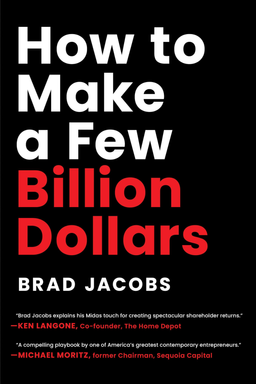
How to Make a Few Billion Dollars cover

How to Make a Few Billion Dollars

by Brad Jacobs

How to Make a Few Billion Dollars offers a strategic guide to crafting a team capable of achieving extraordinary business success. Learn the art of recruitment, management, and motivation to elevate your company''s performance and reach financial heights.

How Billion-Dollar Thinking Rewires the Brain

What really separates billionaires from everyone else? Is it luck, talent, or timing? Brad Jacobs argues in How to Make a Few Billion Dollars that the answer lies in something more fundamental—how they think. Jacobs, who built multiple multi-billion-dollar companies across industries, contends that to achieve extraordinary financial success, you need to rearrange your brain to think differently, and act with focus, optimism, and humility. The book is not merely about wealth accumulation; it’s a blueprint for rewiring your mental, emotional, and strategic operating system to perform at world-class levels.

The Billionaire’s Mindset

Jacobs begins with the observation that the most successful people—from scientists to CEOs—operate with a distinct mental discipline. They think expansively, challenge their automatic negative thoughts, and approach problems with calm curiosity instead of fear. He shows, through stories ranging from oil trading to logistics empires, that wealth creation depends more on psychological conditioning and decision habits than on raw intelligence. His philosophy, influenced by cognitive behavioral therapy (CBT), mindfulness, and positive psychology, invites you to reshape patterns of thought—learning how to refute internal negativity and expect positive outcomes. Like Aaron Beck and Albert Ellis, whose CBT models reframed human behavior, Jacobs believes your ability to choose “the mental lens” determines not just happiness but also profit.

Expanding the Possible

A recurring theme is mental expansion. Jacobs often uses what he calls “thought experiments”—from imagining the Big Bang to meditating on the vastness of the universe—to train his brain for non-linear thinking. This sense of cosmic scale allows him to stay calm and creative under pressure. For example, during negotiation crises, he recalls moments of deep love to center his emotions. This, in turn, enables better decisions and more empathetic leadership. His message: your mental flexibility defines your success far more than external factors do.

Humility and Love as Business Tools

Jacobs isn’t just describing mental gymnastics; he’s advocating emotional intelligence at an extreme level. “Throwing love vibes,” as he calls it, involves deliberately invoking feelings of love and gratitude—even during high-stakes negotiations. Such techniques, inspired by Martin Seligman’s positive psychology, reduce friction and build trust. The lesson: calm state of mind + expansive empathy = better deals. Likewise, humility anchors ambition. He recounts the story of his jazz mentor, Bill Dixon, who chastised him for “chasing money,” reminding Jacobs that purpose matters more than prestige. This balance—ambition rooted in humility—is his antidote to the intoxicating arrogance that derails many entrepreneurs.

A Framework for Big Success

Across the rest of the book, Jacobs develops the framework for multiplying value. After restructuring the mind, he teaches how to identify major trends (especially technological ones), execute mergers and acquisitions at speed, recruit “outrageously talented people,” lead electric meetings, and build cultures that crush competition through clarity, collaboration, and open communication. Each chapter translates his own track record—from Amerex Oil Associates to XPO Logistics—into replicable principles: get the big trend right, move fast on high-quality M&A, fire kindly, and never stop listening.

Why This Matters

Jacobs’s argument echoes lessons from Ray Dalio’s Principles and Jim Collins’s Good to Great: sustained billionaire-level performance comes from disciplined thinking and radical self-awareness. He adds, however, a deeply human dimension—love, humility, and curiosity are not soft traits but essential business advantages. In a world obsessed with quarterly profits, Jacobs reframes success as a spiritual and intellectual pursuit where money follows mastery of mindset. His recurring invitation—“Think huge”—reminds you that creating a billion-dollar company isn’t just an external act of scaling, but an internal act of transformation.

Core Premise

To make a few billion dollars, you must realign how you think, feel, and lead—cultivating radical optimism, deep empathy, and cosmic perspective. Success isn’t about chasing money; it’s about building the kind of mind that money chases.


Get the Big Trend Right

Jacobs’s mentor Ludwig Jesselson gave him advice that became his lifelong mantra: “You can mess up a lot of things in business and still do well—as long as you get the big trend right.” This idea underpins Jacobs’s string of billion-dollar successes. He approaches every new venture by identifying industries where scalability meets transformation—where tech or cultural forces create enormous shifts. His method is meticulous research, obsessed learning, and direct dialogue with experts.

Learning from Two Million Years of Technology

Jacobs takes a long historical view, tracing technological progress from stone tools to artificial intelligence. The takeaway: technology evolves faster every century, compressing opportunity windows. Every industry that “merges with tech,” he says, creates exponential returns. That’s why he integrates automation, robotics, and AI into every company he builds. His timeline—from fire to smartphones—is more than trivia: it’s proof that staying aligned with technological acceleration is essential for survival. (Yuval Noah Harari’s Homo Deus similarly explores this evolutionary convergence of human and machine.)

Research with Obsessive Curiosity

Before investing, Jacobs reads everything—academic journals, SEC filings, and analysts’ reports. He compiles questions for CEOs, investment bankers, and venture capitalists, then meets them face-to-face. He treats these interviews as dialectical conversations, often challenging experts to defend contradictory views. For you, the lesson is simple: before risking capital, study the trend until you understand its downside as clearly as its promise. He encourages creating word clouds, pattern maps, and “pros and cons universes” to uncover bias-free insight.

AI: The Mothership of the Future

Jacobs predicts that AI will redefine industries far beyond software. He warns that refusing to integrate AI is like ignoring electricity in 1900. Yet, he also recognizes its paradox: AI can obliterate companies as easily as it empowers them. He cites accounting, legal, and education sectors as high-risk examples where automation will compress margins and obliterate traditional roles. Conversely, logistics, healthcare, and manufacturing will thrive through AI optimization. His question for every aspiring entrepreneur: Is my industry converging with AI—or getting eaten by it?

Spotting Actionable Trends

Jacobs’s own ventures illustrate the payoff of correct trend alignment: unified data sharing in oil (Amerex), waste routing software (United Waste Systems), dynamic pricing and equipment standardization (United Rentals), and full automation in freight brokerage (XPO). Each rode the vanguard of its time. His approach parallels how Elon Musk pairs technology vision with industry transformation—from electric cars to rockets. The philosophy: find sectors on the cusp of disruptive clarity, not crowded hype.

Step Outside the Noise

Jacobs also emphasizes resilience against public doubt. He recalls examples like IBM’s Thomas Watson claiming only “five computers” would suffice, and Newsweek’s Clifford Stoll dismissing e-commerce in 1995. To stay sane, you must see past the noise. He credits futurist Ray Kurzweil’s idea of the “Singularity”—where humans and tech merge—as an influence, speculating that Homo sapiens might evolve into a hybrid species this century. Whether or not you agree, Jacobs insists that great entrepreneurs are futurists by necessity, not choice.

Core Premise

To build billion-dollar companies, cultivate the intuition for what’s coming next—then commit fully before everyone else believes in it. Getting the big trend right forgives most other mistakes.


Mastering High-Quality M&A

Jacobs became a billionaire serial entrepreneur largely through mergers and acquisitions. He believes M&A is the sharpest weapon for scaling fast—but only if done with discipline, empathy, and speed. Across 500 deals, he learned that success depends not on financial engineering but emotional intelligence and operational clarity.

The Philosophy of Smart Buying

For Jacobs, every acquisition begins with one question: “Does this deal make us better, not just bigger?” He defines winning deals as accretive to long-term shareholder value, not vanity projects. Drawing from hard lessons—like the failed sale of United Rentals to Cerberus before the 2008 crash—he drills down on risk management. His rule: if the downside isn’t tolerable, walk away. Like Warren Buffett’s margin of safety principle, he insists on scenarios where even worst-case performance still yields solid returns.

Respect and Culture Fit

M&A, Jacobs says, is human psychology disguised as corporate finance. Sellers are emotionally invested and fearful; respecting that emotion is pivotal. He cites his wife's “three Ps”—patient, pleasant, polite—as the secret to deal success. Early in his career, his aloofness cost him acquisitions. Later, he learned to express genuine enthusiasm and clarity up front, balancing firmness on must-haves with openness on trivial preferences. His CIA friend Dick Houston, who analyzes honesty during deals, exemplifies the subtle interplay of psychology and due diligence.

Integration: The Hard Part

Integration, not acquisition, makes or breaks value creation. Jacobs divides it into cultural and operational phases and insists the first task is harmonizing human energy. He treats post-acquisition teams with humility and gratitude instead of domination. At XPO, simultaneous integration of $7 billion worth of deals taught him the power of “overorganization.” Each task was owned individually, tracked weekly, and refined through constant feedback loops. “Everyone has a plan until they get punched in the face,” he quotes Mike Tyson, reminding that flexibility wins the integration war.

Speed Without Pressure

Jacobs’s signature is pace: turning months of due diligence into weeks through rigorous pre-meeting preparation. His teams study targets like analysts and move fast, but avoid pressure. Running multiple parallel conversations reduces emotional dependence on any single deal—a tactic also used by private equity giants. He believes that maintaining calm intensity yields better negotiations and smoother outcomes. His metrics include “wash, rinse, repeat” systems for continuous M&A quality improvement.

Core Premise

High-quality M&A requires combining analytical rigor with emotional intelligence—respecting sellers, integrating cultures, and aiming for results that are beautiful not just on spreadsheets but in human terms.


Building an Outrageously Talented Team

Jacobs insists that people, not products, create billions. “An organization is like a party,” he writes. “You only want to invite people who bring the vibe up.” His hiring philosophy boils down to four traits: intelligence, hunger, integrity, and collegiality. He learned through multiple CEOs—Mario Harik (XPO), Malcolm Wilson (GXO), and Drew Wilkerson (RXO)—that diversity in personality doesn’t matter if alignment in values does.

Intelligence Over Pedigree

Rejecting pure credentialism, Jacobs prioritizes genuine cognitive agility. A top university or high SAT score might show discipline, but not necessarily capability. True intelligence, he says, manifests as curiosity, dialectical thinking, and adaptability. Like Richard Feynman’s scientific humility, Jacobs favors people who “can change their opinion.” At XPO, most hires had mental reflexes sharper than their CEO’s, producing what he calls “electric energy in meetings.”

Hunger and Motivation

A billion-dollar culture cannot tolerate complacency. Jacobs hires hungry people who love hard work and are “motivated to make a lot of money.” He treats material ambition not as greed but as passion. Lean staffing amplifies hunger—a slightly understaffed team, he explains, outperforms an overstaffed one. He even monitors burnout levels to ensure sustainable drive. His managerial act of telling star performers to “chill, recharge, and come back swinging” reflects humane intensity.

Integrity and Collegiality

Integrity is non-negotiable. “If someone lies about small things, they’ll lie about big things,” Jacobs warns. He screens for people whose words and actions match. Collegiality—kindness, humour, and baseline civility—also defines long-term success. The cruelly competitive may win short-term, but collaborative empathy compounds trust. At XPO, employee surveys routinely scored over 9/10 in job satisfaction, proving that kindness can scale profitability. (Similar themes echo in Satya Nadella’s transformation of Microsoft’s culture through empathy.)

Overpay and Align

Jacobs defies corporate frugality by “overpaying” top performers. His alignment model ties bonuses and equity directly to shareholder value. He cites billionaire Dick Colburn’s insight: profit-sharing drives loyalty and excellence. Jacobs reviews equity holdings regularly for fairness, extending ownership deep into the organization. By ensuring everyone profits proportionally, he turns employees into entrepreneurs—motivated not by directives but ownership. “Don’t be cheap with talent,” he advises, “they’ll make you rich.”

Core Premise

To build an outrageous team, hire brilliant, hungry, ethical, kind people—and pay them extravagantly. The ROI on human excellence eclipses any other investment.


Run Electric Meetings

Boring meetings, Jacobs argues, are corporate diseases. His antidote: “electric meetings” where ideas spark like neurons. Borrowing from his education at Bennington College—where small, intense seminars demanded active participation—he designs meetings around engagement, crowdsourcing, and spontaneity. Every discussion should feel like a live jazz improvisation, not a scripted performance.

Small Groups, Big Energy

Jacobs caps meeting size at 15–20 people—large enough for diverse input, small enough for intimacy. He encourages cross-functional attendance so leaders see beyond silos. This holistic awareness keeps decisions company-wide, not department-deep. Operating reviews (MORs and QORs) are the nerve center, rotating monthly and quarterly to assess progress. Each participant reads the deck beforehand, submits ranked questions, and crowdsources the agenda; no one enters unprepared.

Moderators and Spontaneity

He frequently chooses “surprise moderators”—sometimes junior staff—to maintain neutrality and authenticity. The goal: remove spin, invite honest debate, and replace monologue with dialogue. Jacobs detests pre-rehearsed corporate theater, preferring unscripted Q&A even in investor meetings. “If you can predict the outcome of a meeting before it starts,” he quips, “cancel it.” This mirrors Peter Drucker’s view that true management requires constant learning amid uncertainty.

Rules of Energy

Jacobs enforces four simple rules: turn off devices, one person speaks at a time, no side conversations, and disagree respectfully. Violating them—even for senior executives—results in temporary bans. When empathy and attention are enforced as discipline, psychological safety emerges. He ends meetings with positivity rituals: participants must name teammates whose “stars went up” and affirm what they admire about them. Such acts convert communication into connection, the currency of sustainable innovation.

Crowdsourcing and External Meetings

Jacobs extends crowdsourcing to external audiences. During fireside chats and global calls, he lets attendees set the agenda. This reversal generates engagement and trust—people remember how you made them feel, not your slides. His communication philosophy blends mindfulness and management: validate first, correct second. By pairing disagreement with respect, he turns confrontation into collaboration. (John Gottman’s research on communication in relationships echoes this dynamic balance of validation and critique.)

Core Premise

Meetings should be alive, authentic, and emotionally safe. When ideas collide respectfully in an electric atmosphere, innovation becomes inevitable.


Kill Competition, Not Each Other

Jacobs’s most human chapter reframes competition as cooperation. He compares great corporations to superorganisms—like ant colonies—that function as unified, communicative entities. The goal of leadership, he says, is to channel collective intelligence while preserving individuality. “We can learn from ants,” he writes, “but we’re not ants.”

The Superorganism Mindset

Inspired by Edward O. Wilson’s The Superorganism, Jacobs observes that ants achieve perfection through cooperation, not competition. Likewise, successful companies operate as living systems—interdependent, responsive, and communicative. His jazz background reinforces this metaphor: musicians harmonize through listening and improvisation, just as teams must blend structure with spontaneity.

Communication Everywhere

Jacobs’s motto is “over-communicate.” Every employee deserves transparency. At XPO, he instituted open social channels, direct emails, town halls, and employee surveys. His principle: clarity kills fear. It’s backed by psychology—uncertainty breeds anxiety more than bad news does. He also extends openness to board members, granting them full access to internal data and staff—a radical move compared to most companies. The effect: trust above bureaucracy.

Listening as Leadership

Jacobs elevates listening to spiritual discipline. He draws from Marina Abramović’s performance art “The Artist Is Present”—silent connection as dialogue. True listening, he argues, requires non-judgmental concentration. He invites employees to email or call him directly, promising personal attention. In one case, a worker reported a leaking roof; Jacobs acted in days. He treats listening as sacred reciprocity between leader and follower.

Feedback as Gold

Instead of suppressing criticism, Jacobs democratizes it. At XPO, every employee receives quarterly surveys asking: “What’s your best idea?” and “What’s the stupidest thing we’re doing?” Results are published company-wide without censorship. “Criticism isn’t dirty laundry—it’s gold,” he says. Radical transparency turns gripe into insight and builds agile cultures capable of self-correction. (This recalls Ray Dalio’s feedback-driven meritocracy at Bridgewater Associates.)

External Trust

Jacobs applies the same openness to investors and customers. When XPO lost a $600M account, he practiced radical acceptance—publicly acknowledging the loss, reassuring employees, and strategizing recovery rather than hiding embarrassment. Within two years, XPO tripled its market cap. His crisis playbook is simple: confront facts fast, communicate everywhere, and refocus on service quality. Trust multiplies faster than capital.

Core Premise

The most competitive cultures are the most collaborative ones. When communication flows openly—from CEO to frontline worker—the company evolves into a self-healing, billion-dollar organism.


The Entrepreneurial Spirit

In his closing reflections, Jacobs returns to the heart of the book: entrepreneurship as virtue. Making billions, he argues, is not about wealth itself but about fulfilling a dual purpose—serving society and mastering yourself. He sees markets as moral arenas where prosperity arises from value creation, not extraction.

Profit as Purpose

Jacobs links every venture to social good: United Waste cleaned America’s landfills, United Rentals improved industrial safety, XPO optimized logistics efficiency. Free markets reward solutions that uplift society. “I never forget,” he says, “that my teams and I are fiduciaries for other people’s money.” Like Adam Smith’s invisible hand, his capitalism is ethical stewardship.

All-In Attitude

Jacobs’s personal story—from teenage meditation to founding Amerex—embodies lifelong enrichment. He recalls attending Rhode Island’s “Governor’s School for the Gifted,” where he learned that greatness demands total dedication. “Go all in or go home,” he tells readers. Every major success in his career mirrors this mindset: immersion, creative risk, and emotional involvement. He treats work as art, a mirror of life energy, echoing Steve Jobs’s view that entrepreneurship is “a form of self-expression.”

Beyond Money

Jacobs closes with humility: money is fun, but meaning matters more. He dedicates his success to everyday entrepreneurs like Steve, his HVAC technician, who takes pride in honest service. Billion-dollar and small-business builders share one spirit—the desire to improve life through value creation. This democratizes Jacobs’s philosophy: anyone who works with intensity, creativity, and compassion participates in the entrepreneurial tradition.

Core Premise

Entrepreneurship is a calling to create value and meaning simultaneously. When you go “all in,” wealth becomes a byproduct of passion, discipline, and service.

Dig Deeper

Get personalized prompts to apply these lessons to your life and deepen your understanding.

Go Deeper

Get the Full Experience

Download Insight Books for AI-powered reflections, quizzes, and more.