
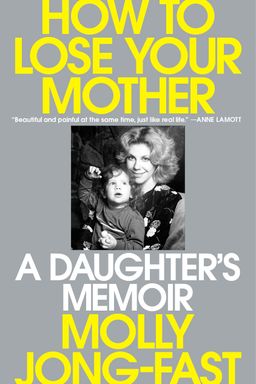
How To Lose Your Mother cover

How To Lose Your Mother

by Molly Jong-fast

A contributing writer at Vanity Fair and podcast host describes her relationship with her mother, Erica Jong.

Loving a Famous Mother as She Vanishes

What do you do when the person who made you—your mother, your myth, your measuring stick—can no longer remember who you are? In How to Lose Your Mother, Molly Jong-Fast argues that daughterhood in a family like hers is a lifelong negotiation with three relentless forces: fame, addiction, and disappearance. She contends that fame acts like a virus, alcoholism like a fog, and dementia like an eclipse—each reshaping love, identity, and duty until you’re forced to reinvent what being a “good daughter” means.

This is a memoir about a daughter raised in the blast radius of literary celebrity—Erica Jong’s Fear of Flying and the cultural stagelight that followed—and then called, in midlife, to locate her mother inside a fast-narrowing world. Along the way, Jong-Fast manages a second catastrophe: her husband Matt’s pancreatic neuroendocrine tumor. She learns to hold competing truths: you can be grateful and burned out, loyal and resentful, loving and still unwilling to destroy your own life in the name of caretaking.

The Book’s Core Argument

Jong-Fast’s core claim is that losing a mother you never quite had is a specific, complicated grief—a “both/and” loss. It’s the ache of ambiguous loss: the person is physically present but psychologically absent (family therapist Pauline Boss popularized this frame). The daughter’s work becomes twofold: to protect a parent’s failing dignity while refusing to re-enter the family’s denial system that once kept addiction and chaos running. To survive, you have to build boundaries strong enough to hold love and truth at the same time.

What You’ll See Unfold

First, you’ll see how fame reconfigured her family. Erica Jong’s success—the Tonight Show, Newsweek covers, the cultural shock of the “zipless” idea—brought money, adulation, and a chronic inability to become “unfamous.” For Molly, this translated into being an accessory to a public brand: the daughter who absorbed strangers’ projections about feminism, sex, and celebrity, while often missing the private, ordinary mothering most kids take for granted.

Second, you’ll walk through the multigenerational undertow of alcoholism: a grandmother (Eda) who raged and drank, a brilliant mother who functioned yet disappeared nightly into white wine, and a teenage Molly who went the other way—into inpatient treatment at nineteen, then decades of sobriety. She describes AA’s practicality, its unglamorous rooms, and why anonymity never shielded her mother from using it as source material. (Compare to Mary Karr’s The Liars’ Club for a parallel arc of maternal love complicated by addiction.)

Third, you’ll enter the brutal logistics of caregiving. The early red flags (repetitive questions, lost nouns, wrong years), the neurologist in caftans (Dr. Devi), the denials, and then the non-negotiable thresholds: feces in sheets, unpaid bills, unsafe living, and finally, the World’s Most Expensive Nursing Home. Jong-Fast gets power of attorney, hires aides, battles over showers, sells the apartment, navigates pot prescriptions and poodles, and lives with the refrain in her head: “I am a bad daughter.”

Why It Matters—To You

You don’t need a famous mother to recognize these dynamics. Many adult children of alcoholics and adult children of cognitively impaired parents will see themselves in the toggling pronouns—she is/was—and in the bargaining around responsibility: How much do I sacrifice? When do I choose my children over my parent? What counts as betrayal—and what counts as sanity? Jong-Fast insists that you cannot love someone out of dementia or addiction, and you cannot save them by vanishing yourself. The moral center she lands on is paradoxical: boundaries are an act of care, not abandonment.

How the Book Moves

The memoir interleaves past and present. We move from eighty’s New York—haunted townhouses, stalkers on the stoop, exotic dinner parties, diet pills and Bergdorf binges—to present-tense crises: an Instagram “Neat” on a friend’s memorial post, a dementia workup on East 76th Street, and the strange calm of a cancer clinic where “curative” is a rare word. The past contextualizes the present caregiving: a daughter who once waited outside a locked office for attention now stands outside a memory-care unit negotiating bath schedules and wine restrictions.

Throughline

You don’t get to control the order of losses, but you can decide which stories you’ll keep. The only way through is through—forward, eyes open, without lying to yourself.

What You’ll Take Away

Expect a field guide to loving someone you’re losing, written by a daughter who learned to triage truth and tenderness. You’ll see practical markers for cognitive decline, scripts for hard conversations, and the math of eldercare that never quite works. You’ll also see how writing can be both a betrayal and a benediction. By the end, as Jong-Fast and her husband walk their dogs at night, newly minted as the “grown-ups,” the book delivers a steady, unsentimental hope: you can be the adult your childhood didn’t give you, even if you still carry its echoes.


Fame as a Lifelong Virus

Jong-Fast presents fame not as a boon but as a chronic condition. When Fear of Flying made Erica Jong a household name, the family system reorganized around her celebrity. There were limousine arrivals, the Tonight Show, and a generation of readers who mapped their sexual and feminist awakenings onto a novelist. But in the memoir’s telling, fame behaves like a virus—it infects identity, metabolizes attention, and leaves withdrawal symptoms long after the spotlight shifts.

How Fame Rewrites a Person

Molly notes that “becoming unfamous” wasn’t a return to baseline for her mother; it was a second illness. Erica’s story slots alongside her own father’s father, Howard Fast (author of Spartacus), who struggled with fading renown. The shared symptomatology: entitlement to attention, rehearsed public scripts, and a performance layer that never quite comes off. Even when dementia erodes memory, the performance engine can sputter back to life—like at Erica’s Barnard reunion, where she strings together platitudes that still charm the room.

Family Life in the Blast Radius

For a child, living with a “brand” means there’s no offstage. Molly becomes a “Rorschach test” for other people’s feelings about feminism and sex. Random strangers clutch her hand to talk about Fear of Flying, or repeat a quip her mother made about her on TV. She learns to control the one thing she can: she won’t read her mother’s books. It’s an act of self-protection in a household where “everything is copy” (Nora Ephron’s line that Molly cites repeatedly)—and where raw material often includes the daughter’s body, learning struggles, and embarrassments.

The Afterlife of Fame

When the market moves on, the emotional economy doesn’t. Erica launches a lawsuit to reclaim film rights (a move she would later consider career-ruining), reminisces about lunching with the famous, and measures dignity in column inches. Decades later, The New York Times Book Review puts the 50th anniversary of Fear of Flying on its cover. It should be a coronation; instead, dementia robs the reward of meaning. She fixates on not being called for comment. For Molly, the moment underscores the central cruelty: external validation cannot retroactively repair a childhood, nor can it console a parent who no longer remembers why attention mattered.

Comparative Lens

If Joan Didion’s The Year of Magical Thinking anatomizes grief’s private weather, Jong-Fast’s book dissects fame’s public climate. Both show how language can stabilize chaos. But where Didion’s gaze is solitary and controlled, Molly’s is social and entangled—mothers quoted on talk shows, daughters quoted in newspapers, lawsuits, stalkers, and the flattening pressure of being knowable to people you’ve never met.

Key Idea

Fame promises significance but often steals intimacy. When the audience becomes the confidant, the child becomes the prop.

What This Means for You

If your family has a public-facing figure, expect the fault line to run through privacy. You may need explicit “no-go” zones (no reading each other’s work, no public anecdotes without consent) to restore a boundary between person and persona. And if you’re the formerly famous parent, grief for a past self is normal; just don’t draft your child as your audience.


The Alcoholism Everyone Denied

Across three generations—Eda (grandmother), Erica (mother), and Molly (daughter)—alcoholism shapes the family’s daily weather. Eda drinks and rages; Erica drinks and performs; Molly drinks, drugs, then gets sober at nineteen at Hazelden in Minnesota. The memoir’s engine is the clash between denial and declaration: the family insists it isn’t alcoholism; Molly insists it is, and lives the counterexample—publicly sober, one day at a time.

High-Functioning and Hidden

Erica is what many families call “high-functioning.” She writes, publishes, toasts, tours, and dazzles. She also passes out in makeup, slurs through wedding speeches, and “just has wine” in moments that require sobriety (like watching grandchildren at a hotel pool). Molly catalogues the telltale family moves: reframing (“she’s tired”), minimizing (“just white wine”), and reassigning worry (blaming Molly’s sobriety for overreacting). These are textbook defense mechanisms (see Janet Woititz’s Adult Children of Alcoholics)—and they keep the system running until it breaks.

What Works When You Love a Drinker

Molly shows the tools, not just the feelings. She sets bright lines (no leaving kids with an intoxicated grandparent), chooses meetings over arguments, and refuses to be the family’s sobriety police. She also models amends—when she slips (like trusting her mother to supervise at the Beverly Hills Hotel cabana), she apologizes to her children and resets the rule.

AA as Scaffold

Hazelden, sponsors, and the daily disciplines of recovery sit quietly under the narrative. Molly shares without sermonizing: late-night meetings before funerals, phone calls to a longtime sponsor, and an insistence that anonymity and humility coexist even for public people. She also names something under-discussed: an addicted parent can be “too famous” to surrender in the rooms if they won’t let go of their specialness. (Compare Leslie Jamison’s The Recovering for a literary exploration of art, addiction, and humility.)

The Sharpest Cruelties

Some of the memoir’s most painful pages involve public drinking: a birthday toast that spirals into humiliation; a Passover where Erica dips, licks, then drains the wine. These are tiny domestic deaths for the daughter who once begged a therapist to make her mother stop taking pills. And yet, Molly keeps the analysis human: she refuses to demonize, even while refusing to collude.

Key Idea

Naming the disease isn’t betrayal; it’s boundary-making. The most loving sentence can be “I can’t do that.”

For Your Toolkit

  • Assess function, not intention: “High-functioning” still means impaired judgment. Plan accordingly.
  • Make rules visible: No childcare while drinking. No “just a glass” exceptions.
  • Choose rooms over fights: If you’re sober, meetings are a better use of energy than debates.

Mothering the Mother: Boundaries in Care

The caregiving plotline begins with whispers and ends with court documents. People pull Molly aside to ask, “Is your mom okay?” A neurologist—Dr. Devi, elegant and exacting—administers tests; Erica can name her birth year but not much else. Her husband Ken, a divorce lawyer with early Parkinson’s, denies what’s obvious. And then come the thresholds that convert concern into action: feces in sheets, dogs unfed, unpaid obligations, and the sense that no adult is in the room.

The Decision Architecture

Jong-Fast spells out what many families experience but seldom narrate: the move from “maybe it’s hearing” to medical confirmation; from informal help to power of attorney; from home care to facility care. She picks Inspir, a high-end assisted living on New York’s East Side—“the World’s Most Expensive Nursing Home,” she jokes—and endures the ethics of euphemism (it’s a “hotel,” not a “home”) while knowing exactly what she’s doing.

The Guilt Loop

Molly’s interior refrain—“I am a bad daughter”—never fully lets up. She contrasts herself with friends who moved parents in with them. She also remembers a childhood of benign neglect relabeled as a “parenting style.” The memoir’s moral clarity lies here: she refuses to romanticize martyrdom. Her young family, her work, and her sanity are legitimate claims. She hires aides, sets limits on wine, negotiates bathing, and says the sentence adult children dread: “You can’t live at home anymore.”

Practicalities No One Teaches

Expect paperwork, money math that never works, and awkward allies. An accountant advises “wear the jewelry, don’t sell it” (for capital-gains reasons), which doubles as a dark metaphor for inheriting identities. Auction houses show little interest in once-glamorous libraries. A “pot doctor” experiments with cannabis to reduce anxiety. Aides become lifelines—one is literally named Comfort.

When Death Arrives

Ken’s decline accelerates. Hospice rolls in; Molly signs the tablet. He dies within days; her mother, in the adjacent bed, sleeps through it—an almost-too-on-the-nose image for a family that often slept through what mattered. At the funeral, Molly braces for a catastrophic eulogy; instead, Erica offers a simple, lucid love note. Then Molly stands and realizes, mid-sentence, how much Ken actually saved the family from imploding. It is a final boundary lesson: sometimes insight arrives after the last chance to say thank you.

Key Idea

You can’t outsource the choice, only the task. Deciding is daughter’s work; bathing can be an aide’s.

If You’re Here Now

  • Track triggers: repetition, safety lapses, delusions—compile a simple timeline.
  • Name thresholds: hygiene failures, wandering, financial confusion—pre-agree on action points.
  • Split the roles: you decide; professionals execute. That’s not heartless; it’s how families last.

Ambiguous Loss and Complicated Grief

Jong-Fast narrates a specific grief: losing a mother who is alive. She toggles verbs on NPR—“she is,” “she was”—and lives with the shock that the most famous person in her world now can’t hold a timeline. The Barnard reunion becomes an exhibition of this in-betweenness: Erica is at once diminished and adored, platitudinal and magnetic. The New York Times Book Review cover arrives like a too-late crown; instead of savoring it, Erica fixates on not being interviewed for the piece.

What Ambiguous Loss Feels Like

Molly captures the cognitive dissonance: proof-of-life photos that feel ghoulish; reminders that “you spoke already” that feel cruel; textless moments of tenderness (helping her dress) that feel like grace. There are days when Erica sounds like Daisy Buchanan—opulent, airy—and then can’t track who Ken is. The daughter’s task isn’t to reconcile these versions, but to function inside the contradictions.

Grief in Advance, Grief on Delay

Parallel to the maternal eclipse, Molly experiences anticipatory widowhood: her husband’s “runway,” embolizations, and the terror of every portal refresh. She learns a secular liturgy—scan, wait, read, ask, hope. The near-miss of metastasis (and the rare, wonderful word “curative”) creates a second paradox: joy is allowed even when another grief is ongoing. Two truths can stand.

Rituals That Help

Molly doesn’t offer five-step plans so much as tiny practices: walking the dogs late at night with Matt, going to meetings on days when funerals stack up, acknowledging she can’t read the portal yet, then reading it anyway. She leans into work when she must (cable news hits between hospice visits) and forgives herself later for needing the relief.

Key Idea

Some losses don’t end; they change address. Your job is to keep living in the neighborhood of love without moving back into denial.

For You, If You’re Stuck Between Is/Was

  • Use correct verbs for the day you’re on; switch tomorrow if needed.
  • Mark micro-rituals: a walk, a meeting, a text to a friend who “gets it.”
  • Allow joy alongside sorrow; coexisting emotions aren’t disloyalty.

Money, Stuff, and the Myth of Legacy

One of the book’s most sobering revelations: the estate is a mirage. A lifetime of first editions, paintings, and fashionable clothes turns out to be more landfill than lifeline. Sotheby’s declines most of it; Doyle takes a pass on some; the accountant warns that selling jewelry can trigger unwelcome taxes. The myth that “someday this will all be yours” collapses into moving boxes, Housing Works drop-offs, and a daughter slipping an opal ring onto her own finger because she needs one nice thing to survive this season.

Shopping as Soothing

Bergdorf Goodman gets a whole chamber in the family’s emotional house. Mother and daughter climb its floors like a temple, armloads of designer dresses doubling as anesthesia. Later, the bills arrive, the fights follow, and nothing is truly solved. In retrospect, the habit reads like a financial analogue to drinking: a fast calm, then consequences. The closing of accounts becomes, for Molly, a second sobriety—this time from fantasy.

What “Legacy” Really Means

Molly contrasts the scarcity of buyers for her mother’s once-hot artifacts with the white-hot market for Joan Didion’s sunglasses. But her larger point is less about auction comps than clarity: legacy isn’t the box of rare books; it’s the story you can live with. She chooses to sell libraries and keep a few humanizing pieces (a Henry Miller watercolor, photos, a ring). She also chooses not to become what she fears—another keeper of a museum no one visits.

Practical Counsel (No Romance Added)

  • Assume your art-and-rare-books market is thinner than you think; take early appraisals as reality checks.
  • Ask an accountant before selling jewelry or art; sometimes wearing (or loaning) is wiser than liquidating.
  • Keep a small, significant set—objects that steady you—let the rest go with gratitude.

Key Idea

Heirlooms don’t fix history. They can, at best, help you tell a truer story about it.


When Your Partner Gets Cancer

Amid eldercare, another story erupts: Molly’s husband, Matt, has a two-centimeter mass in the tail of the pancreas. The ER doctor says the words everyone dreads. They Google. They try to rename fear (“mass,” not “tumor”). They protect the kids with strategic vagueness. And then Sloan Kettering’s pancreatic oncologist—brisk, brilliant—offers the rarest sentence: “We think this surgery could be curative.” Molly chronicles the entire arc: diagnosis, drains, setbacks, portal results, and the final relief of “no evidence of metastasis.”

How She Manages the Medical Maelstrom

She crowdsources the right doctor (word-of-mouth from a friend who lost a mother), prepares question lists (tumor sequencing, margins, lymph nodes), and calibrates language for different audiences (kids don’t get “tumor,” they get “mass”). She develops a rhythm with the portal: sometimes she can’t look; sometimes she forces herself to look. She honors grief rituals (grief diet, sleeplessness) without making them identity.

Marriage Under Scanlight

Illness changes how a couple talks. They inventory bank accounts, crypto, and contingency plans—a grim romance of shared spreadsheets. They trade mordant jokes about which cancers run in which families. After good news, their marriage returns to ordinary irritations (a shoe tie on a sunny sidewalk). That mundanity is the memoir’s greatest payoff: the rediscovery that normal life—annoyances included—is a luxury.

Takeaways You Can Use

  • Bring a written question list to every appointment; fear erases memory.
  • Decide a portal policy together (who reads, when, what “flags” trigger a call).
  • Name a “language plan” for kids—choose honest words you won’t have to retract.

Key Idea

In cancer seasons, ordinary is holy. A clean scan restores your right to be bored together.

(Context: Suleika Jaouad’s Between Two Kingdoms explores a younger patient’s perspective; Jong-Fast offers the spouse’s playbook—how to love, manage, and keep a family’s weather survivable.)


Breaking the Cycle in Parenting

Jong-Fast measures her mothering against the template she inherited and the one she’s building. She refuses to make her children characters in her work—no public over-sharing, no careless confession. She learns from the cabana incident (leaving kids with a drinking grandma) and tightens guardrails. She fights the urge to become her mother’s archivist and instead becomes her kids’ advocate.

What She Changes

Presence replaces performance. She treasures “mental health days” but not at the cost of safety. She isn’t afraid to lie to protect (calling a “tumor” a “mass” for a time), but she avoids lies that corrode trust. Unlike her childhood of empty, silent rooms and TV dinners alone, her home is punctuated by ordinary togetherness: TV on the sofa, long talks, and late-night dog walks.

The Interior Work

Sobriety gives her an operating system: meetings, sponsors, amends, and the daily refusal to catastrophize. Therapy—though ambivalently embraced—helps her notice when depression slides from weight into undertow. Exposure therapy returns flying to her life (a comic subplot, given her mother’s famous title). She admits to “grief eating” and “grief not-eating,” to insomnia and numbness, and still shows up for parenting.

A Note on Privacy Ethics

She draws a line her mother often crossed. Kids aren’t content. Even in a memoir about motherhood, Jong-Fast keeps her children’s specifics offstage—focused instead on her choices. That restraint is its own kind of repair (see Dani Shapiro’s Inheritance for another model of honoring family while protecting the living).

Key Idea

Cycle-breaking is mostly small, repeatable acts—showing up, telling the truth you can bear, and refusing to turn your child into copy.

What You Can Practice

  • Define “no-post” zones for your kids; let them own their stories.
  • Pair honesty with development-appropriate language (don’t outsource anxiety to a child).
  • Use meetings, walks, and routines to metabolize fear before you parent.

Memoir as Moral Risk

Jong-Fast is frank about the betrayal problem. She grew up as material—nanny names, dyslexia, weight, even a children’s book about divorce that featured her bare toddler backside—and now she’s writing a book about her mother’s decline and her husband’s illness. Is she repeating the cycle? In the memoir, she argues for a different ethics: specificity without cruelty, confession that owns its costs, and protections for innocents.

The Rules She Tries to Keep

No gratuitous humiliation. No diagnosing from a distance beyond what doctors actually say. Children stay unnamed, unexposed. She invites corroborating voices (cousins, doctors) and includes her own worst angles (envy about the books, relief at institutionalizing her parents). She also names the risk: when you tell the truth in a family built on denial, someone will call it treason.

Why Tell It Anyway?

Because secrecy kept addiction running. Because precise language helps other daughters triage their own chaos. Because silence would be a second abandonment—of the reader who needs a map, and of the self who needs a witness. (Compare to Alison Bechdel’s Fun Home or Tara Westover’s Educated for the same wager: that testimony, even when costly, heals more than it harms.)

A Working Standard

  • Tell what you did and saw; be cautious with what you infer.
  • Protect those who can’t consent; minimize collateral damage.
  • Name your motives—relief, warning, meaning-making—so readers can weigh them.

Key Idea

Memoir done well isn’t revenge; it’s reportage of the soul—with footnotes of accountability.


What Survives: Choosing Adulthood

By the last pages, Jong-Fast and her husband walk three dogs under a winter-blue sky and say the quiet part aloud: “We’re the grown-ups now.” Her stepfather is gone; her father-in-law is gone; her mother is half-gone but still here; her husband’s cancer is, for now, at bay. The inheritance is not the library; it’s capacity—boundaries, love, humor, and the resilience to carry many griefs without dropping your life.

The Philosophy She Lands On

Forward is the only direction. The past can be honored without being reenacted. You put on your own life jacket first, not because you’re selfish, but because suffocating helps no one. You can hold mercy for a mother who couldn’t give you what you needed and still make different choices for your children.

Everyday Practices of Adulthood

  • Walk the dogs; make the appointment; read the portal; go to the meeting.
  • Sell the things that are museums; keep the things that anchor you.
  • Tell your kids enough truth that they feel safe, and not so much that they carry your fear.

Why This Ending Comforts

It refuses false solace. No one is “fixed.” Motherhood is still complicated. Money is messy. Fame fades. But the memoir closes with agency regained. If grief is a place you visit often, Molly shows how to maintain a second home in gratitude—how to keep paying the mortgage on ordinary life.

Key Idea

Adulthood is choosing what to carry forward—and what to lovingly set down.

Dig Deeper

Get personalized prompts to apply these lessons to your life and deepen your understanding.

Go Deeper

Get the Full Experience

Download Insight Books for AI-powered reflections, quizzes, and more.