
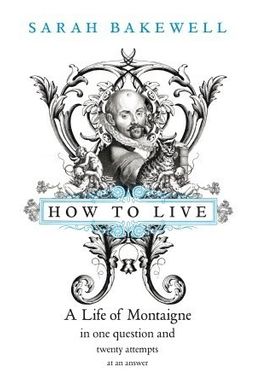
How to Live cover

How to Live

by Sarah Bakewell

How to Live explores the life and philosophies of Montaigne, the pioneering writer of the Essays. Sarah Bakewell delves into his innovative thoughts on embracing imperfection and mediocrity, offering readers timeless insights into self-discovery and the human condition.

The Art of Living Deliberately

How can you live wisely when the world is full of uncertainty, mortality, and noise? Michel de Montaigne, the sixteenth-century essayist, set out to answer that question not through doctrine but through experiment. His Essays became both a mirror and a laboratory: a place where a person could learn to live deliberately. He did not aim to teach you how to be a hero or saint but how to inhabit ordinary life—to observe, question, and adapt with intelligence and humility.

Montaigne’s method was revolutionary: he treated his own mind and experience as philosophical material. He fused classical wisdom with Renaissance curiosity, religious tolerance, and a modern sense of subjectivity. Each essay is a small experiment in attention, self-study, and moral balance. Read together, they ask how to survive love and loss, reconcile solitude and sociability, and achieve calm without illusion.

Humanity as the Central Question

Montaigne begins with humility. Human beings, he argues, are not reason made perfect but a shifting bundle of impulses, habits, and perceptions. The old philosophers built systems that pretended to explain everything; Montaigne dismantles these, discovering that the self is known only in motion. "I study myself more than any other subject," he writes, because knowledge begins in the ordinary. You learn wisdom not by escaping imperfection but by examining it.

He crafts a human-scale vision of philosophy: one that fits the texture of daily life. (Note: Unlike Descartes, who later sought absolute certainty, Montaigne values self-scrutiny and doubt as stabilizing virtues.) His thought trains you to live with incompleteness rather than conquer it.

Death, Fear, and Liberation

The crucible of his thought was near-death. Thrown from a horse and left barely conscious, he felt life slip away "with infinite sweetness." That sensory brush with oblivion overturned the Stoic ideal of a rational, heroic death. He realized dying is mostly involuntary: when it comes, nature conducts the process for you. Therefore, to spend life rehearsing death is to waste the present. The cure for fear is not denial but acceptance—the knowledge that life ends gently, as if drifting to sleep. From then on he chose presence over preparation: “When I dance, I dance.”

Writing as Attention

After the accident and the loss of his beloved friend Étienne de La Boétie, Montaigne withdrew to his tower and started to write. This was not mere retreat but an active discipline of attention. The tower library—curved shelves, inscriptions from Pliny and Euripides, and a secluded inner “room behind the shop”—became his mental observatory. There he wrote to inspect his thoughts, to give fleeting impressions permanence. Writing was his way to hold the world still enough to look at it. Every essay is an “attempt” (an essai), not a doctrine but an experiment in noticing.

Skepticism and Balance

Montaigne’s intellectual temperament joins three ancient schools: the Stoic’s endurance, the Epicurean’s appreciation of pleasure, and the Pyrrhonian’s suspension of judgment. From Stoicism he takes calm under pressure; from Epicurus, delight in simple moments; from Skepticism, the art of saying “I do not know.” This mixture allows him to live in turbulent times—the French Wars of Religion—without succumbing to zealotry. His motto, engraved on medals, is Que sais-je? (“What do I know?”). Doubt for him is not paralysis but composure; it frees him from the tyranny of certainty that drives cruelty and fanaticism.

Ordinariness as a Masterpiece

Travel, public office, sickness, and domestic life all test his resolve. As mayor of Bordeaux during plague and factional violence, he practices moderation: steady governance instead of heroics. The moral of his politics is the same as his ethics—do good well, but not grandly. Heroic extremes ruin the very humanity they claim to defend. “To live appropriately,” he writes, “is our great and glorious masterpiece.” Ordinary existence, handled with curiosity and civility, is itself an art form.

At home and abroad, he remains a pioneer of the private interior life. His Essays model a human conversation kept alive across centuries, a space where a reader can test ideas without being crushed by them. The book itself grows and digresses like its author: each edition expands, corrects, contradicts, and deepens what came before. The Essays become a living organism, proof that thought and life evolve together.

Legacy and Modern Relevance

Montaigne’s lesson for you is simple but radical. You can cultivate wisdom through attention, self-knowledge, and moderation rather than through final truths. You can accept imperfection without despair. You can protect a private “room” for reflection while remaining open, sociable, and kind in the public world. Later thinkers—from Shakespeare to Virginia Woolf, from Pascal to Stefan Zweig—found in him a pattern of intellectual freedom and humane skepticism that survives every age of fanaticism.

A timeless insight

The art of living, Montaigne teaches, is not about certainty or perfection—it is about conversation: between your senses and your reason, solitude and society, past and present. To live well is to keep that dialogue alive.


Becoming Human: Childhood and Education

Your character begins long before you are aware of it. Montaigne’s own education, engineered by his father Pierre Eyquem, was an extraordinary humanist experiment. Pierre arranged for the infant Michel to be fostered by peasants so he would absorb the manners of common people, then raised him in pure Latin so thoroughly that he could speak no French until age six. This double initiation—into peasant speech and ancient language—gave him both empathy with ordinary life and distance from cultural dogma.

Learning by Living

At the Collège de Guyenne in Bordeaux, young Michel experienced the shock of discipline: from rural freedom to scholastic routine. The mix of classical immersion and civic turmoil—tax riots, plague, public executions—taught him that life is both fragile and irrational. These lessons survive in his mature Essays as an eye for the instability behind all institutions and a distrust of anyone who claims to possess permanent truth.

Education, for Montaigne, should cultivate judgment, not memorization. He criticizes schools for teaching words instead of sense, urging instead that a child learn from experience: to ride, travel, debate, and look. The goal is not brilliance but balance—a mind that can assess and adapt. (Note: This humanist reform echoes Erasmus and anticipates Rousseau.)

The Cost of Experiment

Pierre’s educational experiment left scars. The peasant fosterage distanced Michel from his mother; the Latin immersion made him alien among his peers. These tensions explain Montaigne’s later mix of intimacy and detachment, his ability to observe himself as if from outside. His education birthed both independence and solitude—the twin conditions of a writer-philosopher who studies humanity as if forever both within and apart from it.


Friendship, Love, and Loss

Montaigne’s deepest moral education came not from books but from friendship. His bond with Étienne de La Boétie, a young magistrate and writer, provided the emotional center of his life and the spiritual engine of the Essays. They called their union a blending of souls—'Because it was he, because it was I.' The friendship exemplified the highest kind of love: freely chosen, equal, and pure of calculation.

When La Boétie died at thirty-two, Montaigne’s grief nearly destroyed him. He turned that sorrow into literature, editing his friend’s writings (including the radical treatise On Voluntary Servitude) and composing memorial passages that probe both affection and mortality. Through mourning, he discovered writing as therapy—an act that preserved the dead within thought. His library became a shrine where dialogue with his friend could continue.

Love’s Political Lesson

La Boétie’s treatise argued that tyranny depends on people’s consent, a political insight Montaigne admired but handled cautiously in a time of civil war. He refused radicalism: friendship, not revolution, was his model of freedom. A society built on loyal conversation rather than dogma resists becoming enslaved to fanatic leaders. Montaigne’s political ideal was private fidelity elevated to public principle—the belief that compassion and prudence accomplish more than ideological crusades.


Fear, Death, and the Art of Letting Go

Montaigne’s philosophy begins with his body’s collapse. Thrown unconscious from his horse and left vomiting blood, he experienced death as a gentle slipping away, not a moral drama. That revelation overturned a lifetime of Stoic training. Death, he saw, was less a test of reason than a natural process governed by the body itself. To fight it through constant rehearsal only multiplies misery; to trust nature is wiser.

He replaces terror with curiosity. Dying, he discovered, is like falling asleep: at once uncontrollable and serene. The lesson: stop expending your life on fear. Living fully is the best preparation for dying well. His later Essays—'When I dance, I dance'—embody this transformed temperament, teaching that attention to pleasure, moderation, and presence frees you from anticipatory death.

Key idea

By accepting nature’s order, you reclaim the only domain you truly control: how you live now.


Writing and Attention

Writing became Montaigne’s discipline of awareness. After resigning from public life, he built his tower library—a circular room of books and inscriptions—and began to 'spy on himself.' He wrote not to teach but to observe: every sensation, memory, irritation, or joy became material. His essays meander because attention does; he wanted to catch thought in motion, not freeze it into doctrine.

The Essay as Method

He named his pieces essais—“attempts”—because each was an experiment, not a conclusion. He allowed contradictions to stand because the self changes daily. To write was to test consciousness, stretch attention, and invite correction. Later writers from Bacon to Woolf inherit this approach: thought as exploration rather than system. For you, his method suggests that journaling and reflection are not indulgence but exercises in clarity.

Practical guidance

Create your own 'room behind the shop'—a space of private reflection. Write freely, then read yourself with patience. The act of attention will sharpen every other part of life.


Skepticism and the Freedom to Doubt

For Montaigne, doubt is not despair but discipline. Drawing on Pyrrhonian Skepticism, he practices epokhè—suspension of judgment—and makes it a psychological habit. He even mints medals engraved with scales and the motto Que sais-je? By refusing to chase certainty, he preserves peace of mind. You can be devout without being dogmatic, reflective without being paralyzed. This 'gentle doubt' equips you to resist the zealotry of your time.

He applies skepticism politically as well: instead of fighting ideological wars, he governs through moderation, patience, and respect for fallibility. Suspense of judgment opens space for tolerance. (Note: Descartes and Pascal later wrestle with Montaigne’s legacy, each trying to rebuild certainty; both pay tacit homage to the freedom he discovered.)


Practical Wisdom and Ordinary Virtue

Montaigne’s goal is not transcendence but balance. He fuses Stoic endurance, Epicurean delight, and skeptical modesty into an ethic of moderation. His practical test is simple: what steadies life? The answer is curiosity, politeness, routine pleasures, and freedom from mania. Living moderately is not mediocrity—it is proportion, the art of staying human amid extremes.

As mayor, he embodied this ethic: cooling tempers, commuting death sentences, preferring conversation to martyrdom. He valued mercy over display, realism over righteousness. In an age of fanatic religion and civil war, moderation itself was courage. The masterwork is not glory, but composure; not empire, but humanity.


Solitude and Sociability

Montaigne instructs you to cultivate both independence and conversation. His tower’s 'back shop' is the model for interior freedom: a mental space where you can think your own thoughts without intrusion. But he also delights in talk, laughter, dinners, and guests. He would rather lose sight than hearing because conversation is the crucible of humanity.

Solitude deepens perception; sociability corrects it. Montaigne treats open hospitality as moral practice—trust disarms hostility. He praises mercy and empathy as civic virtues, training yourself to judge situations, not abstract laws. The interplay of privacy and conviviality becomes his social philosophy: to think clearly, retreat; to live fully, return.


The Living Book

The Essays are not a fixed text but a living organism that grows as their author does. Montaigne keeps revising across editions—1580, 1588, and the posthumous additions in the Bordeaux Copy. Digression is his method: truth appears sideways, through anecdote and wandering. Titles mislead, connections surprise, and the self becomes both subject and form. Reading him teaches active attention: follow his mind in motion rather than seeking conclusions.

After his death, his disciple Marie de Gournay safeguards the text, editing and defending it in 1595. Her passionate advocacy, proto-feminist voice, and painstaking labor ensure Montaigne’s survival. Later critics fight over textual purity—Bordeaux or Gournay, manuscript or print—but the deeper legacy is process itself: a book that models growth, not closure.


Afterlives and Interpretations

Across centuries, Montaigne’s Essays reinvent themselves. John Florio’s 1603 translation naturalizes him into English, influencing Shakespeare and the birth of the personal essay. Romantics rewrite him as a prophet of passion; skeptics claim him for reason; exiles like Stefan Zweig read him as a manual for inner freedom. Each age finds its mirror in his pages.

He anticipated this freedom: once a book is born, he said, it belongs to readers. Later editors abridge, moralize, or psychoanalyze him—proof that his work lives. To accept reinterpretation, even misreading, is to apply his own lesson of amor fati: love fate, even in reception. Montaigne’s ultimate triumph is that he remains alive because he never insisted on the final word.

Dig Deeper

Get personalized prompts to apply these lessons to your life and deepen your understanding.

Go Deeper

Get the Full Experience

Download Insight Books for AI-powered reflections, quizzes, and more.