
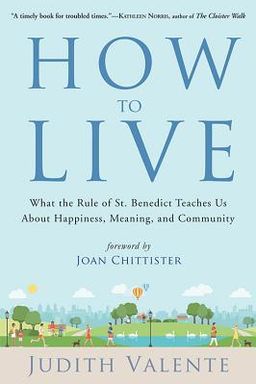
How to Live cover

How to Live

by Judith Valente

Judith Valente''s ''How to Live'' reveals how the ancient Rule of St. Benedict can transform modern life. Explore timeless principles like deep listening, silence, humility, and community to cultivate happiness, meaning, and balance amidst today''s chaos.

Living With Intention and Balance Through Benedictine Wisdom

How can you live fully in a world that seems to reward constant motion, ceaseless achievement, and noisy distraction? Judith Valente’s How to Live draws on the timeless wisdom of St. Benedict’s Rule to show how ancient spiritual practices can help us cultivate balance, attention, and peace in the frenetic pace of modern life. Valente—a journalist and former workaholic—translates the monastic principles that kept the sixth-century Benedictines sane in chaotic times into practical strategies for the twenty-first century professional, spouse, and citizen.

At the heart of Valente’s argument lies a radical idea: we can build a monastery in our own hearts. You don’t have to wear a habit or retreat behind monastery walls to live contemplatively. Instead, she says, Benedict’s ancient guide offers a spiritual technology for slowing down, listening deeply, living simply, and connecting authentically. It’s about crafting a life where your outer actions match your inner values—a life shaped not by competition but by compassion, not by noise but by silence, and not by self-interest but by community.

Rediscovering the Rule in Troubled Times

The parallels between Benedict’s time and ours are uncanny. Sixth-century Rome was collapsing under greed, violence, and cultural decay. Its citizens sought security in wealth and power. Benedict walked away to carve out a saner alternative: a community rooted in simplicity, work, and prayer. Valente frames his response as deeply modern, an answer to the burnout, polarization, and spiritual fatigue of our post-digital age. “To cope with the chaos,” she writes, “Benedict embraced silence.” Instead of grumbling, he counseled gratitude. Instead of wealth, simplicity. Instead of competition, community.

That countercultural choice, Valente insists, remains our greatest challenge. Beneath the headlines about division and despair, she sees “the genie of discord” tempting us to be our worst selves. The Rule becomes a blueprint not just for monks but for ordinary people yearning for decency, belonging, and depth. (Joan Chittister—who writes the book’s foreword—calls Benedict’s spirituality a “template for living” essential for restoring our fractured human world.)

From Principle to Practice: Turning Values Into Habits

Valente uses the structure of The Rule to frame her lessons. Each chapter explores a Benedictine theme—listening, humility, balance, forgiveness, community, simplicity—and pairs it with stories from her own life as a writer and visitor to Mount St. Scholastica Monastery in Kansas. Through her meetings with the sisters, she learns to regard even ordinary experiences, from washing dishes to writing poems, as spiritual disciplines. These encounters reshaped how she thought about work, time, and relationships.

“Community. Simplicity. Humility. Hospitality. Gratitude. Praise.” Valente calls these the pillars of Benedictine spirituality—the things that matter when society forgets what matters most.

The Personal Transformation: From Journalist to Contemplative

The book opens with Valente’s journey from exhaustion to awakening. Standing before the stained-glass window of Mount St. Scholastica’s chapel, she reads the inscription “Omni tempore silentio debent studere”, translated roughly as, “At all times, cultivate silence.” In that quiet moment, she realizes how far she has drifted from her own center—teaching others to live contemplatively while neglecting her own spirit. That awakening becomes her turning point. She begins to see that the real monastery is not a building, but a rhythm of the heart—the intentional balance of prayer and work, silence and speech, rest and service.

Valente also uses contemporary research to confirm Benedict’s intuition. She cites economist Paul Zak’s studies on oxytocin, the “morale molecule,” showing that humans are biologically wired for trust and generosity. Zak’s findings—that communities built on compassion thrive—echo Benedict’s warning that “No one is to pursue what he judges better for himself to the detriment of others.” Science, it turns out, affirms monastic wisdom.

Why These Ideas Matter Now

In the end, How to Live speaks directly to anyone at risk of forgetting how to be human in an overconnected, undercontemplative world. It is a call to turn off the noise without turning away from the world. To replace the anxiety of achievement with the joy of awareness. To realize that being spiritual isn’t about withdrawal—it’s about engagement, rooted in stillness. Valente’s writing feels both ancient and immediate, blending Benedict’s calm authority with her reporter’s clear-eyed realism.

If you’re yearning for life—St. Benedict’s opening question—you’ll find in Valente’s pages not lofty theology, but a lived invitation: to begin again, daily, in the small sacred acts of listening, forgiving, balancing, and belonging. It’s a monastic roadmap for worldly souls, guiding you to live fully awake amid the ordinary. The monastery, she reminds us, is the human heart.


Listening With the Ear of the Heart

Listening is the first word of St. Benedict’s Rule—and it’s the first practice Judith Valente asks you to reclaim. Instead of filling silence with more talk, she invites you to listen “with the ear of the heart.” This phrase, found in the Prologue of The Rule, means listening not only with intellect but with compassion, humility, and openness to transformation. As Valente learned, true listening can mend relationships, deepen empathy, and awaken spiritual awareness.

Listening as Active Attention

Valente recounts Supreme Court Justice Sonia Sotomayor’s advice to law students after Justice Scalia’s death. Despite years of fierce disagreements, the justices stayed collegial because they listened. “You may not like what they’re proposing,” Sotomayor said, “but that doesn’t mean they’re doing it from an evil motive.” This attitude embodies Benedict’s concept of listening as an act of will—active engagement rather than passive hearing.

Valente confesses that even as a journalist trained to listen professionally, she often fails to hear in her personal life. When coworkers criticized her strong opinions, her first reaction was anger. Only later did she listen with her heart and realize her tone could feel condescending. This act of awareness transformed her understanding of obedience—another Benedictine theme rooted in oboedire, meaning “to give ear.”

Mutual Obedience and Humility

In monastery life, obedience isn’t authoritarian submission but mutual respect. Benedict emphasizes “mutual obedience”—all listening carefully to one another. Valente tells stories of monks and nuns who embraced unexpected turns in their lives out of obedience to community. Joan Chittister, for example, was sent to work as a camp cook instead of attending graduate school. That detour strengthened her vocation and writing. Sister Irene Nowell, told to study German rather than music, discovered that it later opened the door to her scriptural scholarship. Obedience thus becomes a delicate listening to life itself—a surrender that leads not to confinement but to truth.

Wisdom in Unexpected Voices

Valente also learns to recognize wisdom in the simplest people. Her father’s homespun advice—“When you’re hungry, you eat; when you’re tired, you sleep”—once sounded naive. After landing in the hospital for exhaustion, she saw its spiritual genius: attention to bodily truth is part of listening. Likewise, Eva, an elderly retreat participant in Alabama, became Valente’s accidental teacher when she brought poems and blessings instead of credentials. Listening to Eva reminded her that prophets often hide “in plain sight.” (Like in Henri Nouwen’s The Wounded Healer, the humble messenger carries divine insight.)

To listen with the ear of the heart is to receive the world as it is—through empathy rather than judgment, through quiet rather than assertion. Valente challenges you to ask daily: Who are the wise ones I’m overlooking? What message lies inside the complaint, the disappointment, or the ordinary conversation I rush through? Like Benedict says, “Let us open our eyes to the light that comes from God and our ears to the voice from the heavens.” Listening becomes your first act of love.


Waking Up to Life

In Chapter 3, “Run with the Light,” Valente turns Benedict’s call to “wake up” into a modern meditation on awareness. Just as the monk urges followers to arise from spiritual sleep, Valente warns that many of us are sleepwalking through life. Her stories—from seeing a shooting star at dawn to encountering a grieving man dressed as Santa—reveal what awakening looks like in practice: choosing to see, notice, and act where others drift by unseeing.

The Urgency of Awareness

Like Zorba’s story of the almond tree planted by a ninety-year-old man who knows he won’t live to see it bloom, Benedict’s exhortation to “run while you have the light of life” insists on urgency. Valente recounts how early monastics, such as Antony the Great, taught that each day might be your last. Far from morbid, this teaching is a call to live fully awake while there’s still light to see. The Romans 13:11 verse—“It is high time to arise from sleep”—becomes both metaphor and mantra.

Seeing Others’ Hard Battles

Valente’s most poignant awakening comes through her journalism. When she meets Joe, a man who played Santa for thousands of children, she assumes he’s jolly and fulfilled. Only later does she discover he lives in his car, forgotten and desolate. Her encounter with Joe becomes a sacred moment of compassion, echoing Bob Dylan’s grandmother’s advice: “Everyone you’ll ever meet is fighting a hard battle.” Waking up, Valente realizes, isn’t only about opening your own eyes—it’s about seeing others’ pain with empathy, one of the spiritual senses Benedictine living revives.

Practicing the Sacrament of the Present Moment

Abbot Jerome Kodell calls awareness “the sacrament of the present moment.” Valente adopts this phrase as a key to everyday holiness: pouring coffee, writing a story, seeing a rabbit pause on the lawn—all can become contemplative practice. Benedict asks that we “open our eyes to the light that comes from God.” To live awake is to reclaim ordinary life as sacred space. (Brother David Steindl-Rast echoes this in Gratefulness, the Heart of Prayer: gratitude makes awareness possible.)

Valente ends with this challenge: Stop sleepwalking. Stand still long enough to see the star, the skunk, the suffering person beside you. Don’t pass through life anesthetized. To wake up is to run with the light—and the light is life itself.


The Art of Peaceful Living

One of St. Benedict’s most practical teachings comes from his “Tools for Good Works,” which Valente calls the Magna Carta for ethical life. These are the simple, sturdy habits that make peace possible: showing kindness, forgiving quickly, helping the poor, speaking truthfully, and avoiding grumbling. For Valente, the tools are less commandments than instruments for practice—skills we refine daily, often clumsily.

Tools, Not Rules

Tools are learned through apprenticeship. Valente compares spiritual training to carpentry or surgery—you master the craft through repetition and humility. Benedict’s tools teach us to “make peace before the sun goes down.” But Valente’s own story of estrangement from her brother shows how hard this is. After their mother’s death, the siblings fought over minor finances; hurt calcified into silence that lasted twenty years. She confesses her failure to act on the Rule’s wisdom and admits that spiritual practice doesn’t guarantee success, only continual learning.

Community as Peace Laboratory

Valente points to Benedictine communities as living models of reconciliation. The monastery embodies Ezra Pound’s maxim “make it new”—renewing ancient ethical simplicity in modern form. She juxtaposes the serenity of Brooklyn’s multi-ethnic neighborhoods, where Jews, Muslims, Christians, and immigrants live peaceably side by side, with the perennial conflicts of Jerusalem. Peace, she argues, begins in the neighborhood.

Each tool—gratitude, truthfulness, kindness—chips away at the walls dividing us. When she reads Benedict’s line “Never do to another what you do not want done to yourself,” she recognizes not moral restraint but radical empathy. This practical spirituality mirrors the teachings of Buddhist mindfulness and Stoic ethics (see Epictetus’s Enchiridion): mastering the inner response, not controlling the external chaos.

To live peacefully, Valente insists, we must “never lose hope in God’s mercy.” That means staying human even when our attempts to forgive fail, our tools rust, or our pride gets in the way. Like any craft, peace requires patience and practice. Restoring harmony starts where you are—with the next person you meet and the next word you speak. And if the sun sets before you find peace, Benedict reminds us: there’s always morning to begin again.


The Transformative Power of Silence

Silence, for Valente and for St. Benedict, is not emptiness—it’s presence. It is the atmosphere in which truth can breathe. In a noisy world of constant alerts and opinions, this chapter—“Restraint of Speech”—feels revolutionary. “There are times,” Benedict writes, “when even good words are to be left unsaid out of esteem for silence.” Valente takes this to heart, examining her own work as a talkative journalist who discovers that saying less awakens more.

Silence as Teacher

Visiting the Abbey of Gethsemani, the home of Thomas Merton, Valente feels its palpable hush—the monk’s poetry of stillness. She recalls his line from “In Silence”: “Listen to the stones of the wall.” Silence, she realizes, teaches listening at its deepest. Merton’s wisdom—“solitude is not something you hope for in the future, it is a deepening of the present”—becomes her mantra.

Cultivating the Inner Quiet

Monastics ask three questions before speaking: Is it true? Is it kind? Is it necessary? Valente adopts this discernment for her own communication, echoing mindfulness traditions from Buddhist right speech to Quaker simplicity. She shows how unnecessary words drain empathy and breed toxins like gossip, complaint, and grumbling—those spiritual pollutants Benedict condemns. Tracking her own speech patterns, she notices that every word of complaint “poisons the soul twice—once when spoken, once when replayed.”

Finding Quiet in a Loud World

Silence isn’t limited to monasteries. Valente practices “email Sabbaths,” a modern translation of Benedictine restraint. She turns off devices for entire weekends to reclaim interior space. Even five minutes of quiet in a stairwell can become sacred pause. Such practices mirror contemporary neuroscience findings: silence restores focus and reduces stress. (Note: Kelly McGonigal’s The Willpower Instinct shows similar effects of conscious rest.)

But silence is not withdrawal. Valente’s friend Sister Mary Lou Kownacki reminds her there are times to speak out—for justice, truth, and compassion. Silence clarifies when to speak. Living with restraint of speech teaches you the art of timing: to pause before reacting, to speak with the weight of kindness. When “the heart is full,” her Trappist friend Brother Paul says, “the tongue goes silent.” Silence then becomes not the absence of sound but the presence of awe.


Humility and the Ladder of Growth

Of all Benedict’s teachings, humility is the hardest to embrace. Valente humorously admits her struggle—like snapping at a bus driver and realizing later how pride blinds her to connection. In Chapter 7, “Have Patience With Me,” she explores humility not as humiliation but as groundedness: from humus, “of the earth.” Humility reminds you that everyone, from bus drivers to executives, shares equal human soil.

Climbing Jacob’s Ladder

Benedict patterns humility after Jacob’s dream of angels ascending and descending—a ladder of twelve steps toward self-understanding. Each rung challenges ego: reverence, surrender, patience, confession, restraint of speech, gentleness. Valente dissects these demands with humor and clarity. Who wants to endure suffering “without escape”? Yet she recognizes, echoing Aeschylus, that “by suffering we learn.” Difficulty is not punishment but the chisel shaping character.

Transforming Anger and Ego

The desert fathers taught that anger is the greatest obstacle to humility and prayer. Valente’s Sicilian temperament tested this repeatedly. She distinguishes between ego-driven anger (which imprisons us) and righteous anger against injustice (which fuels compassion). Redirecting anger into action—writing stories about social inequity instead of venting—becomes her moral apprenticeship. (Psychologist Daniel Goleman’s Emotional Intelligence echoes this technique of reframing emotion into empathy.)

Humility as Love

Ultimately, humility softens the boundaries between self and other. At Mount St. Scholastica, sisters bow to each other before prayer and say, “Um Jesu willem, have patience with me.” That phrase captures Benedict’s vision of humility as relational—a rhythm of mutual forgiveness. Imagine starting your day at work, Valente muses, by bowing to colleagues with those words. Might we live gentler lives?

Benedict promises that when we stop acting out of fear and start acting out of love, humility becomes effortless. We rise and fall, rise and fall, as the desert wisdom says. The ladder doesn’t end in perfection—it ends in compassion. Have patience—with others, and with yourself.


Building Real Community

In “Linking Arms,” Valente explores how community transforms solitude into love. Benedict built monasteries not to escape the world but to model an alternative one—where respect replaces rivalry and belonging replaces isolation. Valente, once a solitary journalist chasing deadlines across cities, discovers home among the Benedictine sisters of Mount St. Scholastica. Their motto: “Only the nuts stay.” In other words, only those willing to keep working on togetherness.

From Loneliness to Belonging

Valente’s longing for companionship mirrors the modern epidemic of disconnection described in Robert Putnam’s Bowling Alone. Yet in monasteries she witnesses a counterculture of care: sisters sign up instantly to help one another, fill volunteer sheets, and show up for chores. “We can disagree,” Sister Molly tells her, “and not see each other as threats.” Community isn’t comfort—it’s commitment.

Stability and Staying at the Table

Benedict’s vow of stability—remaining in one community for life—echoes Valente’s insight that relationships deepen through endurance. In a transient society, staying put is radical. “Community,” she writes, “is about the people sitting right next to you.” Staying at the table, even when conversations turn uncomfortable, keeps connection alive. Like marriage or civic life, community thrives through patience, humor, and shared purpose.

Adding Your Light to the Sum of Light

Borrowing from the film The Year of Living Dangerously, Valente reminds us that we can’t fix all suffering, but we can “add our light to the sum of light.” Extending small decencies—listening, forgiving, serving—creates ripple effects. People don’t have to “like” each other, Sister Molly says, but must care enough to stay united. Benedict’s call to “be the first to show respect” keeps the community human.

Community begins with the neighbor on your block, the colleague next door, the stranger who needs welcome. We build holy cities not by grand idealism but by small gestures of presence. Linking arms, we become light together.

Dig Deeper

Get personalized prompts to apply these lessons to your life and deepen your understanding.

Go Deeper

Get the Full Experience

Download Insight Books for AI-powered reflections, quizzes, and more.