
Idea 1
How Numbers Can Fool You
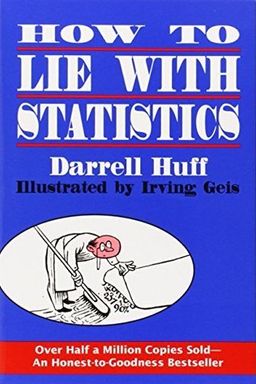
How many times have you seen a bold statistical claim that seemed too perfect to question—“90% of people prefer this brand,” or “students at this university earn twice as much after graduation”—and felt a twinge of doubt? In How to Lie with Statistics, Darrell Huff argues that numbers, while seemingly objective, can be twisted, truncated, and dressed up to mislead you more effectively than any outright lie. Rather than railing against mathematics, Huff’s mission is to show that statistics are powerful tools—in the right hands—and dangerous weapons in the wrong ones.
First published in 1954, Huff’s slim but influential book reads like a witty exposé on the hidden tricks of statistical persuasion. You’ll learn how advertisers, journalists, and policymakers manipulate data not necessarily by fabricating it, but by choosing biased samples, well-selected averages, and half-told figures that omit critical context. Huff’s blend of humor and insight makes what could be a dry subject an engaging guide to thinking critically about the numbers that shape public opinion and personal decision-making.
Why Statistics Mislead
Huff begins by framing statistics as a kind of language—one that can communicate truth or conceal it, depending on who’s speaking and why. Much like rhetoric, statistics rely on choice: choice of what to count, how to present it, and how to describe it. He cautions that the seductive veneer of precision—decimal points, percentages, or charts—often causes readers to suspend common sense. As Huff quips, “A well-wrapped statistic is better than Hitler’s big lie; it misleads, yet it cannot be pinned on you.” Numbers, he suggests, are rarely the problem—the interpretation is.
At its heart, Huff’s book is an invitation to reclaim skepticism. When you read that toothpaste A prevents “23% more cavities,” do you wonder how many people were in that test—or whether 23% means one fewer cavity out of four? He teaches that critical questioning, not mathematical skill, is what keeps you from being duped. It’s a philosophy echoed decades later by thinkers like Hans Rosling (Factfulness) and Nate Silver (The Signal and the Noise), who also insist that statistical literacy is essential for informed citizenship.
The Anatomy of Deception
Throughout the book, Huff dissects the most common statistical sins. He starts with the biased sample—when data are gathered from a group that doesn’t represent the population. Think of Time magazine’s proud statement that “the average Yaleman, Class of ’24, earns $25,111”—a figure derived from the few who replied to an alumni survey, most likely the wealthier ones. He then explains how the term “average” itself hides three distinct meanings—mean, median, and mode—all of which can tell drastically different stories depending on which one a speaker chooses to highlight. A neighborhood can seem affluent or impoverished based solely on which average you prefer.
In later chapters, Huff shows that deception doesn’t require lies—it often comes from omissions. The “little figures that are not there” include missing margins of error, missing ranges, and missing contextual comparisons. As Huff puts it, “Knowing nothing can be healthier than knowing what isn’t so.” Averages without ranges, for example, can bankrupt housing design, as when builders created “average-sized” homes for the mythical 3.6-person family—ignoring that most households are either smaller or larger. The result: whole suburbs mismatched to real demand.
Why It Still Matters
Nearly seventy years after its first publication, How to Lie with Statistics remains relevant because the techniques Huff exposes are timeless—even if the mediums have changed. Today’s “gee-whiz graphs” appear not in newspapers but on social media feeds; “semiattached figures” drive viral infographics; and biased sampling powers online polls and political surveys. The human susceptibility is the same: we trust clean numbers and clear lines more than messy context. Huff’s warning is that once numbers start to feel trustworthy, your defenses drop.
Ultimately, Huff’s goal isn’t cynicism but empowerment. He closes the book with what he calls “talking back to statistics”—five questions that anyone can use to test the trustworthiness of any claim: Who says so? How do they know? What’s missing? Did somebody change the subject? And does it make sense? These five questions, simple as they seem, can dismantle deceptive headlines, faulty research, and manipulative advertising alike.
You don’t need a degree in mathematics to wield Huff’s lessons—only curiosity and a willingness to look twice. By the end of the book, you’ve not only seen how numbers can be used to lie, but also how to make them tell the truth again. In a world increasingly governed by data—from polling to public health—Huff’s deceptively humorous manual turns out to be a civic survival guide.