
Idea 1
The Art of Talking Across Deep Divides
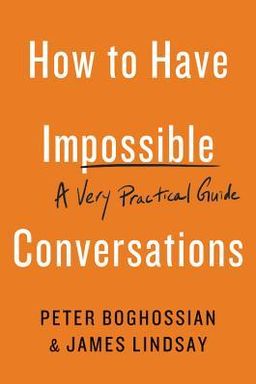
How do you talk to someone when you deeply disagree—about religion, politics, or morality—without the conversation turning toxic? In How to Have Impossible Conversations, philosophers Peter Boghossian and James Lindsay argue that we’ve lost the art of meaningful dialogue in an age of ideological division. The book contends that it’s possible not only to talk to those who disagree but to change minds—our own and others’—by cultivating humility, empathy, and curiosity instead of confrontation.
The authors’ premise is simple yet counterintuitive: productive conversation isn’t about proving a point. It’s about understanding how people form beliefs and engaging them as partners rather than opponents. The book builds a skill-based framework for conversation, starting with human fundamentals like listening and rapport, moving through intermediate interventions that can foster doubt and reflection, and culminating in expert tools for navigating deeply entrenched ideologies. This gradual progression mirrors how one builds mastery of any discipline—from fundamentals to refinement and finally to wisdom.
Why Impossible Conversations Matter
Boghossian and Lindsay open by acknowledging the modern crisis of discourse: social media outrage, political polarization, and moral certitude have eroded our capacity for civil exchange. People talk past each other, fortified by echo chambers and motivated by confirmation bias. The authors argue that this isn’t just bad manners—it’s a threat to reason and democracy. We act on what we believe, they explain, so when beliefs can’t be questioned, cooperation collapses. Learning to converse therefore becomes not a soft skill, but a civic and moral imperative.
From Winning to Understanding
The book replaces adversarial “winning” mindsets with collaborative “understanding” ones. Drawing inspiration from negotiation experts like William Ury (Getting to Yes) and psychologists like Paul Ekman, the authors outline practical tools: listen more than you speak, assume charitable intentions, paraphrase accurately before disagreeing, and, crucially, model the humility you want others to emulate. These habits rewire conversations from power struggles into mutual learning sessions.
Building the Skill Ladder
The book’s seven chapters ascend from beginner to master level. You start with fundamentals—clarifying goals, forming partnerships, building rapport, and listening. At the intermediate stage, you learn interventions like “Let friends be wrong” (accept disagreement), “Build Golden Bridges” (create face-saving exits), and “Reframe” (shift perspective to shared values). Advanced chapters teach deeper tools for reasoning—Rapoport’s Rules (paraphrase before rebutting), seeking disconfirmation rather than confirmation, and managing anger. Expert sections introduce strategies borrowed from hostage negotiations and philosophical dialectics, while the final “master” level unpacks moral reframing and epistemological humility for conversing with ideologues.
Why Listening Changes Minds
Underlying every tactic is the insight that belief change rarely happens through evidence or logic alone. People cling to beliefs because they’re tied to identity, community, or morality. Facts, ironically, often backfire—making people more entrenched. Genuine transformation occurs only when we dissolve defensiveness and invite reflection, helping people see for themselves how their reasoning could be flawed. As the book puts it, “Make understanding your goal, not victory.” This principle echoes Carl Rogers’s person-centered therapy and Jonathan Haidt’s concept of moral intuitions: empathy creates the psychological safety required for reason to work.
Why These Skills Are Crucial Today
We live in a time when discussion itself feels dangerous. Whether it’s political polarization, religious disputes, or cultural disagreements, many of us avoid conversation altogether. How to Have Impossible Conversations doesn’t promise agreement—it promises understanding. By turning dialogue into a skill set that can be practiced through techniques borrowed from philosophy, psychology, and negotiation, the authors envision a future where disagreement is not a threat but a pathway to truth. These aren’t rhetorical tricks; they’re habits that make everyday communication constructive.
“The mark of an educated mind is to entertain a thought without accepting it.” – Aristotle
Ultimately, Boghossian and Lindsay transform conversation from a battlefield into a workshop for collaborative truth-seeking. Their message is clear: the skill of dialogue is foundational to reason itself. If practiced intentionally, it can bridge divides, dissolve moral hostility, and revive the simple human act of talking to one another.