
Idea 1
Make Every Day a Good Day
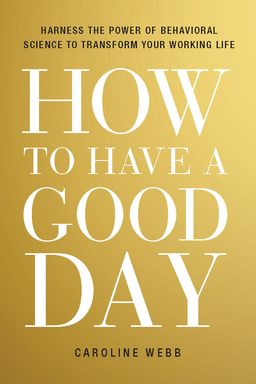
What if you could stack the odds in your favor so that more of your days felt satisfying, productive, and meaningful? In her science-based guide to improving everyday performance, Caroline Webb argues that the difference between an ordinary day and a great day often lies in how you manage your mind. Drawing on behavioral economics, psychology, and neuroscience, Webb shows that by understanding how your brain operates—its biases, rhythms, and needs—you can redesign how you think, decide, and interact. The result isn’t about relentless positivity; it’s about practical use of evidence on how human cognition works so you can make smarter choices and feel more in control of your time and relationships.
Two systems, one brain
Webb builds her framework on the idea of the two-system brain. Your deliberate system, centered in the prefrontal cortex, handles reasoning, self-control, and planning but tires easily. Your automatic system operates rapidly and effortlessly, relying on shortcuts that filter perception and steer attention. Because you never see an objective world—only what the automatic system deems relevant—your mindset and expectations profoundly shape what you notice. That’s why priming your attention each morning, as Martin the strategy director does, can shift your day from distraction to purpose. This dual-system view underpins every tactic in the book, from how you set goals to how you handle conflict.
The discovery–defend axis
At any moment, your brain also scans for threat or reward. If it perceives danger—social rejection, loss of control, criticism—it triggers defensive mode, narrowing thinking and sabotaging collaboration. When it instead perceives reward, curiosity and openness flourish. Webb distinguishes these as the discover–defend axis. Shifting yourself and others toward discovery mode is crucial for better problem-solving. When an executive softened his feedback tone, meetings transformed overnight; when a government director reframed tough talks around shared goals, creativity returned. The small wins of humor, appreciation, and curiosity interrupt the brain’s threat response and restore intelligence.
Mind–body loop and energy
Mental performance depends on physical upkeep. Sleep, exercise, and mindfulness adjust neurotransmitters in ways that protect the prefrontal cortex from fatigue. Webb weaves research from Charles Czeisler and John Ratey to show that rest, movement, and mindful pauses aren’t luxuries—they’re vital infrastructure for clear reasoning. As Anthony the marketer found, even a brisk walk can jolt creativity back online. The same loop explains why short breathing exercises or labeling emotions can dissolve anxiety in minutes.
From intention to action
Because your attention follows what you expect to see, Webb urges readers to set explicit intentions each day: What matters most? What mood will serve? What do I want to notice? Combine those answers with concrete “when–then” plans—simple cues that automate wise choices. The approach fuses Oettingen’s mental contrasting (pair optimism with obstacle planning) and Halvorson’s implementation intentions (link cues to behaviors). Together they transform vague aspirations into practiced habits that feel effortless.
Work smarter with structure
Productivity, Webb reminds us, isn’t about busyness but about selective focus. By singletasking, batching, and planning deliberate downtime, you protect the scarce capacity of your deliberate system. Structured thinking tools—like issue trees or social reframing—break complexity into digestible pieces and exploit how the brain loves narrative. When you imagine a logistics problem as two characters coordinating, your intuition improves. Sleep, order, and physical cues—light, posture, props—prime higher reasoning, making deep work sustainable.
Communication, influence, and confidence
Understanding brain science also transforms how you relate to others. People engage when conversation starts in discovery mode—with novelty, reward, or human connection. Webb translates research on attention and fluency into actionable rules: open with surprise, tell concrete stories, simplify your message, and show, don’t tell. To sustain influence, make actions easy, give reasons, offer choices, and show social proof. And when pressure hits, reframe arousal as readiness, reconnect to purpose, and claim psychological and physical space. Confidence, in Webb’s view, is learned through small, repeatable rituals that anchor calm.
Energy, resilience, and meaningful work
Finally, Webb argues that good days multiply when you manage energy as carefully as time. Her quick lifts—gratitude, kindness, curiosity, connection, and small wins—shift brain chemistry within minutes. Long-term, the secret is playing to your strengths. Identifying and deploying what you do best at work increases engagement, echoing Seligman and Gallup’s findings. And when setbacks arrive, practices like affect labeling, perspective distance, and cognitive reappraisal keep you learning rather than spiraling.
Core message
“A good day” isn’t random luck—it’s the result of small, evidence-based choices about how you think, move, and interact. When you understand how your brain’s systems work, you can craft conditions where your best self shows up more often, and help others do the same.