
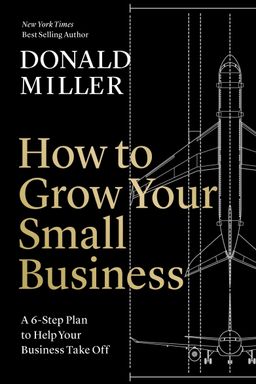
How to Grow Your Small Business cover

How to Grow Your Small Business

by Donald Miller

How to Grow Your Small Business by Donald Miller is a practical guide offering a six-part strategy to elevate your business from startup struggles to sustained success. Learn to align your team, optimize products, engage customers through storytelling, and master cash flow for long-term growth.

Professionalizing Your Business for Predictable Growth

What separates a small business that thrives from one that crashes? Donald Miller argues that success isn't defined by passion alone—it depends on professionalizing your operations. In How to Grow Your Small Business, Miller contends that many entrepreneurs are natural creators and visionaries but fail to build reliable systems. His remedy is a practical six-step blueprint that treats your company like an airplane—a metaphor revealing how every part of a business must work in proportion for the whole to fly.

The Airplane Metaphor: Seeing Business as a Machine

Miller’s metaphor is simple but powerful. A business, like an airplane, will only stay in the air if its six essential parts are engineered correctly: the cockpit (leadership), the right engine (marketing), the left engine (sales), the wings (products), the body (overhead and operations), and the fuel tanks (cash flow). If any part grows out of proportion, the plane becomes unstable and risks crashing. Strong wings and engines must balance a lean body, and adequate fuel must power the flight.

He opens with a familiar scenario: an entrepreneur launches a product, demand surges, but chaos soon ensues—overstaffing, disorganization, and dwindling cash flow. The business owner, pulled from their creative sweet spot, spends their days putting out fires. Miller’s insight: this “S-curve” phenomenon—where growth leads to collapse—is avoidable if you professionalize your operation through systems and clarity.

The Six-Step Flight Plan

Miller’s six-step plan helps owners transform from reactive operators into confident pilots:

  • Leadership (Cockpit): Define your mission, economic priorities, and guiding principles so everyone knows where the business is going.
  • Marketing (Right Engine): Clarify your message with the StoryBrand framework, positioning customers as heroes in a story your brand guides them through.
  • Sales (Left Engine): Craft a “million-dollar sales pitch” that continues the hero narrative and drives purchasing momentum.
  • Products (Wings): Optimize offerings for profitability and demand, pruning what doesn’t sell and innovating wisely.
  • Operations (Body): Use management systems to streamline overhead and maintain a healthy workflow.
  • Cash Flow (Fuel Tanks): Manage money through transparent, separate accounts that provide simple optics and steady power.

Each step corresponds to a real-world business function, but together they create synergy—a well-proportioned “airplane” that can fly safely and profitably for years. The beauty of Miller’s model lies in its simplicity: any small business owner can diagnose problems by seeing which part of the plane is underpowered or overweight.

Why It Matters

The statistics are sobering—65% of small businesses fail within ten years. Miller’s core argument is that passion and effort aren’t enough; clarity, focus, and proportion are what make businesses sustainable. Unlike motivational business books, this one emphasizes mechanics over inspiration. It gives entrepreneurs structure—a flight plan—to replace chaos with predictability.

Miller’s advice echoes principles found in The E-Myth Revisited (Michael Gerber), which champions systems over personality-driven business. Yet Miller’s storytelling approach makes it more immediate: he insists you can’t “look successful without being successful.” Fancy branding and big offices won’t help if your engines stall and the body outweighs the wings. His challenge to readers—stop winging it and start professionalizing—transforms the dream of entrepreneurship into an achievable, disciplined journey.

Key Insight

Treat your business like an airplane, not a passion project. If every part of your company—leadership, marketing, sales, products, operations, and cash flow—functions in proportion, you’ll create a reliable machine that can fly farther and higher than you ever imagined.


Leadership: Building a Business on a Mission

Miller begins with the cockpit—the leadership seat of your business. He argues that clarity of mission is the difference between purposeful growth and chaotic guessing. Most small-business owners operate without clear direction, making decisions reactively rather than strategically. To remedy that, Miller introduces the Business on a Mission Framework—a system for outlining your guiding principles on one page so your entire team understands where the airplane is headed and how each role contributes.

Crafting a Mission Statement That Works

Most mission statements fail because they’re vague (“We exist to serve customers with excellence”) or meaningless corporate jargon. Instead, Miller’s formula is refreshingly concrete: We will accomplish X by Y because of Z. In this formula, “X” represents three specific economic priorities, “Y” a clear deadline, and “Z” the reason the mission matters. This ensures your mission opens a story loop that energizes people to take action. He calls this “narrative traction”—the discomfort that drives momentum until the mission is fulfilled.

For example, a real estate office might declare: “We will help forty-two clients sell their homes, fifty-three buy new ones, and host twenty open houses by December 31, because every person deserves to walk into a home they love.” Notice how the statement quantifies objectives, sets urgency with a timeline, and ends with emotional purpose. The result isn’t just corporate clarity—it’s personal engagement.

Economic Priorities and Real Numbers

Miller insists every mission must be economically grounded. Too many teams avoid talking about money, thinking it’s unspiritual or shallow. But as he humorously notes, even employees who “aren’t motivated by money” still expect a paycheck. Normalizing financial conversations ensures decisions align with profitability. He recommends limiting priorities to three measurable targets—sales, retention, or margins—because the human brain can only effectively prioritize three things at once.

Deadlines Create Urgency

Without deadlines, missions lose energy. Miller compares this to storytelling: a hero’s challenge becomes exciting only when a ticking clock appears. For example, in TV’s 24, Kiefer Sutherland’s race against time grabs attention—the same psychological pull motivates your team when the mission has an end date. Set a window of one to two years; longer than that feels too remote.

Infusing Purpose: The “Because” Factor

The “because” clause transforms a goal into a mission. Humans crave meaning and significance beyond metrics. A brewery’s team may commit to “increase distribution by the end of the fiscal year because everyone deserves access to their new favorite beer.” This emotional “why” bonds people to a cause greater than profit. It transforms work into service.

Hiring and Culture

Once the mission statement is defined, Miller introduces Key Characteristics—traits every team member must embody. Unlike vague “core values,” these are actionable qualities tied directly to the mission. A restaurant might define three as “We love people and enjoy serving them,” “We are obsessed with great-tasting food,” and “We are calm under pressure.” Such specifics shape both behavior and hiring. Aspirational characteristics encourage transformation—turning everyday staff into purpose-driven professionals.

Critical Actions Drive the Culture

Finally, Miller maps culture to action through Critical Actions: three habitual behaviors everyone can perform daily to advance the mission. Like Chick-fil-A’s “My pleasure” response, these reinforce identity through repetition. They unify teams and communicate brand values outwardly. A bakery might decide to “offer a sample to every customer,” “check ingredient freshness each hour,” and “clean workstations regularly.” Small, consistent actions create tribal belonging and operational excellence.

Key takeaway

Clarity beats intensity. A specific mission, measurable goals, emotional purpose, and daily habits turn a group of employees into a crew united by flight coordinates. Leadership begins with writing down where you’re headed—and why.


Marketing: Clarify Your Message and Make Customers the Hero

Most small-business owners confuse activity with progress. They design logos, print swag, and post on social media—yet none of it sells. In Step Two, Miller insists that marketing is about words, not visuals. If your message isn’t clear, customers tune out. His StoryBrand Framework helps businesses craft communication so customers instantly understand how your product helps them survive and thrive. Like storytelling itself, effective marketing draws attention, builds connection, and makes people act.

Humans Are Wired for Survival and Simplicity

Our brains filter out anything irrelevant to survival. Customers only listen to messages that promise concrete benefits—saving money, gaining security, prestige, health, or happiness. Every other detail (like your company history) is noise. Moreover, people avoid complexity. The average brain daydreams 30% of the time, conserving mental energy. Story commands attention because it organizes information into a survival narrative. Marketing that mirrors story structure bypasses this filter.

The StoryBrand Seven-Part Framework

Miller crystallizes seven talking points—Soundbites—that compose your brand’s message:

  • 1. A Character Who Wants Something: Identify clearly what your customer wants (e.g., “to rekindle love with their spouse” rather than vaguely “to be happy”).
  • 2. Has a Problem: Customers buy solutions to problems. Describe their frustration vividly so they feel understood.
  • 3. Meets a Guide: Position yourself not as the hero but the guide. Empathy + authority = trust.
  • 4. Who Gives Them a Plan: Offer a simple path—ideally three steps—to reduce perceived risk.
  • 5. Calls Them to Action: Always ask for the order; people rarely act without invitation.
  • 6. Helps Them Avoid Failure: Explain what pain or loss your product prevents.
  • 7. Ends in Success: Paint a picture of transformation—what life will look like after buying.

These components form a BrandScript—a document every team member can use. When embedded across websites, emails, and presentations, it brings coherence to your voice. Miller’s advice mirrors Joseph Campbell’s hero’s journey applied to commerce: the customer is the protagonist, and your product is their mentor’s tool.

Talk Less About Yourself

Miller warns against self-focused marketing. Customers instinctively ignore brands that talk about their own achievements or longevity. Instead, express empathy (“We know how frustrating it is…”) and demonstrate authority (“Our award-winning solution has served thousands”). When a brand shows compassion and expertise, customers trust it as the guide they’ve been seeking.

Words Create Lift

Clarified language is your right engine’s thrust. A website with simple Soundbites such as “Save money. Sleep better. Feel secure.” outperforms any design flourish. Even price perception improves when value is described vividly. Miller gives an example of a $3,000 electric bike whose perceived worth doubles when copy highlights savings on gas, enjoyment of outdoors, and eco-friendly status. Words create economic value.

Marketing takeaway

Stop designing messages for aesthetics; start designing stories for survival. Communicate in clear, simple phrases that show customers how your product helps them live better—and they’ll pay attention, trust you, and buy.


Sales: Crafting a Million-Dollar Sales Pitch

In Step Three, Miller turns to the left engine—sales—and tackles one of entrepreneurship’s biggest fears: selling. Many owners avoid it because they equate it with manipulation. Miller reframes sales as an act of clarity and empathy. His tool, The Customer Is the Hero Framework, transforms every sales conversation into a story that makes the client feel understood and empowered. When used consistently, it can generate what he calls “million-dollar sales pitches.”

Think in Story, Not in Pressure

The framework asks salespeople to picture six color-coded elements corresponding to storytelling beats:

  • Red: The customer’s problem.
  • Purple: Your product positioned as the solution.
  • Brown: A three-step plan that bridges their problem to your solution.
  • Yellow: Negative stakes—what failure looks like if they don’t buy.
  • Blue: Positive stakes—what success looks like once they buy.
  • Green: Call to action—your clear invitation to purchase.

In one example, Miller compares two at-home chefs. The first says, “I cook meals in your house.” The second says, “You know how most families don’t eat together anymore? I cook healthy dinners so your family can reconnect without worrying about cleanup.” The latter invites the listener into a story—the parent who becomes a hero by hiring the chef. It’s not pushy; it’s persuasive through empathy.

Building Trust Through Empathy and Authority

Effective sales begin with identifying a customer’s problem, which hooks attention. Humans are problem-solving machines; when we recognize our pain, we want a solution. Next, position your product as that solution. People value things that solve problems—the urgency and perceived worth automatically increase. Combine empathy (“we understand your frustration”) with authority (“we’ve helped thousands solve it before”) to create trust that leads naturally to purchase.

Reduce Risk with a Clear Plan

Buying always feels risky. To ease resistance, provide stepping-stones—a short three-step process. For instance, the chef might say, “Step one: I meet with you for thirty minutes. Step two: I cook dinner. Step three: if your family loves it, we schedule weekly meals.” Plans reduce cognitive dissonance and turn anxiety into confidence.

Paint the Stakes and Call Them to Action

Stories have stakes—something must be won or lost. In sales, remind customers what failure looks like (“keep missing family dinners”) and what success feels like (“daily moments of connection”). This emotional contrast motivates action. Finally, give clear, confident calls to action: “Would you like me to cook for your family this Thursday?” Many owners use timid phrases like “learn more,” which signal hesitation. Confidence comes from believing your product truly solves the problem.

Handling Rejection and Scaling Trust

Rejection isn’t the end of the story—it’s data. If someone declines, exit gracefully and invite referrals. The objective is clarity, not coercion. Miller’s own anecdote at a jewelry counter—where a salesperson confidently asked, “Would you like me to box this up?”—illustrates how simple, respectful action converts latent desire into purchase. The clarity gave permission to act.

Sales takeaway

Stop selling—start storytelling. When your customer sees themselves as the hero and your product as the solution, they’ll buy not because you pressured them, but because you made their story stronger.


Products: Optimizing What You Sell

What gives a business lift? Not clever advertising but products people actually want—and that generate profit. In Step Four, Miller focuses on the wings of the airplane. Many owners don’t realize their product lineup may be weighing down the business. His Product Optimization Playbook helps you identify what’s profitable, what’s dragging you down, and how to innovate intelligently without wasting resources.

Rate Products for Profit

Start by listing your offerings and ranking them from most to least profitable. You’ll often discover that 20% of your products generate 80% of your revenue. Nonperforming products create drag. Miller compares this to strapping two-by-fours to the wings—useless weight. He suggests focusing marketing and sales energy on high-profit items before launching anything new. Most companies think expansion requires new products, but often the money is hidden in selling more of what already works.

Prune What Doesn’t Fly

Cut products that don’t contribute meaningfully. Storytelling wisdom applies here: “kill your darlings.” Sentimental attachment can bankrupt creativity. Exceptions exist—loss leaders that bring customers into profitable purchases—but be ruthless with dead weight. Streamlining product lines frees mental and financial energy for innovation.

Innovate Through Value, Not Complexity

Once you’ve trimmed, brainstorm what new offer could deliver exceptional value. Miller identifies six demand categories where people pay gladly:

  • Making money
  • Saving money
  • Reducing frustrations
  • Gaining status
  • Creating connection
  • Offering simplicity

He shares stories of entrepreneurs optimizing without expansion: two dance studio owners shifted from $250 children’s classes to $10,000 corporate team-building events filmed for social media, multiplying revenue fivefold without extra work. A wedding planner created a $5,000 “Plan Your Own Wedding” video course with group coaching, scaling client capacity tenfold. Both examples show how smart packaging—subscriptions, certifications, or bundles—can enlarge wings quickly.

Use Product Briefs as Wind Tunnels

Before launching a new product, test it through a Product Brief—a short analysis of risks, profitability, and customer impact. Miller calls this the “wind tunnel” for ideas. It slows impulsive decisions that drain resources. Product briefs may create doubt—but that’s the point. If your idea survives honest scrutiny, it’s probably good. They also professionalize operations, aligning teams around logic rather than emotion.

Product takeaway

Great businesses don’t just make products—they optimize them continually. Focus on profitability, simplify your offerings, and test new ideas deliberately before adding them to your wings.


Operations: Streamline the Body of the Airplane

A bloated body crashes an airplane. Miller’s fifth step, focused on Overhead and Operations, helps you lighten weight by increasing management efficiency. Instead of firing people, he shows how to transform team energy into productivity through the Management and Productivity Made Simple Playbook. This playbook organizes your workflow with five recurring meetings that synchronize communication, focus, and accountability.

The True Source of Overhead

Overhead isn’t just expenses—it’s wasted energy. The biggest culprit is labor misalignment: people working hard on tasks that don’t advance economic priorities. Miller learned this when remote contractors wasted weeks on canceled projects. Instead of cutting staff, he created systems to ensure every activity served the mission.

Five Meetings That Replace Chaos

  • All-Staff Meeting: Weekly alignment around economic priorities, updates, and morale.
  • Leadership Meeting: Department heads address initiatives and roadblocks.
  • Department Stand-ups: Quick daily check-ins (under 15 minutes) to set goals and remove obstacles.
  • Personal Priority Speed Checks: Weekly one-on-ones for feedback and coaching.
  • Quarterly Performance Reviews: In-depth discussions of performance, growth, and compensation.

By establishing rhythm, information flows smoothly from cockpit to cabin, reducing redundant meetings and confusion. During COVID-19, Miller’s company applied this system and grew revenue 20% despite shutdowns—proof that simplicity beats size.

Hire the Right Operator

Not every leader should run this system personally. Miller distinguishes between three archetypes: artists (product visionaries), entrepreneurs (growth opportunists), and operators (systems managers). The operator loves structure and truth-telling; they’re ideal for installing management frameworks. Once the playbook runs smoothly, artists return to creativity and entrepreneurs to expansion—while operators keep the plane stable.

Encourage Accountability and Morale

Regular feedback through performance reviews keeps morale high and clarifies expectations. Miller offers a simple incentive formula—raises and bonuses of 1%–5% tied to company revenue goals—to ensure fairness and predictability. When employees control their future through transparent metrics, engagement soars.

Operations takeaway

You streamline overhead not by cutting people but by aligning them. Clear meetings, consistent communication, and disciplined management turn a cluttered cabin into a coordinated crew.


Cash Flow: Fueling Long-Term Stability

No airplane flies without fuel—and no small business survives without cash flow. In Step Six, Miller introduces the Small Business Cash Flow Made Simple Playbook, his five-account system that brings real-time clarity to finances. Designed for entrepreneurs who hate spreadsheets, it provides instant optics on performance and reserves, preventing the financial chaos that sinks so many small businesses.

The Five Checking Accounts

  • Operating Account: Where all business income and expenses flow.
  • Personal Account: Your fixed salary transferred automatically—no dipping into business funds.
  • Business Profit Account: Reserves for surplus and rainy-day fund.
  • Tax Account: Dedicated savings for taxes, eliminating panic each quarter.
  • Investment Holding Account: Excess profits for long-term investments and personal wealth.

Miller discovered this by accident—each new account solved a pain point until he realized he’d built a system that even non-financial founders could use intuitively. Instead of micromanaging budgets, you simply monitor high-water marks in each account. When your Operating Account exceeds its mark, transfer surplus evenly into profit and tax accounts. When profit exceeds its mark (typically six months of operating costs), move it to investment holdings.

Simplify Decision-Making

This system isn’t about accounting sophistication—it’s about psychological clarity. Viewing all five balances at once gives immediate insight: business health, personal stability, tax preparation, and investment strength. You literally see your company’s “fuel tanks.” Miller aligns closely with Mike Michalowicz’s Profit First approach but prefers transferring surplus sporadically rather than by fixed percentages, adapting to fluctuating small-business cash flow.

Peace of Mind Is the Return

Miller emphasizes serenity as the system’s greatest ROI. With funds separated and visible, you stop losing sleep over payroll, taxes, or emergencies. The business becomes predictable, which enables creativity. When your financial fuel tanks stay full, you can circle the airport confidently during tough times instead of crash-landing in panic.

Cash flow takeaway

Separate your money to see clearly. Five simple accounts create transparency, discipline, and peace—fuel for a business that stays airborne through any turbulence.


Integrating the Flight Plan for Lasting Growth

After laying out his six frameworks, Miller closes with implementation advice. Professionalizing your business doesn’t happen overnight—it’s a step-by-step process of installing the six parts of your airplane. He offers flexibility: start with the area where you’re struggling most, then expand. Whether you’re a solopreneur or a CEO, the Small Business Flight Plan adapts to your scale. Its goal isn’t perfection—it’s predictability and freedom.

Take It One Step at a Time

Miller encourages implementing each step sequentially over six months to a year. Begin with the one causing the most pain—perhaps cash flow or sales—and build momentum. Tools like MyBusinessReport.com help diagnose which airplane part needs immediate attention. You can also hire Business Made Simple coaches to guide installation, join small cohorts, or use online templates from SmallBusinessFlightPlan.com.

Professionalization Is Freedom

Many owners feel trapped inside the machine they built: constantly firefighting, hustling, and worrying. Once systems replace chaos, owners rediscover the joy of creation—their authentic role as pilot, not passenger. Miller testifies that after professionalizing, he spends less time managing and more time innovating and being with family. The Flight Plan isn’t just about business efficiency—it’s about reclaiming life balance.

The Larger Purpose

Small businesses aren’t just profit engines—they’re the backbone of the economy and communities. Miller notes that more people work for small businesses than for the top ten U.S. corporations combined. When owners learn to manage well, they create dignity, stability, and opportunity for millions. His final message is heartfelt: your persistence matters. Following the Flight Plan makes you a better leader, parent, and friend because peace of mind at work translates to presence at home.

Final takeaway

Professionalizing isn’t bureaucracy—it’s liberation. Each framework brings clarity, efficiency, and calm. When you build your business like an airplane, you’re not just ensuring flight—you’re enjoying the journey.

Dig Deeper

Get personalized prompts to apply these lessons to your life and deepen your understanding.

Go Deeper

Get the Full Experience

Download Insight Books for AI-powered reflections, quizzes, and more.