
Idea 1
How to Future: Leading Through Uncertainty and Possibility
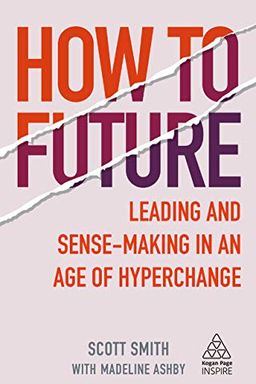
Have you ever looked at the headlines—political unrest, climate catastrophe, AI breakthroughs—and wondered, “How do I even begin to make sense of what’s coming?” In How to Future: Leading and Sense-Making in an Age of Hyperchange, futurists Scott Smith and Madeline Ashby argue that understanding the future isn’t about prediction—it’s about participation. They contend that futuring is a process, not a destination: a practical, methodical way to imagine, test, and prepare for emerging worlds rather than waiting to be shaped by them.
Most of us, they say, consume “The Future” like a brand—something sold to us by tech companies or politicians. We decorate our walls with slogans like “Tomorrow, today!” but rarely pause to question whose future that really is. Smith and Ashby’s central argument is that futuring should be democratized. You don’t need to be a professional futurist to think critically about tomorrow. From managers and policymakers to teachers and activists, anyone can learn to “future” effectively—with the right tools and mindsets.
Why Futuring Matters Now
The authors paint an urgent backdrop: nations and industries are faltering amid hyperchange—climate instability, automation, social fragmentation, and the collapse of old narratives like the social contract. Meanwhile, mass media oscillates between utopia and dystopia, leaving little room for nuance. Against this binary, Smith and Ashby invite readers to step into the role of active futurers. In Madeline Ashby’s words, “Your utopia is always somebody else’s dystopia.” The book insists that plurality—multiple possible futures—is the real antidote to fatalism.
From Forecasts to Frameworks
Instead of crystal balls and grand predictions, How to Future offers a structured approach through nine practical phases. It begins with scoping—defining whose future is being explored—and moves through sensing (collecting signals and trends), sense-making (finding patterns), scenario development (storytelling possible worlds), and prototyping (creating tangible artefacts of those worlds). Later chapters focus on measuring impact and building a sustainable futuring culture.
Each phase blends elements of strategic foresight, design thinking, and ethnography. The process is cyclical rather than linear—future work happens iteratively, much like software design. Futuring, Smith and Ashby stress, should be “always-on”: an organizational behavior that continuously adapts to change, not an annual report exercise.
The Human Side of Futuring
The book dives deeply into how people perceive time, uncertainty, and agency. Not everyone “futures” in the same way—some think linearly (past-to-present-to-future), while others see time as cyclical. Some treat uncertainty as a threat; others use it as creative material. Learning to future well, the authors argue, means recognizing and bridging these differences. Smith draws on his global experience at Changeist—a practice that’s worked with organizations from UNICEF to Google—to show how diverse teams can find common ground. Every team, he insists, is full of latent futurists—they just need frameworks to unlock that capacity.
Why You’re a Futurist Already
Perhaps the most empowering idea of the book is that “We are all futurists now.” If you’ve ever prepared for a business pivot, imagined your retirement, or wondered how your city might evolve, you’re already doing futuring. The challenge is making it intentional and structured. The authors show how to move from casual speculation to purposeful exploration—how to filter noise, recognize signals, and frame questions that lead to action. As they write, “Not doing is not knowing.”
From Imagination to Design
The most tangible part of Smith and Ashby’s method comes in the later chapters on scenario building and storytelling. They demonstrate how futures can be experienced through prototypes—objects, media, or interactions that bring a speculative scenario to life. For instance, they describe designing a speculative newspaper about big data and football, or mock refugee identity kits for humanitarian futures. These “artefacts from the future” transform abstract insights into concrete experiences. This approach aligns with Stuart Candy’s concept of “experiential futures,” where futures aren’t read—they’re felt.
Leadership for the Future-Ready
Ultimately, How to Future reframes leadership. Future-ready leaders, Smith writes, don’t command certainty—they cultivate agility. They enable their teams to think nonlinearly, question official futures, and accept uncertainty as a resource. The goal isn’t to avoid risk but to know how to navigate it. This skill set, he claims, is as essential for a tech startup as for a public servant or activist mobilizing for climate justice. “Leadership must enable a culture that views uncertainty as material to build with, not as risk to be mitigated.”
The Larger Mission: Improving Reality
In its conclusion, the book circles back to a moral premise: seeing a better world obligates you to help make it real. Borrowing anthropologist Genevieve Bell’s words, Smith affirms that futuring is not escapism—it’s activism. The authors invite you to use futuring to envision inclusive, resilient societies—and to approach tomorrow as an active verb. As you learn to map signals, design scenarios, and test possibilities, How to Future reminds you that the most radical act of futuring isn’t predicting the next trend—it’s participating in the change already unfolding.