
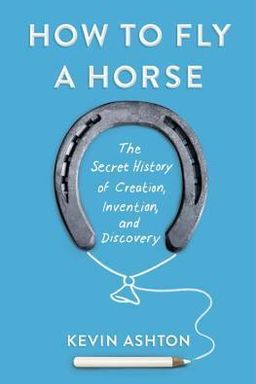
How to Fly a Horse cover

How to Fly a Horse

by Kevin Ashton

How to Fly a Horse by Kevin Ashton reveals that creation is a universal process accessible to all, not just the gifted few. By exploring historical examples and modern innovations, Ashton shows how persistence, teamwork, and the willingness to learn from failure can unlock anyone''s creative potential.

Creation as Work, Not Magic

Why do we still believe in the myth of the lone genius—the Mozart who writes whole symphonies in a night or the inventor with an instant eureka moment? In How to Fly a Horse, Kevin Ashton dismantles that myth and replaces it with a humbler, truer account: creativity is ordinary work done persistently over time. What looks like sudden brilliance is usually the last visible step of thousands of small, unseen iterations. The book traces a simple but transformative claim: creation is not divine inspiration; it is effort, attention, failure, and persistence multiplied by community.

The ordinary origins of the extraordinary

Ashton opens by exposing how romanticized creation stories came to dominate Western imagination. For centuries, societies reserved “creation” for gods or geniuses, separating makers from the rest of humanity. But this belief, he argues, is comfort fiction—it lets most people remain spectators. Drawing on his own invention of RFID-based systems that became the foundation of the “Internet of Things,” Ashton demonstrates that innovation grows from pragmatic tinkering. He didn’t dream up the idea in a flash; he followed a tedious trail of observation, testing, rejection, and revision across years of collaboration at MIT and industry labs.

Mozart, Edison, and the Wright Brothers—all commonly depicted as prodigies—fit the same pattern when examined truthfully. Mozart’s “instant composition” letter was a forgery; Edison oversaw countless lab assistants and thousands of trials; the Wrights spent years revising aerodynamic coefficients and testing gliders before flight. Creation, Ashton reminds us, is labor disguised as revelation.

Steps, not leaps

Psychologists like Karl Duncker and Allen Newell support Ashton’s thesis with evidence. Their experiments show that what we call “insight” emerges from sequences of incremental problem-solving. In Duncker’s Candle Problem, people stumble toward the answer (using the box as a candleholder) through many small steps, not a single leap of intuition. The Wrights’ methodical experiments, Kandinsky’s twenty sketches for White Border, and Dyson’s 5,126 prototypes show that durable creation is evolutionary, not revolutionary.

This perspective dissolves the paralysis of perfectionism. You don’t have to wait for inspiration; you need to start, fail, and keep refining. Creativity becomes procedural: break the problem, test ideas, evaluate outcomes, repeat. The insight you crave comes at the tail of repetition.

Everyone can create

If creativity is ordinary work, then everyone has creative potential. Ashton roots this universality in our species’ biology and history. Humans evolved to improve tools—fifty thousand years ago our ancestors started modifying their environment, and that adaptive impulse defines us. Through examples like Edmond Albius, the enslaved teenager who transformed vanilla cultivation by hand-pollinating orchids, Ashton shows that breakthroughs come from unexpected places. Creativity is distributed; genius is collective.

Modern data confirm this inclusivity. Millions of unique patent authors, soaring publication counts, and widespread artistic output all prove that novel creation is no longer the territory of a few. High IQs or pedigrees barely predict creative achievement. The lesson: you belong in the species of new.

Attention, failure, and commitment

Ashton argues that creation depends less on innate brilliance and more on disciplined attention—seeing what others overlook—and courage to persist through failure. Robin Warren’s discovery of H. pylori happened because he attended to what centuries of doctors ignored. Judah Folkman’s decades-long fight for angiogenesis theory defined innovation as tolerance of rejection. The pattern persists: creators succeed because they commit, not because they are blessed.

That commitment demands sacrifice. Robert Johnson’s “crossroads” legend symbolizes the moment when a person commits fully to craft. Whether it’s music, science, or entrepreneurship, every creator faces a choice: to devote energy to mastery or squander it on distraction.

Creation as collective and moral practice

Every discovery also sits in a chain of predecessors, collaborators, and consequences. Rosalind Franklin’s X-ray work underwrote Watson and Crick’s DNA model, yet credit followed hierarchy, not fairness. Likewise, every tool—from a Coca-Cola can to a stealth aircraft—emerges from vast networks of prior labor and global materials. Ashton asks you to remember that when you create, you inherit others’ work and bear responsibility for how your creation shapes the world. Ethical awareness is part of creative maturity.

Ultimately, How to Fly a Horse redefines creativity as a set of learnable habits rather than an accident of birth. Start badly, iterate frequently, pay attention to what others miss, and persist when failure seems endless. Creation is not a mystery to admire—it’s a discipline to practice. Ashton’s vision democratizes invention: if you work, you can create. And if you do create, you join a long, human chain of problem-solvers who keep the world becoming new.


Failure as the Engine of Progress

Ashton insists that failure is not opposition to success—it is its raw material. Every creator you admire accumulates a graveyard of failed versions behind each visible triumph. That accumulated failure, treated as feedback instead of defeat, is how you advance.

Learning from failure, not fleeing it

Judah Folkman embodies this idea. His angiogenesis hypothesis—once considered an absurd fantasy—was rejected for two decades. Yet he persisted, testing failed compounds until one worked, saving a child named Jennifer with an experimental therapy. Similarly, James Dyson failed over five thousand times before arriving at his famous vacuum. Stephen King deletes two words for each he keeps. Their common thread isn’t perfection but endurance.

Failure is expensive, but ignorance is worse. Ashton warns against two traps: ignoring data (like Franz Reichelt, who died testing a parachute suit he refused to prototype) or internalizing rejection (like Ignaz Semmelweis, whose discovery of hand hygiene was dismissed, leading to breakdown). The right path is neither denial nor despair but iteration guided by evidence.

Lesson

“If your idea succeeds, they call it persistence; if it fails, they call it stubbornness.” Only results define which you were—but the only way to get results is to keep trying.

By reframing failure as training data, Ashton encourages psychological resilience. Expect rejection, design small tests, iterate privately, and measure outcomes. This process converts frustration into learning. It’s what psychologists might call a growth mindset made operational.

The emotional skill of persistence

Persistence is as much emotional as cognitive. The Ilongot people’s wisdom—passion guided by knowledge—is apt here: raw energy fuels innovation only when structured by reflection. Passion without control burns out; disciplined persistence crafts something lasting. Practice isn’t glamorous, but it’s the sole guarantee that your ideas can mature beyond fantasy.

Every great discovery includes thousands of invisible missteps. Fail early, fail intelligently, document what broke, and try again. Your progress is the sum of your experiments, and failure is your most honest lab partner.


Attention and the Art of Seeing

What you notice determines what you can create. Ashton devotes one of the book’s most memorable sequences to how attention shapes discovery. Two people can stare at the same data yet see different worlds, depending on expectation and bias. If you train your eye and mind to notice anomalies—to see what “can’t” be there—you expand what’s possible to create.

When sight deceives insight

Robin Warren’s detection of Helicobacter pylori is Ashton’s proof story. Countless researchers had seen the same biopsies, but tradition told them the stomach was sterile. Warren’s curiosity overrode convention, and with Barry Marshall he proved that ulcers stem from infection. The discovery revolutionized medicine and earned a Nobel Prize decades later. Their case shows that discovery depends as much on attention as intelligence.

By contrast, Percival Lowell’s conviction that Mars had canals illustrates the peril of presumption: he literally projected the veins in his retina onto the telescope’s view. The moral is clear—expectation guides perception just as much as optics do.

Balancing expertise and curiosity

Expertise focuses perception—it lets chess masters see patterns instantly (as de Groot’s studies show)—but also blinds them to what doesn’t fit learned models. Zen teacher Shunryu Suzuki’s “beginner’s mind” expresses this balance: mastery plus humility. Ashton suggests alternating between modes—expert review and naive questioning—to avoid blindness born of certainty.

Try deliberate ignorance: re-inspect old data pretending you don’t know what should appear. Ask outsiders for feedback; rotate tasks to refresh perspective. In science, art, and daily problem-solving, beginners’ eyes and expert precision form the dual lenses of creative seeing.

Discovery depends on attention because what you expect determines what you see. The discipline of creativity begins not with brilliance but with noticing. Look longer, look differently, and you will eventually see what others miss.


Starting Bad and Iterating Forward

Ashton writes that every creation starts badly. The professional’s secret is to start anyway. Creative work is an endless cycle of generating, evaluating, and culling. You produce messy drafts, refine them through feedback, and repeat until something shines. This simple discipline—begin often and edit ruthlessly—separates creators from dreamers.

The myth of the perfect start

Many imagine masterpieces as perfect first attempts. But Woody Allen’s mountains of discarded script pages and Stephen King’s quota of two thousand words per day prove otherwise. You make progress not through epiphany but through production. Stravinsky’s morning Bach ritual and daily composition hours show routine as the incubator of inspiration.

Practice rule

Create first, correct later. The goal of your first draft isn’t excellence—it’s existence. You can’t edit what doesn’t exist.

As in biology, creative survival depends on variation and selection. Generate abundantly, then cut mercilessly. Invite critique to test the strength of ideas. Editing, editing, and more editing: that’s how raw output becomes lasting contribution.

Micro‑quotas and momentum

Instead of waiting for motivation, Ashton advises small quotas: ten-minute starts, two-hundred-word drafts, rough sketches. Momentum itself becomes motivation. Keep visible piles of early failures to remind yourself that ugliness is the norm before beauty.

Creation rewards those who act before they’re ready. Begin now, awkwardly, cheaply. That messy first motion transforms uncertainty into learning and finally into art.


Motivation, Teams, and the Creative Environment

No one creates in isolation, and no one sustains creation through external pressure alone. Ashton combines psychological research and historical case studies to show that intrinsic motivation and supportive teams matter more than rewards or hierarchy. Environments built on autonomy, curiosity, and direct action outperform those organized for compliance.

Intrinsic vs extrinsic motivation

Teresa Amabile’s laboratory experiments revealed a paradox: when people expect evaluation or rewards, creativity declines. Artists told their collages would be judged produced duller work. Poets paid to write wrote worse poems. Harry Harlow’s monkeys solved puzzles for curiosity’s sake but failed when bribed with food. Intrinsic joy—love of the task itself—is the sustaining engine of originality.

You can still combine pay and purpose, but only if autonomy remains. When individuals choose their projects or approach, small rewards reinforce effort. Forced incentives, by contrast, stifle experimentation. The message is simple: choose tasks that fascinate you, not those that merely promise applause.

Partnerships and small groups

Burt and Ernie, Parker and Stone, and the Lockheed Skunk Works teams—all prove that creativity thrives in small, empowered circles. The best pairs alternate instinct and correction, energy and restraint. Preschoolers outperform MBA teams in prototyping challenges because they play, test, and learn collaboratively instead of over‑planning. Keep teams small, safe, and experimental. Begin projects by doing, not meeting.

Building creative systems

Kelly Johnson’s Skunk Works exemplifies a high‑performance creative structure: minimal hierarchy, short communication loops, direct testing, and a countdown focus (“be quick, be quiet, be on time”). The ethos “show me, don’t tell me” replaced arguments with evidence. Protect truth-tellers—those who speak uncomfortable facts—and you protect innovation.

Contrast this with the hidden curriculum of most institutions, which reward saying over doing. Meetings and compliance smother discovery by incentivizing risk‑avoidance. To counter this, leaders must reward contribution, shorten feedback loops, and make experimental wins visible.

If you manage, build mini‑Skunk Works teams; if you create, seek such environments. In both cases, autonomy and shared purpose generate more breakthroughs than any financial bonus ever will.


The Moral Chain of Creation

Ashton ends by widening the frame from the individual to the collective and moral. Every creation rests on invisible predecessors and carries consequences forward. Seeing that chain clearly is both humbling and empowering: it reminds you that all innovation depends on networks and choices.

Credit and inheritance

Who gets credit for innovation is rarely who did the work. Rosalind Franklin’s Photo 51 enabled the DNA model but fame went to Watson and Crick. The sociologist Robert Merton called this the “Matthew effect”: the famous receive disproportionate praise, while anonymous contributors get neglected. Ashton calls for fair attribution—not sentimental justice, but because it sustains future creativity. When recognition flows accurately, collaboration grows stronger.

Remember that even “giants” stand on layers of unseen labor. Every scientific revolution builds on technicians, illustrators, fieldworkers, and material suppliers whose names fade. To create ethically, cite your sources—human and material alike.

Tool chains and global consequences

The humble Coca‑Cola can encapsulates this interdependence. Tracing its materials—from Australian bauxite to corn syrup in U.S. refineries—reveals thousands of people, continents, and ecological costs. Creation, Ashton argues, is planetary in scope. Each invention changes environments and societies. Mining, manufacturing, distribution—all form part of the moral ledger of making.

The Luddites and Amish, though often caricatured, model ethical reflection on technology: one fought blind exploitation; the other selected tools compatible with community values. Their lesson persists—evaluate invention not only by novelty but by consequence.

Rejecting the genius myth and embracing the species of new

Ashton ends where he began: creativity is collective. Against Francis Galton’s false heredity of genius, he offers data and humanism. Progress accelerates because populations grow, knowledge spreads, and individuals cooperate. You are a link in that expanding web. Small contributions—like Albius’s pollination gesture—can ripple globally through the tool chain of human invention.

Creation, then, is moral participation in ongoing human becoming. Work honestly, credit others, mind the consequences of your tools, and remember: every act of making adds one more rung to the ladder our species climbs together.

Dig Deeper

Get personalized prompts to apply these lessons to your life and deepen your understanding.

Go Deeper

Get the Full Experience

Download Insight Books for AI-powered reflections, quizzes, and more.