
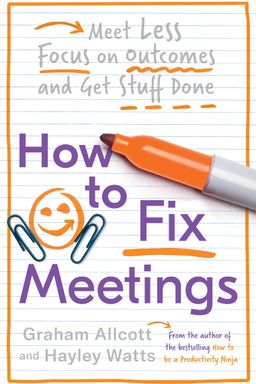
How to Fix Meetings cover

How to Fix Meetings

by Graham Allcott and Hayley Watts

How to Fix Meetings is a transformative guide to turning tedious meetings into productive, results-driven sessions. Authors Graham Allcott and Hayley Watts provide actionable strategies to streamline meetings, ensuring they are purposeful, engaging, and impactful. Discover how to harness effective planning and follow-through for meetings that truly matter.

Fixing the Broken Culture of Meetings

When was the last time you left a meeting feeling truly energized, inspired, and clear on what had to happen next? If you’re like most professionals, it’s hard to remember. In How to Fix Meetings: Meet Less, Focus on Outcomes and Get Stuff Done, Graham Allcott and Hayley Watts turn this universal frustration into a roadmap for reclaiming time, attention, and focus in the modern workplace. They argue that meetings aren’t inherently bad—they’re just broken by poor habits, unclear purposes, and fragmented human attention.

Allcott and Watts contend that meetings should be purposeful spaces for collaboration and progress, not the productivity sinkholes they’ve become. Drawing on insights from their “Think Productive” workshops with global organizations like Amazon and Google, they reveal how to transform meetings from passive rituals into dynamic engines of clarity and momentum. Their approach challenges you to think about meeting culture through a fresh lens: meetings are a reflection of how well you and your organization manage attention, balance deep work with deep listening, and create environments where human connection drives real outcomes.

Why Meetings Are Broken

The authors begin with an uncomfortable truth: most modern meetings waste massive amounts of time. Studies cited from Harvard Business Review and the Wall Street Journal show executives spending more than half their week in unproductive sessions. These hours represent lost opportunities to do meaningful work. When calendars are clogged with back-to-back Zoom calls, teams experience burnout, shallow decision-making, and generic groupthink. The root cause, as Allcott and Watts explain, isn’t time—it’s attention. In our hyperconnected age, attention has become our scarcest resource, constantly fragmented by notifications, multitasking, and the ever-present lure of digital distraction. Learning to manage attention, not just time, is the foundation of productive meetings.

Attention: The Currency of Productivity

Allcott and Watts position attention as the true fuel for quality collaboration. They reference studies showing even a silent, unused smartphone can drain brain power simply by being present. This insight reframes how we think about focus in meetings: every ping and vibration is stealing cognitive capacity from creative problem-solving. When leaders cultivate “generous attention”—being fully present and listening deeply—they unlock trust, empathy, and innovation. Great meetings become human moments of connection where people feel heard, respected, and engaged. Poor ones become rituals of impatience and distraction.

The Productivity Ninja Mindset

Before diving into tactics, the authors introduce their framework from Allcott’s previous book, How to Be a Productivity Ninja. The nine ninja traits—such as Zen-like calm, Ruthlessness, Mindfulness, Preparedness, Agility, and Human (not Superhero) thinking—shape how you approach meetings. For example, ruthless attention management means saying no to unnecessary invitations; preparedness ensures you show up ready to contribute; and being human means acknowledging that mistakes and discomfort are part of growth. These traits form the foundation for fixing meeting culture without resorting to unrealistic solutions or trendy buzzwords.

The Yin and Yang of Meetings

The book’s central philosophy is balance. Allcott and Watts borrow from Daoist yin-yang principles to describe two modes of attention—deep work and deep listening. Yin represents the calm, empathetic, reflective energy that values people and ideas; Yang symbolizes decisive, action-oriented focus that drives results. Great meetings blend both forces: empathy fuels connection, action fuels outcomes. Too much yin creates endless talking without decisions; too much yang breeds aggressive task-chasing with no collaboration. Success lies in harmonizing them to create clarity and momentum.

A Framework for Change: Before, During, and After

To make the transformation practical, the authors structure their system around three stages—Before, During, and After meetings. They insist that what happens outside the meeting determines success inside it. Preparation (designing the meeting with purpose, protocols, and the right people) is 40% of the work; the meeting itself is 20%; and follow-through—the actions taken afterward—counts for the remaining 40%. This “40-20-40 continuum” encourages leaders to devote most energy to the preparation and aftermath that actually drive results. (This mirrors ideas from Cal Newport’s Deep Work and Matthew Syed’s Black Box Thinking—real improvement comes through reflection and disciplined focus.)

Why This Matters

If your calendar feels like a prison, How to Fix Meetings offers liberation through clarity, presence, and intentional design. Meetings, when structured well, are opportunities for collective deep attention—a rare pocket of focus where teams align, resolve problems, and make change happen. The book argues that fixing meetings isn’t just about saving time; it’s about restoring humanity to modern work culture, replacing fatigue and futility with empathy and impact. Allcott and Watts challenge you to rethink your relationship with meetings entirely: not as obligations to survive, but as spaces to thrive.

“Aim to do fewer meetings, but do them well,” they write. “Done well, they can create real impact. Done badly, they drain time and energy.”

By the time you finish the book, you’ll have learned practical rituals, balance strategies, and mindset shifts to turn ordinary gatherings into moments of shared purpose. From ruthless calendar pruning to cultivating generous attention, Allcott and Watts provide both philosophy and practicality. The reward isn’t just better meetings—it’s better work, better teams, and a better relationship with your own attention.


The Attention Economy and Deep Work

Allcott and Watts urge you to view attention—not time—as your most precious professional resource. Meetings, they argue, are microcosms of the modern “attention economy” dilemma: everyone is busy but rarely focused. Phones, email, and social platforms fragment thought, leaving no space for reflection. Their remedy is what Cal Newport calls Deep Work—sustained focus on cognitively demanding tasks—and its relational twin, Deep Listening—shared attention that fosters genuine collaboration.

Reclaiming Attention

Studies cited in the book reveal staggering costs of distraction: a smartphone can sap focus even when turned off and hidden. The average adult attention span has dropped from twelve minutes to five. In meetings, this translates into constant mental drift and “multitasking malaise.” By learning to pause notifications, step away from devices, and focus single-mindedly on one conversation, you transform not just the meeting but your overall productivity.

Deep Work vs. Deep Listening

Allcott and Watts frame deep work and deep listening as two sides of the same coin. Deep work requires solitude, structure, and proactive attention to make progress on complex problems. Deep listening, on the other hand, demands presence and compassion. When you’re fully tuned into someone else—listening without crafting your next response or glancing at notifications—you create trust and space for creativity. These forces mirror yin and yang: one is individual focus, the other collaborative focus. Balancing them is the essence of productive team culture.

Practical Ways to Protect Attention

  • Block “proactive attention” hours in your calendar for concentrated work.
  • Be ruthlessly selective with meeting invitations using the “one in three” rule—attend only one of every three recurring sessions.
  • Experiment with “digital detox” techniques during meetings—phones out of sight, notifications off, or apps like Forest to grow focus trees as a group challenge.
  • Practice mindfulness to regulate emotional distraction and procrastination.

These habits cultivate what the authors call “Zen-like calm”—a centered state where your mind is uncluttered and attention generous. It’s the antidote to reactive busyness, and the fuel for meaningful collaboration.

Attention as Leadership

Great leaders, the authors write, are generous with attention. They treat presence as a gift: listening deeply, responding thoughtfully, and creating environments where everyone feels seen. “Giving your fullest attention,” Allcott and Watts say, “is the most generous thing you can do.” When attention becomes a shared currency instead of a scarcity, meetings shift from time drains to trusted spaces for progress.


Balancing Yin and Yang in Collaboration

To fix meetings permanently, you must cultivate balance—between people and productivity, empathy and efficiency, calm and action. Allcott and Watts map this onto the timeless yin-yang paradigm. Yin represents reflection, compassion, and listening; Yang embodies drive, decisiveness, and execution. The healthiest meeting cultures blend these energies to spark connection and achieve outcomes.

Yin Behaviors: Listening Generously

The yin side begins with mindfulness and valuing human connection. This means eliminating distractions (phones in a box, laptops closed), practicing presence, and noticing emotional undercurrents. Chairs are encouraged to create opening and closing rounds, where participants share thoughts or feelings in one word, grounding the group. Yin also manifests in kindness: thanking others, listening actively, recognizing contributions. These gestures create psychological safety that allows honest dialogue and creative dissent.

Yang Behaviors: Driving Outcomes

Yang complements yin through ruthless efficiency, preparedness, and decision-making. Meetings need structure—agendas, purpose statements, time limits, and clear actions. The authors invoke Peter Drucker’s maxim: “Meetings are a symptom of bad organization—the fewer, the better.” Cutting unnecessary gatherings, keeping sessions short, and concluding with explicit actions (“Who will do what by when?”) infuse yang energy. Being ruthlessly focused doesn’t mean being cold; it means prioritizing clarity and momentum.

Balancing Both Forces

Too much yin leads to endless chatter and sentiment; too much yang results in burnout and shallow decisions. Allcott and Watts teach leaders to carry “the seed of the opposite” within each force. During calm reflection, maintain outcome awareness; during decisive action, keep empathy alive. They even design meetings around this rhythm—beginning with yin (welcoming, connection), moving through yang (decision and action), then closing with yin again (gratitude and reflection). This cyclical pattern mirrors what psychologist Daniel Kahneman might call “thinking fast and slow” applied to group dynamics.

Balanced meetings don’t just achieve goals—they strengthen culture. When teams learn to listen before acting and act with empathy, they create sustainable collaboration that transcends any single project.


Designing Meetings with the 4 Ps Framework

Preparation—the first '40' in the 40-20-40 continuum—is where magic happens. Allcott and Watts outline the 4 Ps Framework to design meetings that deliver results: Purpose, Plan, Protocols, and People. It’s the meeting’s blueprint, applicable to sessions of any type—from short check-ins to executive summits.

Purpose: Clarity Above All

Every meeting must have a purpose statement. Begin with “By the end of this meeting we will have…” followed by active verbs—decided, agreed, resolved, confirmed, or learned. This simple practice prevents drifting conversations. For instance, a board may state, “By the end of the meeting we will have agreed on next year’s strategic plan and identified emerging opportunities.” Such precision clarifies why the meeting exists and when it is done.

Plan: The Journey Structure

A good plan outlines agenda items, timings, and expectations. The authors suggest thinking like a storyteller: every meeting has a beginning (context), middle (struggle and ideas), and end (resolution and actions). They even borrow Rudyard Kipling’s “Six Honest Serving Men”—What, Why, When, How, Where, and Who—to craft agendas that explore problems comprehensively. Innovative timing—starting at 10:10 or ending at 10:50—signals intention and avoids calendar fatigue.

Protocols: Ground Rules for Respect

Protocols manage expectations—device policies, confidentiality, and participation norms. Because phones undermine focus, they propose rituals like placing devices in a communal box or using productivity apps to reward non-usage. For online meetings, protocols include camera-on accountability and tech check-ins to preempt frustration. These simple agreements ensure the shared attention that creates progress.

People: Quality over Quantity

Inviting the right people is an act of respect. Borrowing Jeff Bezos’s “Two Pizza Rule,” the authors advise keeping numbers small—no more participants than two pizzas can feed (around six). Every person should know exactly why their presence matters. Seating and role distribution—chair, timekeeper, host, and note-taker—bring structure and accountability. Too many people create cognitive overload; too few risk missing insight. The balance of diversity and focus is key to dynamic collaboration.

The 4 Ps model turns abstract intention into structured design. Used consistently, it reduces wasted time, aligns teams, and restores purpose to your calendar.


Practical Meeting Formats that Drive Results

Once purpose and preparation are clear, format determines impact. Allcott and Watts supply a creative 'meetings menu' to suit different needs—from daily huddles to silent meetings. Instead of defaulting to sit-down sessions, select formats that fit the outcome.

Daily Huddles

Short, stand-up huddles (under ten minutes) keep momentum high and reduce the need for longer weekly meetings. Think Productive’s own HQ huddle includes quick prompts: good news, metrics, frogs (what's been procrastinated), stucks, and a check for tomorrow’s readiness. These build rhythm, transparency, and collective energy.

Silent Meetings

The 'silent meeting'—pioneered by Square’s Alyssa Henry—levels the playing field for introverts and remote participants. Everyone writes opinions in a shared document before speaking. This ensures thoughtful contributions and minimizes dominance by extroverts or senior voices. Allcott and Watts tested this method with success in their own workshops, finding that reflection deepens conversation quality.

Brainstorming and “Blow Sh*t Up” Culture

Borrowing from BrewDog’s disruptive ethos, “Blow sh*t up” sessions challenge sacred corporate cows—identifying practices to kill or reinvent. Post-it Notes become truth bombs for change. This positive disruption reawakens creativity, encouraging teams to rebuild stale processes. It’s cathartic, fun, and surprisingly productive.

Board Meetings and 1-to-1s

Even formal settings can be improved through clarity and conversation design. Boards should focus on strategy, not minutiae; one-to-ones must prioritize development, not just updates. Embedding purpose statements and rotating chairs keeps these meetings alive instead of bureaucratic.

By diversifying formats, you choose the right tool for the job rather than fitting all communication into one mold. Format variety sustains engagement, inclusion, and better outcomes.


Leading and Participating Effectively During Meetings

During meetings, leadership and participation merge. The chair’s role is to orchestrate attention—balancing personalities, pacing, and direction. Participants share responsibility for maintaining energy and focus. Allcott and Watts offer practical tools to ensure smooth collaboration.

Chairing for Balance

A skilled chair manages the flow like a conductor. They reconfirm purpose, keep discussion aligned, and manage time with discipline. They also create moments of yin—active listening or reflection—and yang—rapid closure or decision. They may use strategic pauses to diffuse tension or reinvigorate focus. Visual cues like timekeepers and agenda projections help everyone stay oriented.

Handling Conflict and the HiPPO Effect

Conflict isn’t to be feared—it fuels creativity if handled well. Pixar founder Ed Catmull’s “Braintrust” model inspires candid feedback without blame. To prevent power imbalance, chairs manage the 'Highest Paid Person’s Opinion' (HiPPO). They invite junior voices first, encourage diversity of thought, and save senior remarks for last. This democratizes decision-making and improves psychological safety.

Participant Responsibility

As a participant, bring your best self: stay hydrated, take succinct notes, and track actions yourself. Say no to unrealistic commitments and clarify deadlines. Use doodling to enhance memory, change positions to sustain energy, and focus on the meeting’s defined purpose. If conversation drifts, guide it gently back. Asking, “Can we clarify the next action here?” injects yang energy at just the right moment.

Creativity Through Constraints

Odd constraints—one-word answers, balancing books while speaking, time challenges, or using Edward de Bono’s Six Thinking Hats—can transform group problem-solving. Constraints sharpen thinking and encourage original solutions. They reintroduce playfulness and discipline into otherwise dull routines.

Meetings during this stage aren’t just about roles—they’re about managing collective energy. By blending empathy, rhythm, and decisive closure, everyone leaves with clarity and motivation to act.


After the Meeting: Turning Talk into Action

Talk means little without follow-through. The final ‘40’ in the 40-20-40 continuum emphasizes that productivity begins when the meeting ends. Reflection, organization, and accountability transform discussion into impact.

Reflection and Continuous Improvement

Using Matthew Syed’s concept of “Black Box Thinking,” Allcott and Watts ask leaders to treat meetings as experiments. Afterward, evaluate whether the 4 Ps were successful—was purpose achieved, was the plan effective, were protocols respected, and did the right people attend? Feedback from participants provides insight into what to refine next time.

Clarity and Next Physical Actions

Vague commitments kill momentum. Record every decision as a discrete, measurable action: *who* will do *what* by *when*. Distinguish between next physical actions (specific tasks) and delegated outcomes (broader responsibilities). Chairs ensure each action has one owner, a deadline, and reporting method. This explicit clarity protects against the “we thought someone else was doing it” trap.

Systems for Follow-through

Allcott and Watts import their Productivity Ninja principles here: maintain a second brain (a trusted task management system) to track outcomes; use waiting-for lists to monitor dependencies; perform weekly reviews to reassess progress and priorities. Rituals like the “Power Hour” focus collaborative work time, and “eat the frog” practices—the hardest task first—help overcome procrastination.

Culture of Accountability

Regular reflection cultivates accountability. Leaders and teams normalize checking back on previous commitments rather than superficial reporting. When this becomes habit, meetings evolve into accountability engines where everyone ends clear on what success looks like. The energy of the final ten minutes—recapping, gratitude, and agreed next steps—ensures that momentum extends beyond the room.

The authors close by linking efficient meetings to human connection: better meetings make better organizations and kinder cultures. By fixing meetings, you fix collaboration itself.

Dig Deeper

Get personalized prompts to apply these lessons to your life and deepen your understanding.

Go Deeper

Get the Full Experience

Download Insight Books for AI-powered reflections, quizzes, and more.