
Idea 1
Failing Your Way to Success: Systems, Energy, and Luck
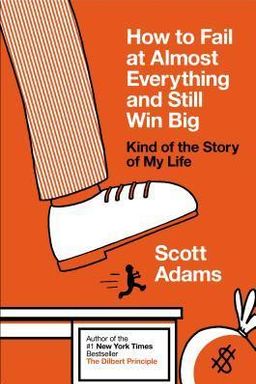
What if you could fail at almost everything in life—your inventions, your investments, your jobs—and still come out ahead? In How to Fail at Almost Everything and Still Win Big, Scott Adams, creator of the comic strip Dilbert, argues that success isn’t about winning every battle, setting perfect goals, or having superhuman talent. Instead, it’s about developing a personal system—a repeatable way of working, learning, and staying energized so that luck is more likely to find you.
Adams contends that the world rewards persistence, optimism, and understanding your “energy engine” more than it rewards raw intelligence or passion. His core argument is both simple and subversive: systems beat goals, and the best way to win in life is to become a skill-stacking, failure-loving, energy-optimizing “moist robot.”
Over the course of the book—part memoir, part self-improvement manifesto—Adams shares his own string of humiliating and hilarious failures: the Velcro Rosin Bag invention, a failed restaurant venture, a burrito brand called the “Dilberito,” doomed software projects, and even a voice disorder that once left him mute. The fact that he managed to turn this endless reel of embarrassments into success is the mystery he sets out to unpack.
The Problem with Goals and the Beauty of Systems
Adams distinguishes between goal-oriented thinking, which focuses on achieving a specific outcome, and systems thinking, which focuses on repeated processes that increase your odds of success over time. Goal seekers constantly live in a state of “pre-success failure,” while systems thinkers win every day they perform their process. If your system is to exercise daily or learn new skills continually, you’re a success every time you act on it. (Jim Collins’ Good to Great and James Clear’s Atomic Habits echo this philosophy: consistent systems, not burning ambition, create greatness.)
Adams claims his own system—“keep trying things until something works”—is what made Dilbert possible. Every failure gave him new skills, contacts, and insights. The “losing” invention that went nowhere became the stepping stone to a new business idea, which improved his future odds. The punchline: if you fail ninety-nine percent of the time but stay in the game, you only need to be lucky once.
From Passion to Energy: A Different Success Metric
In one of the book’s most provocative ideas, Adams argues that “passion is bullshit.” The idea that all you need is passion, he says, is survivor bias in disguise—people get passionate about what works. What actually fuels performance and persistence isn’t passion but personal energy. If you optimize your diet, sleep, exercise, schedule, and mindset to keep your energy high, you’ll naturally perform better at everything.
Adams measures his decisions by one guiding question: “Does this choice raise or lower my personal energy?” When your energy is high, everything else improves—your work, creativity, relationships, and resilience. He calls this the “Energy Metric,” suggesting that you should organize your life around energy just as capitalism organizes businesses around profit. Energy management becomes the central “operating system” of all success systems.
The Moist Robot: Reprogramming Yourself for Success
Adams invites readers to think of themselves as “moist robots”—biological machines whose outputs depend on their inputs. Change the food, information, and people you surround yourself with, and you change who you are. He urges you to take control of the inputs by adjusting your physical environment, daily habits, and associations. This mechanical metaphor dismantles magical thinking: you aren’t “willed” into success; you’re programmed by repetition and environment.
This model leads directly to one of the book’s recurring themes—association programming. Humans unconsciously imitate the people around them. If you spend time with winners, strivers, or health-conscious peers, those traits seep into your “code.” (This aligns with concepts from Charles Duhigg’s The Power of Habit and Daniel Coyle’s The Talent Code—environment shapes behavior far more than willpower does.)
Stacking Skills to Multiply Luck
Adams popularized the career strategy of “talent stacking”: being not the best at any one skill but moderately good at several complementary ones. He’s not a world-class artist, writer, or entrepreneur—but the combination of those skills made Dilbert unique and commercially unstoppable. Each skill you add doubles your odds of success, he says, because good + good > excellent.
To “stack your talents,” learn broadly useful, transferable skills—communication, public speaking, business writing, persuasion, psychology, basic design, and technology. The more loops you add to your system, the more places luck can find you. This concept parallels Cal Newport’s “career capital” in So Good They Can’t Ignore You: becoming valuable through skill accumulation beats chasing a single passion.
The Broader Payoff: Happiness, Health, and Controlled Luck
Ultimately, Adams extends his framework beyond career success into health, happiness, and meaning. Happiness, he argues, is chemistry—more a function of diet, sleep, imagination, and exercise than circumstances. Health and consistent exercise raise your physical “baseline happiness.” Systems and affirmations build optimism, which, in turn, makes you an easier target for luck. And while luck can’t be controlled directly, it can be invited through persistent action, practice, and preparation—what he calls “staying in the game.”
By presenting failure as the raw material of success, Adams challenges the culture of instant wins and passion-chasing. His message resonates because it’s fundamentally encouraging: you don’t have to be exceptional, perfect, or even disciplined all the time. You just need a system that keeps you energized, learning, and in motion. Luck will do the rest.