
Idea 1
Cooking as Memory, Place, and Sensual Storytelling
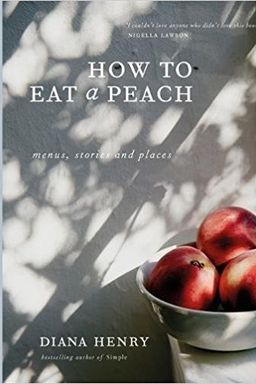
What does it really mean to eat well—not just in body, but in soul? In How to Eat a Peach, Diana Henry transforms cooking into a lush act of remembrance and imagination. Food, for her, is far more than recipes; it’s how we revisit the places that shaped us—France, Spain, Italy, Turkey, Mexico, Northern Ireland—and how we create intimacy and meaning in an often hurried life. The book argues that menus are stories: each one evokes a season, a landscape, or a love affair. Through them, cooking becomes a way to see the world anew.
Henry invites you to treat cooking not as performance or competition, but as an act of care, sensuality, and attention. She insists that good food doesn’t demand luxury ingredients or elaborate technique; it requires presence. A simple bowl of peaches soaked in chilled Moscato, she suggests, can embody all that’s beautiful about eating together. This philosophy threads through every page—a union of nostalgia and practicality, of planning and spontaneity, of sensual delight and reflective memory.
Menus as Maps of Emotion
For Henry, food is an emotional geography. Each menu conjures a memory: smoky October nights in Northern Ireland, long lunches in Brittany, a heartbreak healed by Mexican mole. The book’s structure mirrors the seasons—Spring and Summer, Autumn and Winter—revealing how the rhythm of the year shapes appetite and mood. You don’t only taste with your tongue here; you taste with your past, your longing, and your imagination. That’s why her very first menu, “Cider and Gitanes,” recalls falling in love with France—the leeks vinaigrette, the Breton cider, and even the rain-soaked sky outside the window become part of the meal’s meaning.
The Craft of Menu-Making
Henry sees menu creation as a discipline and a pleasure. Growing up in Northern Ireland, she used to compose imaginary dinner menus in a school notebook, learning early that balance—between textures, colors, and emotions—is what gives a meal resonance. Like Alice Waters and the Chez Panisse approach she admires, Henry builds menus around the seasons and simplicity. She believes two essentials: never overload a meal with too many last-minute dishes, and never repeat richness without contrast. A velvety cheese gratin needs a peppery leaf salad; an indulgent lasagne like vincisgrassi deserves a palate-cleansing citrus jelly to follow. Taste, for Henry, is narrative rhythm.
Food as a Language of Care
Much of the book’s tenderness arises from Henry’s understanding that feeding people expresses love better than words. She recalls her mother’s buffet parties—good craic, whiskey, dancing—and how these were really lessons in generosity, not recipe lists. Now she urges you to think beyond “entertaining” and toward hospitality: a well-dressed green salad, a jug of water with wild mint, or even just bread chosen with thought. The point is not impressing others, but creating atmosphere. This is the art of care through detail: a flicker of candlelight, the right song, the shock of cold sorbet after rich food. These are gestures of attention that speak louder than perfection.
Cooking as Travel and Memory
Each section of How to Eat a Peach travels across Henry’s culinary map. France is her touchstone—her “becoming a cook” moment—but she moves onward: Spain (“the soul of light and dark”), Italy (“the joy of simplicity”), Mexico (“the shock of color and heat”), Istanbul and the Middle East (“lavish generosity and spice”), and home again to Britain and Ireland (“smoke, apples, and October light”). Recipes like mouclade or crêpes dentelles with caramelized apples aren’t just instructions; they’re memory portals. The reader is reminded that to cook something from another place is to briefly inhabit it, to experience its textures and tempos through flavor.
The Call to Sensual Attention
Ultimately, Henry’s message is that cooking—and by extension, living—demands attention. In an era of industrialized food and digital distraction, she insists on recovering what she calls “volupté”: deliciousness that pleases all the senses. It’s about noticing the weight of a ripe peach, the way caramel smells just before it burns, the moment a sauce turns glossy. If other modern food writers (like Nigel Slater or M.F.K. Fisher) taught us about comfort and desire, Henry fuses those qualities into a subtle aesthetic manifesto: to cook is to feel, to notice, to remember. The question she leaves you with is deceptively simple: What if every meal could be a small act of beauty and attention?