
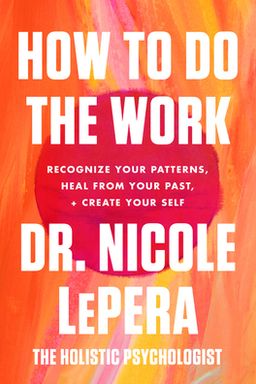
How to Do the Work cover

How to Do the Work

by Nicole LePera

How to Do the Work is a practical guide to holistic healing that connects the dots between physical, mental, and emotional health. By addressing past traumas, setting boundaries, and nurturing self-awareness, readers can transform their lives and relationships.

Healing the Whole Self

Why do so many people remain stuck despite therapy, medication, or spiritual breakthroughs? In her work on Holistic Psychology, Dr. Nicole LePera proposes that the missing piece is integration—the daily, embodied practice of aligning mind, body, and spirit so they function as one system. Healing isn’t a single intervention or specialized treatment; it’s a continuous process of reconnecting with your own power to regulate, reflect, and choose. You are both the patient and the healer.

Throughout her book, LePera charts her own transformation from disillusioned clinician to what she calls the “Holistic Psychologist.” After suffering burnout and an emotional collapse “over a bowl of oatmeal,” she began rebuilding her health and self-trust through simple, consistent practices—morning breathwork, better nutrition, daily movement, and journaling. Her philosophy spread rapidly, inspiring millions of followers who began adopting micro-habits to restore their nervous system and reclaim agency.

The Three Dimensions of Healing

LePera’s holistic model rests on three interconnected pillars: psychological consciousness, physiological regulation, and spiritual reconnection. The mind is trained through attention and belief reprogramming; the body through nervous system work, breath, and nutrition; and the soul through presence, compassion, and community. None can be healed in isolation because each influences the others through feedback loops of stress, emotion, and thought.

When consciousness grows but the body remains dysregulated, insight alone stalls progress—a truth echoed in trauma research (Bessel van der Kolk’s The Body Keeps the Score explores similar terrain). LePera’s model weaves those disciplines together, showing how top-down and bottom-up methods create sustainable change.

From Awareness to Practice

The heart of her method is daily self-practice. Healing unfolds not through revelation but repetition. Breathwork, Future Self Journaling, mindful movement, and small promises (like drinking water before coffee) rebuild self-trust—the foundation of all transformation. The nervous system learns safety through consistency, not grand gestures. This approach asks you to shift from waiting for someone else to fix you toward witnessing and nurturing your own process.

Community also plays a crucial role in LePera’s philosophy. Healing begins within but matures in relationship. Through her SelfHealers community, she saw how shared vulnerability creates co-regulation: collective nervous systems learning to downshift together. When isolation is replaced by interdependence, growth stabilizes.

The Book’s Journey

LePera leads readers through a structured path: first learning to observe the subconscious and conditioned ego, then working through childhood and relational wounds, and finally establishing new habits of self-parenting, boundary-setting, and emotional maturity. Every chapter intertwines biography, case examples, and science—Stephen Porges’s polyvagal theory, Bruce Lipton’s epigenetics, Gabor Maté’s stress research—to show how self-awareness translates into cellular and relational change.

Along the way, characters like Jessica, Ally, and Christine mirror the reader’s journey. Jessica finds freedom by linking reactivity to unprocessed grief; Ally transforms chronic illness through compounding micro-habits; Christine heals from family denial by naming her trauma. Their stories illustrate the book’s premise: that small, conscious acts create big internal rewiring.

The Core Promise

Ultimately, LePera argues that healing is a return to authenticity. When you slow down enough to sense your body, question your beliefs, and speak compassionately to your inner child, you begin to live from choice rather than conditioning. This, she insists, is true empowerment—neither ego death nor transcendence, but steady embodiment. In her closing story about the pizza box quote—“We don’t remember days, we remember moments”—she reminds you that transformation is measured not in dramatic breakthroughs but in subtle daily choices that honor your whole self.

Core belief of Holistic Psychology

“Healing is a daily event. You can’t go somewhere to be healed—you must go inward.”

This opening idea anchors everything that follows: consciousness, nervous system training, reparenting, boundaries, and community are all expressions of the same truth—that wholeness is self-created in partnership with your body and the world around you.


Conditioning and Conscious Awareness

LePera begins the healing process with awareness of how conditioning shapes your everyday life. Your subconscious runs most of your day on autopilot, recycling habitual thoughts and emotional reactions rooted in childhood experiences. Awareness—the act of becoming the thinker of your thoughts—is the first tool of liberation.

The Conscious and Subconscious Mind

Your conscious self, housed in the prefrontal cortex, plans, observes, and chooses. Meanwhile, the subconscious stores learned patterns from your formative years—what you came to believe was safe or necessary for love. If you repeatedly practiced people-pleasing or suppression, those responses became default programs. LePera cites research showing that most people operate 90–95% of the day from this subconscious automation.

This system resists change through what she calls the homeostatic impulse: a deep bodily urge to maintain the familiar. When you try to initiate new habits, resistance appears as mental excuses (“You deserve a break”) or physiological discomfort (tension, fatigue). Recognizing resistance as a protective reflex—not laziness or failure—transforms how you persevere.

Strengthening Attention

LePera teaches simple attention practices that strengthen the brain’s ability to pause before reacting. Setting a phone reminder to ask, “Where is my attention now?” or doing a one-minute check-in while washing dishes builds neural capacity for choice. Over time, these micro-practices rewire the prefrontal cortex and create emotional distance from impulses.

Jessica’s story illustrates this: she spent years reenacting grief through relationship drama until yoga and mindful breath strengthened her attention muscles. Once she could pause, she recognized the sadness underneath anger—and stopped projecting pain onto her partner.

Witnessing the Ego

LePera reframes the ego not as an enemy but as an old protector. This voice narrates meaning behind events: “He ignored me, so I must not matter.” Ego work begins by noticing those “I am…” stories and naming them—as she does by calling her own inner critic “Jessica.” The goal is to build space between stimulus and response. When you can recognize activation with curiosity rather than judgment, the ego relaxes and new behavior becomes possible.

Practice Insight

You are not your thoughts; you are the observer who can choose them. Daily mindfulness builds the bridge from unconscious reaction to conscious creation.

This groundwork—awareness of conditioning, observation of the ego, and mastery of attention—prepares you for deeper emotional and relational healing. Without it, trauma work risks becoming another intellectual exercise rather than an embodied transformation.


Childhood Wounds and the Inner Child

To create lasting change, you must revisit the early environment where your subconscious programming began. LePera expands trauma beyond obvious abuse to include chronic emotional neglect, spiritual invalidation, and boundary violations. Every child who felt unseen or unsafe carries what she calls an “inner child”—the emotional essence that learned how to survive but never learned how to feel safe being authentic.

Understanding Trauma

Trauma, LePera emphasizes, is not the event but the body’s helplessness response. When you cannot protect or express yourself, stress chemicals stay trapped, shaping adult patterns of avoidance, shame, or self-betrayal. Using Robert Scaer’s definition (a threat experienced in helplessness) and Stephen Porges’s polyvagal theory, she shows how trauma imprints physiology—through chronic inflammation, vagal dysregulation, and emotional addiction to familiar stress hormones.

Examples like Christine (who dissociated from family denial) and Nicole’s own fainting episodes illustrate how survival modes persist even when physical danger is gone. Healing requires body-based tools—breathing, gentle movement, cold exposure—to tell the nervous system it is finally safe.

Meeting the Inner Child

Reconnecting to your inner child bridges the intellectual understanding of trauma with emotional repair. LePera lists archetypes that reveal old coping strategies—the Caretaker, Overachiever, Underachiever, Yes‑Person, and others. Writing letters to these parts (“Dear Little Caretaker, you don’t have to protect everyone anymore”) becomes a ritual of reparenting. The act of compassionate writing rewires shame messages and builds internal security.

Anthony’s story captures this process: after years of shame and self-isolation, identifying and soothing his inner child released the false belief “I am a bad person.” With time, he replaced achievement-based worth with self-acceptance.

Healing Practice

Name the child part that drives your current reaction. Write, breathe, and speak reassuringly to it until your body softens. That tenderness tells your subconscious you now have an adult capable of protection.

This practice ties emotional healing to physiology: when self-compassion replaces intrusion or neglect, the nervous system moves from survival to connection, the body heals, and new attachments become possible.


Reprogramming Beliefs

Beliefs determine what you perceive as possible. They’re not abstract ideas but repeated thoughts reinforced by emotional charge. LePera teaches that lasting transformation demands belief work—intentionally replacing childhood stories like “I’m unworthy” with new, practiced meanings that align with your desired identity.

How Beliefs Take Hold

A child unconsciously absorbs reality from parental modeling and emotional feedback. Repeated messages hardwire into the brain through the Reticular Activating System (RAS), which filters incoming data to confirm existing beliefs. If you believe you’re invisible, the RAS edits out evidence of care. LePera’s kitchen‑table memory—child Nicole watching anxiously for her father—solidified her core wound “I am not considered.”

Science of Expectation

Drawing on research such as Ellen Langer’s famed “counter-clockwise” study and placebo evidence, LePera shows that belief reshapes physiology. Expecting wellness triggers measurable changes in hormones and gene expression (a principle echoed by epigenetics). The nocebo effect proves the inverse: belief in harm can worsen illness. This means mental narratives literally train your body.

Future Self Journaling

Her signature tool, Future Self Journaling (FSJ), combines affirmation, gratitude, and behavioral intention. Each day you identify one belief to replace, one tiny promise to keep, and one reflection on your evolving self. Over time, the neural pathways linked to old beliefs weaken while the RAS begins highlighting proof of the new story. Consistency—not conviction—creates the shift.

Applied Insight

Pair mindset practice with bodily cues—breathing calmly as you write—to teach your system that new beliefs feel safe, not forced.

LePera reframes belief change as both science and faith: your body becomes evidence that new stories are real. Each reinforced shift—from “I’m broken” to “I’m becoming whole”—reshapes the biology and behavior that define your future identity.


Boundaries, Reparenting, and Emotional Maturity

Reparenting is the process of becoming the caregiver your younger self needed. It blends emotional regulation, self-discipline, care, and play—four pillars that gradually rebuild self-trust. Alongside this inner parenting, LePera emphasizes skillful boundary-setting, the external equivalent that protects the self you’re nurturing.

The Four Pillars of Reparenting

Emotional regulation restores stability through breathwork and awareness of bodily sensations. Loving discipline creates reliability by keeping small promises. Self-care fulfills physical needs—sleep, nutrition, nature. Childlike wonder revives play and joy, which regulate stress and expand resilience.

LePera encourages making a “reparenting menu”—tiny daily acts for each pillar. The goal isn’t perfection but consistency that proves you can trust yourself again. Over time, this inner structure enables authentic relationships.

Boundaries and Enmeshment

Healthy boundaries mark where you end and others begin. Many grew up in enmeshed families that rewarded self-erasure (“family is everything”) and punished individuality. LePera’s example of Susan—whose mother constantly intruded—illustrates the cost of blurred boundaries: exhaustion, resentment, and invisibility.

Start with small, clear limits: “I need 24 hours to think” or “I’m not available tonight.” Use calm, factual language, and hold the line when challenged. Expect discomfort or guilt; those sensations are evidence of growth. As you maintain new edges, you model for your nervous system that safety and separateness can coexist.

Emotional Maturity

Emotional maturity grows as you practice staying present with uncomfortable feelings. LePera’s “ninety‑second rule” reminds you that sensations pass quickly unless recycled by rumination. Recognizing this window helps you pause before reaction. Soothing acts (like music or breathwork) calm the body, while endurance skills (grounding, reframing) teach you to ride emotion without collapse.

Living Insight

Boundaries and emotional regulation are adult versions of parenting yourself. Each time you hold a limit or soothe distress, you teach your psyche that love and structure can coexist.

By combining reparenting and boundary work, you evolve from reactive child consciousness to responsive adult awareness—a transformation that naturally extends into healthier relationships and communities.


From Trauma Bonds to Interdependence

Healing culminates in reconnection—with others, not dependence on them. Early insecure attachments often evolve into adult trauma bonds: relationships fueled by fear, intensity, and intermittent reward that mimic love. LePera integrates attachment theory with neuroscience to show how transforming inner safety reforms outer bonds.

Recognizing Trauma Bonds

Trauma bonds form when childhood inconsistency trains your nervous system to equate drama with attention. As an adult, you may feel addictive pull toward emotionally unavailable partners. Nicole’s own relationship with Sara—marked by denial and confusion—replayed her family pattern of doubting her instincts. Similarly, Joshua and Shira’s push‑pull dynamic demonstrated how two wounded systems feed each other’s insecurities.

Signs include self‑betrayal, obsessive fascination, or a cycle of highs and lows that feel necessary for connection. The first step out is awareness: noticing when attraction feels like anxiety disguised as excitement.

Practicing Co‑Regulation

Healing attachment wounds begins by regulating your own autonomic state. When your body can return to calm after activation, you stop being magnetized only to chaos. Simple breathwork, safe social interactions, and honest communication (“I feel myself shutting down”) help retrain your nervous system for stable love. Co‑regulation—the resonance between safe nervous systems—then becomes possible.

Creating Authentic Connection

As you stabilize internally, you can form interdependent relationships—connections rooted in honesty, equality, and emotional presence rather than need. LePera illustrates this in her friendship with Jenna and the global SelfHealers community: individuals practicing autonomy and togetherness. Online networks, she argues, can offer genuine belonging when they foster accountability and compassion rather than performance.

Final Reflection

Interdependence means being separate but connected—able to love without losing yourself. The health of your community mirrors the health of your connection to yourself.

LePera’s journey closes with quiet trust: a small act, a quote on a pizza box, a letter to her family. Healing, she reminds you, is not perfection but choice repeated daily—choosing trust, choosing regulation, choosing community. Each moment of awareness ripples outward, transforming not only your life but the collective nervous system we share.

Dig Deeper

Get personalized prompts to apply these lessons to your life and deepen your understanding.

Go Deeper

Get the Full Experience

Download Insight Books for AI-powered reflections, quizzes, and more.