
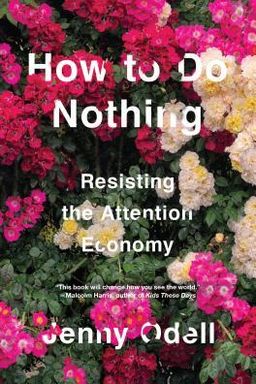
How to Do Nothing cover

How to Do Nothing

by Jenny Odell

In ''How to Do Nothing,'' Jenny Odell challenges the relentless drive for productivity in today''s attention economy. By advocating for strategic disengagement and renewed focus, Odell offers a guide to reclaiming personal agency and discovering deeper meaning in everyday life. This transformative read urges us to cultivate attentiveness and redefine success.

Doing Nothing as Political Resistance

When was the last time you truly did nothing—no scrolling, no checking notifications, no mental to-do list buzzing in the background? In How to Do Nothing: Resisting the Attention Economy, artist and writer Jenny Odell asks this deceptively simple question to challenge the capitalist notion that our worth is measured by productivity. She argues that doing nothing isn’t laziness or a withdrawal from life—it’s a radical act of resistance in an economy that thrives on our attention, our anxiety, and our constant sense of inadequacy.

Odell contends that capitalism’s logic—what she calls the “attention economy”—has colonized our time, emotions, and even identity. Our every moment online becomes a transaction, every thought an opportunity for data extraction. But amid this “continuum of catastrophe,” Odell insists on preserving what philosopher Walter Benjamin called the “small crack” where redemption lives. Doing nothing, she says, means reclaiming that crack by refusing to frame our existence in terms of usefulness and optimization.

Why 'Nothing' Matters

For Odell, the irony of doing nothing is that it’s not literal inactivity—it’s an active recovery of attention, imagination, and empathy. She positions “doing nothing” as a three-part movement: dropping out from the demands of productivity, moving laterally into deep engagement with people and places around us, and moving downward into a sense of environmental and historical rootedness. These three moves push against capitalism’s vertical ladder of progress, which privileges disruption, innovation, and growth at any cost.

This perspective ties Odell to thinkers like Hannah Arendt, who lamented the substitution of political engagement with the mechanical efficiency of labor, and to ecological writers like Wendell Berry, who warned about the “world of wounds” we ignore in our chase for advancement. Odell’s challenge is intimate yet political: to step out of the constant whirl of digital noise, to rediscover what the “real” world feels like—to re-learn what it means to be human and embedded in place.

Against the Attention Economy

Odell’s critique focuses on how platforms such as Facebook, Instagram, and Twitter monetize human connection itself. These networks convert our desire for community into profitable engagement metrics while fostering feelings of envy, anxiety, and isolation. She doesn’t reject technology outright—she acknowledges that tools can connect us meaningfully—but she condemns the commercial designs that manipulate behavior and redefine productivity in purely capitalist terms.

Her stance resonates with thinkers like Jaron Lanier (Ten Arguments for Deleting Your Social Media Accounts Right Now), who similarly warn that tech platforms keep us in a “profitable state of anxiety.” Yet Odell diverges by offering a constructive middle path: cultivating “slow” attention through art, nature, and local engagement. Instead of logging off in protest, she urges us to reclaim our perception itself—to notice birds, people, streets, and histories that capitalist time would erase.

The Environment of Attention

Odell grounds her theory in her home region, the San Francisco Bay Area—a place of stark contrasts, where redwood forests meet the headquarters of Silicon Valley. She juxtaposes venture-capital firms with the natural resilience of a 500-year-old redwood called Old Survivor, which she uses as a metaphor for “resistance-in-place.” The tree survived logging precisely because it was gnarled, odd-shaped, and therefore deemed “useless.” For Odell, uselessness itself becomes resistance. Like Zhuang Zhou’s ancient parable of the “Useless Tree,” Old Survivor thrives precisely by refusing exploitation—a living symbol of endurance through nonconformity.

In this analogy, to do nothing is not to vanish but to transform—becoming an “anachronistic figure,” like the poet or the dreamer, who insists on ambiguity and inefficiency in a world obsessed with speed. Odell invites you to see yourself as part of an ecological and historical continuum, not a data point. By rediscovering “placefulness” and bioregional thinking—seeing the land and life around you as interconnected—you root your attention where it belongs: in the real.

The Heart of Resistance

Doing nothing, Odell makes clear, is not escapism. It’s a precondition for meaningful action and care. Without slowing down, we lose the capacity to think critically, to empathize, to imagine a better world. By reclaiming attention—by listening deeply to ourselves, others, and our surroundings—we resist a system that equates value with visibility and speed. In the end, Odell hopes to inspire readers not to retreat permanently, but to “stand apart”: to stay where we are, seeing clearly, connecting authentically, and cultivating the kind of consciousness capable of sustaining both activism and joy.


The Case for Nothing: Escaping Overstimulation

Odell opens with the premise that modern life has become an assault on thought. Following the 2016 U.S. election, she describes walking to Oakland’s Rose Garden, where she began the practice of “doing nothing” as survival. For her, this garden—built during the 1930s Works Progress Administration—symbolizes what happens when communities create public, noncommercial space, a rare refuge from measurement and monetization.

Silence as Creative Prerequisite

Odell quotes philosopher Gilles Deleuze’s observation that “repressive forces don’t stop people from expressing themselves but rather force them to express themselves.” The constant pressure to produce opinions mirrors capitalism’s obsession with measurable output. Doing nothing—remaining silent and still—becomes the necessary precondition for meaningful speech and art. Odell connects this to Pauline Oliveros’s concept of Deep Listening, a meditative practice of perceiving every sound as worthy of attention. True listening, in her view, transforms perception from shallow reaction into embodied care.

Public Space and Collective Autonomy

By exploring spaces like labyrinths, libraries, and gardens, Odell reveals how architecture itself can encourage stillness. In contrast to privatized consumer spaces—such as corporate plazas or faux urban malls—true public environments invite you to exist without buying or performing. She reminds us that parks and libraries are physical manifestations of political resistance: places for “what we will,” echoing the nineteenth-century labor movement’s demand for eight hours of chosen time.

When public spaces vanish and our own time becomes commercialized—as seen in gig-economy cultures like Fiverr or flexible work policies that erase boundaries—we lose the realm of rest and reflection that sustains democracy. Odell links Franco Berardi’s concept of the “fractalization of labor” with our inability to stop working: each notification becomes a micro-task, a sale of our nervous energy.

Self-Care as Political Warfare

Ultimately, Odell reframes self-care as collective care. Quoting Audre Lorde, she insists that “caring for myself is not self-indulgence, it is self-preservation—and that is an act of political warfare.” Doing nothing restores the energy and clarity needed to act meaningfully in an overstimulated world. For Odell, missing out becomes liberation: she proposes #NOMO, the necessity of missing out. This strategic withdrawal allows you to resist the logic of constant productivity, giving space to rediscover responsibility, empathy, and creativity beyond metrics.


The Impossibility of Retreat

Odell warns against escapism disguised as enlightenment. Whether it’s digital detox camps, communes, or libertarian seasteads, she argues that leaving society altogether neglects our responsibility to each other. Her chapter “The Impossibility of Retreat” travels from temporary getaways to philosophical experiments—from the Epicurean garden school to the communes of the 1960s—and shows that true withdrawal must be mental, not geographic.

Lessons from Utopia

Camp Grounded, a 2010s digital detox retreat founded by Levi Felix, illustrates the contradiction of monetizing escape. Although Felix began with sincere ideals—creating phone-free community—the movement became packaged for corporate wellness, echoing B.F. Skinner’s technocratic utopia Walden Two. Both proposed engineered happiness through controlled environments. Similarly, Peter Thiel’s “seasteading” dreams of floating libertarian islands represent retreat repurposed as elitism: an escape from politics in service of unbridled capitalism.

Standing Apart, Not Aside

Drawing on monastic thinkers like Thomas Merton, who discovered compassion through contemplation, Odell suggests a middle path: “standing apart.” This means staying where you are while regaining perspective. By stepping outside reactive systems—without abandoning the world—you can reenter it with vision and empathy. She writes that to escape “the world” shouldn’t mean rejecting other people, but rejecting frameworks that exploit them. Standing apart is a disciplined refusal to be absorbed into frenzy, allowing space for moral clarity and creative thought.

(Comparatively, Thoreau’s Walden offered similar insight: solitude was not the end but the means to perceive truth and return to society transformed.)


Anatomy of a Refusal: Saying 'I Would Prefer Not To'

Looking to Herman Melville’s “Bartleby, the Scrivener,” Odell identifies refusal as a subtle but revolutionary gesture. When Bartleby says, “I would prefer not to,” he does more than deny a task—he rejects the premise of the question. Odell compares this linguistic act of resistance to ancient models like Diogenes of Sinope, who ridiculed social conformity by living in a barrel and walking backward through Athens. Both figures reveal a timeless strategy: resisting on your own terms within the public eye.

Volition as Freedom

Odell traces refusal through time—from individual acts of rebellion to large-scale collective action, like the 1934 San Francisco General Strike and Rosa Parks’s deliberate civil disobedience. True refusal requires discipline—what Cicero called voluntate, studio, disciplina (will, devotion, training)—and thrives only when people align in shared attention. The act of resisting is both spiritual and political, demanding sustained focus rather than reactive outrage. In this sense, attention itself becomes the resource that fuels civil resistance.

Attention as Collective Power

Odell connects Bartleby’s linguistic rebellion to our own digital dissidence. In a culture ruled by clicks and reaction, withdrawal of attention is akin to organizing a strike against distraction. She invokes philosopher Franco Berardi’s idea of “sensitivity” versus “connectivity”: surface-level reactions keep people fragmented, while sensitivity builds solidarity through time and presence. For Odell, to resist the attention economy is to refuse its tempo—to choose disciplined stillness over automated response, transforming individual focus into collective awareness.


Exercises in Attention: Learning to See and Listen

In perhaps her most poetic sections, Odell treats attention itself as an art form. She draws on her experiences with visual artist David Hockney, minimalist composer John Cage, and her own practices of birdwatching. Through these examples, she defines attention not as passive observation but as active co-creation with reality—a way of rendering the world anew.

Seeing the World Again

Hockney’s multi-camera landscapes and cubist photo collages show that perception is not instantaneous but built over time. Similarly, John Cage’s performances—whether of silence or ordinary sounds—train audiences to reengage their senses. Experiencing Cage’s Song Books, Odell recalls walking outside afterward and hearing urban noise for the first time as music. Art becomes a technology of attention: it can teach you to notice the hidden richness of what already surrounds you.

Attention as Discipline

Drawing on William James, Odell describes attention as a muscle requiring willpower and repeated effort. In a world designed to exploit distraction, deliberate concentration is a political act. Like meditation or artistic focus, it transforms perception from immediate gratification to sustained curiosity. Odell calls this deliberate return to observation “discipline-as-freedom”—the antidote to manipulation and mindless consumption.

These exercises reorient your awareness toward phenomena beyond utility—birdsongs, creek patterns, graffiti, or the subtle shifts of light. As you learn to look longer, what once seemed ordinary reveals infinite depth. This, Odell suggests, is the opposite of productivity’s narrow gaze. It’s the art of discovering abundance in what capitalism calls waste.


Ecology of Strangers: Reconnecting People and Place

Odell expands attention outward—from self to society and ecosystem. In “Ecology of Strangers,” she recounts a moment helping a stranger during a seizure, which turned her perception of everyday life upside down. That episode crystallizes her belief that interconnectedness—human and nonhuman—is the foundation of ethics and empathy.

Rediscovering the Other

Drawing on David Foster Wallace’s “This Is Water,” Odell argues that compassion begins with attention. Seeing others beyond our own 'default setting' transforms the mundane world—like a grocery store crowd—into a sacred shared existence. She ties this insight to bioregionalism, an ecological philosophy proposing citizenship rooted in local ecosystems rather than nations. To notice your street’s birds or rivers, she says, is to rejoin the more-than-human community already sustaining you.

Beyond the Self

Odell dismantles the myth of the isolated individual. Citing Alan Watts and Michael Pollan, she redefines identity as an ecological network—fluid, relational, and contingent. When you interact authentically with strangers, places, and species, you find liberation in permeability rather than control. She argues that this ecological model heals both loneliness and environmental exploitation, since both emerge from the illusion of separateness.

Ultimately, paying attention to your physical surroundings—neighbors, trees, water systems—restores ethics. It reawakens the human impulse to care, organize, and act. As she writes, “eventually, to behold is to become beholden.”


Restoring the Grounds for Thought

Odell ends where she began: in the physical world, urging a return to “the grounds for thought.” She diagnoses modern digital life as a collapse of context—spatial, temporal, and historical. Each tweet or headline isolates information from its environment, turning the public sphere into a flood without memory. Against this, she calls for “context collection,” grounded in real spaces and slower systems of communication.

Reclaiming Context

Odell draws from studies by danah boyd and Joshua Meyrowitz on “context collapse.” Social media’s permanent audience flattens nuance; its instantaneity kills reflection. She contrasts this with historical examples of true community dialogue—like 1970s Berkeley’s Community Memory project, an early public computer terminal that connected neighbors locally and anonymously. Its physicality and slowness fostered sincere conversation absent in modern social media’s profit-driven design.

Toward Slow Networks and Real Places

Odell imagines a non-commercial, decentralized social network modeled on ecological systems—where interactions are local, contextual, and mortal. She cites community-run mesh networks like Oakland’s People’s Open Network as examples of grassroots technology that restores autonomy. True connection, she argues, happens in “spaces of appearance” (borrowing from Hannah Arendt), where people act and speak together physically, face to face.

Ending with scenes of bird-filled wetlands and restored parks, Odell shows that such spaces—ecological and civic—are not ancillary to thought; they are its ground. Without them, both ecosystems and ideas die. To resist the attention economy, she concludes, is to replant awareness in the earth itself: “When we pry open the cracks in the concrete, we stand to encounter life—nothing less and nothing more.”

Dig Deeper

Get personalized prompts to apply these lessons to your life and deepen your understanding.

Go Deeper

Get the Full Experience

Download Insight Books for AI-powered reflections, quizzes, and more.