
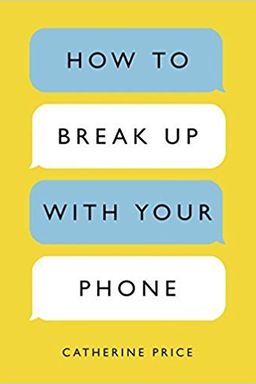
How to Break Up with Your Phone cover

How to Break Up with Your Phone

by Catherine Price

How to Break Up With Your Phone provides a practical, 30-day plan to help you reclaim your life from phone addiction. Discover the science behind your screen habits, learn to set healthier boundaries, and transform your relationship with technology. Embrace newfound time for real-life experiences and personal growth.

How to Regain Control of Your Attention and Your Life

When was the last time you went through an entire meal, commute, or evening without checking your phone? For most of us, the answer is: not recently. In How to Break Up with Your Phone, journalist Catherine Price invites you to reconsider not just your usage habits, but the nature of your relationship with your phone itself. Her provocative claim is that smartphones are not neutral tools—they’re intentionally engineered to hijack our attention, reshape our brains, and subtly manipulate our behavior for profit. By confronting these invisible forces, Price believes we can regain agency over our time, attention, and ultimately, our lives.

Price’s mission is not technological abstinence—she isn’t proposing that we throw our phones under buses or live as digital monks. Instead, she argues for a conscious, balanced relationship with our devices—one that retains the benefits of connectivity without surrendering mental clarity, creativity, and authentic connection. Her “breakup” metaphor isn’t a gimmick; it reframes our attachment to the phone as an intimate and sometimes toxic relationship that needs boundaries, reflection, and healing.

Why Smartphones Are Different

Price begins by showing that smartphones differ fundamentally from previous revolutions in technology. Unlike televisions or radios, our phones are portable, interactive, and omnipresent. They’re also deliberately optimized for addiction, built by companies who profit when our attention lingers. Former Google product manager Tristan Harris famously compared them to “slot machines in our pockets”—devices engineered to deliver unpredictable rewards that hook us into endless loops of checking. This design philosophy, euphemistically called “user engagement,” relies on psychological manipulation of dopamine pathways in the brain—literally rewiring how we think and feel.

As Price notes, even tech innovators like Steve Jobs and Bill Gates severely restricted their own children’s device use. That irony reveals a troubling truth: those who design these tools understand their addictive potential better than their users do. The very engineers who build “engaging” apps often choose to protect their own families from them.

The Real Costs of Constant Connection

Smartphones don’t just consume our time—they diminish our cognitive abilities. Chapters like “Your Phone Is Killing Your Attention Span” and “Your Phone Messes with Your Memory” reveal how digital multitasking trains the brain to flit between tasks rather than focus deeply. Neuroscientists Adam Gazzaley and Larry Rosen, who study the “distracted mind,” find that constant switching weakens the prefrontal cortex—the part responsible for executive function and self-control—and exhausts mental energy through decision fatigue. Every notification, every link, and every alert forces the brain to make tiny choices, leaving us too drained for meaningful concentration. The result? We skim instead of read, scroll instead of think, and consume instead of creating.

Smartphones also affect emotional health. Research shows correlations between heavy phone use and higher anxiety, loneliness, and depression—especially among adolescents. Price cites psychologist Jean Twenge’s alarming claim that the rise of smartphones coincides with the steepest mental health declines in decades. This isn’t accidental. Social media platforms amplify FOMO (fear of missing out) and social comparison while harvesting data to sell personalized ads. They promise connection but deliver curated illusion.

Rewiring Your Brain for Presence

After diagnosing the problem, Price offers practical science-based healing. The book’s second half, a 30-day guided plan, begins with “Technology Triage,” where you audit your phone use, observe habits, and identify emotional triggers. Later sections—“Changing Your Habits” and “Reclaiming Your Brain”—gradually shift toward mindfulness, creating healthier defaults like no-phone zones and device-free mornings. Rather than preaching detox for detox’s sake, Price emphasizes awareness: learning to pause before checking your phone, to ask, “What for? Why now? What else could I do?”

This mindfulness-based approach echoes the work of Judson Brewer, a psychiatrist who used mindfulness to treat smoking addiction. Like Brewer’s subjects, phone users learn to study cravings nonjudgmentally, tracing the loop from trigger to satisfaction. Over time, self-awareness replaces compulsion. The book’s final week, “Your New Relationship,” reframes technology as a conscious choice. Price doesn’t ask you to abandon your phone—only to make sure you own it, not the other way around.

Why This Matters

Price’s argument taps into a defining tension of the modern era: we’re increasingly connected yet profoundly distracted. She makes a cultural, not just personal, plea—to protect the collective resource of human attention. Attention, she insists, is the currency of our consciousness: “Our lives are what we pay attention to.” If our attention is constantly hijacked, our capacity for joy, empathy, and purpose erodes. In the spirit of thinkers like Nicholas Carr (The Shallows) and Tim Wu (The Attention Merchants), Price positions digital mindfulness as both a survival skill and a moral act.

By the end of How to Break Up with Your Phone, what seems like a self-help manual reveals itself as a manifesto for reclaiming humanity in an age of manufactured distraction. It’s not really about phones—it’s about rediscovering presence, depth, and agency in a world designed to keep you endlessly clicking “refresh.”


The Neuroscience of Phone Addiction

Why are smartphones so irresistibly compelling? Catherine Price turns to neuroscience for answers, explaining how app designers weaponize dopamine—the brain’s pleasure chemical—to create habits that verge on addiction. Each swipe, notification, or new message activates the brain’s reward center, giving you a brief sense of excitement. Over time, your mind learns to crave these micro-hits, releasing dopamine in anticipation of them. This is the same neurochemical process that drives compulsive gambling or substance use, just delivered in smaller, more socially acceptable doses.

Dopamine and the Anticipation Loop

The power of dopamine lies in anticipation, not satisfaction. Once your brain links a cue (like a phone vibration) with a reward (a like or message), the cue alone can trigger craving. That’s why you often feel compelled to check your phone even without a notification. As one neuroscientist observed, we’ve become “lab rats pressing the lever”—our phones are the levers, and new social information is the pellet. Without built-in stopping cues—like the end of a book or episode—we scroll endlessly in pursuit of that next dopamine hit.

Designed Addiction

Former Google design ethicist Tristan Harris and Dopamine Labs founder Ramsay Brown have both revealed how app developers intentionally exploit these responses. Brown’s company even built code to withhold notifications temporarily, releasing them in “best bursts” to maximize user engagement. When he created Space—an app that inserted a 12-second pause before opening social apps—Apple initially banned it from the App Store for encouraging people to use their phones less. That decision, Price notes, exposes the perverse incentives of the tech industry: your distraction is their business model.

The Emotional Edge

Price distinguishes between “pleasure” and “happiness.” Dopamine-driven excitement feels good momentarily but doesn’t bring fulfillment. Just as diets overpacked with sugar dull the palate, digital overstimulation dulls our emotional sensitivity. True satisfaction—what philosophers like the Stoics or modern psychologists call eudaimonia—requires the very qualities that smartphone use undermines: focus, presence, and reflection. Her message is clear: our brains aren’t broken—they’re being expertly gamed by an attention economy that profits every time we feel that little buzz.


The Tricks of the Trade: How Designers Hijack Your Brain

Once you start looking, the manipulative design of apps becomes impossible to unsee. Price dissects these “brain hacks” in detail, showing how they tap into our deepest psychological quirks. The techniques range from novelty and reinforcement loops to social validation and fear of missing out. They make our phones feel irresistible because they speak to instincts that once helped humans survive—now turned against us.

Our Hunger for Novelty and Reward

Humans are novelty junkies. We evolved to seek new information because change could signal opportunities or threats. Smartphones flood us with infinite novelty—new posts, alerts, and algorithmic content. The resulting dopamine rush mimics the thrill of early romance, Price jokes, but unlike humans, apps never fall out of love with us. Each refresh delivers uncertainty—the chance that something interesting might appear—creating an intermittent reward schedule identical to slot machines.

Fear, FOMO, and Validation

If excitement draws us in, anxiety keeps us hooked. Notifications exploit our discomfort with uncertainty—what if we miss something? This anxiety manifests as FOMO (Fear of Missing Out), a stress loop reinforced by cortisol surges whenever we put our phones down. The only relief? Check again. Add social validation, and the loop strengthens. Likes, shares, and follows become digital symbols of belonging. Price cites psychologist Adam Alter’s observation that Facebook’s “Like” button revolutionized emotional gambling—publicly quantifying self-worth. Each notification promises love or rejection, making the habit self-perpetuating.

Manipulation Masquerading as Personalization

Finally, personalization amplifies the illusion of control. Changing wallpapers or ringtones makes our devices feel personal, but the settings we can’t adjust—the endless scroll, the autoplay, the inability to limit notifications—reveal who truly holds the power. Price concludes with a chilling analogy: our phones are Trojan horses. They seduce us with utility while hiding systems designed to exploit our psychology. Once inside our lives, they capture not only our attention but our identities.


Social Media’s Secret Economy of Attention

In one of the book’s most unsettling chapters, Price pulls back the curtain on social media as an industry not of connection but surveillance. Drawing on insights from insiders like Antonio García Martínez (Chaos Monkeys), she explains that platforms like Facebook and Instagram are “free” only because users are not the customers—they’re the product. Advertisers pay billions for your attention, which platforms monetize by collecting, analyzing, and selling your behavioral data.

The Business Model of Distraction

“Engagement” is the holy grail of social media economics. Every extra second you spend scrolling increases ad exposure and enriches the platform. To keep you engaged, platforms exploit psychological levers: unpredictable reward cycles, comparison, and outrage. The feeds never end; “likes” quantify popularity; autoplay ensures you never think to stop. Price notes that the more distracted you are, the more profitable you become—so these systems are optimized not for your wellbeing but for your compulsions.

The Happiness Paradox

Paradoxically, the very apps that promise connection often deepen loneliness. Longitudinal research in the American Journal of Epidemiology confirms that higher Facebook use predicts lower well-being. Liking other people’s posts reduces life satisfaction; social comparison erodes self-esteem. Teenagers are especially at risk: after smartphones became ubiquitous post-2007, rates of depression, anxiety, and suicide spiked sharply. As psychologist Jean Twenge observes, “They are on their phones, in their rooms, alone—and often distressed.”

Surveillance and the Erosion of Reality

The surveillance dimension is equally dark. Facebook doesn’t just know what you share—it tracks your browsing habits, purchases, and even offline activity through data partnerships with credit agencies like Equifax. Personalized feeds segment society into echo chambers, where truth fragments into algorithmic echo. “The goal is clicks,” Price warns, “not truth.” When attention becomes currency, reality itself becomes collateral damage.


Multitasking Myths and Mental Exhaustion

We often tell ourselves that smartphones make us efficient multitaskers. Price dismantles this illusion with clarity and humor: there’s no such thing as multitasking for the human brain. What we call “multitasking” is actually rapid task-switching—forcing the brain to stop, reorient, and start again, which burns time and cognitive energy. Research from Stanford by Clifford Nass found that heavy multitaskers were worse at focusing, filtering irrelevant information, and organizing memory than those who didn’t multitask. They were, Nass said bluntly, “terrible at every aspect of multitasking.”

The Cost of Constant Switching

Each time you glance at a notification or swap apps, you incur a “switch cost”—a disruption that can take over twenty minutes to recover from. You might think that you’re handling multiple tasks efficiently, but your productivity and creativity degrade. You also fatigue the prefrontal cortex, the brain region required for restraint and strategic thought. In a culture that prizes speed, multitasking ironically slows us down and makes us less mentally agile.

How Phones Train Distractibility

By encouraging constant switching between texts, emails, and feeds, smartphones turn distraction into default mode. Over time, you train your brain to expect novelty and stimulation, weakening your ability to persist with complex or meaningful tasks. In Price’s framing, multitasking isn’t productivity—it’s addiction disguised as efficiency, leaving you exhausted but unaccomplished.


Your Brain on Screens: Plasticity and Overload

Our devices don’t just change our habits—they reshape our brains. Drawing from journalist Nicholas Carr’s The Shallows, Price recounts how London taxi drivers studying “The Knowledge” physically expanded their hippocampi through deep memorization. The takeaway? Repetition builds neural pathways. If cab drivers rewired their brains for navigation, smartphone users are rewiring theirs for distraction.

From Deep Focus to Shallow Attention

By spending hours skimming feeds, we strengthen circuits optimized for quick reactivity rather than sustained thought. Our brains become better at superficial scanning and worse at contemplation. Price calls this “an intensely focused state of distraction,” a paradox where we are utterly absorbed but never immersed. The cost is erosion of memory, creativity, and empathy—the very capacities that make us human.

Memory Meltdown

Our working memory (the conscious mental workspace) can hold only a few items at a time. Phones overload it with constant stimuli, preventing the transfer of new information into long-term storage. When everything is stored externally—notes, photos, directions—we outsource memory itself. The result, Price warns, is not just forgetfulness but a narrowing of thought. The more we delegate our minds to machines, the less we build the mental schemas essential for original ideas.


The 30-Day Breakup: A Blueprint for Change

Having exposed the problem, Price shifts from science to strategy. The second half of her book offers a 30-day guided plan that resembles cognitive-behavioral therapy for your phone. Divided into four weeks, it moves from awareness to habit change to reclamation. The approach is flexible—you can adapt it to your life—but structured enough to produce real behavioral shifts.

Week One: Technology Triage

The first week is all about diagnosis. You use tracking apps to log screen time, journal your feelings before and after phone use, and identify emotional triggers—boredom, anxiety, loneliness. The goal is mindfulness through data and observation, not judgment. Price encourages symbolic gestures like setting your lock screen to read, “What do you want to pay attention to?”—a constant reminder of your true priorities.

Weeks Two and Three: Habit Change and Brain Rebuilding

The next phase targets cues and environments. You turn off notifications, tidy your apps into folders, and designate “No-Phone Zones” such as the bedroom or dinner table. You replace reactive habits with intentional ones—journaling, walking, meditating. Later, Price adds mindfulness exercises like “Stop, Breathe, and Be” to re-train attention muscles. The “Trial Separation,” a 24-hour phone fast, is the emotional climax—a chance to rediscover stillness and rediscover what free time feels like.

Week Four and Beyond: A New Relationship

The final week consolidates your gains. You develop sustainable rituals—Digital Sabbaths, boundaries for work, structured social media use—and reflect on how you’ve changed. By this point, most participants, Price reports, describe not deprivation but relief. The breakup isn’t about loss—it’s about reclaiming time, clarity, and agency.


Mindfulness: The Secret to Long-Term Freedom

Beneath the book’s humor and practicality lies a profound insight: mindfulness is the antidote to digital compulsion. Price draws on Buddhist teacher Pema Chödrön and mindfulness researcher Judson Brewer to show that awareness—not willpower—is what dissolves addiction. You can’t out-muscle craving, but you can out-see it.

See the Craving, Don’t Feed It

When you feel the urge to check your phone, pause. Notice the tension in your body, the flicker of excitement or anxiety. Describe it mentally—“tight chest,” “itchy hands.” This act of observation interrupts the loop. Just as mindfulness reduced smokers’ relapse rates in Brewer’s experiments, it reduces the automaticity of screen addiction. Over time, the craving loses its charge.

Reclaiming Attention as a Moral Act

Price closes with a call to action echoed by Tim Wu in The Attention Merchants: reclaiming your attention is both a personal liberation and a societal necessity. Attention defines life. To consciously direct it—to loved ones, to art, to the natural world—is to choose presence over manipulation. Mindfulness is not withdrawal from technology; it’s wisdom applied to it. As Price writes, “We have less time in life than we realize—but more time than we think.” The difference lies in how, and to whom, we pay attention.

Dig Deeper

Get personalized prompts to apply these lessons to your life and deepen your understanding.

Go Deeper

Get the Full Experience

Download Insight Books for AI-powered reflections, quizzes, and more.