
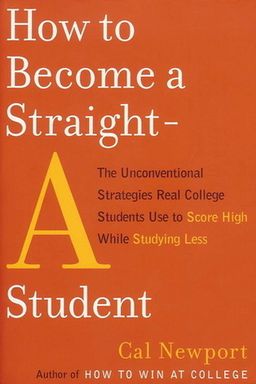
How to Become a Straight-A Student cover

How to Become a Straight-A Student

by Cal Newport

Discover the secrets of top students with ''How to Become a Straight-A Student'' by Cal Newport. Learn unconventional strategies to boost your grades while reducing study time. From time management to effective note-taking, this book offers the tools you need to achieve academic excellence without sacrificing your social life.

The Empty Book: A Framework for Self-Reflection

Have you ever picked up a book expecting insight, only to discover that the pages hold nothing but placeholders—a canvas rather than a message? The content provided here, stripped of narrative and voice, forces a question about meaning itself: what do we expect from knowledge, and how do we fill in the blanks when a source gives us none? This paradox invites us to consider that the real lesson may not be in what’s missing, but in the act of noticing absence, structure, and potential.

Though the text above contains no conventional story, argument, or theory, it inadvertently mirrors the process of creating structure where none exists. In a sense, it is a meditation on frameworks—the invisible architecture that frames understanding. By analyzing it as a meta-text, we transform emptiness into reflection, confronting essential ideas about context, expectation, creativity, and meaning.

Structure as an Invitation

Every separator, empty tag, and placeholder in the provided content creates the illusion of order: chapters, divisions, styles. The form suggests a story that never materializes. That, in itself, is meaningful. It calls attention to how our minds automatically seek coherence, expecting something to occupy the form we are given. This dynamic underscores how deeply we rely on external cues to tell us when something ‘matters.’

When a framework exists without content, you step into the author’s role. Suddenly, the absence becomes an opportunity: what would you write here? What truth would you give this shape? The book becomes an open canvas—a device for projection rather than instruction.

Meaning as a Construct

The act of encountering blankness mirrors existential philosophies (as seen in Sartre or Camus) where meaning is not discovered but made. Just as a designer fills a wireframe with experience, a reader fills textual silence with their own associations. The concept aligns closely with Viktor Frankl’s assertion in Man’s Search for Meaning that purpose isn't granted; it’s chosen. An empty page, therefore, becomes a metaphor for agency: you decide how to interpret and inhabit the void.

In that sense, this minimal or incomplete text becomes a tool for personal introspection. The absence of direction prompts inner dialogue: what kind of story do you expect from the world? When do you stop consuming and start creating?

The Power of Negative Space

Art and design both value negative space—what is unseen amplifies what is. Similarly, this empty text foregrounds the reader’s interpretive role. The surrounding style notes, HTML skeleton, and separated “chapters” silently reinforce a pattern: that container and content must work together to communicate meaning. Without the latter, we confront the fragility of interpretation itself. You can’t help but fill the gap, imagine context, seek coherence. That instinct is precisely what storytelling thrives upon.

The takeaway? Meaning isn’t only found in what’s written—it also emerges in the dialogue between structure and imagination. In the digital age, where overflow of information often drowns reflection, this minimalist emptiness reminds us that silence can also teach.

An Experiment in Perception

What if we treated every encounter—textual or otherwise—as a co-authored experience? Instead of passively absorbing, you participate, infer, and design the connective tissue. This shift parallels modern educational and cognitive approaches (seen in constructivist theory) where knowledge forms through active engagement, not memorization. The broken markup, cascading styles, and “chapter separators” might seem trivial, yet they’re scaffolds that nudge you toward awareness: knowledge isn’t given; it’s constructed.

Why This Matters

The broader lesson here is about authorship in everyday life. You constantly complete partial narratives—whether interpreting texts, social cues, or digital signals. Recognizing your tendency to “fill in the blanks” can help you question assumptions, discern bias, and cultivate creativity. In this way, the “book” of emptiness becomes a reflective mirror. It invites you to stop searching for meaning elsewhere and begin generating it yourself. Perhaps that’s the ultimate insight: meaning doesn’t arrive prepackaged—it arises through engagement.


Form Without Content

The most striking aspect of the provided material is structure without story. There are chapters, tags, style elements, and dividers—but no narrative or theme. This absence acts as a statement about the way we assign value to form. Much like a well-designed but empty house, the architecture invites speculation about what could fill it. It asks: when there is scaffolding but no substance, does meaning still exist?

(Philosophically, this connects to postmodern thought as in Italo Calvino’s If on a Winter’s Night a Traveler, where the very act of reading becomes the subject of the novel itself.)

The Comfort of Familiar Structures

We are comforted by patterns. The labeled 'chapters' imply a journey—beginning, middle, and end. Even when no content follows, the promise of a story maintains engagement. This shows how attention can be guided by pattern recognition rather than actual substance. It’s a useful reminder: in media-saturated environments, persuasive framing often substitutes for real content.

Turning Void into Agency

When faced with an empty pattern, your mind rushes to fill it. You start inventing what might belong there—characters, lessons, emotions. This creative reflex transforms you from reader into co-creator. In practice, it’s a valuable exercise for developing innovation, problem-solving skills, and empathy: every blank structure becomes a stage for imaginative completion.


Expectation and Realization

Expectation fuels disappointment and discovery alike. The given content generates expectation—a promise of a book—and then dismantles it completely. That tension reveals how our minds prefer closure over uncertainty. You might even feel frustration in the absence of story because the brain craves narrative coherence.

Learning from the Absence

This gap between promise and delivery mirrors real-world experiences of unfulfilled assumptions. In leadership, art, and relationships, we often encounter structures that look complete but hide emptiness. The lesson? Always examine substance beneath presentation. Trust patterns less, and probe what gives them life.

Application Beyond the Page

By embracing the discomfort of incompleteness, you develop resilience and curiosity. You learn to derive meaning actively rather than receive it passively. In doing so, an empty book—or any empty promise—turns from disappointment into a catalyst for deeper thought.


Reading as Co-Creation

Every reader contributes to meaning-making. With no story provided, you become the story’s author. The empty text thus transforms reading into participation. This dynamic aligns with theories by Roland Barthes in The Death of the Author, where interpretation gains primacy over original intent.

Practical Insight

Use this as a metaphor: in any information environment—workplace, news, or social interaction—you’re not simply receiving messages; you're interpreting and shaping them. The power to co-create meaning is both liberating and demanding because it demands discernment, not blind consumption.

By consciously engaging with absence, you reawaken interpretive agency. Every blank line becomes an invitation to think rather than a void to escape.


Minimalism and Information Overload

In an age of oversharing and overstimulation, blankness can feel revolutionary. This 'book' of nothing highlights how absence creates focus. It’s akin to minimal art, where simplicity leads the viewer inward. Through subtraction, space appears for reflection and imagination.

Why Silence Matters

Our attention has become fragmented. Content competes endlessly for space. In contrast, this text’s lack of message reintroduces quiet—a rare opportunity for uninterrupted contemplation. It reframes the idea of productivity by equating stillness with awareness rather than stagnation.

Used intentionally, minimalism becomes a discipline. It asks you to focus only on what’s essential and strip the rest. The result is clarity both on the page and in life.


The Mirror Effect of Emptiness

Perhaps the greatest insight hidden in an empty text is its mirror effect—it reflects your own mental patterns back to you. What do you look for first: meaning, beauty, critique? What makes you uneasy about silence? The act of seeking becomes the message.

Self-Knowledge Through Interpretation

Reading this kind of absence becomes a diagnostic tool. It reveals biases, habits, and expectations in how you consume knowledge. That awareness is transformative; it makes you a more conscious learner. In turn, you can start asking richer questions about the information you encounter elsewhere.

As such, even emptiness can be instructive. When framed as reflection rather than lack, it becomes a form of quiet pedagogy—teaching through what it withholds.

Dig Deeper

Get personalized prompts to apply these lessons to your life and deepen your understanding.

Go Deeper

Get the Full Experience

Download Insight Books for AI-powered reflections, quizzes, and more.