
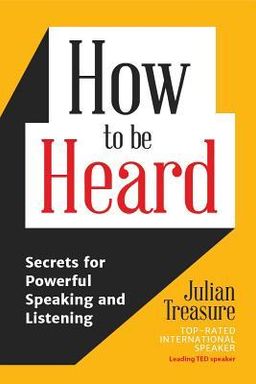
How to be Heard cover

How to be Heard

by Julian Treasure

In ''How to be Heard,'' Julian Treasure reveals the secrets to becoming a compelling speaker and an attentive listener. Discover techniques to command attention, build stronger connections, and communicate effectively in every aspect of life. Transform your interactions with insights on the power of sound and storytelling.

Reclaiming the Lost Art of Speaking and Listening

When was the last time someone truly listened to you—without interrupting, judging, or checking their phone? In How to Be Heard: Secrets for Powerful Speaking and Listening, Julian Treasure, a renowned sound expert and five-time TED speaker, argues that modern life has eroded our ability to truly communicate. We live, he suggests, in a world dominated by noise, distraction, and ocular bias—where we’ve learned to read and write but forgotten how to speak and listen. Treasure believes that these twin arts are essential to happiness, effectiveness, and healthy relationships, and that recovering them can transform not only individual lives but also entire communities.

The Crisis of Modern Communication

Treasure starts by diagnosing a communication crisis. With earbuds in our ears and screens in our hands, many of us, he notes, have grown more comfortable typing than talking. Teenagers break up via text. Professionals hide behind emails. Even politics has devolved into slogans, memes, and 140-character outrage. He calls this the tyranny of the eyes—where sight has overtaken sound as our dominant sense and connection has given way to performance. In societies that prize visibility over voice, we’ve lost touch with the most human of capacities—conscious listening and authentic speaking.

The result? Misunderstanding, loneliness, noise pollution, and diminishing empathy. “Democracy depends on civilized disagreement,” Treasure warns, “and that is only possible if we understand other people’s points of view.” The anecdote of corporate leaders who designed billion-dollar buildings without asking, “How will it sound?” underscores his broader point: when we don’t listen, we overlook what truly matters.

A Sound-Based Lens on Human Behavior

Drawing on his years as founder of The Sound Agency, Treasure brings a unique auditory lens to personal development. He starts from a fundamental insight: sound affects us in four powerful ways—physiologically, psychologically, cognitively, and behaviorally. The hum of an air conditioner raises heart rate; birdsong can reduce stress; rhythmic entrainment aligns our heartbeat to external tempo; office chatter cripples focus.

By becoming conscious of these influences, Treasure argues, we can design not only healthier workspaces and cities but also more harmonious relationships. Just as a sound engineer tunes a space for clarity, so too can you tune your life—managing noise, refining tone, and using the voice as an instrument of empathy and influence.

The Interdependence of Speaking and Listening

The heart of Treasure’s message is circular: listening and speaking are not separate acts but mutually reinforcing. “The way you listen affects the way I speak,” he writes, “and the way I speak affects the way you listen.” This means that powerful communication begins not with mastering delivery techniques but with transforming attention. Listening generates understanding, intimacy, persuasion, health, and learning; speaking generates meaning, leadership, and change. Together they form what he calls conscious communication—the art of cultivating awareness in every interaction.

Treasure’s circular model challenges the usual “transmitter–receiver” metaphor that dominates communication studies. Speech is not a solo act but a duet. As he reminds us, “It’s hard to be a great speaker if you don’t listen—and impossible to be a great listener if you can’t articulate yourself.”

From Noise to Harmony

In practical terms, the book teaches both inner and outer awareness. Treasure shows you how to quiet the inner noise of self-criticism (“You idiot!”) by reframing inner dialogue, how to detect the “leeches” and “deadly sins” that drain conversational power (fear, gossip, negativity, excuses, dogmatism), and how to rebuild connection through listening practices—like silence, savoring everyday sounds, and attending with “your ears, eyes, and heart.”

He then guides readers through the mechanics of effective speech: breath, pitch, timbre, pace, and prose. Using models like HAIL (Honesty, Authenticity, Integrity, Love), he distills what makes speech resonant and trustworthy. Unlike formulaic “public speaking” manuals that obsess over gestures and postures, Treasure’s approach is holistic—rooted in consciousness, compassion, and sound design. The voice, he says, is an instrument we all play, capable of deep power when used with precision and purpose.

Why This Matters

Treasure’s argument is ultimately a call to restore our humanity through the senses. He believes that listening consciously to others, the environment, and ourselves can heal much of the stress, disconnection, and polarization in modern life. In a time when technology amplifies every voice but deepens few conversations, How to Be Heard insists that the future belongs not to those who shout the loudest but to those who can truly listen.

By integrating science, sound design, and mindfulness, Treasure merges the poetic and the practical. His mission is urgent but hopeful: to help you rediscover the power of the human voice—so that when you speak, people stop and listen; and when you listen, the world comes alive around you.


The Four Effects of Sound

Julian Treasure argues that sound is not a background element in our lives—it is a constant, transformative force acting on every layer of our being. He describes four distinct ways that sound affects you: physiological, psychological, cognitive, and behavioral. Becoming aware of these influences, he suggests, is the first step toward mastering conscious communication and designing more harmonious environments.

1. The Physiological Effect

Your body is a resonant instrument—more than 70% water—making it a superb conductor of vibration. Sudden noises trigger your ancient fight-or-flight response, while rhythmic or soft sounds can entrain calmer breathing and slower heart rates. In Treasure’s words, “Sound can change our heart rate, breathing, hormone secretions, even our brain waves.”

He offers a simple application: if you struggle to sleep, play gentle surf at six to ten cycles per minute, roughly matching the rhythm of sleeping breath. Conversely, the jolt of an alarm clock is physiologically violent—“a poor way to begin consciousness.”

2. The Psychological Effect

Sound shapes emotion. Music can make you feel joy or sadness instantly. Treasure illustrates this through universal acoustical cues: fast tempos excite us; slow rhythms calm us. Birdsong makes us feel safe and alert because, over millennia, we’ve learned that when birds are singing, danger is absent. (Recent research supports this connection—UK scientists found that birdsong aids psychological recovery.)

Treasure draws on a Swedish study identifying six emotional “pathways” through which sound influences feeling—from brain stem reflexes to emotional contagion and episodic memory. A melody can trigger ancient instincts or personal nostalgia. The key takeaway: emotions are acoustically constructed; choosing your soundscape means choosing your mood.

3. The Cognitive Effect

The brain’s auditory bandwidth is limited—roughly 1.6 conversations at once. That’s why office chatter drives you crazy; even if you try to tune it out, your brain can’t help decoding nearby speech. “We have no earlids,” Treasure quips. Open-plan offices, he warns, destroy concentration: productivity can fall by two-thirds in noisy spaces. His advice? If you can, find a quiet environment or use nature sounds or low-density music to mask distractions. The result: sharper focus and less fatigue.

4. The Behavioral Effect

Noise doesn’t just affect how we think—it changes how we act. Loud, fast-paced music makes drivers speed and restaurant diners chew faster. Treasure recounts Lancaster, California’s experiment installing a calming soundscape of birds and water downtown: not only did citizens feel better, but crime dropped by 15%. The lesson? Soundscapes can regulate collective behavior. As with aroma, we move toward sounds that soothe and away from those that irritate.

Ultimately, Treasure’s fourfold model reframes sound from passive background to active architecture. Once you start listening consciously—to traffic, wind, your own tone—you can redesign your acoustic world. Your health, mood, and relationships all begin to resonate, quite literally, at a higher frequency.


The Dark Side of Communication

Before you can master powerful speaking and listening, Julian Treasure insists, you must confront the emotional habits and cultural forces that undermine them. He calls these “the dark side”—the automatic behaviors, toxic patterns, and modern technologies that suck energy out of conversation. Through metaphors like the Four Leeches and the Seven Deadly Sins of Speaking, he reveals how fear-driven habits dilute authenticity and connection.

The Four Leeches: Fear Beneath the Words

Each of the four leeches—looking good, being right, people pleasing, and fixing—springs from fear. The fear of disapproval, rejection, or emotional discomfort makes us perform rather than connect. Treasure recalls Stephen Covey’s insight that most people “listen with the intent to reply,” not to understand—what he calls “speechwriting.” We compose responses instead of hearing others. The remedy? Awareness. When you notice yourself interrupting, approving, or rescuing, pause and breathe. Consciousness, Treasure writes, “is the light that causes these shadows to wither.”

The Seven Deadly Sins of Speaking

Based on his TED talk that reached millions, these are gossip, judging, negativity, complaining, excuses, exaggeration, and dogmatism. Each makes you harder to listen to. Gossip erodes trust—if you speak ill of others, your listener assumes you’ll speak ill of them. Negativity and complaining drain energy, while dogmatism (having to be right) kills dialogue. Treasure offers exercises: keep a “praise journal” to counter condemnation, write gratitude lists to dissolve complaining, and practice “rigorous honesty” to replace exaggeration with credibility. The goal is not moral purity but vocal integrity.

Technology and Impatience: Modern Barriers

Treasure warns that constant connectivity has created the illusion of communication without its substance. Drawing on MIT professor Sherry Turkle’s research (Alone Together), he shows how “personal broadcasting” replaces dialogue. Social feeds make us performers of self rather than participants in conversation. Headphones, while useful, encourage what Murray Schafer called “schizophonia”—a split between the world we hear and the world we inhabit. The cost is social: we stop listening to one another.

His antidote is patience and humility: take “tech checks” to assess how devices shape your communication; cultivate empathy by reading opposing views; and beware of “desensitization”—the numbness that follows sensationalism. Treasure’s message is not anti-technology but pro-intention: tools amplify either connection or isolation, depending on how consciously you use them.


Listening as a Superpower

Listening, says Treasure, is “the silent skill.” It’s invisible, untested, and often undervalued, yet it defines how human culture functions. He calls it a superpower because it creates understanding—the very foundation of civility and love. Conscious listening, he argues, can transform relationships, teams, and even democracies. The book’s fourth chapter lays out a comprehensive toolkit for developing this skill through seven powerful practices.

Seven Practices of Conscious Listening

  • Silence: Spend at least three minutes a day in quiet to recalibrate. Silence, Treasure writes, is “your aural sorbet.” It resets sensitivity dulled by constant input.
  • The Mixer: In any soundscape, identify individual components—voices, machines, birds—to cultivate awareness.
  • Savoring: Treat sound like taste; relish the hum of a refrigerator or rain on glass. Enjoy auditory texture.
  • Listening With Ears, Eyes, and Heart: Attend fully to a speaker—observe body language and feel their emotion.
  • Listening Positions: Shift stance consciously—be active or passive, critical or empathic, reductive or expansive depending on context.
  • Listening For: Clarify your purpose—are you listening for ideas, emotions, needs?
  • RASA: Receive, Appreciate, Summarize, Ask—a simple but profound conversational sequence.

Applied Listening: Leading, Selling, and Loving

Treasure extends listening’s reach beyond self-improvement. Good salespeople, parents, and leaders, he shows, all rely on empathic listening. His story of a quiet salesman named John—whose calm attention outsold flashy colleagues—illustrates that listening persuades more than speech. Likewise, couples who listen revive intimacy; managers who listen build trust. Referencing Hyrum Smith (cofounder of Franklin Covey), he concludes that listening may be the single most important leadership skill because “you can’t solve problems you can’t hear.”

Ultimately, Treasure reframes listening as an ethical act. To listen is to love—to honor another’s truth without imposing your own. This is not passive agreement but active presence. In a noisy world, your willingness to listen consciously becomes a radical, restorative choice.


The Human Voice: Your Instrument of Influence

The voice, says Treasure, is the only part of you that can leave your body. It is your breath made audible—your primary tool for connection, inspiration, and leadership. Most people, he laments, receive no training in how to use it effectively. Chapters five and six transform this neglect into mastery through two key frameworks: HAIL, the foundation of persuasive speech, and the “vocal toolbox,” a practical guide to tone, pitch, pace, and presence.

Speaking with Integrity: The HAIL Model

Treasure’s TED-famous acronym HAIL stands for Honesty, Authenticity, Integrity, and Love. Honesty means clarity and plain speech. He mocks bureaucratic mumbo-jumbo (“strategically targeted aerospace initiatives”) by contrasting it with JFK’s elegant moon-landing goal. Authenticity means showing up as your true self rather than donning masks to please others. Integrity means keeping your word so that what you say carries weight. And Love—defined as wishing others well—turns speech into service rather than self-display.

Each principle comes alive through story: Gerald Ratner’s careless joke about his jewelry company’s products (“that’s crap”) destroyed £500 million in value overnight—proof that words have consequences. In contrast, public speakers grounded in goodwill radiate trust. Their message resonates beyond information; it carries emotional frequency.

Mastering the Vocal Toolbox

Treasure likens speech to music. The voice has instruments—register, timbre, pace, pitch, and space—each altering how you’re perceived. A deep chest voice conveys authority; varied prosody (rhythmic tone) adds interest; pauses create drama. You can practice these skills: breathing from the diaphragm for power, playing with pitch to signal emotion, and eliminating filler words (“um,” “like,” “you know”) that drain clarity. (He humorously calls these verbal “tics.”)

More than technique, though, Treasure urges respect for sound itself. “The human voice is the most powerful sound in the world,” he writes. It can start wars—or whisper love. To speak well is to wield that power responsibly. With HAIL as moral compass and the vocal toolbox as method, you learn to speak so that people not only hear you but want to listen.


The Art of Stagecraft and Presence

Public speaking terrifies many, but Julian Treasure demystifies it as an act of conscious design, not performance anxiety. His final chapters on stagecraft and closing bring together the book’s wisdom: preparation, awareness, and inner silence yield confidence. Stagecraft, he says, is simply mindfulness in motion—the art of managing context so your message lands with power.

Preparation and Practice

Great talks begin long before the first word. Treasure’s meticulous checklists—covering venue acoustics, lighting, seating, timing, and technology—read like a pilot’s preflight inspection. He shares hard-earned lessons (like arriving early to test projectors and microphones) and urges full rehearsals “at actual size,” not while sitting and mumbling. Practice transforms nerves into flow; over-preparation paradoxically frees spontaneity.

The Power of Warm-Up and Presence

Before any talk, Treasure performs physical and vocal warm-ups—stretching, breathing, humming sirens—to tune the instrument. He also uses BESS (Breathe, Expand, Stance, Smile): take a deep breath, expand peripheral vision to include the whole audience, ground your body, and smile genuinely. This sequence transforms anxiety into connection. “To speak well,” he reminds, “is to be fully present—awake to every moment.”

Conscious Connection

Onstage charisma, Treasure insists, doesn’t mean performing— it means aligning words, body, and intention. He teaches “stage anchoring,” mapping concepts physically (past to your right, future to your left) to give structure and visual coherence. He even reframes silence as ally: space between words lets ideas resonate. The best speakers, he writes, “don’t fill every second—they give listeners time to think.”

Ultimately, stagecraft is not about impressing an audience but serving it. You are not the hero of the story—the listener is. Prepare well, speak consciously, and close with awareness. Your words will linger not because they were loudest but because they were true.

Dig Deeper

Get personalized prompts to apply these lessons to your life and deepen your understanding.

Go Deeper

Get the Full Experience

Download Insight Books for AI-powered reflections, quizzes, and more.