
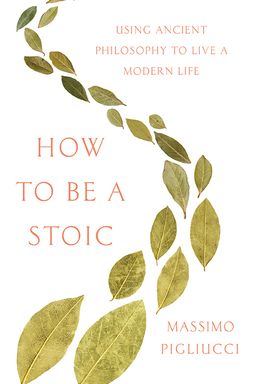
How to Be a Stoic cover

How to Be a Stoic

by Massimo Pigliucci

Massimo Pigliucci''s ''How to Be a Stoic'' explores how ancient Stoic philosophy can be applied to modern life, offering guidance on dealing with change, embracing moral virtues, and finding peace with mortality. Learn to prioritize what you can control and cultivate meaningful relationships for a more fulfilling life.

Living a Good Life Through Stoic Wisdom

What if the secret to serenity wasn’t escaping life’s hardships, but embracing them with courage and reason? That question sits at the heart of Massimo Pigliucci’s How to Be a Stoic: Using Ancient Philosophy to Live a Modern Life. In this thoughtful and engaging work, Pigliucci—an evolutionary biologist turned philosopher—argues that the 2,000-year-old principles of Stoicism, first developed by Zeno, Epictetus, and Seneca, remain a robust guide for anyone seeking calm, meaning, and character in the chaos of modern life.

In a conversational dialogue with the Stoic master Epictetus, Pigliucci explores how ancient wisdom can help you navigate anger, anxiety, loneliness, and even death—without needing religion, and without hiding from discomfort. Stoicism, he reminds us, is not about suppressing emotion or being cold. It’s about understanding our emotions, directing them toward virtuous ends, and distinguishing between the things we can control and those we cannot.

Why Stoicism Matters in Modern Life

In an age marked by social unrest, digital distractions, and existential uncertainty, many people find themselves turning inward, searching for a durable sense of purpose beyond wealth or pleasure. Pigliucci suggests Stoicism offers precisely that: a philosophy built for action, resilience, and serenity. The ancient Stoics believed that true happiness—what they called eudaimonia—comes not from fleeting emotions or external success, but from living virtuously in accordance with nature and reason.

Through clear explanations and real-world examples, Pigliucci bridges the classical Stoic teachings with findings from neuroscience and psychological therapies such as Cognitive Behavioral Therapy (CBT), showing that Stoicism remains powerful precisely because it was always meant as a practice, not an abstract theory. (Note: CBT itself openly credits Stoic philosophy as one of its roots.)

Guiding Principles of Stoicism

The book revolves around three core Stoic disciplines: the discipline of desire (what is proper to want or not to want), the discipline of action (how to behave in the world), and the discipline of assent (how to react thoughtfully to events). Each discipline corresponds to key virtues—wisdom, courage, justice, and temperance—and together they create a moral compass for navigating life’s difficulties with dignity.

Pigliucci presents these principles through lively stories involving both ancient history and personal experience—from the slave-turned-philosopher Epictetus teaching self-mastery to the modern-day example of Admiral James Stockdale, who survived years in a Vietnamese prison by applying Stoic principles of self-control and meaning-making.

The Dichotomy of Control

The Stoics distinguished between what is within our control—our choices, values, and opinions—and what lies beyond it: health, wealth, fame, and the behavior of others. Pigliucci shows how internalizing this simple yet radical distinction can transform your daily life. When you stop wasting emotional energy on uncontrollable outcomes, you can instead focus on virtuous action and peaceful acceptance. As Epictetus put it, “Make the best use of what is in your power, and take the rest as it happens.”

Pigliucci applies this lesson through real examples—missing flights, workplace stress, political turmoil—reminding readers that tranquillity isn’t passive withdrawal but a form of moral strength grounded in perspective.

Virtue, Character, and the Art of Living

At the heart of Stoicism is the conviction that character is destiny. Virtue, defined as moral excellence in thought and action, is both the means and the end of a fulfilling life. For Stoics, courage, temperance, justice, and practical wisdom are not lofty ideals reserved for heroes or saints—they are skills anyone can practice daily, whether in leading a nation or simply showing kindness during an argument.

Pigliucci shows how wisdom means navigating complexity with clear reasoning, temperance restrains impulses, courage enables right action despite fear, and justice governs how you treat others. Acting virtuously, he argues, is the one path to a calm and meaningful existence because it aligns your inner world with the natural, rational order of the universe.

A Living, Practical Philosophy

Unlike rigid religious dogmas or abstract academic ethics, Stoicism is adaptable. Pigliucci demonstrates how Stoics were open to revising their ideas, valuing truth over tradition. That flexibility makes Stoicism uniquely suited for our scientific age: it’s at once logical and spiritual, individualistic yet deeply social.

If you practice its teachings, Pigliucci promises, you can achieve a steady mind even in chaos—a mind that neither seeks to control the world nor shrinks from it.

“We die every day,” wrote Seneca. “A man cannot live well if he knows not how to die well.”

In that spirit, Pigliucci’s How to Be a Stoic is more than a philosophical treatise—it’s a manual for living wisely and dying peacefully. By exploring the interplay between ancient insight and modern reason, he offers readers not just intellectual clarity but practical tools for becoming better, calmer, and freer human beings.


The Dichotomy of Control: Finding Peace Through Perspective

One of the cornerstones of Stoic thought, and arguably the most transformative for daily life, is the dichotomy of control—the recognition that some things are up to us, and others are not. This idea, first stated by Epictetus in his Enchiridion, underlies nearly every Stoic practice. Pigliucci introduces it early on, showing how this single shift in thinking can bring remarkable peace of mind in an unpredictable world.

What’s in Our Power—and What’s Not

Epictetus told his students, “Our opinions, impulses, desires, and aversions are in our power, but our bodies, possessions, reputation, and public offices are not.” Pigliucci helps readers reinterpret this not as passivity or fatalism, but as strategic focus. By discerning where influence ends, you save energy for what truly matters—your values, your reactions, your choices.

He illustrates this with vivid modern examples. When a flight is canceled, your anger at the weather or the airline fixes nothing, while acceptance allows you to calmly rebook and move on. When dealing with illness, you can’t stop aging, but you can choose courage and humor in facing it. (Compare this to Viktor Frankl’s work in Man’s Search for Meaning, which shows that freedom lies in our response, not our circumstances.)

Equanimity, Not Indifference

Many misread Stoicism as cold detachment. Pigliucci clears up the confusion: true Stoicism doesn’t suppress feelings; it channels them through reason. It’s not about ignoring suffering, but about refusing to be enslaved by it. The goal is equanimity—training yourself to act wisely and calmly, even amid chaos.

He recounts how Roman Stoics like Paconius Agrippinus reacted to exile and death sentences with remarkable composure, reminding themselves that some misfortunes lie outside one’s governance. Their calm wasn’t indifference—it was mastery over reflexive panic.

Applying Stoic Focus Today

Pigliucci invites readers to practice a mindful filtering of attention. When frustration arises, pause and ask: “Is this within my control?” Over time, this becomes a habit of serenity. Think of it as emotional triage—address what you can; accept what you can’t. Even small applications—a rude colleague, a broken laptop, a political argument online—become opportunities to strengthen moral endurance.

“The key is not to wish that events happen as you want, but to wish that they happen as they do—and you will go on well.”—Epictetus

This practice, Pigliucci argues, is profoundly liberating in an age of anxiety. Once you internalize that you control only your thoughts and actions—not outcomes or other people—you can release resentment and fear, replacing them with presence and purpose. The reward isn’t apathy but freedom: the calm confidence of one who lives in harmony with reality.


Living According to Nature: Reason and Connection

What does it mean to live according to nature? This classic Stoic phrase can sound mystical or even moralizing, yet in Pigliucci’s hands it becomes both scientific and spiritual. To live according to nature, he explains, is to live as a human being ought—to apply reason to social life and to fulfill our potential as rational, social animals.

Human Nature Revisited

Drawing on his expertise as a biologist, Pigliucci places Stoicism within an evolutionary framework. Humans, he writes, are not special because of divine favor, but because of our capacity for reflection, cooperation, and moral reasoning. These traits evolved precisely because they helped us survive and flourish together. “The point of life for human beings,” he writes, “is to use reason to build the best society possible.”

He emphasizes that this does not mean following “nature” in the simplistic sense—our impulses or desires—but rather our higher nature, the rational and social capacities that distinguish us from other animals. When we act cruelly, selfishly, or irrationally, we betray the very essence of our humanity.

Stoic Cosmopolitanism

From this understanding comes the Stoic concept of cosmopolitanism—the idea that we are citizens of the universe, belonging to a vast web of shared rationality and moral concern. Hierocles, a later Stoic philosopher, illustrated this with concentric circles of concern—starting with self, then family, community, country, and finally all humanity. The task of life is to pull these circles inward, to treat strangers more like kin.

In an increasingly globalized yet divided world, this ancient teaching feels urgent. Living according to nature means widening empathy, acting for the common good, and aligning our choices with the rational, cooperative order of which we’re part.

Beyond the “Appeal to Nature” Fallacy

Pigliucci also distinguishes “following nature” from the logical fallacy of assuming that what’s natural is necessarily good. Poisonous mushrooms are natural too. What the Stoics meant, he clarifies, was acting in line with our nature as rational beings. Our task isn’t to imitate animals or elements, but to discover our own proper function—living wisely, justly, and communally.

To live according to nature, then, is to live as part of humanity’s ongoing experiment in reason and compassion. As Epictetus put it, “To do everything for his own sake is not unsocial.” In helping others, we help fulfill our own nature, because we are, by nature, connected.


Virtue and Character: The Soul of a Good Life

For Pigliucci, as for the Stoics, living well means living virtuously. Virtue is not an abstract moral rule, but the excellence of character that enables you to make good choices in any situation. The Stoics emphasized four cardinal virtues—wisdom, courage, temperance, and justice—each intertwined with the others like limbs of a single body.

Virtue as Skilled Living

Pigliucci reminds us that virtue is a kind of skill. Just as a musician perfects her art through daily practice, a person cultivates moral character through repeated acts of right judgment. Wisdom helps you discern the good; courage lets you pursue it despite fear; temperance restrains excess; and justice guides your actions toward fairness and dignity for others.

He illustrates this with historical and modern examples—Seneca advising Emperor Nero, the teenage activist Malala Yousafzai standing for education, and ordinary citizens who act with integrity under pressure.

All Virtues, One Essence

The Stoics, drawing from Socrates, believed that all virtues are facets of one fundamental wisdom. You can’t truly be courageous without temperance or just without prudence. Hence, moral excellence is holistic—it shapes who you are, not just what you do. As Epictetus said, “It is no trifle you have in keeping, but self-respect, honor, constancy, and a quiet mind.”

Character as Freedom

Pigliucci warns that modern culture confuses external achievement with character. Titles, wealth, social status—these are “preferred indifferents,” nice but morally neutral. True worth lies in integrity: the ability to remain steadfast when tested. He likens this to Aristotle’s “hexis”—a stable disposition of the soul built through habit.

“See what is the price at which you sell your will,” Epictetus cautioned. Your will—your capacity for moral autonomy—is the one thing truly yours. Virtue, Pigliucci concludes, is not constraint but liberation: the freedom to act rightly regardless of circumstance.


Death and the Open Door: Facing Mortality with Dignity

If most philosophies aim to teach us how to live, Stoicism also teaches how to die. In one of the book’s most moving chapters, Pigliucci wrestles—through conversation with Epictetus—with the fear of death and the moral question of suicide. His conclusion is not morbid but freeing: death is part of nature’s rhythm, and to accept it is to live fully.

Accepting Our Mortality

Epictetus counseled calm acceptance of death as “a return of elements to the whole.” Pigliucci recounts how this perspective helped him personally transform anxiety into gratitude. “We are stardust,” he reflects, recalling Carl Sagan, “and we will return to dust.” To rail against our mortality is to deny our nature; to embrace it is to mature into wisdom.

The Open Door

Perhaps more controversially, Pigliucci explores the Stoic notion of the “open door”—suicide as a rational exit when life becomes intolerable through pain or loss of agency. He retells the moving story of Betsy Davis, an artist with ALS who held a farewell party before ending her life under California’s assisted-suicide law. Epictetus’s response: “If it is not to your profit, the door stands open; if it is to your profit, stay.”

For the Stoic, autonomy and judgment matter most. Suicide can be justified only when life no longer allows virtuous action—never as escape from emotional despair. Zeno, Cato, and Seneca all ultimately chose their exits with reason, not despair, exemplifying dignity in death.

Living Wisely Until the End

By contemplating death daily—as Seneca urged, “We die every day”—you remove its sting. The purpose is not nihilistic resignation but renewed appreciation. As Pigliucci writes, awareness of finitude “sharpens our gratitude” and reminds us of what really matters: love, integrity, and presence. To study philosophy, he says, borrowing from Montaigne, “is to learn how to die.”


Managing Anger, Anxiety, and Loneliness

Modern life provokes constant irritation and unease, yet the Stoics offer tools to master such emotions through reason, habit, and perspective. Pigliucci blends Epictetus’s teachings with modern psychology, showing how anger, anxiety, and loneliness can be managed—perhaps not eliminated, but reframed for growth.

Anger: The Temporary Madness

Epictetus’s parable of the stolen lamp illustrates this: thieves may steal objects, but in doing so they lose their integrity, which is far costlier. Pigliucci recounts losing his wallet to a pickpocket and consciously choosing equanimity over rage. The Stoic reminds us—anger harms the angry more than the offender. Modern psychology agrees: reframing situations, deep breathing, and humor dissolve fury faster than revenge ever could.

Anxiety: Control What You Can

Epictetus explained that anxiety stems from wanting outcomes beyond our control—like a musician fearing the audience’s reaction rather than focusing on performance. Pigliucci applies this to teaching, confessing his own stage nerves. Preparation and acceptance, he learned, cure much of anxiety. Rational analysis—what’s within your influence, what isn’t—restores calm.

Loneliness: Solitude with the Self

Stoic resilience also transforms aloneness into strength. Pigliucci cites psychologist Colin Killeen, who called loneliness “an innate part of the human condition.” Epictetus urged, “A man must prepare himself for solitude—able to commune with himself.” By seeing solitude not as deprivation but as reflection, you build inner companionship that no circumstance can take away.

Practicing these responses doesn’t numb feeling—it restores agency. Feel anger but choose humor; feel anxiety but act wisely; feel alone but seek inner peace. Stoic psychology, Pigliucci shows, is not suppression—it’s mastery through understanding.


Practical Spiritual Exercises for Modern Stoics

Philosophy, Pigliucci insists, only matters if practiced. In his final section, he compiles twelve Stoic “spiritual exercises,” drawn from Epictetus’s Enchiridion and updated for modern life. Each exercise trains you to align thought and action through mindfulness, reason, and self-examination.

Core Practices

  • Examine your impressions – pause before reacting; ask if this situation is within your control.
  • Remember impermanence – everything you love is mortal; cherish it while you can.
  • Use the reserve clause – add “Fate permitting” to every plan, preparing the mind for change.
  • Pause and breathe – detachment begins with stillness and conscious thought.
  • Reflect nightly – before sleep, review your day without judgment: what did you do well, and what needs work?

Other exercises—speaking less, choosing company wisely, responding to insults with humor—reinforce the Stoic art of mastery through calm awareness. These are not dogmas but cognitive habits that reshape perception over time.

Stoicism as a Daily Practice

These exercises translate philosophy into psychology, echoing CBT rituals like journaling and reframing. Pigliucci himself keeps a Stoic diary, as Seneca suggested, using it for daily ethical audits. The point isn’t perfection but progress—becoming a little wiser, kinder, steadier each day.

“The spirit ought to be brought up for examination daily,” wrote Seneca. “How sweet is the sleep which follows this self-examination.”

Pigliucci ends by reminding readers: Stoicism isn’t an escape from life—it’s training for it. By combining reflection with disciplined action, you become resilient not because life softens, but because you learn to meet it with strength, humor, and grace.

Dig Deeper

Get personalized prompts to apply these lessons to your life and deepen your understanding.

Go Deeper

Get the Full Experience

Download Insight Books for AI-powered reflections, quizzes, and more.