
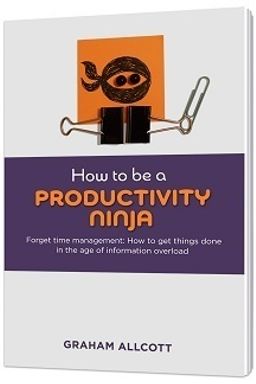
How to Be a Productivity Ninja cover

How to Be a Productivity Ninja

by Graham Allcott

How to Be a Productivity Ninja redefines productivity for the modern professional. With actionable insights and innovative strategies, it empowers you to manage attention, streamline tasks, and transform your workflow, ensuring you achieve more with less stress.

The Way of the Productivity Ninja

Why do some people seem to glide through their days with effortless calm while the rest of us drown in emails, meetings, and endless to-do lists? In How to Be a Productivity Ninja, Graham Allcott dismantles the myth of the superhuman multitasker and invites you to adopt a new identity: the Productivity Ninja. A Ninja, he argues, isn’t faster or smarter than anyone else—they simply harness focus, calm, and preparedness to outthink the chaos of the modern working world.

Allcott’s central argument is powerful: time management is dead. In an age of information overload, it’s not how much time you spend but where you place your attention that determines your productivity. He asserts that the modern knowledge worker must evolve from trying to manage hours to mastering attention. Productivity, he insists, is “the ability to achieve what you want to achieve, for the least effort.”

From Chaos to Clarity

Allcott’s philosophy was born from his own struggles. Far from a natural planner, he confesses he’s “flaky, instinctive, allergic to detail,” yet transformed his work life by creating structures of ruthless simplicity that anyone can use. The book’s purpose is to turn normal humans into productivity experts—not through superpowers, but through smarter habits, better mental models, and a calmer perspective.

He starts by reframing productivity as less about doing everything and more about doing the right things with focus. If you’ve ever ended your day buried under unfinished emails, wondering where the hours went, Allcott shows it’s not a failure of ability—it’s a failure of systems and attention. The Ninja identity helps rewire both.

Why Time Management Is Dead

In the 1980s, with predictable workflows and paper memos, “time management” worked. Today’s worker, however, faces nonstop input—email, instant messages, social media, meetings—and amorphous projects that never truly end. “You will never get everything finished,” Allcott warns, so stop pretending you can. The goal shifts from completion to control: cultivating clarity on priorities and making deliberate choices about where your mental energy goes. He introduces a new paradigm called attention management, which holds that focus, not time, is your most precious asset.

The Mindset of a Ninja

A true Productivity Ninja blends calm awareness with decisive execution. Allcott outlines eight core characteristics to embody: Zen-like Calm (staying clear even amid chaos), Ruthlessness (saying ‘no’ often), Weapon-savviness (using tools wisely), Stealth and Camouflage (protecting your attention from interruptions), Unorthodoxy (breaking needless rules), Agility (adapting fast), Mindfulness (observing your habits), and Preparedness (always ready for what comes next). These qualities form both a practical system and a philosophy for work and life.

Far from the myth of the superhero CEO, Allcott insists you embrace your humanity—your laziness, curiosity, and imperfection. The Ninja is not flawless but self-aware, calmly ruthless in protecting focus, and compassionate toward their own limitations. “Even the bravest get scared, even the strongest leaders occasionally lack direction,” he writes. The point is not perfection—it’s awareness.

Attention Is the New Currency

Allcott uses an analogy: your attention is a currency to be spent. Meetings, distractions, and digital noise are expensive drains. The Ninja’s task is to invest attention in high-value work—the 20% of tasks that generate 80% of results (a direct nod to Pareto’s Law). Everything else—emails that feel urgent but lack importance, redundant meetings, or administrative busywork—should be ruthlessly minimized or delegated.

(Note: This aligns closely with Cal Newport’s Deep Work, which similarly argues that focus, not availability, defines modern excellence.)

Systems for Sanity: From Chaos to CORD

To translate mindset into action, Allcott introduces the CORD Productivity Model, a system to regain control over your work: Capture and Collect everything vying for your attention, Organize it into trusted systems, Review regularly to refocus your priorities, and then Do the meaningful work. Each habit supports the next, creating a “second brain” that holds commitments so your mind can think clearly rather than remember details.

This model is designed for the realities of knowledge work—fluid, collaborative, and digital. Instead of attempting rigid time blocks, it allows for agility and mindfulness: thinking about the process of work as much as the work itself.

Being Human in an Age of Hustle

Underneath its clever Ninja metaphors, Allcott’s book is a rebellion against burnout culture. He reminds you to respect your physical and emotional limits, take lunch breaks, and build renewal into your days. A “Zen-like calm” isn’t spiritual fluff—it’s neuroscience. Stress-inducing patterns (overcommitment, multitasking, lack of clarity) are eliminated by systems that support calm focus.

“Productivity isn’t about getting everything done—it’s about being peaceful and powerful in what you choose to do.”

By the end of the book, Allcott redefines productivity as artistry: the joy of making meaningful things happen through focus, courage, and balance. Whether you’re a manager drowning in meetings or a freelancer juggling projects, adopting the Ninja mindset turns anxiety into agility. You become “response-able”—able to respond with clarity rather than react in panic. That, Allcott insists, is how ordinary people quietly achieve extraordinary results.


Attention Management Over Time Management

Graham Allcott proclaims that traditional time management is an artifact of a bygone era. In today’s work environment, the challenge is no longer scheduling hours—it’s managing focus. We inhabit an age where inputs, interruptions, and information streams flow continuously, leaving little time for 'real work.' This new reality demands a new central skill: attention management.

The Death of Time Management

In the old model, productivity gurus taught people to slot tasks neatly into calendars and prioritize using ABC lists. But as Allcott notes, “By 9:15 a.m., most of us have already received more information than a manager in 1980 saw in a week.” Emails, Slack messages, calls, and chats arrive nonstop. The very notion that you can plan your day and stick to it is a comforting illusion.

Therefore, productivity today requires not tighter scheduling but better decision-making: knowing what deserves your attention and, just as crucially, what doesn’t. You can’t manage time—it passes relentlessly—but you can train your focus to land where it counts most.

The Three Levels of Attention

Allcott identifies three “attention states” that cycle throughout your day:

  • Proactive Attention — the rare, high-energy periods when your brain is sharpest and decision-making best. Use this time for strategic, creative, or complex tasks.
  • Active Attention — steady, operational energy. Great for meetings, collaboration, or incremental tasks.
  • Inactive Attention — the low-energy slumps when you should handle routine tasks, catch up on reading, or take breaks.

By becoming aware of these patterns (and recording them, as he suggests, on an “attention timetable”), you can design work that respects your natural fluctuations rather than fighting them.

Separating the Boss and the Worker Within

Allcott uses a vivid metaphor from Peter Drucker: you are both the boss and the worker. The boss plans, thinks, and prioritizes (requiring proactive attention). The worker executes tasks and moves projects to completion (requiring active or inactive attention). Because the two roles exist in one brain, they constantly interfere. Without clear boundaries, the boss interrupts the worker mid-task with “new ideas,” while the worker hijacks boss-time with busywork.

The solution is structured distinction: reserve blocks for boss-mode thinking—your weekly and daily checklist moments—and protect them as fiercely as meetings with clients. When you’re working, silence your inner manager and just do.

Protecting Focus

Attention, like muscle strength, depletes with overuse. Allcott prescribes “stealth” and “camouflage” to conserve it: work offline for blocks of time, close email tabs, mute notifications, and use headphones as physical barriers. Protecting attention is essentially what Viktor Frankl called “choosing your response”—directing energy where it matters.

He also advocates for Internet famines: deliberate disconnection to deepen focus. “Yes,” he jokes, “this productivity book tells you to turn off the Wi-Fi.” It’s radical only because our modern addiction to connectivity has blurred the line between activity and accomplishment.

“Attention is your most valuable currency—spend it wisely.”

Attention management, then, becomes the ultimate meta-skill—more fundamental than any app or methodology. You can only do great work if your attention consistently aligns with your priorities. That requires awareness, systems, and—above all—ruthless choice. Every Yes is a No to something else. Every minute distracted is one minute unrecoverable. The Ninja knows this—and guards attention like treasure.


The CORD Productivity Model

At the heart of Allcott’s system lies the CORD Productivity Model, a simple yet powerful cycle that transforms overwhelm into order. CORD stands for Capture and Collect, Organize, Review, and Do. If practiced consistently, these four habits create what he calls your ‘second brain’—a trusted external system to hold your tasks, projects, and ideas so your mind can focus on decisions, not data storage.

Capture and Collect

The first step is simple but revolutionary: get everything out of your head. “Your brain is for having ideas, not for holding them,” Allcott quotes David Allen (Getting Things Done). Whether they’re tasks, worries, or creative flashes, write them down or record them digitally. Create “collection points”—your inbox, notepad, voicemail, and physical trays—and empty them regularly. The point is clarity: once captured, you can stop mentally reminding yourself and start thinking freely.

He emphasizes ubiquitous capture: have tools wherever you are. Use apps for notes, paper pads, or voice recorders—whatever lets you seize an idea before it vanishes. For Allcott, this simple act is an antidote to stress itself because it transforms cognitive clutter into manageable form.

Organize

Next comes turning your chaotic list into structure. Allcott helps you build three lists: a Projects List (larger goals), a Master Actions List (immediate next steps), and a Daily To-Do List (specific focus for the day). The Ninja doesn’t keep vague to-dos like “report” or “conference.” Instead, they define crisp, physical actions—“Email Sarah three venue options for the April conference.” This keeps your brain out of ambiguity and in doing mode.

He introduces the two-minute rule (borrowed from Allen): if something can be done in under two minutes, do it now. Otherwise, delegate, defer, or add it to your actions list. Every entry gets sorted by place (Office, Home, Phone), attention level (Proactive, Active, Inactive), and sometimes people (e.g., “Conversations with my boss”). This categorization means that even when fatigue hits, you always have the right options available.

Review

Every Ninja has a Weekly Checklist and a Daily Checklist: structured times to think. On Fridays or Mondays, you set aside an hour or two to process everything back to zero—clear inboxes, check lists, update projects, and identify “big rocks” (high-value tasks). Each morning, a five-minute ritual refocuses you on the day ahead: reviewing deadlines, identifying resistance points, and planning proactive work for peak energy hours.

Allcott compares Weekly Reviews to “deep-sea diving”—descending into your second brain to ensure all parts are aligned. This reflection produces what he calls “playful, productive momentum and control.” You become both calm and confident, ready for surprises but not defined by them.

Do

Finally, Do—execution without fuss. Because your thinking is already done during the Organize and Review phases, you can now focus fully, like the worker putting “cherries on cakes.” Allcott recommends monotasking—one job, full attention—versus multitasking, the enemy of flow. The Ninja uses “Power Hours” for tough tasks and small breaks (like Pomodoro 25-minute bursts) to sustain focus.

Together, these four habits form a closed loop of clarity. Neglect any one phase, and the cord frays. Master all four, and your second brain hums with frictionless flow. This, Allcott insists, is what separates productive professionals from the perpetually busy.


The Eight Ninja Characteristics

Graham Allcott distills the Ninja mindset into eight interlocking traits that turn chaos into craft. Like a martial artist blending stillness and speed, you can design your work around these eight characteristics: Zen-like Calm, Ruthlessness, Weapon-savviness, Stealth and Camouflage, Unorthodoxy, Agility, Mindfulness, and Preparedness.

Zen-like Calm

Central to all Ninja behavior, calmness is cultivated—not assumed. Allcott teaches that stress arises from ambiguity: unclear next steps or incomplete systems. By trusting your “second brain,” you eliminate uncertainty and create clarity, freeing your mind for quality thinking. He prescribes physical health, structured review, and acceptance that you’ll never finish everything. Calmness, paradoxically, is what lets you move faster.

Ruthlessness

A Productivity Ninja says No—often and without guilt. Every Yes has a cost in attention. Allcott encourages ruthlessness not as cruelty but as clarity: decide what aligns with your purpose and eliminate the rest. He applies Pareto’s 80–20 power rule: focus energy on the 20% of tasks that create 80% of results. Perfectionism, he warns, is just resistance in disguise; completion and clarity beat polish and procrastination.

Weapon-Savviness

A Ninja wields the right tools wisely. From simple pens to digital task apps, tools are meant to amplify focus, not distract from it. Allcott mocks the addiction to “productivity porn”—jumping from one app to another as if the tool itself were the solution. Choose tools you trust and stick to them. (He personally favors Evernote for reference and Toodledo for tasks.)

Stealth and Camouflage

Protecting attention often means disappearing. Be hard to interrupt, Allcott says. Work remotely, use headphones, block off “thinking time” in your calendar under vague titles. Go dark—turn off email, phone, and Wi-Fi—to reenter deep flow. Use “stealth delegation” by piggybacking on others’ momentum or partnering with “allies-in-crime” to multiply results with less effort.

Unorthodoxy and Agility

Unorthodox thinking rejects bureaucracy and convention. Allcott urges you to question every “that’s how we’ve always done it.” Break rules compassionately, prototype fast, and model success from other fields. Agility complements unorthodoxy: keep your commitments light, diaries underbooked, and systems scalable so you can pivot quickly. Prepared minds are agile minds.

Mindfulness and Preparedness

Mindfulness means paying attention to your own habits and emotions. Notice resistance before it takes hold. Preparedness, meanwhile, is the physical manifestation of mindfulness: clean workspaces, charged devices, packed bags, and well-maintained checklists that let you spring into action without scramble. Together, they create the invisible infrastructure of effortless productivity.

“A Ninja is not superhuman—but they sometimes appear to be so.”

Each characteristic reinforces the others. Calm under pressure requires preparedness; unorthodoxy requires mindfulness. The result is a disciplined fluidity—a paradoxical balance where clarity meets speed. Embodying all eight, you don’t just manage work—you transform it into a craft of intention.


Why Stress and Resistance Are Productivity Enemies

Allcott devotes significant time to addressing two invisible enemies that sabotage productivity: stress and resistance. Both are psychological reactions to information overload and fear, but the Ninja learns to recognize and disarm them through awareness, systems, and self-compassion.

Understanding Stress

Modern work constantly triggers the body’s fight-or-flight response. Emails, performance anxiety, and vague workloads make our amygdala—the brain’s survival center—think we’re under threat. Physical symptoms like fatigue and tension follow, leading to poor decisions. Allcott positions stress not as weakness but as data: a sign your systems are broken or your expectations unrealistic.

He distinguishes between good stress (short bursts of energy and focus under challenge) and bad stress (chronic anxiety that erodes calm). The antidote is control and clarity: knowing what’s on your plate, what truly matters, and what can wait. By strengthening your second brain through weekly reviews and organized lists, you release the psychological grip of uncertainty.

Resistance and the Lizard Brain

Resistance is deeper. Borrowing from Seth Godin and Steven Pressfield (The War of Art), Allcott personifies resistance as the “lizard brain”—an ancient voice whispering excuses, perfectionism, or procrastination. It fears standing out, failing, or succeeding. Whenever you delay sending an email or hesitate to start a presentation, that’s the lizard brain nudging you back to comfort.

He suggests two ways to fight resistance: acknowledge it, or cheat it. Acknowledge it by writing your fears down, meditating, or talking to mentors—sunlight kills its power. Cheat it by bypassing thought: set public deadlines, use routines to slip past anxiety, or create “Power Hours” for focused work. The key is momentum. Resistance loses the moment you act.

The Myth of Perfection

Perfectionism, Allcott warns, is productivity’s polished disguise for fear. Striving for ‘flawless’ output leads to paralysis. Productivity Ninjas embrace anti-perfection: done well is better than perfectly undone. He reminds us of Miles Davis’s Kind of Blue—recorded in just a few hours yet immortal. The difference between genius and mediocrity often isn’t talent—it’s willingness to ship.

The Ninja’s peace lies in compassion for imperfection, humor towards self-doubt, and trust in disciplined routines. Stress and resistance never vanish, but they become signals, not shackles. Through calm systems and mindful courage, you transform struggle into mastery.

Dig Deeper

Get personalized prompts to apply these lessons to your life and deepen your understanding.

Go Deeper

Get the Full Experience

Download Insight Books for AI-powered reflections, quizzes, and more.