
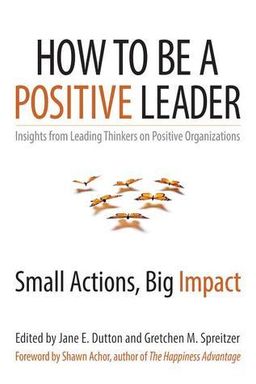
How to Be a Positive Leader cover

How to Be a Positive Leader

by Jane E Dutton and Gretchen M Spreitzer

Delve into the groundbreaking field of positive organizational behavior with ''How to Be a Positive Leader.'' This book combines cutting-edge research with real-world examples to offer actionable strategies for cultivating thriving workplaces, boosting employee engagement, and achieving high performance.

Small Actions, Big Impact: The Power of Positive Leadership

Have you ever wondered how some leaders seem to bring out the best in everyone, even in times of stress and uncertainty? How to Be a Positive Leader, edited by Jane Dutton and Gretchen Spreitzer, argues that extraordinary results are not born of charisma or authority, but of small, intentional actions rooted in optimism, meaning, and connection. The central idea is simple yet profound: by focusing on what’s right with people and organizations—rather than what’s wrong—you can expand the zone of possibility for excellence. This expansion opens pathways to greater energy, creativity, resilience, and collaboration, leading not just to higher performance but a more humane, thriving workplace.

Dutton and Spreitzer draw on the field of Positive Organizational Scholarship (POS), an evidence-based discipline championed at the University of Michigan’s Ross School of Business. POS examines how organizations and individuals flourish—not merely survive—by cultivating compassion, authenticity, trust, and purpose. In contrast to traditional management paradigms that emphasize control or correction, this approach encourages leaders to notice everyday opportunities to generate positivity, even within the constraints of bureaucracy or scarcity. Positive leadership isn’t soft; it’s strategic. When employees feel valued, when trust replaces fear, and when meaning replaces monotony, sustained high performance follows.

The Core Shift: Leadership as Resource Activation

The book reframes leadership from managing deficits to unlocking resources already present inside people, teams, and systems. Rather than treating employees as problems to fix, positive leaders treat them as partners and assets with untapped potential. This mindset reshapes organizational dynamics—from reactive management to generative collaboration. Whether through enabling thriving, job crafting, cultivating hope, or expressing gratitude, leaders create ripples that amplify excellence across individuals and teams.

Consider the example shared in the book’s epilogue: a large organization facing layoffs used empathy, transparency, and collaboration—not corporate e‑mails—to guide change. Leaders met face-to-face with employees, listened deeply, and emphasized shared purpose rather than fear. The result? Trust grew stronger, energy increased, and people invented new solutions instead of shutting down. A crisis became an opportunity to become a better version of themselves. This illustrates the book’s thesis—small, humane actions can radically transform organizational ecosystems.

The Architecture of Positive Leadership

Across thirteen chapters by leading scholars, the book explores four dimensions of positive leadership:

  • Foster Positive Relationships—build trust, gratitude, and mindful interaction. Think of Jane Dutton’s concept of “high-quality connections,” or Adam Grant’s practice of connecting employees to the people whose lives their work impacts (“Outsource Inspiration”).
  • Unlock Resources from Within—help people find meaning and vitality. Gretchen Spreitzer and Christine Porath’s “Enable Thriving at Work” and Amy Wrzesniewski’s “Engage in Job Crafting” show how autonomy and purpose ignite innovation.
  • Tap into the Good—activate virtues, ethics, and higher purpose. Kim Cameron’s “Activate Virtuousness” and Robert Quinn’s “Imbue the Organization with a Higher Purpose” demonstrate that ethical integrity and transcendence fuel both performance and moral fulfillment.
  • Create Resourceful Change—cultivate hope, creativity, and resilience during transformation. Oana Branzei’s “Cultivate Hope,” Scott Sonenshein’s “Treat Employees as Resources,” and Lynn Wooten and Erika James’s “Create Opportunity from Crisis” illustrate how adversity becomes a site for growth.

Why These Ideas Matter Now

Amid global uncertainty, burnout, and erosion of trust, this book’s message is timely—and urgently needed. Shawn Achor’s foreword reminds us that the “greatest competitive advantage in the modern economy is a positive and engaged brain.” In the 21st century, you can’t just extract more hours or effort from people; you must cultivate environments that renew energy and meaning. Positive leaders represent this evolution. They see their organizations not as machines but as living systems fueled by relationships, hope, and purpose.

“A positive leader believes that capacities for excellence can always be expanded. Every small act—of gratitude, hope, or authenticity—can shift the trajectory toward greatness.” —Jane Dutton and Gretchen Spreitzer

Ultimately, How to Be a Positive Leader is both inspiration and instruction manual. It reveals how the smallest shifts—listening with presence, sharing information, expressing appreciation—can unleash exponential impact. You learn that optimism isn’t naivety; it’s strategy. Gratitude isn’t sentiment; it’s fuel. And leadership isn’t command; it’s connection. When you act from grounded optimism, you activate forces that elevate everyone around you, turning ordinary work into a space of thriving and moral greatness.


Fostering Positive Relationships

Positive leadership begins with relationships—the lifeblood of any organization. Jane Dutton’s chapter, “Build High-Quality Connections,” shows that brief interactions, when infused with respect, presence, and playfulness, can literally strengthen people psychologically and physiologically. You’ve probably felt it yourself: one moment of genuine recognition or attentive listening at work can shift your entire day’s mood and energy. Dutton calls these High-Quality Connections (HQCs), describing them as micro-moments of human vitality that generate resilience, creativity, and trust.

Four Pathways to Connection

Dutton identifies four repeatable actions leaders can use to foster HQCs:

  • Respectfully engage others through genuine presence and supportive communication. Simple practices—turning off devices during conversation, paraphrasing what you’ve heard—signal worth and build trust.
  • Task-enable colleagues by helping them succeed. Coaching, emotional support, and flexibility convey that you’re invested in their growth.
  • Trust others by delegating responsibility and being open to input. Vulnerability strengthens collaboration when grounded in reliability.
  • Play—incorporate curiosity and joy into daily work. Play sparks creativity and deepens relational bonds (as explored in Barbara Fredrickson’s Love 2.0).

Designing Organizations for Connection

Dutton doesn’t stop at personal habits; she demonstrates how leaders can institutionalize connection through culture and systems. Reward relational skills, embed collaborative routines like peer recognition or team-based incentives, and model caring behavior—especially in times of stress. A poignant example from Phil Lynch, president of Reuters America, shows how empathetic leadership during the 9/11 crisis helped employees heal collectively and strengthen bonds across the company.

Leaders at Southwest Airlines and Zingerman’s demonstrate how cultivating relational coordination and gratitude rituals can elevate both morale and performance. These companies use team huddles, open-book management, and public appreciation not as feel-good extras but as engines of sustained collaboration.

The Lesson for You

If you want to bring out the best in your team, start small. Build one genuine connection at a time. Replace transactional interactions with moments of human recognition. High-Quality Connections aren’t about changing others—they’re about changing how you relate to them. Dutton’s research proves that quality interactions create measurable improvements in health, engagement, and problem solving. Over time, these moments weave a resilient social fabric where people thrive and organizations flourish.


Enabling Thriving at Work

Imagine feeling energized and continually growing at work—alive, creative, and excited about learning. That’s what Gretchen Spreitzer and Christine Porath call thriving. Thriving combines vitality (the spark of energy) and learning (the sense of growth). It’s not about escaping hard work; it’s about doing meaningful work in a way that renews rather than drains.

Four Individual Strategies

Anyone can begin thriving using four behavioral strategies:

  • Craft your work to be more meaningful—link tasks to their impact or beneficiaries (as Adam Grant suggests in “Outsource Inspiration”).
  • Seek opportunities to innovate and learn continuously, building competence through feedback and reflection.
  • Invest in energizing relationships that uplift rather than drain. One toxic tie can outweigh multiple positive ones.
  • Manage energy through health rituals—exercise, sleep, and balanced nutrition—to sustain vitality and recovery.

Organizational Practices for Thriving

Thriving isn’t only an individual endeavor; it’s ecological. Spreitzer and Porath identify four organizational practices that enable widespread thriving:

  • Share information openly so employees understand how their work fits the mission.
  • Provide decision-making discretion to empower initiative and learning from failures.
  • Minimize incivility to protect psychological safety and foster belonging.
  • Offer performance feedback that inspires growth rather than fear.

The case of Zingerman’s Community of Businesses in Michigan exemplifies thriving culture. Through open-book management, employee games, and transparent communication, Zingerman’s employees share responsibility, creativity, and joy—resulting in record revenue and workplace satisfaction.

The Thriving Ethos

Thriving is less a state and more a cycle. As people learn and gain energy, they draw others into upward spirals of engagement. Organizations that embrace this ethos see lower burnout and higher innovation. For you as a leader, enabling thriving means treating vitality and learning as renewable energy sources—fuels for excellence that multiply rather than deplete.


Unlocking Meaning through Job Crafting

If your job feels routine, what if you could redesign it yourself? Amy Wrzesniewski introduces job crafting—the art of reshaping your tasks, relationships, and mindset to align with your values and passions without changing your formal job description. She found that people at every level, from maintenance technicians to executives, actively adjust their work boundaries to feel more purposeful and effective.

Four Crafting Strategies

Wrzesniewski offers four hands-on strategies:

  • Optimize the job you have—analyze your time and adjust tasks to engage your strengths and passions.
  • Re-vision the relational landscape—focus on energizing, life-giving relationships and reframe challenging connections.
  • Queue your tasks strategically—arrange your day to balance difficult and enjoyable activities that sustain momentum.
  • Craft aspirationally—reshape work toward an envisioned future, even if roles don’t yet exist.

Leaders as Enablers

Managers can nurture crafting by increasing autonomy, integrating goals with development plans, and hosting “job-crafting swap meets” where teams exchange tasks to play to strengths. Google famously used these methods to improve satisfaction and collaboration. The case of Burt’s Bees illustrates supportive crafting culture: technicians and customer service staff redesigned roles to pursue process improvements and new challenges—with management’s blessing.

Crafting as Everyday Creativity

Job crafting transforms work identity from passive performer to proactive creator. By reshaping what you do and how you relate, you generate meaning, engagement, and growth. Wrzesniewski’s insight reminds you: purpose isn’t handed down—it’s hand-made. Treat your job as a canvas, not a cage.


Activating Virtuousness

Kim Cameron’s chapter explores how virtuousness—qualities like gratitude, forgiveness, compassion, and transcendence—drives not just personal wellbeing but measurable organizational performance. Virtuous behavior, he shows, boosts profitability, innovation, and engagement, while also healing morale after difficult events like downsizing.

Three Practices for Virtuous Leadership

  • Express gratitude. Daily journaling or in-meeting appreciation multiplies energy and trust.
  • Enable forgiveness. Transform harm into opportunity for growth through empathy and justice—healing individuals and strengthening alliances.
  • Facilitate transcendence. Pursue “Everest goals”—aspirations that inspire awe and purpose beyond profit, like Ford’s democratizing mobility or Interface’s mission for sustainability.

Virtue in Action

Cameron highlights Griffin Hospital, which overcame financial crisis and layoffs by institutionalizing compassion, forgiveness, and optimism. Employees reported higher integrity, trust, and love—making Griffin a perennial entry on Fortune’s “Best Places to Work.” Such examples prove that virtue is not naive; it is an accelerator of excellence. Leaders can deliberately make virtue a metric—to guide decisions and express humanity.

In essence, being a positive leader means prioritizing character when it’s hardest. Virtuous organizations not only survive adversity—they transcend it, turning moral goodness into strategic advantage.


Creating Opportunity from Crisis

Crises reveal true leadership. Lynn Perry Wooten and Erika James show that even devastating ordeals—like the 2008 recession or the BP oil spill—can become catalysts for transformation. Their chapter identifies four strategies for positive crisis leadership: learning and adapting, scanning for possibilities, building trust and authenticity, and embracing crises as opportunities.

The Ford Motor Case

Alan Mulally and Bill Ford Jr. exemplify these principles. During the recession, instead of seeking bailouts, they leveraged resources to innovate fuel-efficient cars and unify the company under “One Ford.” Transparency and collaboration transformed both morale and market trust. Ford not only survived—it prospered, becoming a global symbol of resilience and integrity.

Leadership Lessons

Wooten and James remind you that crisis leadership isn’t just about managing emergencies—it’s about evolving through them. Create psychologically safe spaces for truth-telling, scan for future scenarios, and act from authenticity. When leaders approach turbulence with openness and optimism, they convert breakdowns into breakthroughs.

“Not if, but when business crisis hits: become a student. Figure out how to change and improve your organization, not just bounce back.” —Wooten & James

When faced with adversity, positive leaders embody resilience, humility, and innovation. They don’t wait for calm seas—they learn to sail through storms for the sake of collective growth.

Dig Deeper

Get personalized prompts to apply these lessons to your life and deepen your understanding.

Go Deeper

Get the Full Experience

Download Insight Books for AI-powered reflections, quizzes, and more.