
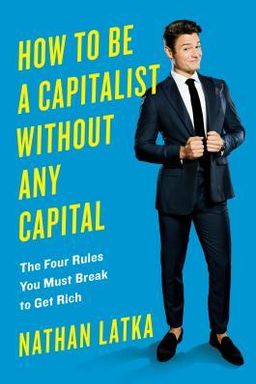
How to Be a Capitalist Without Any Capital cover

How to Be a Capitalist Without Any Capital

by Nathan Latka

Discover how to thrive in capitalism without substantial capital. Nathan Latka reveals unconventional strategies for success, showing how rule-breaking, income diversification, and strategic outsourcing can lead to wealth without traditional constraints.

Becoming the New Rich in Today’s Economy

Have you ever wondered why some people seem to live like kings—traveling wherever they want, working little, and always appearing happy—while others grind away without moving the needle? In How to Be a Capitalist Without Any Capital, Nathan Latka argues that wealth is no longer reserved for those born rich or those who invent something revolutionary. Instead, anyone can become one of the “New Rich” by breaking outdated rules, leveraging modern tools, and designing systems that create wealth automatically.

Latka contends that traditional advice about success—focusing on one goal, creating original ideas, and working endlessly—is designed to keep you poor. He challenges readers to reject what their professors and parents taught them and instead learn what rich entrepreneurs actually do: copy intelligently, multiply their efforts, and exploit every opportunity for leverage. His core claim is that prosperity today isn’t about having money—it’s about knowing how to use other people’s money, networks, and resources to create unstoppable momentum.

The Mindset of the New Rich

Being “rich” today isn’t about yachts or mansions—it’s about freedom. The New Rich, as Tim Ferriss first defined and Latka expands upon, are those who possess time freedom, financial freedom, and mindset freedom. They design lives filled with mobility and choice. Latka shows you how anyone can join this group by building income streams that run themselves—whether through real estate, digital businesses, or clever partnerships that earn money even while you sleep.

What’s refreshing about Latka’s approach is his boldness. He doesn’t romanticize hardship or glorify hustling for years. He sees systems as shortcuts—machines that spin wealth automatically. He backs his argument with his own journey: a college dropout who turned dorm-room coding into a multimillion-dollar enterprise, negotiated global deals, and now lives off passive income from podcast sponsorships, real estate, software firms, and food trucks.

Four Rules You Must Break

Latka reveals four conventional “rules” taught by parents and schools that sabotage success:

  • Rule 1: Focus on one thing. Specialization is overrated; real success comes from diversification and running multiple ventures simultaneously.
  • Rule 2: Come up with a unique idea. Innovation is risky and slow. Copy what already works, then add a twist.
  • Rule 3: Set goals. Goals are limiting. Systems are empowering. Focus on structures that produce wealth repeatedly rather than one-time achievements.
  • Rule 4: Give customers what they want. Don’t chase demand; sell the tools to the people already chasing it—the pickaxes to the gold miners.

Each broken rule becomes its own philosophy for building leverage, multiplying money, and eliminating wasted effort. His argument is radical but practical—you’ll learn how to travel the world for free, buy companies without cash, invest in real estate with zero down, and negotiate deals that look impossible from the outside.

Why These Ideas Matter Now

Latka frames the modern economy as an era of unprecedented accessibility. Tools like Airbnb, Shopify, and Patreon have democratized wealth creation. You don’t need startup capital to win; you need internet access and audacity. In contrast to old-school thinkers like Robert Kiyosaki (Rich Dad Poor Dad), who viewed homes and cars as liabilities, Latka insists they’re assets—if you use today’s sharing economy to turn them into cash generators.

These ideas matter because they flip the script on scarcity. Latka’s argument isn’t moralistic; it’s pragmatic. You’re not asked to dream, but to execute. Every chapter gives concrete tactics backed by emails, real negotiations, and screenshots from his businesses. He shows how to buy software firms for $1,000, get paid to take over failing companies, earn thousand-dollar podcast sponsorships, and live like royalty without paying for it. His life itself becomes proof of concept.

The Road Ahead

In the chapters that follow, Latka constructs a blueprint for achieving rich freedom without inheritance or startup capital. You’ll learn his “three-focus rule” for managing multiple ventures, the art of copying competitors, the discipline of building systems instead of goals, and how to sell pickaxes to existing markets. Later, he teaches unconventional investing, real estate leverage, buying businesses with no money, and multiplying them to infinite returns. Every concept builds toward a singular truth: wealth favors the decisive, not the cautious.

Key Takeaway

Latka’s philosophy turns capitalism into a creative art form. You don’t need capital—you need leverage. Master systems, copy strategically, and use other people’s resources to fund your empire. The world rewards those who dare to ask for what others believe impossible.


Break Free from the One-Thing Trap

Latka begins his crusade against conventional success by debunking the old maxim: “Focus on one thing and do it well.” According to him, focusing on a single pursuit is a setup for failure because it creates a single point of failure. If that job, company, or skill collapses, so does your income. The New Rich diversify—not just their money, but their time, skills, and ventures.

The Power of the Three-Focus Rule

You’re at your best when you’re testing three different opportunities simultaneously. Latka’s “Three-Focus Rule” says to devote 80% of your time to your main project and split the remaining 20% between two smaller ventures. This method maximizes learning and spreads risk. Each idea becomes a swing in the baseball game of wealth—the more balls you swing at, the more chances you have to hit doubles that add up to millions.

For instance, Latka ran his podcast, a software business, and a data company at the same time. He didn’t do more work; he batched his time. By grouping similar tasks into dedicated blocks, he avoided the exhaustion of multitasking while maintaining momentum across ventures. (Jack Dorsey uses this same method to run both Twitter and Square—each weekday has a dedicated theme.)

How Multiplying Works

Focusing on diverse projects also creates opportunities for “multiplying,” a concept Latka defines as using overlapping assets to make 1 + 1 = 3. His podcast audience, for example, became clients for his software company, which in turn drove sponsorships for his shows. The synergy between ventures magnified his influence and income. Elon Musk plays the same game with Tesla, SpaceX, and SolarCity—different projects linked by shared technology and vision.

Why Specialization Is Dangerous

Specialization feels safe because society glamorizes expertise. But in practice, it’s volatile. Markets shift fast, technology destroys old roles, and industries mutate overnight. Latka argues that the true expert today is the generalist—the person who recognizes patterns across fields, combines skills, and adapts quickly. The goal isn’t mastery; it’s flexibility.

His three-project model accelerates luck and learning. Each attempt, even failed ones, builds experience. A missed swing reveals why the next pitch may be profitable. As he says, “Every venture you attempt and shut down accelerates your learning.” (Thomas Edison made thousands of “failed” experiments before discovering the right filament for the light bulb—Latka sees that as the same iterative mindset.)

Key Takeaway

Don’t chase one rabbit; you’ll go hungry. Build three concurrent streams, apply the 80/20 rule to your time, and batch your energy. Success doesn’t come from doing more—it comes from connecting what you already do across multiple plays on the same field.


Steal from the Smartest: Copy Competitors

Latka’s second rule is audacious: copy your competitors. He insists that innovation is overrated. The smartest people use proven ideas and improve them. Facebook copied Snapchat; Airbnb copied Craigslist; Rockefeller refined existing oil processes. Even Andy Rachleff’s Wealthfront literally replicated Dropbox’s “referral bonus” model—turning file-sharing math into investment growth.

Reverse Engineering Success

Latka teaches you to find “winning patterns.” Look at what already earns money, identify the behaviors that make customers buy, and replicate them. He uses Kickstarter and Product Hunt to find hot markets. The Vue Smart Glasses campaign, for instance, raised over $1 million—analyzing its storytelling, early-bird pricing, and humor reveals what triggers virality. Crowdfunding sites are classrooms for pattern recognition.

Then, he layers modern tools like SimilarWeb and Ahrefs to discover competitors’ traffic sources and keywords. He shows that Todoist.com gains thousands of clicks monthly from specific search phrases. If you copy its SEO strategy and create a better product, you inherit its audience. You’re not stealing—you’re learning the system.

Ethical Imitation

Copying doesn’t mean plagiarism; it means cloning efficiency. Latka’s rule echoes Picasso’s quip: “Good artists copy; great artists steal.” A great entrepreneur adds a twist—a different price point, faster delivery, new features, or superior storytelling. When John Lemp launched Revcontent against ad giants Outbrain and Taboola, he didn’t invent “content recommendations”; he simply executed better, reaching $184 million in ad spend in one year.

Freelancers and Fast Execution

You can copy fast by hiring experts through sites like Toptal or Upwork. Latka used Toptal to build GetLatka.com, a $50K project funded entirely by preselling a simple spreadsheet of startup data. Freelancers turn ideas into prototypes quickly without giving up company equity. This transforms copying from imitation into acceleration—you ride an existing wave instead of trying to build the ocean yourself.

Key Takeaway

Copying is research in disguise. Identify proven winners, decode their systems, and out-execute. You don’t get punished for copying success—you get punished for ignoring it.


Build Systems, Not Goals

Latka’s third principle reframes how you think about progress. He says, “Forget goals—they’re keeping you broke.” Setting goals is like chasing golden eggs; building systems is like nurturing a goose that lays them endlessly. The rich design repeatable processes that produce wealth automatically, while the poor celebrate one-time wins that soon vanish.

From Goals to Systems Thinking

Instead of aiming for $100K in sales, design a machine that reliably generates $100K every quarter. Latka shares how he built Heyo, a Facebook marketing software, by turning his manual design service into a drag-and-drop platform. Once the system existed, it ran itself: thousands paid monthly while Latka moved on to other ventures. The system became a self-operating goose.

Inputs, Outputs, and Feedback Loops

Every system runs on four parts: inputs (time, money, people), outputs (results), stocks (assets generated), and feedback loops (how results feed improvement). Latka’s podcast is a living example: inputs are guests and sponsors; outputs are episodes and income; stocks are downloads; feedback loops occur when guests share episodes, attracting new sponsors. Once automated, his show earns $50K per month with only a few hours of his time.

Outsource and Automate

Systems work when you replace yourself. Latka uses virtual assistants for editing, posting, and outreach—saving nine hours for each 15-minute podcast episode. Automation tools like Zapier and scheduling software like Acuity transform effort into flow. He pays $29 per episode in outsourcing fees and earns thousands in sponsorship revenue, proving that investing in systems yields exponential returns.

Key Takeaway

Goals expire; systems compound. Every wealthy person you admire has built machinery that turns effort into automatic profit. Design your goose, feed it, and focus on optimization—not motivation.


Sell Pickaxes, Not Gold

Latka’s fourth rule takes historical inspiration from the California Gold Rush. Instead of mining for gold, sell pickaxes—the tools others need to chase their dreams. In modern terms, this means selling infrastructure to booming markets rather than competing within them.

Finding Modern Pickaxes

Today’s digital pickaxes are data services, delivery systems, marketing software, and platforms that support hot industries. While entrepreneurs chase cryptocurrency riches, Latka sells databases that fund venture capital decisions. His site GetLatka.com tracks real revenue data from founders, which VCs pay up to $15K per month to access. He isn’t digging—he’s supplying the shovels.

How to Identify Hidden Demand

You can spot pickaxes by observing fast-growing trends. Latka explores earning opportunities around Airbnb (property data), food delivery (logistics tools), and social media (ad targeting platforms). He also advises using Siftery.com or TechCrunch funding reports to see where investors are placing bets. Hot markets reveal themselves by how much money flows into them.

Work Smarter than the Miners

The genius of this approach is safety and scalability. Miners fight brutal competition for scarce gold; pickax sellers enjoy stable sales regardless of who wins. Rockefeller expanded his wealth by refining oil efficiently; Ted Turner became a billionaire selling TV airtime—the pickax of advertisers. Latka shows that you can be rich without being glamorous; let the influencers pose while you profit from their tools.

Key Takeaway

Don’t compete for gold—sell the gear. Find what every successful person needs to function and provide that service better, cheaper, and faster. Picking markets is guessing; supplying them is strategy.


Live Like a King Without Owning a Thing

In one of his most entertaining chapters, Latka unveils the New Rich secret to luxury living: act wealthy before you are wealthy. This isn’t about recklessness—it’s about leverage. He teaches how to enjoy Rolls-Royces, Bali villas, and designer suits for free by trading value for access.

The Art of Audacious Asking

Everything begins with audacity and negotiation. Latka emailed car rental companies, luxury hotels, and fashion stylists offering exposure in exchange for free use of products. He got a $350K Rolls-Royce Ghost for a day just by asking; hotels like Bisma Eight in Bali gave him free stays for tagged posts to two million Instagram followers. His partnership emails were short, confident, and clear about value provided.

Trading Clout and Connections

You don’t need celebrity status. Latka teaches how to create trade value even without followers. Offer press, introductions, or content exposure that helps businesses reach their audience. With Airbnb hosts, he negotiated discounts by promising to host mastermind dinners for CEOs—using their property as marketing space. Each exchange built credibility and cashflow.

Buying Audiences Instead of Followers

Rather than build followers from scratch, Latka recommends buying small companies that already have large social accounts. He bought a travel startup for $3K with 100K followers, recouping his investment from sponsored posts within weeks. That audience became leverage to get luxury experiences for free. The lesson: clout is a currency—own it or borrow it.

Key Takeaway

Appear successful to attract opportunities. Leverage exposure, networks, and negotiation to live richly without paying. The New Rich trade influence, not money, for luxury.


Buy Businesses with No Money

Latka demystifies a skill that the ultra-wealthy practice quietly: acquiring companies with little or no cash. He calls this strategy “no money, no lawyers.” You can buy small digital businesses simply by asking, structuring smart payment terms, and providing value.

The SndLatr and Top Inbox Deals

In one email, Latka bought the Chrome extension SndLatr for $1,000, inheriting 75,000 users. In another, he acquired The Top Inbox and was paid $15,000 to take it over because its founders wanted relief from $100K in debt. Both deals turned profitable by adding simple $5-month subscription paywalls. Within months, the tools generated over $130K in recurring revenue.

Creating Leverage Instead of Capital

Latka’s negotiation process is straightforward—start with empathy and end with opportunity. He asks founders emotionally charged questions: “What will you do with the money once I pay you?” If a seller wants to pay off a mortgage or escape stress, Latka tailors terms that satisfy emotions rather than money. Deals are closed through simple email agreements minus legal complexity.

Turnaround Tactics

Once acquired, Latka applies his five-step “playbook”: double pricing, upsell current users, improve SEO, shift paywall timing, and create affiliate networks. Each optimization converts sleepy tools into income machines. Buying a company no longer means spreadsheets—it means identifying untapped leverage and activating it strategically.

Key Takeaway

You don’t need millions to own companies. You need the nerve to ask, the creativity to negotiate, and the skill to add leverage. Cash is overrated; opportunity is priceless.


Multiply What You Already Own

After acquiring or building multiple ventures, Latka introduces the art of multiplication—making small assets feed one another so that 1 + 1 = 3. Instead of expanding outward, you go deeper with existing customers, infrastructure, and skills.

Go Deeper, Not Wider

Latka warns against the obsession with chasing new customers. Instead, find ways to sell more to those who already pay you. He cites Clate Mask of Infusionsoft, who reduced customer churn by raising entry fees—charging serious users more while deterring dabblers. Latka himself capped his database at fifty clients, raising prices periodically to maintain exclusivity and urgency. Depth beats breadth; premium beats volume.

Three Multiplying Tactics

  • Increase wallet share. Sell related products or upgrades so each customer spends more. Amazon Prime and Costco memberships monetize loyalty through convenience.
  • Negotiate discounts on expenses. Latka routinely emails vendors threatening cancellation to get price cuts. Saving money multiplies profit just as effectively as earning it.
  • Make your revenue streams work together. Combine assets—podcast audiences, software skills, and data—to produce new products like GetLatka.com, his million-dollar database spun from podcast interviews.

Multiplying transforms ordinary businesses into self-reinforcing ecosystems. Each piece of work becomes a gear turning the next. Marketers who understand this principle build empires with modest beginnings. Latka’s spreadsheet-turned-software database epitomizes infinite recursion—small ideas multiplied intelligently become big wealth.

Key Takeaway

Wealth grows geometrically when your businesses feed one another. Don’t chase width—engineer depth. When your systems compound, luck becomes predictable.


Know When to Sell and Move On

Finally, Latka teaches the discipline of selling businesses early. Like investor Bernard Baruch, who “made his money by selling too soon,” Latka warns against staying attached to stagnant ventures. Timing beats loyalty.

The Psychology of Timing

When a company drains your time or growth stalls, it’s telling you to sell. Latka observed this in his own startup, Heyo. At twenty-two, he declined a $6.5M offer, thinking bigger deals would come. They never did; by 2016 he sold partial assets for $300K. The lesson: markets cool quickly—exit while hype lasts.

How to Spark Offers

Latka’s method is disarmingly simple—email competitors or complementary companies with, “I really need to sell to take care of personal stuff. Want to chat?” Acting vulnerable prompts responses and starts bidding wars. Once buyers issue letters of intent (LOIs), emotions lock them in; fear of losing face makes them raise offers. He uses fiduciary language—“I must meet responsibilities to investors”—to make negotiations feel objective, not desperate.

From Selling to Momentum

Selling frees time and creates psychological momentum. Latka compares entrepreneurs to Elon Musk, who sold businesses to fund new ones. Each exit fuels another creation. For young or low-risk individuals, selling is often safer than clinging to slow-growth assets. The courage to walk away multiplies future opportunities.

Key Takeaway

Money loves movement. Sell before stagnation, capture momentum, and invest in your next win. Each deal should make you freer, not busier.

Dig Deeper

Get personalized prompts to apply these lessons to your life and deepen your understanding.

Go Deeper

Get the Full Experience

Download Insight Books for AI-powered reflections, quizzes, and more.