
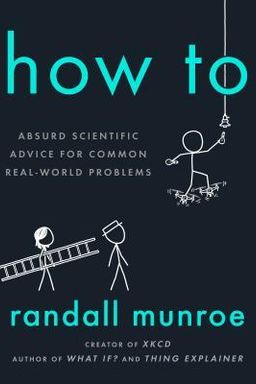
How To cover

How To

by Randall Munroe

Randall Munroe''s ''How To'' offers a whimsical journey through absurd but scientifically plausible solutions to everyday tasks. Blending humor with science, Munroe invites readers to explore reality''s most bizarre possibilities, challenging conventional thinking and inspiring creativity. Whether crash-landing planes or generating Martian electricity, it''s a delightful exploration of imagination.

The Art of Impossible Problem-Solving through Science and Humor

Have you ever wondered what would happen if you tried to build a lava moat around your house or construct a piano big enough for elephants? In How To: Absurd Scientific Advice for Common Real-World Problems, Randall Munroe—the former NASA roboticist and creator of xkcd—turns everyday scenarios into delightful explorations of physics, math, and engineering. Munroe’s central argument is that by taking ridiculous ideas seriously, you can reveal practical insights about how the world actually works. Every absurd question—how to throw a pool party without a pool, how to be on time by changing the flow of the universe, or how to power your house on Mars—becomes a playful blueprint for scientific thinking.

Why Bad Ideas Make Great Science

Munroe suggests that dismissing bizarre ideas as 'impossible' misses the fun—and usefulness—of scientific reasoning. His thought experiments are meticulously grounded in real research, equations, and engineering constraints, but delivered with humor and humility. The absurdity, he argues, gives science freedom: it lets you ask, 'What if?' without fear of failure. This approach, which recalls Richard Feynman’s playground-style curiosity, underscores a broader message: science isn’t just a body of knowledge; it’s a way of seeing the world through creative problem-solving (similar to Feynman’s idea that all great discoveries start with childlike questions).

Playful Problems, Serious Lessons

Each chapter of How To takes a relatable task—digging a hole, moving to a new home, or predicting the weather—and pushes it into scientifically extreme territory. Could you fill a pool using bottled water from Amazon? Technically, yes—but Munroe calculates that you’d spend roughly $150,000 and drown in plastic before finishing. Could you boil a river with electric kettles? Only if you somehow harnessed the energy output of a rocket launch. Through these comical calculations, he demonstrates principles of thermodynamics, engineering, and economics, showing how scale transforms feasibility into absurdity.

The Power of Scientific Curiosity

At its heart, Munroe’s philosophy is that even ridiculous questions deserve rigorous answers. He invites readers to play with the laws of nature—gravity, heat, pressure, kinetics—because understanding limitations teaches creativity. By turning dangerous, inefficient, or comically overcomplicated ideas into solvable physics problems, Munroe reveals the joy in failure and absurdity. His examples—like using thermal analysis to keep a lava moat molten or applying chaos theory to weather forecasts—remind readers that science is a sandbox, not a rulebook.

Why It Matters

In a world that prizes optimization and efficiency, Munroe’s delightfully pointless projects reclaim curiosity for curiosity’s sake. The irony is that they end up teaching efficiency anyway: his calculations about solar panels, electricity, and lifting forces mirror the questions engineers genuinely face. Like Mary Roach’s Stiff or Oliver Sacks’s The Man Who Mistook His Wife for a Hat, Munroe uses humor to reveal humanity. He argues that understanding complex systems—be it the physics of moving a house or the probability of catching a drone with a baseball—helps us be more grounded in reality, even when our imaginations run wild.

From Curiosity to Connection

Ultimately, How To is less a how-to manual than a how-to-think manual. Munroe’s blend of humor and science creates not just knowledge but community, reminding readers that asking odd questions unites us in wonder. Whether you’re calculating the heat loss of a molten moat or the trajectory of a pool party gone wrong, Munroe makes you laugh at the universe while learning to marvel at its logic. His underlying message—stay curious, stay ridiculous, and think deeply—turns every mishap into an experiment and every failed idea into a step toward understanding.


Physics of the Everyday (and Ridiculous)

Physics, in Munroe’s hands, becomes equal parts playground and problem set. Instead of lecturing about formulas, he invites you to calculate what happens if you really try to jump from a mountain ridge in a wingsuit, melt rocks for lava, or dig through the entire Earth. Each hypothetical begins as nonsense and evolves into a lesson in energy, force, or motion. He shows that physics is not just about abstract symbols—it’s the rules that keep us alive and provide the logic behind every absurdity we imagine.

The Gravity of Humor

In “How to Jump Really High,” Munroe calculates how sprinters, wingsuits, and mountain winds interact—revealing that real flight without engines remains impossible not because of imagination but because of physics. He uses gravitational acceleration (9.8 m/s²) and human tolerance limits to show why our bodies impose more practical restrictions than technology. Yet, in quantifying every leap and crash, he transforms failure into fascination. Each calculation feels like a science fair project gone beautifully wrong.

When Equations Get Funny

Rather than hiding behind equations, Munroe brings them alive through absurd imagery. In “How to Throw Things,” George Washington’s mythical coin toss becomes a physics experiment in terminal velocity. Munroe’s throw calculator balances mass, power output, and air resistance—then humorously notes that Carly Rae Jepsen could toss Washington about 35 inches. By turning math into narrative, he transforms intimidating science into approachable fun (similar to the strategy used by Neil deGrasse Tyson in Astrophysics for People in a Hurry).

Learning by Laughing

Throughout the book, Munroe uses visual and verbal slapstick to teach complex principles. When boiling a river with kettles, he scales household electricity to industrial magnitudes, illustrating energy conversion with comic exaggeration—until the reader suddenly grasps what 87 gigawatts actually means. Humor breaks down the psychological barrier between confusion and learning. As Munroe proves, it’s easier to memorize the coefficient of friction if it’s helping you ski down a 35° rubber mountain.

In essence, Munroe’s “bad ideas” are traps for insight. Each ridiculous premise forces you to reverse-engineer the universe’s logic. By resolving impossible tasks with sound physics, he reminds you that limitations are where learning starts.


Engineering the Impossible

Engineering, Munroe shows, is where human optimism meets physical law. The chapters on building—creating pools, moving houses, or constructing lava moats—illustrate how engineering’s beauty lies in problem constraints. No matter how wild the dream, real-world materials, energy costs, and heat tolerances set the boundaries. Yet, those boundaries are what make invention meaningful.

How to Build a Lava Moat

In Chapter 9, Munroe guides you through creating a 1,000°C molten ring around your home. He details the thermodynamics of keeping basalt liquid, then calculates that maintaining a one-acre moat would cost $60,000 a day in electricity. By treating a supervillain fantasy like an engineering project, he teaches readers energy management, material science, and the real cost of heat loss. The humor is in the math, but the wonder lies in realizing that these are the same principles that keep foundries and volcano labs operational.

The House That Flew (Kind Of)

In “How to Move,” Munroe considers moving by driving, hauling, and—naturally—flying your house with rocket engines. He calculates miles per gallon for a home-on-a-flatbed truck, then derivatives for a jet-powered bungalow that burns a gallon every thousand feet. The absurdity turns into a lesson on drag, mass, and legal regulations (including the Supreme Court’s 1985 ruling that your house counts as a vehicle if it’s on the highway). This is engineering comedy at its best—a wild ride anchored in impeccable logic.

Where Fantasy Meets Feasibility

Munroe’s mock-manuals demonstrate the thin line between grandiosity and genius. Whether you’re cooling your lava moat with seawater like Google’s data centers or anchoring your tectonically mobile house with steel piles, the humor emerges from matching imagination with precision. Each design collapses under its own realism, but like any failed prototype, it leaves behind gleaming insight.


Science of Nature’s Chaos

Understanding how the world behaves unpredictably is another theme running through How To. For Munroe, chaos isn’t failure—it’s an invitation to measure. He devotes chapters to weather, time, and randomness to show how science can map uncertainty without ever eliminating it.

Predicting the Unpredictable

In “How to Predict the Weather,” Munroe explores the butterfly effect, referencing mathematician Edward Lorenz’s discovery that infinitesimal atmospheric changes can shift global weather. Through entertaining simplifications, he redefines forecasting as a scale problem: short-term is solvable, long-term is chaos. Munroe even quantifies weather improvement rates (forecasts gain one day of accuracy every decade), turning existential unpredictability into brilliant trivia.

Turning Chaos into Wonder

When he teaches you to interpret the saying “Red sky at night, sailor’s delight,” Munroe unpackages folklore as physics. Light diffraction, air molecules, and planetary rotation become a 3D weather scanner in verse form. It’s a reminder that humans have always done science—we just called it superstition first.

Across these chapters, Munroe encourages an intimacy with randomness: learn to love the limits of prediction, because they define the edge of knowledge. The sky’s chaos isn’t scary—it’s endlessly measurable, one absurd problem at a time.


Everyday Technology Meets Cosmic Scale

From kettles that could boil rivers to servers cooled by the ocean, Munroe continually connects the domestic to the cosmic. Everyday devices become metaphors for planetary energy. By scaling familiar objects to planetary levels, he teaches you to see the hidden vastness—and absurdity—of power use, computation, and industry.

Boiling Rivers and Burning Beer

In one sequence, Munroe calculates that boiling the Kansas River would require 300 million kettles running on enough power to light the entire U.S. His comparison of household and planetary energy scales clarifies efficiency better than any textbook. Likewise, when he explains Cold War scientists testing beer bottles against nuclear blasts, he transforms history into a comic case study in radiation tolerance and human absurdity.

From Data Centers to the Cosmos

In “How to Power Your House (on Earth),” Munroe compares home power needs with global energy sources—from solar panels to vacuum decay (a literal universe-ending idea). When he interviews astrophysicist Katie Mack about triggering vacuum collapse to power a toaster, her response—“Please don’t do that”—condenses both cosmic humility and comedic warning. Through laughter, Munroe translates entropy and physics into tangible, personal stakes.

His recurring lesson: scale is everything. Whether calculating jet-fuel hover time for a flying house or comparing hot lava’s budget to Google’s servers, Munroe makes you marvel at numbers you thought you already understood.


Humor as a Scientific Method

Munroe’s most powerful instrument is not math—it’s comedy. Humor is how he smuggles scientific rigor into the brain without triggering boredom. By structuring How To around failed ideas and ludicrous plans, he creates teachable moments disguised as jokes.

Jokes with Equations

Munroe writes with a deadpan tone that mimics lab notes but hides punchlines within formulas. When he explains that moving a home costs “5 gigajoules of work—about 600 daily rations of 2,000 calories,” the humor lands precisely because it’s technically correct. His style recalls writers like Mary Roach, who fuse precision with playfulness to make science visceral. Each joke has a scientific corollary—an inversion that leaves you both laughing and calculating.

Absurdity Breeds Understanding

The chapter “How to Play Football” turns sports physics into a parable on drag and human strength. By treating NFL plays as fluid mechanics problems (even featuring horse-mounted quarterbacks), Munroe makes laughter synonymous with comprehension. Comedy, in this sense, is a mnemonic device: when you laugh, you remember the concept better.

By the end, you realize the humor is less about silliness and more about accuracy. Once you’ve laughed your way through the impossibility of a 235-key piano, you’ve accidentally internalized how frequency, air density, and sound attenuation actually work. The punchline is knowledge itself.


Curiosity, Failure, and Human Wonder

Behind Munroe’s equations and cartoons lies a deeper philosophy about humanity’s relationship with the unknown. His final chapters—on destroying or preserving this very book—transform humor into reflection. Curiosity, he insists, is our defining trait, and failure is its necessary companion.

Disposing or Preserving Knowledge

In “How to Dispose of This Book,” Munroe humorously compares burning, burying, and launching the book into the Sun. Along the way, he teaches chemistry, geology, and nuclear waste storage, culminating in a meditation on legacy: every written word is a message to the future. His dry note—“I don’t know what date it is when you’re reading these words…”—turns physics into philosophy, a love letter across time.

The Connection of Questions

Through his explorations of ridiculous ideas, Munroe reframes curiosity as compassion. His humor never mocks the questioner; instead, it honors their imagination. Whether testing how a piano tuner might survive nuclear winter or how a meteorologist might use selfies to forecast rain, he reminds you that absurd questions are how progress begins. (As Carl Sagan once said, 'We are a way for the universe to know itself.')

By closing with scientific humility—urging you to 'stand at a safe distance' when trying new ideas—Munroe crafts a philosophy of joyful skepticism. Curiosity may not save you from disaster, but it will make the explosion beautiful.

Dig Deeper

Get personalized prompts to apply these lessons to your life and deepen your understanding.

Go Deeper

Get the Full Experience

Download Insight Books for AI-powered reflections, quizzes, and more.