
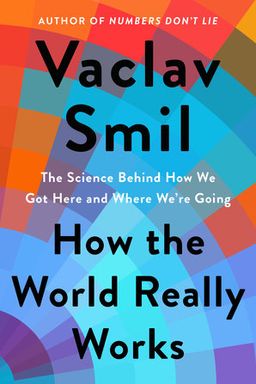
How the World Really Works cover

How the World Really Works

by Vaclav Smil

In ''How the World Really Works,'' Vaclav Smil explores the fundamental science of our past, present, and future. Uncover the essential knowledge of energy conversions that have shaped societies, revolutionized agriculture, and powered modern life. Empower yourself to make informed decisions about the world''s future.

The Story of Life Through Energy Conversions

Where does the energy that fuels your phone, your body, or even the food on your plate actually come from? Throughout history, from single-cell organisms in Earth’s earliest oceans to industrial cities powered by fossil fuels, the same story repeats: life depends on converting one form of energy into another. Exploring Earth’s Story Through Energy Conversions argues that if you want to understand life, civilization, and progress itself, you must understand the mechanisms of energy conversion.

The author contends that energy conversion isn’t just a scientific principle—it’s the beating heart of existence. From photosynthesis to fossil fuels, from metabolism to mechanization, it explains how life evolved, societies grew, and why modern civilization functions as it does. The book traces a breathtaking arc that begins with microbial metabolism and leads all the way to electricity, nuclear power, and global food systems powered by fossil energy.

From Microbial Beginnings to Planetary Change

Three and a half billion years ago, Earth’s story began not with movement or thought, but with metabolism—the conversion of solar energy into chemical energy. Primitive bacteria changed the composition of the atmosphere through photosynthesis. This process didn’t just sustain the microbes; it filled the skies with oxygen, transforming a once-hostile Earth into a thriving planet. Each step of life since then, the book suggests, has been another chapter in the story of how energy changes form to sustain complexity.

When early humans learned to control fire, that same story evolved. Fire was our first tool to convert stored chemical energy in wood into light and heat energy outside our bodies, a “first extrasomatic use of energy.” This moment represented not only survival, but mastery—the ability to control nature using energy beyond our muscles. Humanity’s trajectory since then has been one of ever-greater capacity to capture, store, and redirect energy for our own ends.

Energy as the Foundation of Civilization

Just as life itself depends on capturing energy, so too does civilization. The domestication of animals, for example, extended human capability by outsourcing physical work to oxen, camels, and horses. Later, we turned to the natural forces of wind and water to move ships and power mills. These transitions mark humanity’s progress—in each stage, we found a new way to transform energy and increase efficiency.

With the discovery of fossil fuels, the pace accelerated. Coal ignited the Industrial Revolution by turning the stored energy of ancient plants into mechanical motion via the steam engine. Then came oil, natural gas, and electricity—each one a leap in our ability to convert and distribute energy. Today’s world of smartphones, cars, and skyscrapers all trace their lineage back to that singular drive to harness energy conversion more effectively.

The Physics Behind the Power

The scientific foundation of the book draws from physics, especially the first law of thermodynamics: energy can’t be created or destroyed, only transformed. From Boltzmann’s reflections on free energy to Schrödinger’s assertion that life feeds on it, these ideas reveal that all organisms and all civilizations, including ours, compete to capture energy and convert it into useful work.

“All life is a struggle for free energy.” – Ludwig Boltzmann

Energy Conversion and Human Progress

Where this book shines is in connecting these scientific principles to the huge leaps in human history. The rise of agriculture, for instance, was not just a social or economic shift—it was an energetic revolution. By capturing solar energy through crops and supplementing it with fossil energy through fertilizers, irrigation, and transportation, humanity expanded the planet’s food supply exponentially.

The book also charts the transformation of labor. Thanks to mechanization, fueled by fossil energy, tasks that once took hundreds of human hours can now be completed in minutes. The mechanized wheat fields of Kansas are a world apart from the ox-driven farms of 1800s New York. This isn’t just about efficiency—it’s about how energy has redefined who we are and what we do.

Why It Matters Today

The story of energy conversions isn’t merely historical—it’s a mirror for our present and our future. Every human advancement relies on greater efficiency in converting energy, yet that same process fuels environmental strain. Understanding where energy comes from and how it’s transformed helps explain the roots of climate change, industrialization, and even global inequality.

By the end of this exploration, you’ll see that the very fabric of modern life—our food, cities, and technology—is woven from energy transformations. The question now, the author seems to suggest, is not whether we rely on these conversions, but whether we can sustain them responsibly.


From Photosynthesis to Fire

The story begins in the primordial seas, where bacteria mastered the first great energy conversion: photosynthesis. This simple but profound shift used solar radiation to convert carbon dioxide and water into organic matter, releasing oxygen as a byproduct. Over millions of years, this process turned Earth’s atmosphere from oxygen-free to oxygen-rich, paving the way for more complex life.

Life’s First Technology

Photosynthesis was life’s original technology. It made energy from sunlight accessible to living organisms, establishing a foundation for ecosystems. Through the ages, this biological energy conversion remained constant—but what changed was humanity’s ability to manipulate energy outside itself.

The Discovery of Fire

Fast forward to early humans discovering fire—a revolution equal in significance to photosynthesis. By controlling combustion, humans learned to unlock chemical energy from plant matter and transform it into heat and light. Fire warmed shelters, scared predators, and made tough foods digestible, allowing brain growth and social development. It was humanity’s first deliberate use of an extrasomatic (outside-the-body) energy source, a leap beyond mere metabolism.

This transformative skill changed not only survival but evolution itself. Fire expanded diet options and enabled migrations into colder climates. In a real sense, every campfire became an engine of civilization.


Harnessing Energy Beyond the Body

As humanity evolved, it began outsourcing more energy-demanding tasks. Animals like oxen replaced human muscle, transforming chemical energy from plants into mechanical energy to plow fields and transport goods. This shift freed human strength for other pursuits, setting the stage for technological innovation.

From Beasts of Burden to Natural Forces

Eventually, humans learned to tap natural forces. Sails harnessed wind energy to propel ships across oceans, while waterwheels captured the kinetic energy of rivers to grind grain or power mills. Each innovation demonstrated the same underlying idea: controlling more external energy meant more productivity, freedom, and power.

Before long, inventors discovered that fossilized plant matter—coal—could fuel machines on a scale that neither humans, animals, nor rivers could match. This innovation sparked the Industrial Revolution, introducing the steam engine and the modern age of industry.


The Physics of Energy and Work

To truly grasp how these transitions happened, you need to understand what energy is. As physicists like Ludwig Boltzmann and Erwin Schrödinger explained, energy represents the ability to do work—the capacity to produce motion or change. Every living organism, they argued, competes for “free energy,” the portion that can be converted into useful work.

Energy as Motion and Transformation

In physical terms, work occurs when a force moves an object in opposition to resistance. Energy exists in potential and kinetic forms, and all forms can be converted. A rock on a cliff has potential energy until it falls, when that energy becomes motion. Similarly, when you eat, your body transforms chemical energy into kinetic energy for motion or thought. The same principle applies to machinery: in a steam engine, coal’s chemical energy becomes mechanical energy to move pistons.

“Energy cannot be created or destroyed; it can only change form.” – First Law of Thermodynamics

Even energy lost as friction isn’t truly lost—it’s converted into heat. But, as the book notes, not all energy remains usable. The ability to perform useful work diminishes through conversion, a concept known as entropy. This reality shapes everything from your body’s metabolism to power plant efficiency.


Agriculture: Humanity’s Second Energy Revolution

Human society’s next great leap came with agriculture. The author argues that the Agricultural Revolution was one of the most significant energy conversions in history—a way to harness solar energy on an unprecedented scale. Plants convert sunlight into chemical energy, which humans then harvest. That process made permanent settlements possible and, later, city-states and empires.

The Role of Fossil Fuels

In modern times, agriculture underwent a second transformation powered by fossil fuels. Between 1950 and 2019, the population tripled, yet malnutrition dropped from 65 percent to under 9 percent. The key? Mechanization, advanced fertilizers, and irrigation—all powered by oil and natural gas. Tractors, combines, trucks, and fertilizer plants convert fossil energy into food abundance.

Synthetic nitrogen fertilizers illustrate this principle vividly. Once plants rely solely on time-consuming nitrogen fixation, now humans extract nitrogen from the air using fossil fuels to create ammonia. This industrial process consumes about 1.5% of the world’s total energy but enables global food security. The tradeoff, the author notes, is increased dependence on finite energy reserves.


The Electrical Era and Urban Transformation

The spread of fossil-fueled energy also drove another revolution: electricity and urbanization. The book illustrates this shift through the story of wheat farming in America. In 1801, growing wheat required 120 hours of human labor and 70 hours of oxen per hectare—powered entirely by muscle and sunlight. By 2021, modern machinery reduced that to just two hours per hectare, powered by diesel and electricity.

From Rural Labor to Urban Prosperity

In 1801, 83 percent of Americans worked in agriculture; by 2021, just 1 percent did. Fossil fuels and mechanization liberated billions from subsistence labor, driving mass migrations into cities and fueling industrial economies. The surplus energy freed from farms powered new ventures—factories, media, transportation, and, later, digital industries. The electrical grid became civilization’s circulatory system, converting energy not merely into motion but into information and connectivity.

This chapter underscores that electricity isn’t just another energy source—it’s the ultimate converter. It turns mechanical, chemical, nuclear, and solar energy into a universal utility, powering every facet of modern life from medical imaging to smartphone communication.


The Double-Edged Nature of Abundance

The abundance of energy conversions has brought humanity prosperity but also peril. The same fossil fuels that nourish billions also drive climate change and environmental degradation. The author suggests that our next challenge isn’t discovery but balance—learning how to sustain civilization’s energy appetite without exhausting the planet.

The Next Frontier

The book subtly points to renewable energy as the next chapter—the quest to replicate past leaps, but sustainably. Solar, wind, and geothermal power reawaken older forms of energy conversion, this time with modern efficiency. But the underlying principle remains constant: every step forward depends on how effectively we can transform and distribute energy.

Ultimately, Exploring Earth’s Story Through Energy Conversions is a reminder that humanity’s tale—from microbes to megacities—is not merely a story of survival or progress, but an ongoing dance with energy itself. Understanding it isn’t just academic—it’s essential for shaping the future.

Dig Deeper

Get personalized prompts to apply these lessons to your life and deepen your understanding.

Go Deeper

Get the Full Experience

Download Insight Books for AI-powered reflections, quizzes, and more.