
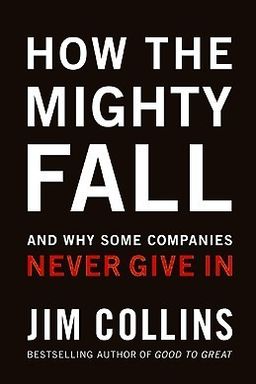
How the Mighty Fall cover

How the Mighty Fall

by Jim Collins

In ''How the Mighty Fall,'' Jim Collins unravels why successful companies collapse due to internal failures, not external forces. Through real-world examples, the book offers leaders guidance to prevent missteps and revive faltering businesses with strategic foresight and disciplined action.

How Great Companies Self-Destruct—and Can Rise Again

Have you ever looked at a brilliantly successful company—or even your own team—and wondered: how would we know if we're starting to fall? In How the Mighty Fall, Jim Collins tackles this haunting question head-on. With the same empirical rigor found in his classics Good to Great and Built to Last, Collins argues that decline in great companies is not inevitable or driven by external forces. Rather, it’s largely self-inflicted. The seeds of failure germinate in times of success, when confidence hardens into pride and discipline slips into overreach.

Collins contends that companies follow a predictable pattern of decline that can be diagnosed—and even reversed—before it’s too late. He outlines five stages of decline: Hubris Born of Success, Undisciplined Pursuit of More, Denial of Risk and Peril, Grasping for Salvation, and Capitulation to Irrelevance or Death. These stages unfold progressively, though organizations may linger or leap across them, and they can strike any institution—corporate, social, or even governmental.

The Hidden Disease of Success

Collins begins with a startling analogy drawn from his personal life. Watching his wife Joanne run energetically up a mountain, he later learns she was already carrying undetected carcinoma—the perfect metaphor for organizational decline. A company can look fit, growing, even dominant on the outside, while cancer quietly eats at its culture and decisions from within. The tragedy is not in failing to recover after collapse, but in failing to notice the sickness early enough to treat it.

In a signature move, Collins combines historical research with statistical rigor. Using data from past projects—over six thousand combined years of corporate history—he identifies eleven companies that went from great to mediocre or worse, such as Bank of America, Circuit City, Motorola, HP, Merck, Rubbermaid, and Zenith. He contrasts these with enduring success stories like Wal-Mart, IBM, Johnson & Johnson, and Texas Instruments, examining why one collapsed while another in the same era thrived.

The Five Stages of Decline

Collins discovered a consistent pattern across fallen institutions. Stage 1, Hubris Born of Success, begins when success is viewed as deserved and perpetual. Stage 2, Undisciplined Pursuit of More, follows when arrogance leads to reckless growth or expansion beyond the company’s unique competencies. Stage 3, Denial of Risk and Peril, emerges as warning signs are ignored or rationalized amid comforting profits. Stage 4, Grasping for Salvation, sees leaders reaching for radical revolutions—a savior CEO, bold acquisitions, or flashy transformations—in a desperate effort to reverse decline. Stage 5, Capitulation to Irrelevance or Death, marks the final surrender, when the enterprise loses the will or capacity to fight back.

Each stage, Collins argues, stems not from external pressure but from an internal erosion of humility, discipline, and purpose. Yet each stage also offers hope: recovery remains possible until the very last one. “Failure,” he writes, “is not so much a physical state as a state of mind; success is falling down, and getting up one more time, without end.”

Why This Matters

Collins wrote How the Mighty Fall in the shadow of the 2008 financial crisis, when titans like Lehman Brothers, Bear Stearns, and Fannie Mae collapsed. His message reaches far beyond business: nations, nonprofits, universities, and even individuals can fall victim to their own success if vigilance fades. “There is no law of nature that the most powerful will remain at the top,” Collins warns. Greatness requires constant renewal.

Ultimately, Collins reminds you that decline is not destiny. A fall from greatness can be avoided—or even reversed—through disciplined thinking and action. Great companies practice preventive medicine: they never confuse luck for skill, never chase growth without purpose, never let arrogance cloud learning, and never stop asking, “What must we do to remain great?” The mighty may fall, but with enough humility, rigor, and resolve, they can rise again.


Stage 1: Hubris Born of Success

Collins’s first stage begins with an ironic twist: the disease of arrogance strikes precisely when success peaks. The organization that once won through discipline and humility begins to believe its greatness is an entitlement, not an achievement. Hubris Born of Success turns confidence into complacency and curiosity into dogma.

Arrogant Neglect

Companies afflicted with hubris stop asking the hard “why” questions about what made them great. They assume their winning formula will work forever. Motorola dismissed the digital revolution in mobile phones, clinging to its analog StarTAC because “43 million users can’t be wrong.” Circuit City neglected its thriving core electronics business while chasing fanciful ventures like the ill-fated Divx video technology and CarMax used car lots. These leaders grew bored with their flywheels—the disciplined systems that had powered success—and sought novelty rather than mastery.

The pattern Collins calls “arrogant neglect” appears in four predictable steps: success breeds confidence; confidence breeds distraction; distraction breeds decline; decline follows as competitors overtake the neglected core. When Circuit City stopped improving its stores, Best Buy swept in, relentlessly renewing its retail model through innovation within its core business.

Confusing What and Why

Hubris also manifests when companies fossilize around past practices instead of underlying principles. A&P, once America’s supermarket giant, refused to modernize its store formats or management approach, mistaking tradition (“We always do it this way”) for truth. The company’s leadership believed preserving founder culture meant keeping everything literally unchanged—even the furniture in old offices. They confused “what we do” with “why we succeed.”

Collins compares this to artists like Picasso or Beethoven, who constantly reinvented themselves within their core discipline. Renewal, not rebellion, sustains greatness. Successful organizations must preserve their guiding why—purpose and values—while refreshing their what—strategies and methods. When innovation becomes mere novelty or stagnates into nostalgia, decline begins.

Learning vs. Knowing

Great leaders remain students of their own success. They maintain steep learning curves, constantly asking questions and acknowledging the role of luck. Hubris-born companies stop learning and start lecturing. Sam Walton, founder of Wal-Mart, is Collins’s antidote to hubris: despite his wealth and influence, Walton remained humble enough to learn from visitors—once spending hours questioning Brazilian retailers who had come to learn from him. When asked about leadership, Walton insisted that “We’re number one today, but something else will be number one tomorrow if we don't keep improving.”

Marker of Stage 1:

Success entitlement breeds arrogance and neglect of the very disciplines that created greatness.

The moment a leader stops asking “Why did this work?” and starts declaring “Of course it works because we’re great,” the descent has begun.

The remedy to hubris is humility—and disciplined renewal. The best leaders treat success like rented property, not ownership. As Collins reminds you, “Failure to grasp why your methods worked” is the first crack in the foundation of greatness.


Stage 2: The Undisciplined Pursuit of More

If hubris is the seed of downfall, the next stage is the overgrown vine. In Undisciplined Pursuit of More, companies chase expansion for expansion’s sake—bigger markets, faster growth, more products—without maintaining excellence or discipline. Collins found that contrary to common belief, most great companies don’t collapse from complacency but from overreaching ambition.

Overreaching, Not Complacency

He discovered that ten out of eleven fallen companies were highly active when decline began. Rubbermaid, once the most admired company in America, introduced one new product per day and entered a new market every eighteen months—until its creativity outpaced its operational capacity. Merck pursued relentless growth, setting public goals to double operating earnings when its core drug pipelines couldn’t support such ambitions. Each chased “more” beyond what they could do with excellence.

Breaking Packard’s Law

Collins adapts “Packard’s Law,” named for HP founder David Packard: no company can grow revenues faster than its ability to attract enough of the right people to implement that growth. Violating this law leads to bureaucratic overload, fractured culture, and mediocrity. Bank of America expanded into risky lending and international markets faster than it could manage, layering one hundred loan committees to compensate for weak talent—eroding clarity and accountability. When bureaucracy replaces discipline, decline accelerates.

The Problem of Power Succession

Many companies worsen Stage 2 by mishandling leadership transitions. Collins points to the Roman Empire under Augustus: brilliant early leadership without strong succession mechanisms led to centuries of chaos. In business, successions gone wrong—domineering founders who fail to groom successors or boards that choose flashy outsiders—create vacuum and turbulence. Ames Department Stores collapsed after its visionary founder handed the reins to an ambitious outsider who sought rapid transformation. Wal-Mart, by contrast, transitioned smoothly from Sam Walton to David Glass, preserving continuity and humility.

Core Warning of Stage 2:

Don’t confuse growth with greatness. Growth that exceeds disciplined capacity—people, culture, systems—will eat away at the roots of excellence faster than stagnation ever could.

For you as a leader, the lesson is clear: growth is a byproduct, not a goal. Before chasing “more,” ask whether you have the right people, cultural strength, and empirical evidence to achieve it without compromising what makes you great. When ambition surpasses discipline, decline is not far behind.


Stage 3: Denial of Risk and Peril

By Stage 3, trouble has arrived—but leaders pretend it hasn’t. Collins calls this phase Denial of Risk and Peril, a period of inflated optimism and selective hearing. Warning signs multiply—shrinking margins, rising debt, declining employee engagement—yet executives cling to positive narratives, amplifying the good and ignoring the bad.

Making Big Bets Against the Evidence

Motorola’s Iridium project is Collins’s textbook example. Conceived as a global satellite phone network, it seemed visionary in the 1980s. But by the 1990s, cellular coverage made the idea obsolete. Despite mounting negative data, Motorola forged ahead—spending billions on an oversized ambition that ended in bankruptcy. Collins contrasts this with Texas Instruments, which spent fifteen years testing digital signal processing before betting big. Where Iridium was a blind leap, TI’s DSP success was a disciplined climb.

Taking Risks Below the Waterline

To manage peril, Collins draws from Bill Gore’s “waterline principle”: imagine decisions as holes in a ship. If you puncture above the waterline, you can patch the damage. Below the waterline, you sink. Leaders in Stage 3 gamble below the waterline—betting the whole enterprise on ambiguous data. The Challenger space shuttle disaster illustrates how ambiguous evidence and shifted decision criteria (“Can you prove it’s unsafe?” instead of “Can you prove it’s safe?”) can lead to catastrophe.

Culture of Denial

Stage 3 companies lose their truth-telling culture. At IBM before its fall, executives dismissed inconvenient findings with “there must be something wrong with your data.” Zenith blamed unfair Japanese competition, failing to confront its own inefficiency. Scott Paper reorganized repeatedly instead of confronting market decline—a pattern Collins likens to rearranging your living room when the house is on fire.

Core Warning of Stage 3:

When internal dialogue shifts from “What’s wrong?” to “Everything’s fine,” and leaders start blaming others, denial has taken hold. It’s not lack of data that kills a great company—it’s refusal to believe the data.

For you, this is the phase to watch most closely. Stage 3 is a crossroads: a humble leader who confronts hard truths early can halt decline here. But the one who rationalizes and spins optimism prepares the ground for Stage 4—and the real reckoning ahead.


Stage 4: Grasping for Salvation

By the time a company hits Stage 4: Grasping for Salvation, decline is visible to all. Panic sets in. Instead of measured recovery, leaders reach for dramatic rescues—shiny new strategies, sweeping reorganizations, or savior CEOs promising transformation overnight. Collins likens this to a patient in cardiac arrest given adrenaline instead of long-term treatment.

The Savior CEO Syndrome

When HP’s board replaced its homegrown CEO Lew Platt with charismatic outsider Carly Fiorina, the company shifted from quiet discipline to media spectacle. Fiorina’s grand visions and “Invent” campaign generated attention but not profitability. Collins contrasts her flair with Louis Gerstner at IBM, another outsider who refused hype, quietly rebuilt systems, and focused on customers. HP’s progress fizzled; IBM’s rose steadily.

Chasing Silver Bullets

The hallmark of Stage 4 is the frantic search for a quick fix. Motorola bet $17 billion on broadband just before the tech bubble burst. Circuit City fired half its experienced staff, then looked for buyers. Rubbermaid restructured repeatedly before selling to Newell. Each move brought short-term optimism, followed by disappointment. Collins warns that each failed silver bullet drains resources and morale, leaving companies weaker than before.

Calm Discipline Over Panic

Collins’s antidote to Stage 4 is calm, deliberate discipline. When panic erupts, emotional decisions magnify risk—like Addressograph’s attempt at “massive change in as short a time as possible,” which destroyed decades of accumulated strength. The remedy: pause, breathe, diagnose, then act on sound evidence. “One shot at a time,” Collins recalls a Marine-turned-entrepreneur advising leaders: aim carefully instead of firing wildly.

Core Principle for Stage 4 Recovery:

There is no miracle moment. Recovery comes from humility, disciplined analysis, and accumulated small wins—not revolutions, restructurings, or rhetoric.

If you ever find your organization lurching from one grand fix to another, pause and ask: are we doubling down on discipline—or just reaching for salvation? Stage 4 is not certain death, but it’s the last place from which meaningful recovery is possible.


Stage 5: Capitulation to Irrelevance or Death

Stage 5 is the bottom of the curve—the quiet surrender or complete collapse of once-great institutions. Collins calls this stage Capitulation to Irrelevance or Death. Here, leaders either give up and sell out for survival, or run out of options entirely as their enterprises shrink into insignificance.

Giving Up vs. Running Out of Options

Scott Paper reached this point when its debt ballooned to 175% of equity, forcing the board to hire “Chainsaw Al” Dunlap, whose brutal cost-cutting yielded brief profits before selling the firm to Kimberly-Clark. In contrast, Zenith exhausted every option—diversifying into computers, cameras, and telephones—only to sink beneath debt and sell off its crown jewel divisions. Both choices end the same way: the cessation of greatness.

Loss of Cash, Loss of Hope

Collins’s former mentor Bill Lazier taught that “you pay your bills with cash; you can be profitable and bankrupt.” Stage 5 leaders forget this. The company bleeds liquidity through restructurings and failed hope cycles until the only choices left are distress sales, bankruptcy, or mediocrity. Yet, even here, Collins emphasizes—collapse need not be total. Capitulation becomes death only when hope disappears.

Distinguishing Denial from Hope

There’s wisdom in knowing when to surrender. If an institution can no longer answer “What would the world lose if we ceased to exist?” then perhaps it should exit gracefully. But if it still serves a vital purpose—if it retains core values and a reason for being—it must fight on. Companies like Xerox, which faced near-death under Anne Mulcahy but recovered through disciplined management and renewed purpose, remind us that redemption remains possible if the will and resources endure.

Final Marker of Stage 5:

Capitulation begins not with liquidation, but with the decision to stop caring. When leadership loses faith in renewal, death follows—not always financial, but cultural and moral.

Stage 5 reminds you that decline is not just economic—it’s spiritual. When conviction and creativity fade, institutions die long before their final balance sheet is written. The only true antidote is never to surrender your purpose, even when all else fails.


Stage 6: Well-Founded Hope and Recovery

The closing section of Collins’s book offers not despair, but redemption. In Well-Founded Hope, he demonstrates that decline—even severe decline—can be reversed through disciplined leadership anchored in humility and purpose. Whether by rebuilding culture, confronting brutal realities, or returning to fundamental management principles, great companies can rise again.

The Path of Recovery

Xerox under Anne Mulcahy stands as proof. When Mulcahy took over a nearly bankrupt Xerox in 2001, she refused flashy reinvention. Instead, she cut costs surgically, resisted panic, and defended long-term investment in R&D. She protected Xerox’s core identity—innovation and pride in engineering—while rebuilding financial discipline. By 2006, Xerox was profitable again, earning Mulcahy recognition as CEO of the Year.

Other companies—IBM under Gerstner, Nucor under DiMicco, Nordstrom under Blake Nordstrom—followed the same path: humble leadership paired with clear purpose and rigorous execution. Each rebuilt success slowly, focusing on getting the right people, defining its hedgehog concept (what it could be best at), and turning the flywheel of consistent action.

Leadership of Resilience

Collins likens these leaders to Ernest Shackleton guiding his stranded crew through Antarctic storms. They refuse despair and inspire discipline. “Never give in,” Churchill’s wartime mantra, captures this ethos. Whether surviving bankruptcy threats or market collapses, great leaders blend faith and realism—the Stockdale Paradox from Good to Great: unwavering belief in eventual success, coupled with confrontation of brutal facts.

Hope Through Discipline

The final message isn’t romantic optimism—it’s well-founded hope. Recovery requires disciplined thought and action: level 5 leadership, getting the right people, confronting brutal realities, focusing relentlessly on what you can do best, and pushing the flywheel patiently. Collins emphasizes that creative destruction doesn’t doom greatness; turbulence favors disciplined organizations. “Get down on your knees and pray for harsh conditions,” he writes, “because that’s when disciplined companies pull ahead.”

The Core of Well-Founded Hope:

Decline is self-inflicted—but so is renewal. As long as a leader retains faith and discipline, the mighty may fall, but they can rise again stronger than before.

For you, the lesson is liberating: success isn’t about avoiding mistakes—it’s about never surrendering your core purpose or commitment to disciplined improvement. The fall is only fatal when you stop getting back up.

Dig Deeper

Get personalized prompts to apply these lessons to your life and deepen your understanding.

Go Deeper

Get the Full Experience

Download Insight Books for AI-powered reflections, quizzes, and more.