
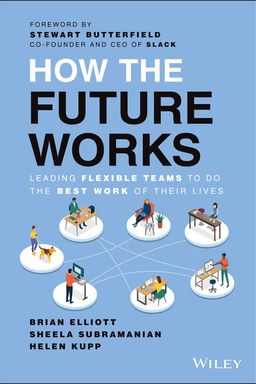
How the Future Works cover

How the Future Works

by Brian Elliott, Sheela Subramanian, Helen Kupp

How the Future Works offers a comprehensive guide for leaders looking to implement flexible work policies effectively. By providing a clear framework, it empowers organizations to enhance productivity, employee satisfaction, and innovation in the modern workplace. Discover strategies to balance autonomy and guidelines, ensuring optimal performance while meeting personal and professional needs.

Reimagining the Future of Work Through Flexibility

Have you ever found yourself questioning why, in an age of instant communication and boundless connectivity, our work routines still follow the Industrial-Era rhythm of the 9-to-5? In How the Future Works, Brian Elliott, Sheela Subramanian, and Helen Kupp argue that the traditional office-centric, clock-bound model of work no longer serves the needs of modern organizations or their people. The authors contend that the future of high-performing, inclusive organizations hinges on embracing flexible, digital-first work systems that measure performance by outcomes rather than hours spent.

This book delivers a blueprint for leaders to redesign how work is done—grounded in research from the Future Forum consortium, launched by Slack to study and guide organizations through this transformation. Drawing from case studies across companies like Dropbox, IBM, Levi Strauss & Co., Royal Bank of Canada, and Atlassian, it shows how modern work can be both flexible and structured, digital and deeply human, distributed yet profoundly connected.

The Core Argument: Flexibility Within a Framework

At the heart of How the Future Works lies a powerful paradox: true flexibility thrives not in chaos but within structure. Flexibility means more than working from home—it’s about giving people control over both where and when they work. The authors introduce the guiding principle of “flexibility within a framework”: a balance between individual autonomy and cohesive team alignment. This approach recognizes that while employees crave choice, organizations need clarity, guardrails, and shared purpose.

Dropbox’s “Virtual First” model illustrates this balance perfectly. The company discarded its old hybrid approach—where remote and in-office workers had vastly different experiences—and replaced it with a unifying ethos: digital tools come first, and physical offices (“Dropbox Studios”) serve as intentional spaces for connection and creativity. The result? A massive rise in job applicants, improved gender and racial diversity, and a culture that values meaningful work over presenteeism.

Why the Old Model No Longer Fits

Elliott, Subramanian, and Kupp trace our modern work habits back to the Industrial Revolution, when the measure of productivity was physical output per hour. In factories, time and production were intertwined; labor could be seen and tallied. But in today's knowledge economy—where ideas, collaboration, and creativity drive value—time is an increasingly poor metric. The invention of the office simply moved the factory’s time discipline indoors, producing what the authors call “the 9-to-5 hangover.”

The pandemic, they argue, was the great unmasking of this outdated system. When knowledge workers were forced home, companies feared productivity would collapse. Instead, studies by Goldman Sachs and the Future Forum showed that productivity actually rose—by over 3% in the first year alone. Employees discovered autonomy, balance, and engagement they hadn’t known in decades. This “grand experiment” proved that performance no longer requires presence.

Digital-First: Redefining Where and How Work Happens

The book’s answer to the chaos of hybrid work is what the authors term a Digital-First operating model. In this model, digital communication becomes the default, while in-person interactions serve as supplements designed with intention—whether for trust-building, brainstorming, or celebration. This shift, Slack CEO Stewart Butterfield writes in the foreword, reflects a reality that’s already arrived: "most organizations have already switched from a world where digital supplements in-person, to one where in-person supplements digital."

This mindset is not about remote-only work. It’s about treating digital spaces—like Slack, MURAL, or Zoom—as the new headquarters of culture, connection, and collaboration. The authors encourage leaders to design “digital headquarters” with the same intentionality once reserved for office space planning. These are the central hubs where transparency thrives, where culture is built across borders, and where information flows freely regardless of physical presence.

From Time-Based to Outcome-Based Work

This new world of work requires a fundamental change in management philosophy. The authors challenge the outdated “monitoring mindset” of tracking hours and activity, replacing it with trust and accountability grounded in measurable outcomes. As one executive quipped, “How did you know people were working when they were in the office?” This rhetorical question captures the shift from performative busyness to meaningful output.

In practice, this shift moves organizations from the “doom loop” of micromanagement—monitoring leading to mistrust leading to disengagement—to the “boom loop,” where trust, clarity, and autonomy fuel performance. Boston Consulting Group’s global PTO program (Predictability, Teaming, and Open Communication) is one example: by establishing protected time off and clear outcome measures, they reduced burnout while sustaining excellence.

The Seven Steps to a Flexible Future

To make this transformation tangible, the authors present a seven-step journey for organizations ready to reinvent how work is done:

  • Stand for Something: Define your purpose and principles for flexible work.
  • Level the Playing Field: Create guardrails that ensure equitable access and inclusion.
  • Commit to How You’ll Work: Develop team-level agreements that turn principles into daily habits.
  • Experiment, Experiment, Experiment: Normalize testing, learning, and iteration.
  • Create a Culture of Connection: Reimagine how digital and physical spaces foster belonging.
  • Train Your Leaders: Equip managers with empathy, trust-building, and coaching skills.
  • Focus on Outcomes: Redefine productivity through results, not time.

Together, these steps form a blueprint for leading flexible teams to do the best work of their lives while building inclusive, resilient organizations. The authors argue that this isn’t merely a management trend—it’s an evolutionary leap comparable to the Industrial Revolution’s impact on work a century ago.

Why It Matters Now

The global competition for talent is fiercer than ever. In Deloitte’s CEO survey, 73% of executives cite labor shortages and 57% cite recruitment as their top challenges. The authors make a compelling case: flexibility isn’t just a “perk” for employees—it’s a strategic imperative. Companies that embrace flexible, equitable, and human-centered work systems will attract the most diverse talent, drive higher engagement, and deliver stronger business outcomes.

Ultimately, How the Future Works is a manifesto for leaders ready to move beyond nostalgia for the old ways of work. It’s a guide for creating workplaces that are adaptive, compassionate, and built for both performance and well-being. In this vision, the 9-to-5 isn’t just outdated—it’s a missed opportunity to build a more fulfilling, sustainable, and human-centered future.


Start with Purpose and Principles

The journey to flexible work begins with clarity about why change matters and what principles will guide it. Elliott, Subramanian, and Kupp argue that too many leaders dive into remote work policies without defining purpose—and end up with chaos or disengagement. Instead, leaders must start by agreeing on a clear purpose (the “why”) and a set of actionable principles (the “how”).

Define Your ‘Why’

Your “why” articulates how flexible work supports your business goals and values. At Royal Bank of Canada (RBC), Chief Human Resources Officer Helena Gottschling led a major cultural shift in a 150-year-old institution. Through global surveys and town halls, employees made one thing clear: they wanted to keep the flexibility gained during the pandemic. For RBC, the purpose became twofold—to meet employee expectations and to stay competitive for global talent. Their flexible work strategy now explicitly supports their core purpose: helping clients thrive and communities prosper.

Slack’s leadership team had a similar debate. When defining their own flexible strategy, they wrestled with competing perspectives until CEO Stewart Butterfield reframed the question: “Do we want to go backward or forward?” Their eventual “Digital-First” directive became not just a policy but a principle—the company would never revert to its pre-pandemic norms.

Craft Your Principles

Principles translate your purpose into behavioral guidelines. They act as your organization’s compass through the messy middle of change. RBC distilled theirs into five core principles, including “Flexible work is here to stay” and the subtly powerful “Proximity still matters.” This principle doesn’t mandate office time—it recognizes that periodic in-person connection strengthens collaboration and belonging.

Common flexible work principles across companies include: ensuring equity and access for all employees; trusting teams with autonomy; measuring results by outcomes; adopting a learning mindset; and maintaining clarity in communication. The authors advise creating no more than five or six—simplicity breeds adoption.

Build Executive Alignment

Once principles are drafted, alignment among top leadership is essential. Boston Consulting Group’s research shows that flexible work strategies driven by CEOs progress twice as fast as those delegated downward. Slack’s leadership meetings, for instance, set recurring agenda time to resolve questions about purpose and principles. “We spent two months deciding what we stood for,” Elliott recalls, “and it was worth every minute.”

The alignment process often surfaces deep-rooted biases—like fears that culture or innovation will suffer if people aren’t in the office. Gottschling confronted this directly by asking leaders at RBC to challenge their assumptions: How did you gauge productivity before flexible work? Why do you equate face time with commitment?

Communicate With Transparency

Purpose and principles are only valuable if everyone knows them. Future Forum surveys found that two-thirds of executives believe they’re being transparent about post-pandemic work plans—but fewer than half of employees agree. This gap erodes trust. Leaders must talk openly about both what is known and what’s still uncertain, reinforcing the message that change is a shared experiment. “We’re going to learn as we go,” Gottschling reminded her teams, emphasizing ongoing conversation.

By standing for something—rooted in purpose, articulated through principles, and communicated with transparency—leaders create a unifying “north star.” As the authors note, flexible work isn’t just a logistical shift; it’s an identity shift. Defining why you do it anchors the entire transformation in meaning.


Building Guardrails to Ensure Equity

Once your purpose is clear, you need structure to make it real. Flexible work fails, the authors argue, when freedom lacks framework—when flexibility becomes “faux” flexibility that benefits a few and penalizes others. To prevent inequity, organizations must install guardrails, which act like protective boundaries that keep flexibility fair and sustainable.

The Equity Imperative

Historically, workers who took advantage of flexibility—especially women, caregivers, and employees of color—paid a career penalty. Helen Kupp shares a story from her consulting days about a brilliant female colleague who worked a four-day week to spend time with her children. Though her performance matched any peer’s, she advanced slower. The assumption that flexibility meant lower commitment revealed a bias baked into workplace culture. Stanford research by Nicholas Bloom supports this: remote workers were 50% less likely to be promoted, even when equally productive.

To address this inequity, the authors propose establishing three layers of guardrails: leadership, workplace, and culture.

Leadership Guardrails: Model From the Top

Leaders shape culture through behavior more than words. When executives are seen working from the office every day, employees infer that face time equals success. That’s why Atlassian’s COO, Anu Bharadwaj, imposed “stricter rules” on her own team—limiting their office attendance to one day a week to model true flexibility. Slack followed suit with an “executive speed limit” requiring senior leaders to cap office visits at three days per week.

Symbolic actions matter, too. At IBM, CEO Arvind Krishna publicly shared the company’s “Work From Home Pledge,” originally written by employees themselves to normalize empathy and boundary-setting. Simple yet powerful commitments like “I pledge to be family-sensitive” signaled that flexibility was not a privilege but a core expectation.

Workplace Guardrails: Redesign Physical and Digital Spaces

Offices must evolve from default workspaces to intentional collaboration spaces. Slack disbanded its executive floor—once the locus of power—and converted it into team meeting areas. MillerKnoll, a design and furniture company, found that social commons, flexible zones, and “quiet floors” boosted connection and belonging by as much as 5%. Guardrails also include meeting norms like Slack’s “one dials in, all dial in” rule, ensuring that remote participants have equal presence during discussions.

Similarly, offsites need rethinking. Instead of arbitrary “in-office days,” teams should design gatherings for specific outcomes—team-building, project kickoffs, learning opportunities—and provide logistical support (budgets, templates, facilitators) to make them meaningful and inclusive. Practices like Levi Strauss & Co.’s “No Meeting Fridays” or Salesforce’s “Async Weeks” create equitable focus time across hybrid teams.

Culture Guardrails: Challenge Old Habits

Perhaps the hardest shift is cultural. Many organizations have a compulsive meeting culture that undermines both focus and flexibility. Slack executives addressed this by declaring “calendar bankruptcy,” deleting all recurring meetings and adding back only those that mattered. Dropbox uses its “3D” filter—discuss, debate, decide—to determine when a meeting is truly necessary.

The authors also highlight research showing that brainwriting, where individuals generate ideas independently before sharing them, produces far more creativity than traditional brainstorming. Flexible work allows this asynchronous innovation to flourish, giving introverts and distributed workers a stronger voice.

Guardrails aren’t constraints; they’re enablers. They prevent burnout, bias, and “faux flexibility” from creeping in, while ensuring equality, inclusion, and trust. As Tracy Layney of Levi’s observed, “These issues—bias, burnout, invisibility—they already existed. Flexibility just gives us a chance to finally fix them.”


Empowering Teams Through Clear Agreements

After setting broad principles and guardrails, organizations must translate them into daily reality. The authors propose Team-Level Agreements (TLAs)—practical, co-created documents that spell out how each team works together. These agreements operationalize flexibility by making expectations explicit and shared.

The Failure of Top-Down Rules

When Apple and Google mandated set office days in 2021, employees rebelled. Apple’s staff wrote an open letter to CEO Tim Cook calling the policy exclusionary. The problem wasn’t the office; it was the lack of choice. Such top-down decrees communicate distrust—implying that leaders, rather than teams, know best how work gets done. By contrast, Amazon reversed course after employee pushback, allowing teams to decide their own hybrid model.

From Principles to Practices

A TLA bridges organizational principles and everyday operations. It answers questions like: How do we communicate? When are our collaboration hours? How will we hold each other accountable? SLAs (service-level agreements) guide machines; TLAs guide humans.

Slack’s TLA template, included in the book’s toolkit, outlines five categories: values, schedules and meetings, accountability, relationships, and check-ins. For example, a team might agree to core collaboration hours from 10 A.M.–2 P.M., with notifications off outside those blocks. Another might opt for “no video Fridays” to prevent burnout. Teams then update their agreements quarterly as needs evolve.

Co-Create, Don’t Dictate

TLAs work because they’re collaborative. Leaders shouldn’t hand down prefilled templates; teams must co-author them. At Genentech, for instance, teams create agreements in workshops where each member “owns” a category—such as scheduling or accountability—and drafts initial norms. The group then discusses, debates, and refines. Writing norms down, the authors emphasize, transforms intention into commitment.

Moreover, TLAs must accommodate diversity of circumstances: parents, caregivers, new hires, introverts, night owls, and global time zones. Flexibility succeeds when no one is left behind. To support adoption, organizations should provide starter templates, example policies, and internal sharing platforms where teams can learn from each other—Genentech makes all TLAs public to encourage cross-team transparency.

Iterate and Adapt

No agreement is perfect from day one. Teams should schedule regular reviews—monthly or quarterly—to ask, “What’s working? What’s not?” This ongoing reflection reinforces learning and accountability. TLAs, the authors write, become the DNA of team culture: living documents that evolve as teams grow, technologies change, and goals shift.


Normalize Experimentation and Learning

Transformation isn’t a one-time project; it’s an experiment in progress. In one of the book’s most energizing chapters, the authors encourage companies to cultivate a “test and learn” culture—borrowing methods from design thinking and agile development. In flexible work, experimentation isn’t optional; it’s survival.

Why Experimentation Matters

Change triggers fear—especially among what Genentech’s Rachael Allison calls “the frozen middle” of middle managers who rose through old hierarchies. They understand yesterday’s playbook and distrust new ways of working. At Genentech, early flexible work pilots stalled until the pandemic forced everyone to test new habits. Data on engagement and productivity thawed the ice. A veteran scientist who once resisted remote work became a vocal champion after seeing results firsthand.

The authors use Genentech’s story to illustrate that data alone doesn’t dismantle skepticism—visible examples and iterative success do. This echoes Amy Edmondson’s research in The Fearless Organization: psychological safety fuels experimentation and innovation.

The Design Thinking Framework

Elliott and his coauthors outline a five-step design thinking process: Empathize with employees’ challenges, Define the core problem, Ideate possible solutions, Prototype on a small scale, and Test while gathering feedback. Slack used this approach to solve hybrid meeting inequities. Teams prototyped various configurations—everyone on laptops, shared audio setups, and even introducing laptop stands for equal visibility—until they discovered what worked. These experiments led to a widely adopted company guardrail: “one dials in, all dial in.”

Build a Task Force of Champions

To institutionalize learning, the authors recommend forming a cross-functional task force representing diverse roles, geographies, and demographics. Slack’s “Digital-First Task Force” dedicated 20% of each member’s time to experimentation. Reporting directly to leadership, they ran pilots, documented results openly in company channels, and communicated progress transparently. This kind of visibility transforms experimentation from a side project into a movement.

Communicate Progress—and Imperfection

Leaders must talk about experiments as they happen, not just when they succeed. “Do your work in public,” the authors urge. When leaders share drafts, pilot results, and vulnerabilities, they model transparency and trust. Levi Strauss & Co.’s CEO Chip Bergh did this during an all-hands “Chips and Beer” session, admitting they didn’t have all the answers but were learning together. Employees appreciated being part of the process rather than recipients of decrees.

Make Learning Continuous

The authors close by reminding leaders that experimentation never ends. Change fatigue is real, but complacency is costlier. Organizations should keep dedicated resources—like Slack’s permanent task force—to ensure ongoing iteration. Reward learning, celebrate pilots, and promote those who drive positive change. As one leader put it, "You can’t unscramble the egg—once work evolves, there’s no going back."


Creating Connection and Belonging Anywhere

A common fear about flexible work is the loss of connection—that virtual work will erode culture and creativity. The authors flip this assumption on its head: done with intention, flexibility can actually increase connection and belonging. “It’s not where we gather that builds community,” they write, “but how intentionally we do it.”

Beyond the Office Myth

Studies from the Future Forum Pulse revealed something surprising: when flexibility increased, so did camaraderie and belonging, particularly among historically underrepresented groups. Black employees working remotely reported higher senses of belonging and psychological safety than in-office peers. The office, once touted as a glue for culture, often magnified inequities and exclusionary dynamics—think of loud brainstorming sessions that silence introverts or “happy hours” that alienate caregivers and nondrinkers.

The Digital Headquarters

To sustain connection, the authors champion building robust digital headquarters—intentional online spaces where culture, communication, and collaboration live. Examples include Slack channels dedicated to team projects, knowledge sharing, and even hobbies, or Async video tools for storytelling and recognition. These hubs become “the new company lobby,” open to everyone regardless of geography. Leaders should invest in these digital infrastructures as seriously as they once invested in office design.

MURAL’s 2020 “Virtual World Tour” exemplifies digital belonging done right. When pandemic lockdowns canceled their global retreat, MURAL turned to creativity: employees received travel-themed boxes, customized Zoom backgrounds, and interactive games that simulated a global adventure. The energy rivaled any in-person party. Their secret was intentionality—asking how to replicate emotion and connection digitally, not merely events.

Hybrid Connection by Design

Physical gatherings still matter—but they need purpose. Fully remote companies like GitLab and Zapier host annual retreats meticulously focused on team bonding, not routine work. Hybrid organizations should adopt this approach: use in-person time for celebration, trust-building, or strategic alignment, never just because the calendar demands it. The key is rethinking offices as “connection studios,” not attendance checkpoints.

As designer Joseph White of MillerKnoll notes, many companies are flipping their real estate ratio—from 80% individual desks and 20% team spaces to the reverse. Open social zones, digital display walls, and café-style commons now serve as belonging hubs. These aren’t frivolous perks but vital enablers of shared identity.

Leadership’s Role in Connection

Leaders must model connection themselves. PepsiCo’s former CEO Indra Nooyi, for instance, wrote hundreds of personal letters to her executives’ parents, thanking them for raising such talented leaders—a gesture that multiplied loyalty far beyond monetary rewards. Connection begins with empathy, recognition, and storytelling. Executives should over-communicate about intentions, celebrate shared moments, and eliminate symbols of hierarchy like “executive floors.”

Ultimately, connection in a flexible era depends less on physical proximity and more on psychological closeness—being seen, valued, and trusted. The authors’ message is clear: belonging isn’t a byproduct of being together; it’s the outcome of being intentional.


Reskilling Managers as Empathetic Coaches

If culture is the heartbeat of flexible work, managers are its pulse. Yet most managers were trained for a world of supervision, not empowerment. The authors reveal that middle managers—the linchpins of day-to-day experience—are the most stressed, least satisfied, and least equipped group in modern organizations. Transforming them into empathetic coaches is crucial to sustaining flexibility.

Redefining Management

Traditional management traces its roots to Henri Fayol’s 1916 “Five Functions”—planning, organizing, commanding, coordinating, controlling. Those verbs reflect a controlling mindset suited to machines, not minds. Agile companies now replace control with trust and direction. As Slack’s Chief People Officer Dawn Sharifan puts it, “Clarity is kindness.” Her management philosophy rests on three tenets: self-awareness, courage with kindness, and clear communication.

Drawing from Google’s decade-long “Project Oxygen,” the authors emphasize that great managers coach rather than command. Their role is to inspire trust, create clarity, and unlock potential—a three-pronged model visualized in Slack’s Base Camp leadership program. Managers must move from taskmasters to catalysts who help people thrive autonomously.

Building Trust and Psychological Safety

Building trust begins with transparency and empathy. A recurring theme in the book is that executives overestimate how transparent they are. Two-thirds believe they communicate plans clearly, but only 42% of employees agree. Managers must bridge this gap by sharing both what they know and what they’re still figuring out—a small act that builds immense credibility.

Empathy can be taught. IBM, for example, trained 30,000 managers in empathetic leadership after recognizing its importance in remote work. One useful tool is the Personal Operating Manual (POM)—a one-page guide where each employee notes their values, communication style, and pet peeves. Sharing POMs helps teams understand one another’s preferences (“I dislike surprise meetings” or “Audio-only calls help me focus”) and builds mutual compassion.

Creating Clarity and Fair Feedback

Managers must replace micromanagement with precise goal-setting and conversation. Regular one-on-ones and feedback loops clarify expectations and promote psychological safety. Research from Stanford’s Clayman Institute shows how bias often skews feedback—women receive more comments about being collaborative, less about results. Focusing feedback on impact and outcomes helps correct bias and aligns with outcome-based work culture.

They must also normalize mistakes as learning tools. As David Kelley, founder of IDEO, once said: “If you’re making new kinds of mistakes, you’re learning.” This mindset ensures innovation over perfectionism.

Unlocking Potential and Preventing Burnout

Leaders have an obligation to set boundaries and model sustainability. Flexibility blurs lines between work and rest; without role models, employees may never truly log off. Managers at Slack encourage “E.T.O.”—Emotional Time Off—to normalize mental health days. They also post Slack statuses showing when they’re unavailable (“walking the dog,” “focus time”) to legitimize boundaries.

When managers act as coaches—trustworthy, transparent, empathetic—teams flourish. The authors insist that reskilling managers isn’t optional; it’s structural. The future of work depends not only on where people work but on who leads them through it.


Measure What Matters: Outcomes Over Activity

How do you know flexible work is working? The final step answers this pressing executive question: by shifting from activity metrics to outcome metrics. The authors contrast two loops—one doomed, one thriving. The “Doom Loop” traps organizations in micromanagement and attrition, while the “Boom Loop” builds momentum through trust and clarity. Escaping the former begins by abandoning the monitoring mindset.

The End of Presenteeism

Monitoring hours, keystrokes, or webcam presence doesn’t measure value—it destroys trust. Studies show heavily monitored workers experience anxiety rates seven times higher than unmonitored peers. Worse, they perform to the metric rather than to meaningful outcomes. As one tech intern told Elliott, “I could finish my work in three hours, but they made me keep my tool open for ten.” In knowledge work, visibility no longer equals value.

The Boom Loop: Focus on Results

Outcome-driven organizations replace measurement with mutual accountability. Instead of counting hours, they set results-based goals and evaluate progress collaboratively. BCG’s Predictability, Teaming, and Open Communication program offers a vivid case: by scheduling protected downtime and measuring team experience weekly, they increased engagement and retention while maintaining client performance.

Slack applies similar principles by creating 30-60-90 day onboarding plans and weekly one-on-ones focused on output, not attendance. Transparent dashboards and shared “Responsible, Accountable, Consulted, Informed” (RACI) charts keep teams aligned without surveillance. This clarity replaces control with empowerment—the essence of flexibility.

Beyond Productivity: Measuring Engagement

The authors insist that company success equals business success plus people success. Revenue and margin matter, but so do engagement, belonging, and growth. Dropbox tracks whether teams are adopting flexible models and whether those correlate with applicant diversity and hiring speed. Similarly, Management Leadership for Tomorrow (MLT) gauges retention risk with three simple questions: Do I feel invested in? Can I succeed here? Do I see a future here? These low-friction surveys yield high insight.

In the flexible era, outcomes expand beyond profit to include purpose. The best companies will track what really drives performance: engagement, equity, innovation, well-being, and trust. Measuring what matters closes the loop on flexible work—proving that the future works best when people thrive, not when they’re watched.

Dig Deeper

Get personalized prompts to apply these lessons to your life and deepen your understanding.

Go Deeper

Get the Full Experience

Download Insight Books for AI-powered reflections, quizzes, and more.